Free Site Depth Visualizer
Enter a website URL to map its URL depth distribution from the sitemap. See which pages are buried too deep in the site hierarchy and may be difficult for search engines to crawl and index efficiently.
QuickSEO shows clicks, impressions, keywords and pages for every website you manage, compared with the period before.
- Unlimited websites on the free plan
- No credit card needed
Why URL Depth Matters for SEO
URL depth — the number of directory levels between the homepage and a page — directly impacts how search engines crawl and prioritize your content. Pages closer to the root of your domain inherit more link equity from the homepage and are crawled more frequently. Google's crawl budget is finite, and deep pages compete for fewer crawler visits.
Studies consistently show that pages within 3 clicks of the homepage tend to rank better than deeply nested pages. A flat site architecture ensures that your most important content is easily discoverable by both users and search engine bots. This is especially critical for large sites with thousands of pages where crawl budget becomes a real constraint.
How URL Depth Affects Crawlability
Search engine crawlers follow links from page to page. Each additional depth level adds another hop the crawler must take to reach the content. Pages at depth 1 (/about) are directly linked from the homepage. Pages at depth 4 (/blog/category/subcategory/post-title) require the crawler to traverse four levels of navigation.
Depth Level Impact
- Depth 0-1: Highest crawl priority. These pages are discovered immediately and receive the most link equity from the homepage.
- Depth 2-3: Good crawl priority. Standard for blog posts, product pages, and category content. Most sites should keep the majority of pages here.
- Depth 4+: Reduced crawl frequency. These pages may be indexed slower, receive less PageRank, and rank lower unless they have strong backlinks or internal links compensating for the depth.
How to Use This Tool
- Enter a URL — Paste any website URL. The tool automatically finds and parses the XML sitemap at /sitemap.xml or /sitemap_index.xml.
- Click "Check" — The tool extracts all URLs from the sitemap (including sitemap index children), calculates the depth of each URL, and groups them by depth level.
- Review the score — A score of 100 means all pages are within depth 3. The score decreases as the proportion of deep pages (depth 4+) increases.
- Examine the depth chart — The horizontal bar chart shows how many URLs exist at each depth level. Red bars indicate depth 4+ pages that may need attention.
- Check deep pages — The deep pages table lists URLs at depth 4 or deeper, sorted by depth. Review these to decide which ones should be restructured or supported with internal links.
- Follow recommendations— The tool provides specific, actionable advice based on your site's depth distribution pattern.
Common URL Depth Issues
Over-Nested Category Structures
E-commerce sites often create deep URL structures like /shop/category/subcategory/sub-subcategory/product. Each level adds depth that dilutes crawl priority. Consider flattening to /shop/subcategory/product or even /product/product-name for important items.
Date-Based Blog URLs
Blog URLs that include year/month/day (/blog/2025/03/06/post-title) start at depth 4 before the post slug is even included. Switch to flat blog URLs like /blog/post-title to keep content at depth 2.
Pagination Deep Links
Paginated content (/blog/category/page/5/post) pushes pages deeper with each pagination level. Use canonical tags, implement infinite scroll, or ensure paginated pages have strong internal links to counteract the depth penalty.
Locale and Region Prefixes
International sites using URL prefixes (/en/us/products/shoes) add 2 depth levels before the actual content path begins. Consider using subdomains (en.example.com) or keeping locale prefixes to a single segment (/en-us/products/shoes).
Frequently Asked Questions
What is URL depth?
URL depth is the number of path segments in a URL after the domain. For example, example.com/blog has depth 1, example.com/blog/seo-tips has depth 2, and example.com/blog/seo-tips/technical has depth 3. The homepage (example.com/) has depth 0. A flatter depth distribution means your content is more accessible to crawlers.
Why does URL depth matter for SEO?
URL depth affects how search engine crawlers discover and prioritize pages. Pages closer to the root typically receive more crawl budget and link equity. Deep pages at depth 4 or beyond may be crawled less frequently, indexed slower, and rank lower because they are further from the homepage authority. Keeping important pages shallow improves overall site crawlability.
What is the ideal URL depth for SEO?
Most SEO experts recommend keeping important pages within depth 3 or less — meaning any page should be reachable within 3 clicks from the homepage. Pages at depth 4 or deeper should be reviewed to determine if they can be moved closer to the root or supported with stronger internal linking from category pages and navigation menus.
How does this tool calculate URL depth?
The tool fetches your XML sitemap, extracts all URLs, and counts the number of path segments in each URL. For example, /products/shoes/running has 3 segments so its depth is 3. Trailing slashes are ignored. The tool then groups URLs by depth level and calculates an overall score based on the percentage of pages at depth 4 or deeper.
How do I fix deep URL issues?
There are several strategies: restructure your URL hierarchy to use fewer path segments, add internal links from shallow pages to deep pages, use breadcrumb navigation to create additional crawl paths, include deep pages in your XML sitemap, and consider whether the deep nesting is actually necessary for your content organization. For date-based blog URLs, switch to flat structures like /blog/post-title instead of /blog/2025/03/post-title.
QuickSEO shows clicks, impressions, keywords and pages for every website you manage, compared with the period before.
- Unlimited websites on the free plan
- No credit card needed
From the blog
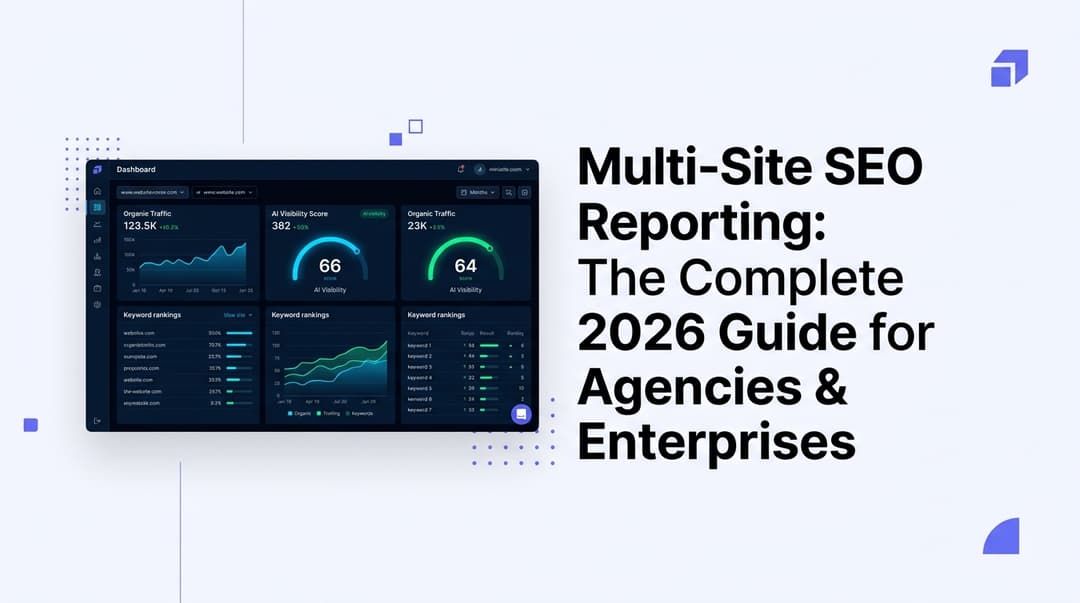
Multi-Site SEO Reporting: The Complete 2026 Guide for Agencies & Enterprises
Master multi-site SEO reporting in 2026. Learn how agencies and enterprises can unify dashboards, track AI visibility, and scale reporting across dozens of websites.

XML Sitemap Checks: The Complete 2026 Guide to Auditing & Fixing Your Sitemap
Learn how to run thorough XML sitemap checks in 2026. Discover common errors, how to fix them, and best practices to improve crawling and indexing.