Free Anchor Text Distribution Analyzer
Analyze anchor text diversity across your internal links. Enter a website URL to crawl pages, categorize every anchor text, and get a detailed breakdown of your anchor text distribution with actionable recommendations to improve internal linking SEO.
QuickSEO shows clicks, impressions, keywords and pages for every website you manage, compared with the period before.
- Unlimited websites on the free plan
- No credit card needed
What is Anchor Text Distribution?
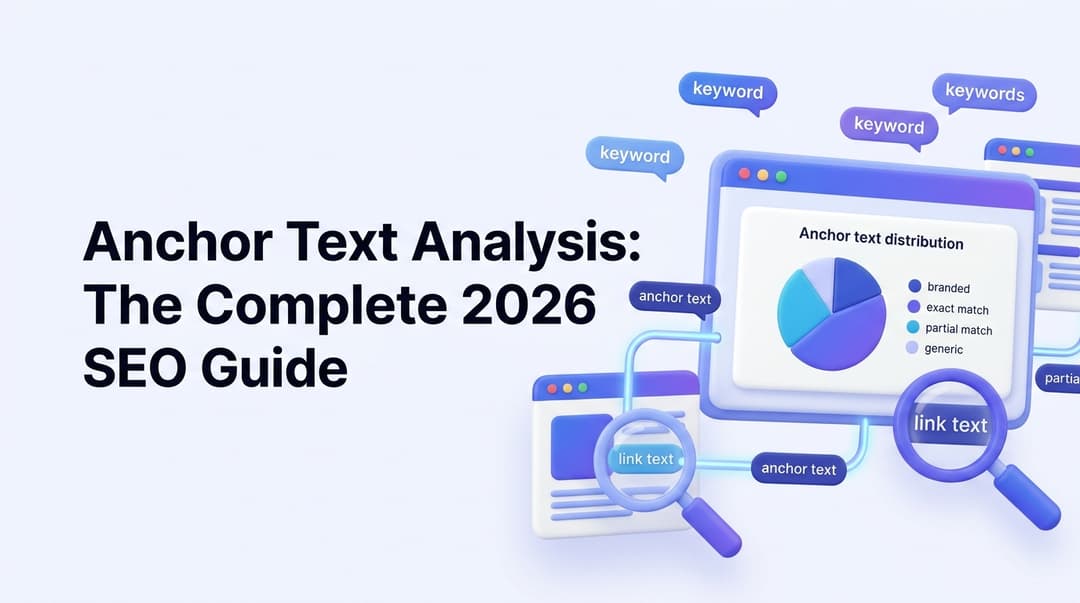
Anchor text distribution describes the mix of different anchor text types used in the internal links across your website. Every time you link from one page to another, the clickable text (anchor text) tells search engines what the destination page is about. The pattern of these anchors across your entire site forms your anchor text distribution profile.
A well-balanced distribution features mostly descriptive, contextual anchors that naturally describe the linked content. Problems arise when too many anchors are generic ("click here"), empty (image links without alt text), or over-optimized (same exact keyword repeated across every link to a page).
Why Anchor Text Diversity Matters
Search engines use anchor text as a strong signal for understanding page relevance. When your internal links use descriptive, varied anchor text, they create a rich network of topical signals that help search engines understand your content hierarchy. Google has confirmed that anchor text is used to understand context about linked pages.
Low anchor text diversity can indicate several problems: excessive use of generic phrases that waste linking opportunities, over-optimization that may trigger algorithmic flags, or poor content linking practices. Improving anchor text quality is one of the highest-impact, lowest-effort SEO optimizations available.
Types of Anchor Text
Descriptive Anchors
Natural, contextual text that describes the linked page content. Examples: "our pricing plans," "technical SEO audit guide," "internal linking best practices." These are the most valuable type of anchor text for SEO because they pass clear topical relevance to the destination page.
Generic Anchors
Non-descriptive phrases like "click here," "read more," "learn more," or "this." They provide no context about the destination page to search engines. While occasionally acceptable for UX, over-reliance on generic anchors wastes internal linking potential.
Naked URL Anchors
Links where the anchor text is the raw URL itself (e.g., "https://example.com/page"). These provide minimal topical context and look unprofessional in body content. Replace them with descriptive text that tells users what they will find at the destination.
Image Anchors
Links that wrap an image with no visible text. Search engines use the image alt attribute as a substitute for anchor text. If the alt attribute is missing or generic, the link provides no topical signal. Always add descriptive alt text to linked images.
Empty Anchors
Links with no text content and no image. These are invisible to users and provide zero context to search engines. They often result from CSS-styled links, JavaScript-driven elements, or development errors. Remove or fix them to improve accessibility and SEO.
How to Use This Tool
- Enter a website URL— Paste any domain or page URL. The tool fetches the site's XML sitemap to discover pages.
- Click "Analyze" — The tool crawls up to 30 pages from the sitemap and extracts every internal link with its anchor text. This may take up to a minute for larger sites.
- Review the score — Your anchor text distribution score (0-100) reflects diversity, generic usage, and empty anchor prevalence. Scores above 80 indicate a healthy distribution.
- Check the category breakdown — See how your anchors split across descriptive, generic, naked URL, image, and empty categories. A high descriptive percentage is ideal.
- Review top anchor texts — The most frequently used anchor texts are shown with their count and category. Look for repetitive patterns or excessive generic usage.
- Follow the recommendations — Actionable tips tell you exactly where to improve your anchor text practices for better SEO performance.
Common Anchor Text Issues
Excessive "Read More" Links
Blog listing pages and card-based layouts often repeat "Read more" for every post. Replace these with the article title or a descriptive phrase like "Read our guide to keyword research." This passes far more topical value through the link.
Navigation Menu Repetition
Sitewide navigation menus create identical anchor text on every page. While this is normal and expected for navigation, ensure your body content uses varied, contextual anchors that complement the navigation links.
Logo Links Without Alt Text
Header and footer logos typically link to the homepage. Without alt text on the logo image, these become empty anchors. Add alt text like "[Brand Name] - Home" to provide context.
Over-Optimized Exact Match Anchors
Using the exact same keyword-rich anchor text for every link to a page looks manipulative. Mix in partial-match anchors, branded text, and natural variations. For example, instead of always linking with "best SEO tools," use "our SEO toolkit," "these analysis tools," or "the tools we recommend."
Frequently Asked Questions
What is anchor text distribution?
Anchor text distribution refers to the variety and proportion of different anchor text types used in the internal links across your website. A healthy distribution has mostly descriptive, contextual anchors with minimal generic or empty anchors. Search engines use anchor text to understand what the linked page is about, so diverse and descriptive anchors improve topical signaling.
What are generic anchor texts and why are they bad?
Generic anchor texts are non-descriptive phrases like "click here," "read more," "learn more," or "this." They provide no context about the destination page to search engines or users. When a large percentage of your internal links use generic anchors, you miss opportunities to pass topical relevance through anchor text, which can weaken your internal linking SEO value.
What is a good anchor text diversity ratio?
A diversity ratio above 50% is generally healthy, meaning more than half of your anchor texts are unique. A ratio below 30% indicates many links use the same repeated anchor text, which can look unnatural. The ideal is varied, descriptive anchor text that naturally describes the content of the destination page.
Can anchor text over-optimization hurt SEO?
Yes, using the exact same keyword-rich anchor text for every link pointing to a page can appear manipulative to search engines. This is more commonly penalized for external backlinks, but excessive exact-match internal anchors can also look unnatural. Use a natural mix of descriptive anchors, partial-match variations, and branded text.
How do I fix empty anchor text on image links?
When an image is wrapped in a link, the anchor text is effectively the image's alt attribute. Add a descriptive alt attribute to the image that describes both the image content and the link destination. If the link contains both text and an image, the text content serves as the anchor text, so make sure it is descriptive.
QuickSEO shows clicks, impressions, keywords and pages for every website you manage, compared with the period before.
- Unlimited websites on the free plan
- No credit card needed
Related Tools
Build a directed graph of internal links with in-degree and out-degree stats per page.
Internal Linking AuditAudit internal links on any page. Analyze anchor text distribution, dofollow vs nofollow ratio, and link depth.
Page Links ExtractorExtract and analyze all links on any web page, identifying dofollow, nofollow, UGC, and sponsored attributes.