Perplexity vs Google in 2026: Why 1% Beats 90% on Conversion

 Summarize in ChatGPT
Google still owns 90% of search. Perplexity has under 1%. So why does Perplexity traffic convert 6× better — and what does it mean for your SEO strategy?
The 30-second answer
This isn't a fight Perplexity is trying to win on volume. The two products have stopped competing for the same job. Google is consolidating around an ad-supported AI layer that monetises commercial intent at billion-user scale — AI Overviews now reach 2 billion monthly users and AI Mode crossed 100 million MAU in mid-2025. Perplexity is building a high-trust subscription product for professional research, paired with the Comet browser and zero-fee commerce, and it formally abandoned advertising in February 2026.
That divergence is the story of the year for SEO. Google still drives the volume. Perplexity drives a different kind of traffic — fewer visitors, but visitors who convert at multiples of organic, skew educated and senior, and arrive pre-researched. The question for any brand is no longer which one wins, but which one is sending you the customers you actually want — and whether you can be visible on both surfaces given that they cite different sources.
The scale gap is enormous — and it's the least interesting part
Google's dominance of overall search is essentially intact entering 2026. StatCounter recorded Google at 90.04% global market share in January 2026, with US share at 85.05%. Google processed roughly 5.9 trillion searches in 2025 — about a 16% increase on 2024 — and Sundar Pichai disclosed during Q2 2025 earnings that AI Overviews now reach 2 billion monthly users across more than 200 countries. AI Mode alone hit 100 million MAU in July 2025 with reports of 1 billion+ monthly queries by December.
Perplexity operates at a different order of magnitude. Standalone monthly active users sit at roughly 45 million entering 2026, with the figure rising past 100 million when distribution partners (Snapchat, Airtel) are included. CEO Aravind Srinivas disclosed 780 million monthly queries in May 2025 — putting 2026 monthly volume at around 1 billion. In the AI chatbot category specifically, Similarweb's January 2026 data puts ChatGPT at 64.5%, Gemini at 21.5%, and Perplexity at just 2.0%.
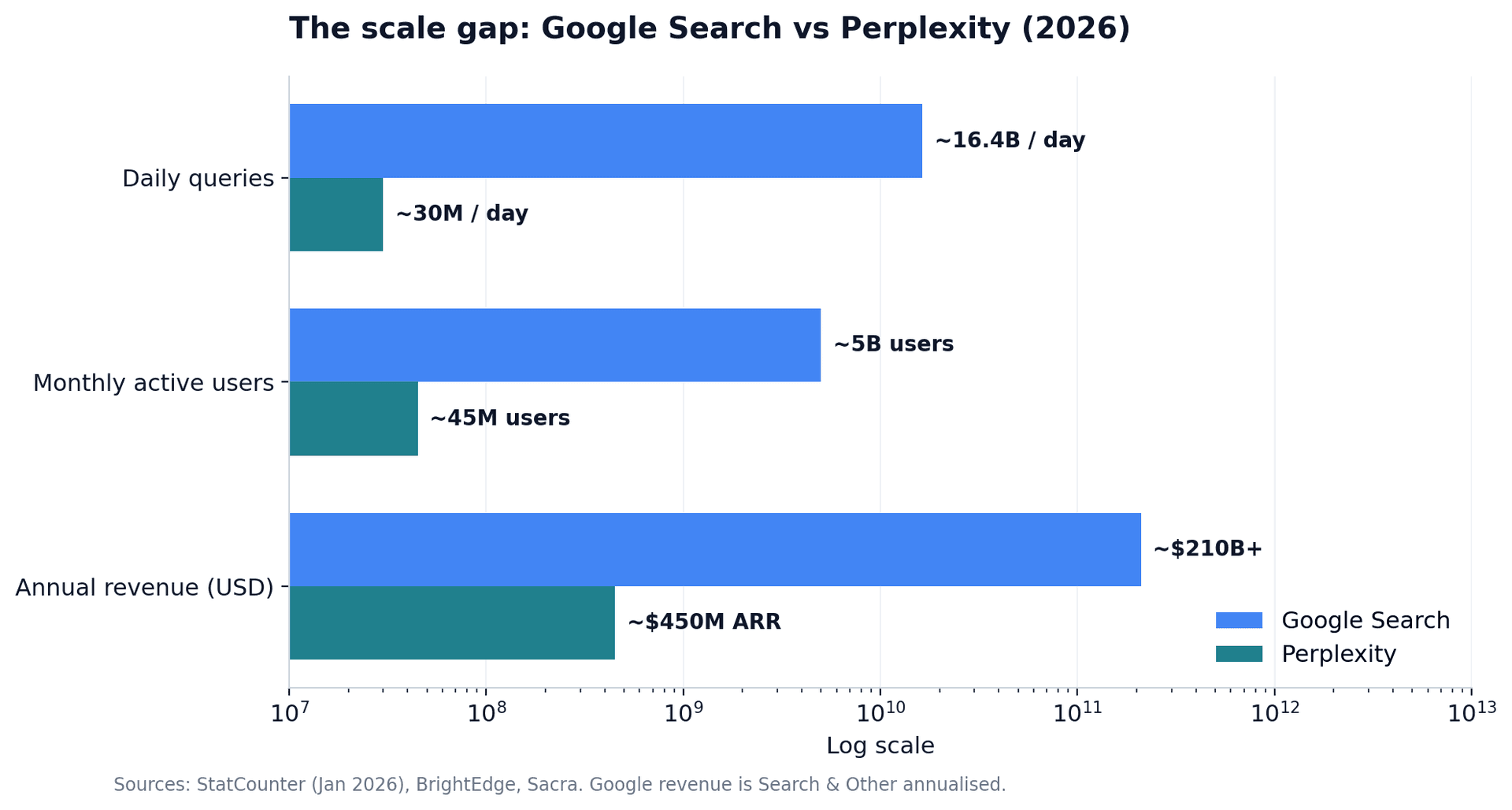
Google operates 100–500× the scale of Perplexity across queries, users, and revenue. The gap isn't closing on raw volume.
The headline scale comparison is straightforward — Google wins by orders of magnitude. The interesting question is what happens to that gap once you weight by traffic quality. |
Traffic quality flips the narrative
Raw volume comparisons understate Perplexity's commercial relevance. Adobe Analytics' 2025 holiday report found AI-driven retail traffic grew 693% year-over-year, with AI referrals converting 31% better than non-AI traffic and generating 254% higher revenue per visit. Independent analysis from Similarweb and Swydo pegs AI referral conversion at 4.4× organic search, with 68% longer time-on-site and 3× more pages per session. Bounce rates run 23–33% lower.
Seer Interactive's data is the cleanest direct comparison. In their study covering 25.1 million impressions, Perplexity referral traffic converted at 10.5% — nearly six times the 1.76% rate from Google organic. Ahrefs separately calculated that AI search visitors convert 23× better than traditional organic and generated 12.1% of signups from just 0.5% of traffic.
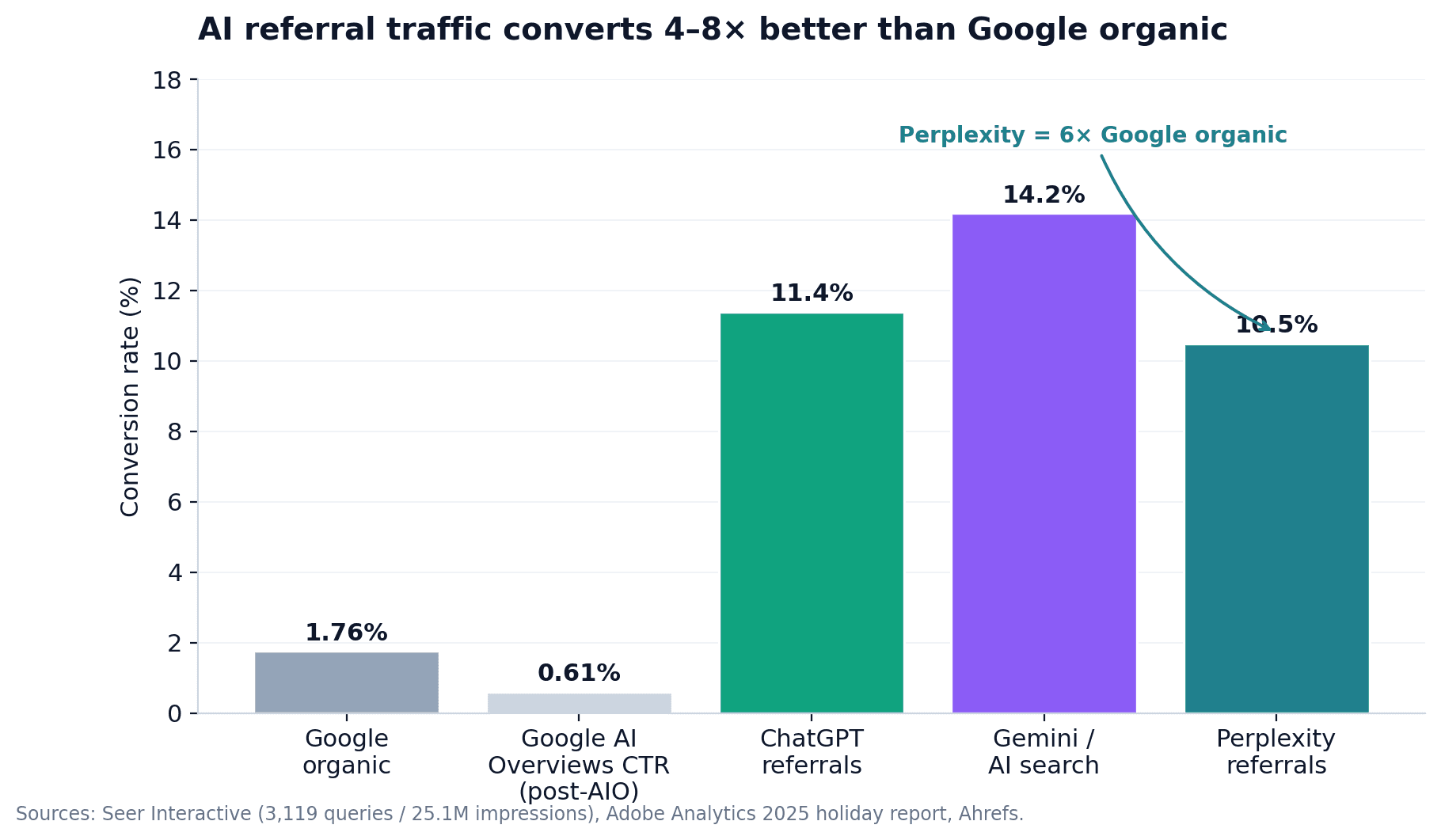
Conversion rates by source. Perplexity's 10.5% is the cleanest direct comparison to Google organic; Adobe's holiday data corroborates the 4–8× uplift across AI sources.
Meanwhile, Google's referral economics are deteriorating. Seer's September 2025 study found organic CTR dropped 61% (from 1.76% to 0.61%) when AI Overviews appear, and paid CTR fell 68%. Ahrefs' December 2025 update showed position-1 CTR collapse from -34.5% (April 2025) to -58% with AIOs present. Pew Research found that when an AI Overview appears, only 8% of users click any result vs 15% without — and just 1% click a citation inside the AIO.
The publisher data tells the same story bluntly. Below is what that has looked like in practice for some of the largest sites:
Publisher | Traffic decline | Time period | Source |
|---|---|---|---|
HubSpot | -70 to -80% | 2024–2025 | Yamini Rangan, INBOUND 2025 |
Chegg | -49% (non-subscriber) | Year ending Q3 2025 | SEC filings |
Business Insider | -55% | Three years to 2025 | Press Gazette |
CNN | -27 to -38% | Q1–Q3 2025 | Chartbeat |
Global publishers (median) | -33% YoY | Through Nov 2025 | Chartbeat / Reuters Institute |
AI Overviews appear on roughly 16–25% of all search queries; for publishers in their crosshairs the impact is severe.
There's a partial offset: Seer found that brands cited inside AI Overviews earn 35% more organic clicks and 91% more paid clicks than uncited brands. That's the entire premise of generative engine optimisation — being cited matters more than ranking when AI surfaces dominate.
They're not actually competing for the same job
The two products only superficially compete. Google is layering AI on top of an ad-supported index that monetises commercial intent at scale. Perplexity is building an answer engine for high-context professional research, paired with an agentic browser. The clearest illustration is what each platform did with monetisation in late 2025 and early 2026.
Google moved aggressively into ads inside AI surfaces: AI Overview ads expanded to 11 new English-speaking countries on December 19, 2025, AI Mode ads launched in early 2026, and Google Search & Other revenue hit roughly $54 billion in Q4 2025 (up 17%) with AI Overviews monetising at the same rate as traditional search, per Google CBO Philipp Schindler. Perplexity went the other way. On February 18, 2026 the company formally abandoned advertising, with executive Jessica Chan citing user trust: a user needs to believe the answer is the best possible one, and ads erode that. Perplexity's merchant program is structurally aligned — zero fees, zero commissions — versus ChatGPT's 4% Agentic Commerce Protocol fee.
Side-by-side: Google Search vs Perplexity (April 2026)
Feature | Google Search | Perplexity |
|---|---|---|
Default response | 10 blue links + AI Overview (48% of queries) | Cited AI answer (always) |
AI surfaces | AI Overviews, AI Mode, Deep Search, Search Live | Pro Search, Deep Research, Spaces |
Underlying model | Gemini 2.5 / 3 (in Search) | Sonar + GPT-5.x, Claude 4.6, Gemini, Grok |
Avg citations shown | 7.7 (AIO) / 9 (AI Mode) | 5–22 depending on query |
Browser | Chrome (Gemini integrated) | Comet (free worldwide; iOS Mar 2026) |
Visual search | Google Lens (1.5B MAU) | Snap to Shop |
Shopping | Shopping Graph (35B products) | Buy with Pro, Instant Buy with PayPal |
Pricing | Free (ad-supported); AI Pro ~$20 | Free / Pro $20 / Max $200 / Enterprise $40 |
Ads | Pervasive: Search, Shopping, AIO, AI Mode | None (abandoned Feb 2026) |
Median cited URL age | ~108 days | ~32.5 days (3.3× fresher) |
Crawler | Googlebot | PerplexityBot + Perplexity-User |
Google is doubling down on ads inside AI surfaces while Perplexity goes subscription-only. The two are now monetising completely different parts of the funnel.
The citation behaviour every SEO needs to understand
This is where SEO and GEO operators should focus most. BrightEdge found 60% of Perplexity citations overlap with Google's top-10 organic results — peaking at 82% in healthcare and dropping to 27% in restaurants. Ahrefs' August 2025 study of 15,000 long-tail queries showed Perplexity hits 33% top-10 overlap, by far the highest among AI engines (ChatGPT, Gemini, Copilot averaged around 12%).
But the relationship is weakening. Ahrefs' AIO/top-10 overlap fell from 76.1% in mid-2025 to 38% in 2026 data. Profound's 680-million-citation study found that only 12% of domains are cited by both ChatGPT and Perplexity, and Google AI Mode shares just 14% URL overlap with Google's own top 10. Each AI surface is increasingly its own ranking system.
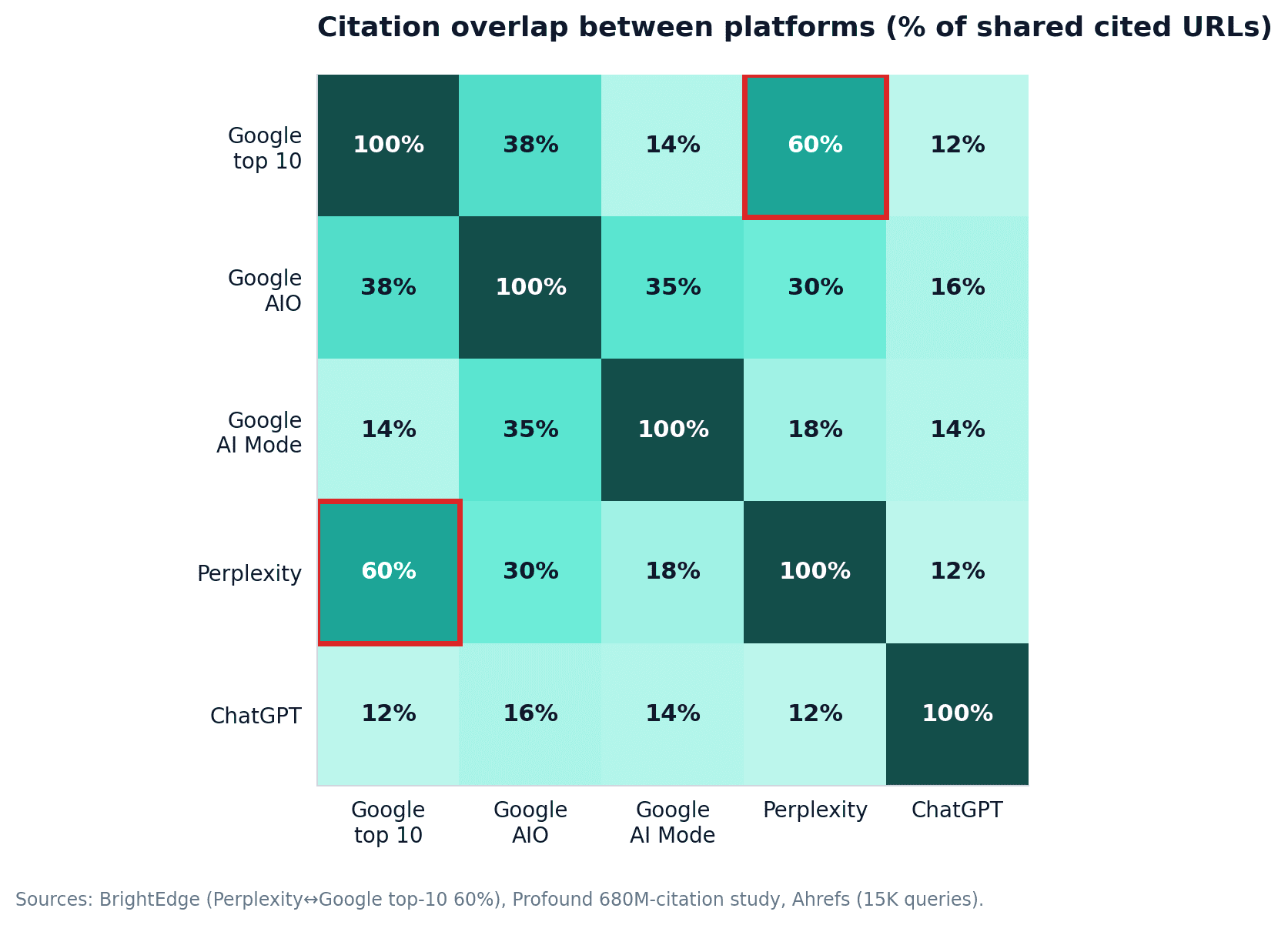
Citation overlap matrix between major search and AI surfaces. The Perplexity ↔ Google top-10 overlap (60%) is highlighted — every other relationship is dramatically weaker.
The source-mix differences underneath those overlaps are stark. Reddit accounted for 24% of all Perplexity citations in January 2026 (Tinuiti) — versus 2.2% in Google AIOs. Google AI Mode and AIOs lean on a more distributed mix that includes YouTube (which dominates social citations 200× over any other video platform per BrightEdge), Wikipedia, Quora, and LinkedIn. LinkedIn climbed from #11 to #5 most-cited domain on ChatGPT between November 2025 and February 2026. Yext's October 2025 analysis of 6.8 million citations crystallised the pattern: Gemini favours brand-owned content (52%), ChatGPT leans on directories (Yelp, TripAdvisor — 49%), and Perplexity skews to third-party news and earned media — three different optimisation profiles.
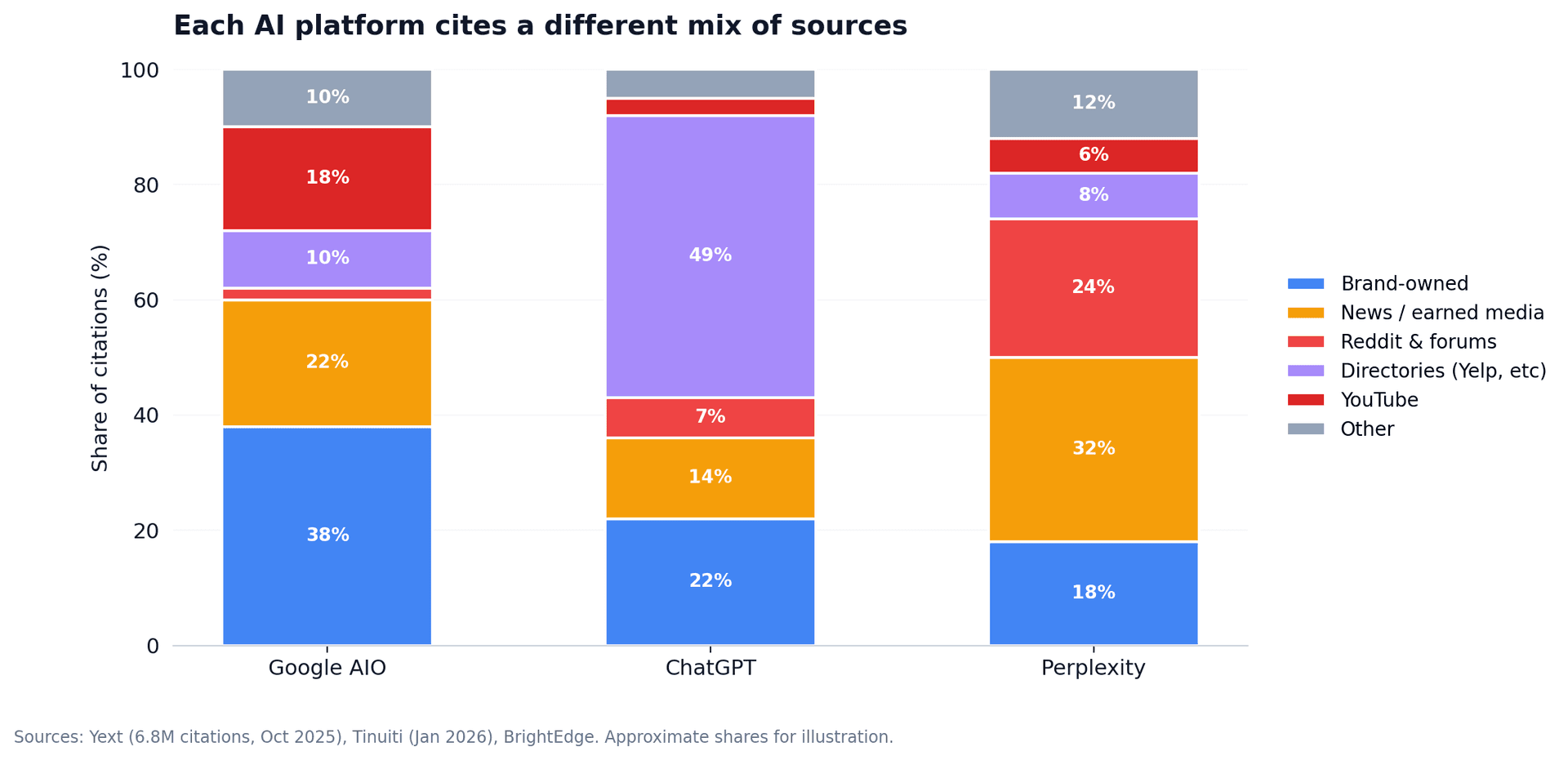
Approximate source mix by platform, synthesised from Yext, Tinuiti, and BrightEdge data. Google AIO over-indexes on brand-owned content and YouTube; ChatGPT on directories; Perplexity on news and earned media.
The 60% Perplexity / Google overlap is the headline number. The 40% that doesn't overlap is what determines whether your brand wins or loses on AI search. |
The audience is why Perplexity's 2% matters
Perplexity's user base is not a smaller version of Google's. It's a different population. The numbers Perplexity has disclosed and that Similarweb has corroborated:
Attribute | Google Search | Perplexity |
|---|---|---|
Reach | Effectively all internet users | ~45M MAU standalone; 100M+ via integrations |
Education | Mirror of general population | ~80% college graduates |
Income / role | Mirror of general population | 65% high-income, white-collar |
Seniority | Mirror of general population | ~30% senior leadership |
Primary use case | Everything (navigational to commercial) | Research-intensive, professional, comparison |
Avg session value | Baseline | $4.56 per session (Superprompt) |
Perplexity's audience is concentrated in exactly the segments that B2B and high-consideration consumer brands most want to reach.
This is why Perplexity's 2% AI-chatbot share matters more commercially than the headline number suggests. For a B2B SaaS brand, being cited in three Perplexity answers per week may be worth more than being cited in thirty Google AIO results — because the people reading those answers are decision-makers, and they convert at 6× the rate of organic search visitors. The economics already reflect this: Perplexity's revenue went from $80M ARR at the end of 2024 to roughly $450M annualised in March 2026, with valuation rising from $9B (Dec 2024) to $20B+ (early 2026).
What this means for your SEO strategy
Four operational realities follow from the data above:
There is no single ranking system to optimise for any more. Citation overlap between Google AIO, Google AI Mode, ChatGPT, and Perplexity ranges from 12% to 60% depending on the pair, and is decreasing. Multi-platform citation tracking is now table stakes, not a nice-to-have.
Shadow SERPs matter as much as your own site. Reddit, YouTube, LinkedIn, and G2 are where AI engines find their human-authority signals. SE Ranking found brand-mention volume on Reddit and Quora correlates 0.664 with LLM citations — stronger than backlinks. If you're not tracking and influencing your presence on those platforms, you're missing the dominant signal.
Freshness is now a citation signal. Perplexity's median cited URL is 32.5 days old vs Google's 108 — a 3.3× freshness premium (Seer). Citation half-life is roughly 13 weeks. Pages need quarterly minimum refreshes to stay eligible.
Track both surfaces, or fly blind on one of them. If you're using Google Search Console, Ahrefs, or Semrush, you can see Google. None of those tools see what ChatGPT, Claude, Gemini, or Perplexity say about your brand.
Where Google Search Console still fits
If you're already using Google Search Console, you have half the picture. The other half — what ChatGPT, Claude, Gemini, and Perplexity are saying about you — needs its own tracking layer.
The bottom line
Google is still where volume lives. Perplexity is where intent and trust concentrate. The two have stopped competing for the same job, and they're going to keep diverging — Google deeper into ad-supported AI surfaces, Perplexity deeper into agentic browsing and zero-fee commerce.
For SEO, the practical reframe is that “search traffic” and “AI citations” are now two different inventories with two different optimisation profiles, two different demographic mixes, and two different monetisation realities. Brands that recognise this early — and build tracking and content strategy that spans both — will end up with a structural advantage. Brands that treat the AI layer as an extension of their existing SEO will find out, slowly and then suddenly, that they were optimising for the wrong system.
Whatever share of search AI answers end up taking, Google Search Console is still where you see the clicks Google actually sends you. QuickSEO puts Search Console for every website you run on one free dashboard. See all your sites in one place →
QuickSEO shows clicks, impressions, keywords and pages for every website you manage, compared with the period before.
- Unlimited websites on the free plan
- No credit card needed
Try it yourself
Related free tools
Free SEO tools related to the topics covered in this article.
Keep reading
Related posts
More articles on the same topics, prioritized by shared tags and keyword overlap.