AI Search vs Google Search in 2026: 40+ Stats That Show Why Your Brand Needs to Track Both

 Summarize in ChatGPT
The way people find products, compare brands, and make purchase decisions is fundamentally changing. In 2026, traditional Google search is no longer the only discovery channel that matters — and for many businesses, it’s no longer even the primary one.
AI-powered search engines like ChatGPT, Google Gemini, Perplexity, and Claude are answering the questions your customers used to type into Google. They’re recommending brands, comparing products, and shaping buying decisions — often without a single click to your website.
The shift isn’t theoretical. It’s backed by hard data.
This post compiles more than 40 verified statistics that show exactly how AI search is growing, where it’s pulling traffic from Google, and why brands that only track traditional SEO are flying blind.
AI search adoption has gone mainstream
The most important thing to understand about AI search in 2026 is that it’s no longer an early-adopter phenomenon. It has crossed into mainstream consumer behaviour across age groups, geographies, and income levels.
37% of consumers now start their searches with AI tools instead of Google (Search Engine Land). ChatGPT alone has crossed 900 million weekly active users — up from 400 million in February 2025. That makes it the fourth most-visited website in the world, with over 5 billion monthly visits (Semrush).
Google’s AI Overviews, powered by Gemini, now reach 2 billion monthly users across more than 200 countries. The standalone Gemini app has grown to 750 million monthly active users — a staggering 10,600% increase in just two years.
Perplexity AI processes 780 million queries per month and has attracted 22–45 million monthly active users. Its audience is disproportionately high-value: 80% are college graduates, 65% are high-income white-collar professionals, and 30% hold senior leadership roles.
Even Claude, Anthropic’s AI assistant, commands 40% of the enterprise LLM API market and serves 300,000+ business customers. While its consumer footprint is smaller, its audience skews toward exactly the kind of high-stakes B2B decision-makers most businesses want to reach.
In the US specifically, 52% of adults now use AI large language models (Elon University), and Gartner’s prediction that traditional search volume would drop 25% by 2026 is tracking close to actual numbers.
AI referral traffic is exploding — and it converts better
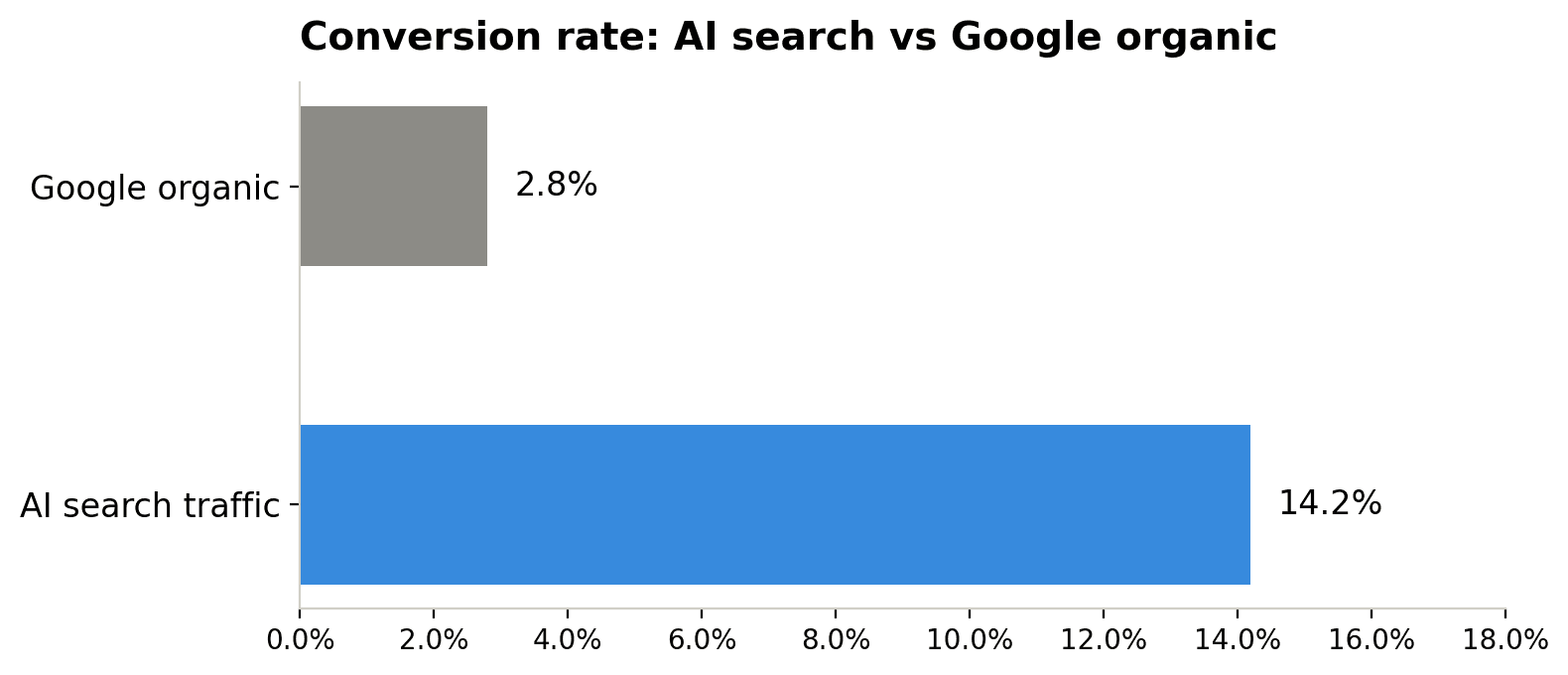
AI search traffic growth (YoY) +527% | AI search conversion rate 14.2% | Google organic conversion rate 2.8% |
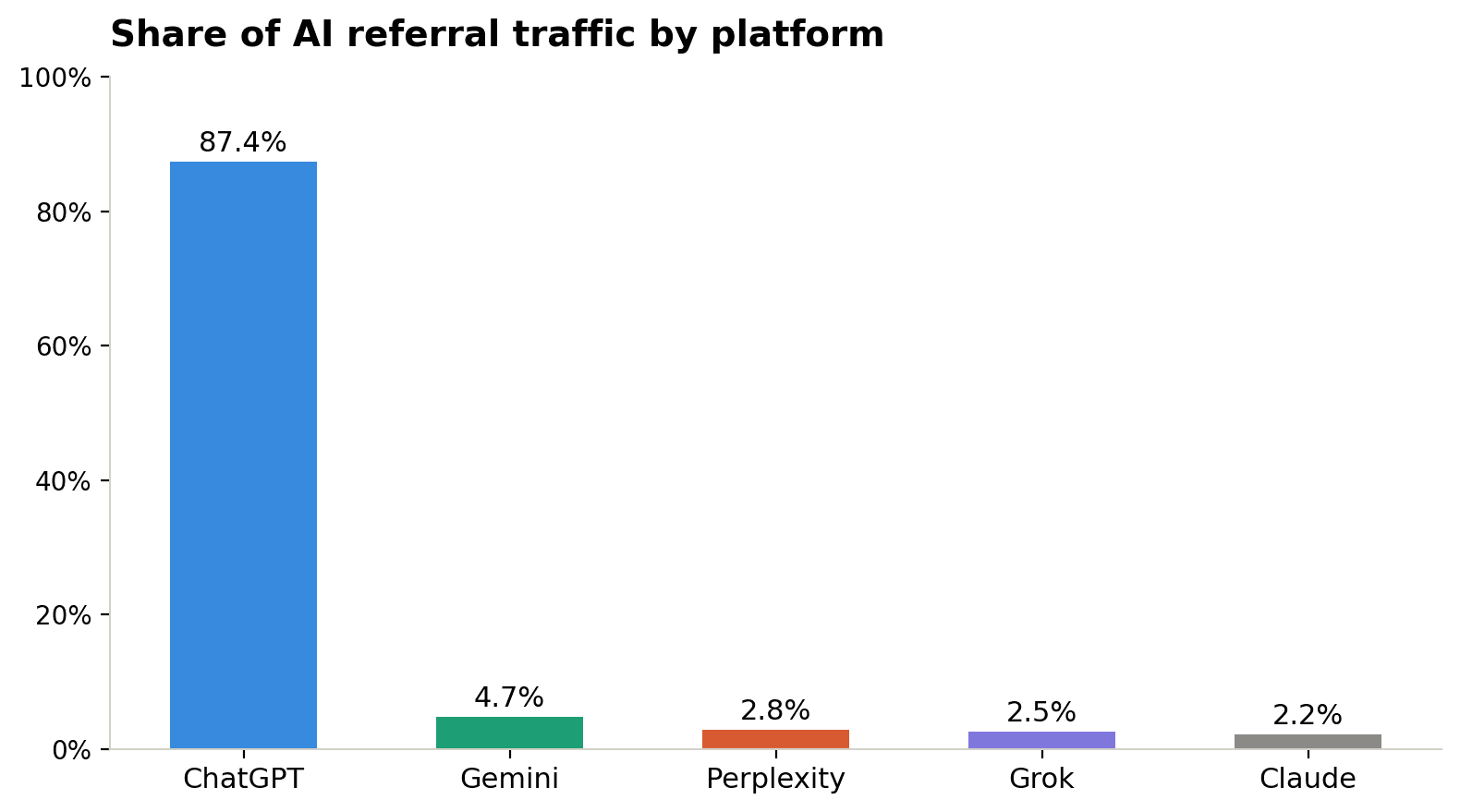
AI platforms generated 1.13 billion referral visits in June 2025 alone — up 357% from the previous year (Similarweb via TechCrunch). The Previsible AI Traffic Report found that LLM-sourced traffic surged 527% year-over-year between early 2024 and mid-2025 (Semrush).
But the headline stat for marketers isn’t volume — it’s conversion rate.
AI search traffic converts at 14.2%, compared to Google’s 2.8% — roughly 5x more valuable per session (Exposure Ninja). Seer Interactive found that LLM visitors convert at 4.4x the rate of traditional organic search visitors. ChatGPT-referred traffic to retail sites specifically converts at 11.4%, more than double Google organic’s 5.3%.
Visitors arriving from AI platforms also engage more deeply. On average, they spend 68% more time on websites than visitors from traditional organic search (SE Ranking). ChatGPT-referred visitors spend 15 minutes on-site compared to 8 minutes from Google, and view 12 pages per visit versus 9.
Despite all this growth, AI referral traffic still represents roughly 1% of total web traffic (Search Engine Land). That means the growth runway is enormous. Semrush projects that traffic from AI-powered search will overtake traditional organic search by 2028.
Zero-click search is accelerating
Google zero-click rate 60% | AI Mode zero-click rate 93% | Organic CTR drop w/ AIOs -61% |
Perhaps the most alarming trend for businesses relying on traditional SEO is the rise of zero-click searches — queries that are answered directly in the search results (or by an AI) without the user ever visiting a website.
Roughly 60% of all Google searches now end without a click to any external site. When AI Overviews appear on a Google results page, that number climbs even higher. In Google’s AI Mode, 93% of searches end without a click (Semrush).
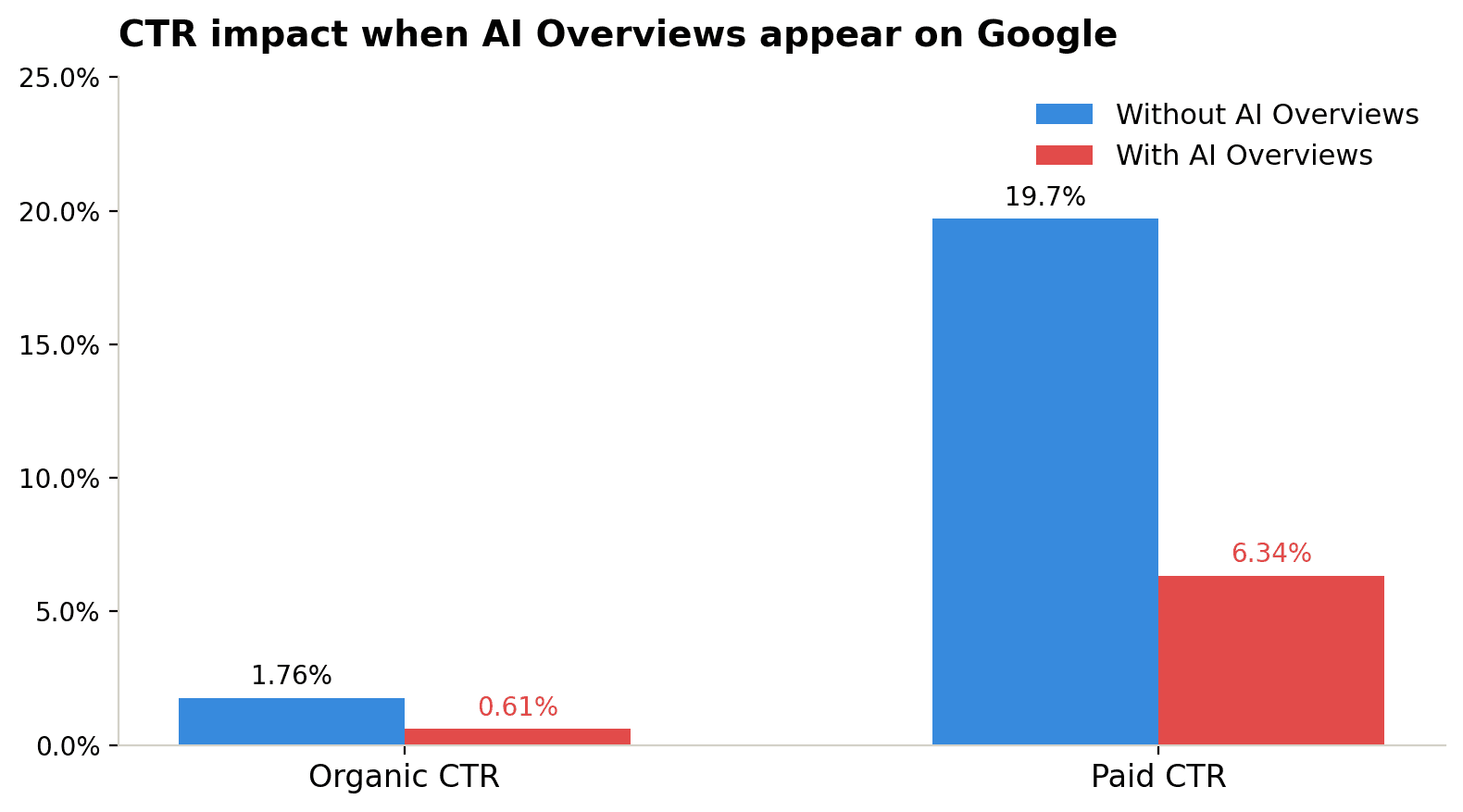
The impact on click-through rates is severe. Seer Interactive’s analysis of 25.1 million impressions found that when AI Overviews appear, organic CTR drops 61% (from 1.76% to 0.61%) and paid CTR drops 68% (from 19.7% to 6.34%). Ahrefs independently measured that AI Overviews reduce the top organic position’s CTR by 58%.
AI Overviews now trigger on roughly 30% of US desktop keywords and up to 47% of all Google queries (Ahrefs). They’ve expanded beyond informational queries: commercial and navigational AI Overviews grew from under 1% in January to over 10% by November 2025.
For publishers, the traffic consequences are already measurable. Google search traffic to publishers has declined globally by a third in the year to November 2025. HubSpot lost 70–80% of its organic traffic. Business Insider dropped 55%. News publishers expect search traffic to fall 43% within three years.
Each AI platform has its own visibility rules
One of the most critical insights from recent research is that AI platforms don’t all work the same way. Each has its own citation sources, brand mention patterns, and discovery algorithms — meaning your visibility on one platform tells you almost nothing about your visibility on another.
Only 11% of domains are cited by both ChatGPT and Perplexity (SparkToro). Only 20% overlap exists between Claude and ChatGPT search results. Only 30–35% of URLs in Google AI Overviews also appear in AI Mode.
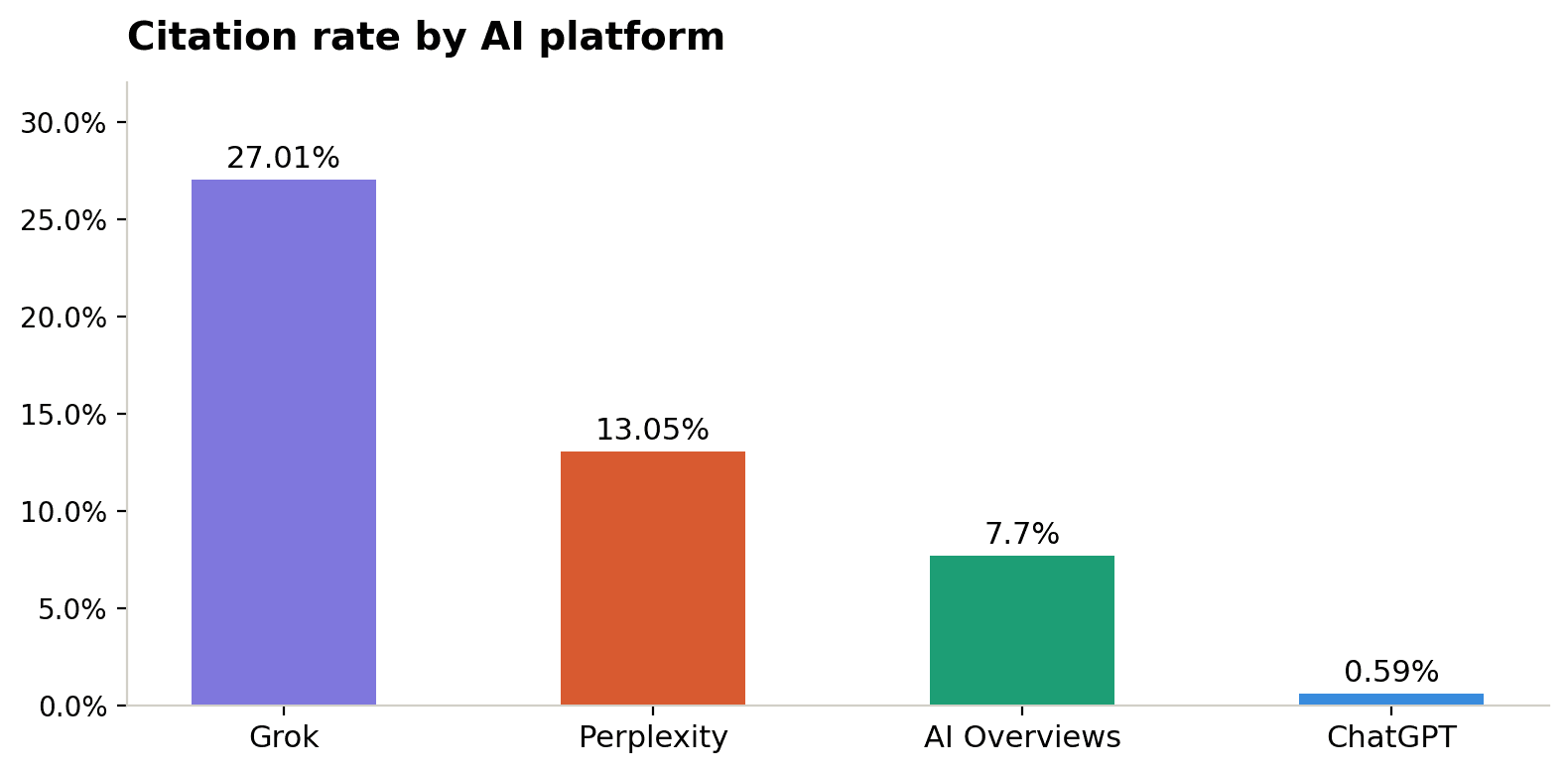
Citation behaviour varies dramatically across platforms. Grok has the highest citation rate at 27.01% of responses. Perplexity cites sources in 13.05% of responses. Google AI Overviews average 7.7 source links per response. ChatGPT has the lowest citation rate at just 0.59%, but mentions brands 3.2x more often than it links to them.
The sources each platform trusts are different too. ChatGPT heavily relies on Wikipedia, third-party directories like Yelp, and user-generated content. 80% of URLs that ChatGPT cites don’t even rank in Google’s top 100, meaning your traditional SEO rankings are a poor proxy for ChatGPT visibility.
Claude uses Brave Search as its backend, with 86.7% overlap between its cited results and Brave’s organic results — not Google’s. Perplexity is the most Google-aligned of the major assistants, and even there Ahrefs found only 28.6% of the URLs it cites rank in Google’s top 10 for the same prompt — so rankings are a real signal, not a substitute for tracking it.
The citation volume differences between platforms can be extreme. Superlines research found that the same brand can see citation volumes differ by 615x between Grok and Claude. This is why multi-platform tracking is essential, not optional.
Google isn’t going away — but it’s not enough
Despite all the disruption, let’s be clear: Google isn’t dying. It still processes 8.9 billion daily searches and continues to grow in absolute terms, adding over 400 million additional daily searches year-over-year. Traditional organic search still drives the majority of website traffic by a significant margin.
But the nature of Google search is changing from the inside. AI Overviews now sit above traditional organic listings on a large and growing share of queries. Google’s AI Mode is being rolled out across 200+ countries. The search experience is being rebuilt around conversational AI answers — and the organic blue links that most SEO strategies target are getting pushed further down the page.
The businesses most at risk are mid-sized companies ranked 100 to 10,000 in their respective categories. The largest brands have the resources to adapt; the smallest specialists often serve niche queries where AI coverage is sparse. It’s the middle tier — businesses that built their growth on traditional SEO — that are seeing 10–55% traffic declines without necessarily understanding why.
What drives AI visibility (it’s not what drives Google rankings)
If you’re used to thinking about SEO in terms of keywords, backlinks, and domain authority, AI visibility requires a different mental model. The factors that make you visible in AI-generated answers overlap with traditional SEO in some areas, but diverge sharply in others.
Domain authority is the top predictor of AI citations. SE Ranking’s study of 2.3 million pages found that high-traffic sites earn 3x more AI citations than low-traffic ones, with domain traffic as the strongest factor.
Content format matters. Listicles achieve a 25% citation rate in AI responses, compared to just 11% for blog posts and opinion pieces (Exposure Ninja).
Freshness is crucial. Pages updated within the last two months earn 28% more AI citations than older content (Superlines).
Content with statistics, citations, and quotations achieves 30–40% higher visibility in AI responses — the original GEO research from Princeton found this to be one of the most reliable optimisation strategies.
Brand mentions across multiple platforms compound. Brands mentioned on 4+ platforms are 2.8x more likely to appear in AI responses. This means your presence on Reddit, Wikipedia, industry directories, and review sites directly influences whether AI recommends you.
The intro matters most. Research shows that 44.2% of all LLM citations come from the first 30% of text — your introduction and opening sections carry disproportionate weight.
Perhaps most importantly: traditional SEO tactics like keyword stuffing don’t transfer to AI. The foundational Princeton GEO research demonstrated that specialised methods like adding statistics, expert quotations, and structured data outperform traditional keyword approaches by up to 40%.
The market for AI visibility tools is exploding
VC funding in GEO startups $200M+ | GEO market (2025) $848M | Projected (2034) $33.7B |
The shift from traditional search to AI search has spawned an entirely new category of marketing technology. Over $200 million in venture capital has poured into AI search visibility startups in 2025 alone, backed by tier-1 investors including Sequoia Capital, Kleiner Perkins, and NEA.
McKinsey projects that $750 billion in US consumer spending will flow through AI-powered search by 2028. Yet only 16% of brands currently track their AI search visibility systematically. The other 84% are making marketing decisions based on incomplete data.
25.7% of marketers plan to develop content specifically for AI citations in 2026 (Exposure Ninja), and 54% of US marketers plan to implement GEO strategies within the next 3–6 months. The early movers are already seeing results: companies using GEO optimisation have reported visibility improvements of 30–40% within 60–90 days.
What this means for your business
The data converges on a few clear conclusions:
Your brand is being talked about in AI — whether you’re tracking it or not. When someone asks ChatGPT “What’s the best [your product category]?” you’re either in the answer or you’re not. Right now, most businesses have no idea which one it is.
Google Search Console only shows half the picture. GSC tells you about clicks, impressions, and rankings on Google. It tells you nothing about whether ChatGPT recommends you, whether Perplexity cites your content, or whether Gemini’s AI Overviews mention your brand.
AI referral traffic is already the highest-converting channel available — 5x more valuable per session than traditional organic. Even at just 1% of total traffic today, the growth trajectory makes this the most important emerging channel to track.
Each AI platform is a separate discovery ecosystem. Your visibility on ChatGPT doesn’t predict your visibility on Perplexity or Claude. Only multi-platform monitoring gives you the complete picture.
The window for early-mover advantage is narrowing. With 84% of brands not yet tracking AI visibility, there’s a real opportunity to get ahead of competitors — but as adoption accelerates, that window is closing.
The bottom line
If you’re already using Google Search Console for your SEO analytics, the next logical step is adding AI visibility tracking to get the full picture of how your brand is being discovered.
The brands winning in 2026 are the ones tracking both sides of the discovery equation. Google search is still essential — but it’s no longer the whole story.
Whatever share of search AI answers end up taking, Google Search Console is still where you see the clicks Google actually sends you. QuickSEO puts Search Console for every website you run on one free dashboard. See all your sites in one place →
Sources cited throughout this article include research from Gartner, McKinsey, Semrush, Ahrefs, SE Ranking, SparkToro, Seer Interactive, Superlines, Exposure Ninja, Search Engine Land, Similarweb, Adobe, BrightEdge, and the foundational GEO research from Princeton University. Individual source links are provided inline.
QuickSEO shows clicks, impressions, keywords and pages for every website you manage, compared with the period before.
- Unlimited websites on the free plan
- No credit card needed
Keep reading
Related posts
More articles on the same topics, prioritized by shared tags and keyword overlap.