Free Bulk HTTP Status Code Checker
Paste up to 100 URLs and check all their HTTP status codes at once. Identify broken pages, missing redirects, and server errors in seconds. Perfect for site migration audits and monitoring.
Paste URLs to Check (One Per Line)
0 / 100 URLs
QuickSEO shows clicks, impressions, keywords and pages for every website you manage, compared with the period before.
- Unlimited websites on the free plan
- No credit card needed
Why Check HTTP Status Codes in Bulk?
Checking URLs one by one is painfully slow when you are managing a site migration, auditing hundreds of pages, or verifying that redirects are in place. A bulk HTTP status checker lets you paste an entire list of URLs and get every status code, redirect target, and response time in a single pass.
- Site migration audits: After moving to a new domain or restructuring URLs, verify that every old URL returns a 301 redirect to the correct new page.
- Broken page detection: Find 404 errors and 5xx server errors across your site before search engines or users do.
- Redirect verification: Confirm that 301 and 302 redirects point to the right destinations and that no redirect chains or loops exist.
- Monitoring after deployments: After pushing code changes, quickly verify that critical pages are still returning 200 OK.
HTTP Status Code Reference
2xx - Success
- 200 OK - The page loaded successfully. Everything is working.
3xx - Redirects
- 301 Moved Permanently - The page has permanently moved to a new URL. Link equity transfers to the new destination.
- 302 Found - Temporary redirect. The original URL may return. Consider using 301 for permanent moves.
- 307 Temporary Redirect - HTTP/1.1 temporary redirect. Method and body are preserved.
4xx - Client Errors
- 404 Not Found - The page does not exist. The most common error after site migrations.
- 410 Gone - The page has been permanently removed with no replacement.
5xx - Server Errors
- 500 Internal Server Error - The server encountered an unexpected condition. Often indicates a code bug or misconfiguration.
- 503 Service Unavailable - The server is temporarily overloaded or under maintenance.
Use Cases
Migration Audits
When moving a website to a new domain, CMS, or URL structure, you need to verify that every old URL redirects properly. Export your old sitemap URLs, paste them here, and confirm every one returns a 301 redirect to the correct new location. Catching missed redirects early prevents traffic loss and preserves your search rankings.
Broken Page Detection
Regularly check your most important pages to make sure they return 200 OK. Pages that return 4xx or 5xx errors are invisible to search engines and frustrating for users. Combine this tool with your sitemap URL list to audit your entire site.
Competitive Analysis
Check the status of competitor backlink targets, resource pages, or content that has been removed. Pages returning 404 represent opportunities to create replacement content and capture their backlinks.
How to Use This Tool
- Paste your URLs into the text area above, one per line. You can paste up to 100 URLs. The tool automatically adds
https://if the protocol is missing. - Click "Check All URLs" to start scanning. URLs are checked in parallel batches of 10 for speed.
- Review the summary cards at the top to see the breakdown of 2xx, 3xx, 4xx, 5xx, and timeout responses.
- Use the filter buttons to focus on specific status categories, such as only redirects or only errors.
- Click column headers to sort results by URL, status code, or response time.
- Export as CSV to save your results for reporting or sharing with your team.
Frequently Asked Questions
How many URLs can I check at once?
You can check up to 100 URLs at once with our free bulk HTTP status checker. Simply paste your URLs into the text area (one per line) and click Check All URLs. The tool processes URLs in parallel batches for fast results.
What HTTP status codes should I look for during a site migration?
During a site migration, look for 301 (Moved Permanently) to confirm redirects are in place, 404 (Not Found) for pages that were not redirected, 302 (Found) for temporary redirects that should be permanent 301s, and 500/503 for server errors on the new site. Ideally, every old URL should return a 301 pointing to the correct new URL.
What is the difference between a 301 and 302 redirect?
A 301 redirect is permanent and tells search engines to transfer all ranking signals (link equity) to the new URL. A 302 redirect is temporary, meaning the original URL may return, so search engines keep the original URL indexed. For site migrations and permanent URL changes, always use 301 redirects to preserve SEO value.
Why do some URLs show a timeout error?
Timeout errors occur when a server does not respond within the 10-second time limit. This can happen because the server is down, the domain does not exist, a firewall is blocking the request, or the server is overloaded and responding slowly. Timeout errors are flagged separately from HTTP error codes.
Can I export the results?
Yes. After the check completes, click the Export CSV button to download all results as a CSV file. The export includes the URL, status code, status text, redirect location (if any), and response time for every URL checked.
QuickSEO shows clicks, impressions, keywords and pages for every website you manage, compared with the period before.
- Unlimited websites on the free plan
- No credit card needed
From the blog

XML Sitemap Checks: The Complete 2026 Guide to Auditing & Fixing Your Sitemap
Learn how to run thorough XML sitemap checks in 2026. Discover common errors, how to fix them, and best practices to improve crawling and indexing.
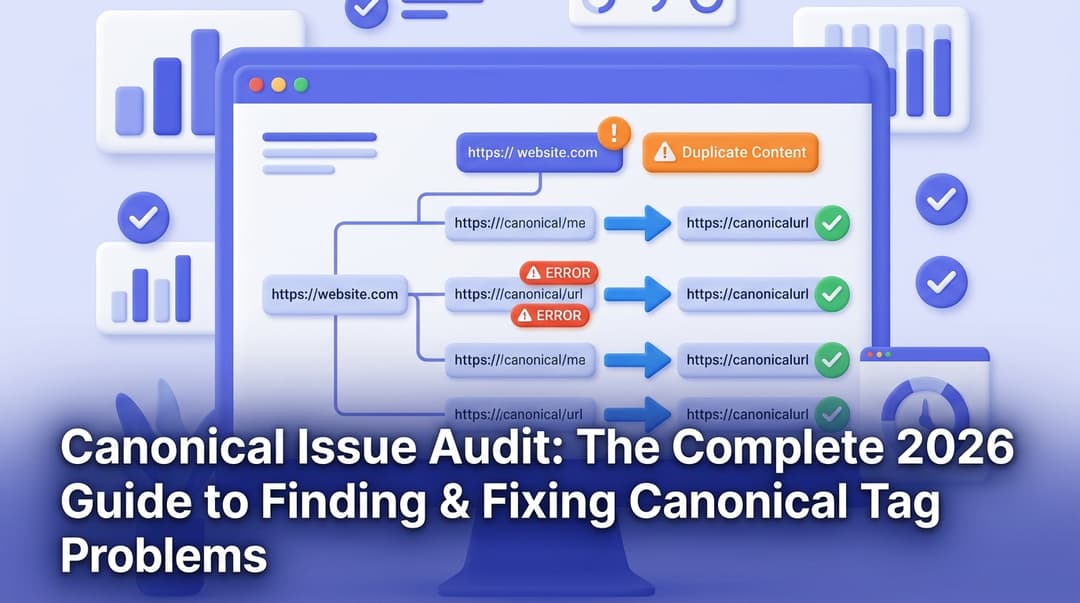
Canonical Issue Audit: The Complete 2026 Guide to Finding & Fixing Canonical Tag Problems
Learn how to run a full canonical issue audit in 2026. Discover the most common canonical tag errors, step-by-step fixes, and tools to protect your SEO rankings.