Free Canonical Conflict Detector
Check for mismatches between your HTML <link rel="canonical"> tag, HTTP Link header, and XML sitemap URL. Conflicting canonical signals confuse search engines and can prevent your preferred URL from being indexed.
Check Canonical Conflicts
QuickSEO shows clicks, impressions, keywords and pages for every website you manage, compared with the period before.
- Unlimited websites on the free plan
- No credit card needed
Why Canonical Conflicts Are Dangerous
Canonical tags are one of the most important technical SEO signals. They tell search engines which version of a URL is the "official" one that should appear in search results. When multiple canonical signals disagree, search engines receive conflicting instructions and may choose the wrong URL, split link equity, or ignore the canonical hint entirely.
Common causes of canonical conflicts include CMS migrations that update HTML templates but not sitemaps, CDN or proxy layers that inject HTTP Link headers, plugin conflicts that add competing canonical tags, and URL parameter handling differences between your canonical tag and sitemap generator.
Three Sources of Canonical Signals
Search engines look at three locations for canonical information. All three should agree:
- HTML Canonical Tag:
<link rel="canonical" href="...">— the primary signal, placed in the page's<head>section - HTTP Link Header:
Link: <url>; rel="canonical"— a server-level signal sent in response headers, useful for non-HTML resources - XML Sitemap: The URL format listed in your sitemap.xml implicitly declares the preferred URL structure (www vs non-www, trailing slashes, protocol)
How This Tool Works
- Enter a URL — paste the full URL of the page you want to check (e.g.,
https://example.com/blog/my-post) - Click "Detect Conflicts"— the tool fetches the page HTML, reads HTTP response headers, and checks the site's XML sitemap
- Review results — see the canonical URL from each source, whether they match, and specific recommendations for any issues found
What This Tool Checks
- HTML canonical tag: Extracts the
<link rel="canonical">from the page source - HTTP Link header: Checks for a
Link: <url>; rel="canonical"response header - XML sitemap presence: Looks for the URL in /sitemap.xml (and child sitemaps from sitemap indexes, up to 3)
- Cross-domain canonicals: Flags if the canonical points to a different domain than the current page
- Self-referencing check: Verifies whether the canonical tag points back to the same page or to a different URL
- Missing canonicals: Detects when no canonical tag is present at all
Common Canonical Conflict Scenarios
- HTTP vs HTTPS mismatch: The canonical tag says
http://but the sitemap useshttps://, or vice versa - Trailing slash inconsistency: One source includes a trailing slash while another does not (e.g.,
/pagevs/page/) - www vs non-www: The HTML canonical uses
www.example.combut the sitemap listsexample.com - Parameter handling: The canonical includes query parameters that the sitemap URL omits, or the reverse
- CDN or proxy injection: A CDN or reverse proxy adds an HTTP Link header that conflicts with the HTML canonical tag
Frequently Asked Questions
What is a canonical tag conflict?
A canonical tag conflict occurs when different sources on your website declare different preferred URLs for the same page. For example, the HTML <link rel="canonical"> tag might point to one URL while the XML sitemap lists a different URL. These conflicting signals confuse search engines about which version of the page should be indexed and shown in search results.
What are the three sources of canonical signals?
The three main sources are: (1) the HTML <link rel="canonical"> tag in the page head, (2) the HTTP Link response header with rel="canonical", and (3) the URL as listed in the XML sitemap. All three should reference the same preferred URL for each page on your site.
How do canonical conflicts affect SEO?
Canonical conflicts can cause search engines to index the wrong version of a page, split link equity between duplicate URLs, waste crawl budget on non-preferred URLs, and in severe cases lead to important pages being dropped from the index entirely. Google treats canonical tags as a strong hint rather than a directive, so conflicting signals weaken that hint and make it more likely Google will choose its own preferred version.
Should I use both HTML canonical tags and HTTP Link headers?
In most cases, using just the HTML <link rel="canonical"> tag is sufficient and recommended. The HTTP Link header is primarily useful for non-HTML resources like PDFs, images, or downloadable files that cannot contain HTML tags. If you do use both methods, they must point to exactly the same URL to avoid conflicts.
What should I do if my sitemap URL differs from my canonical tag?
If your sitemap lists a URL that differs from the canonical tag on that page, update one or the other so they match. Best practice is to only include canonical URLs in your sitemap. Remove non-canonical URL variants and ensure the sitemap URL exactly matches the canonical tag, including protocol (http vs https), www vs non-www, and trailing slashes.
QuickSEO shows clicks, impressions, keywords and pages for every website you manage, compared with the period before.
- Unlimited websites on the free plan
- No credit card needed
From the blog

XML Sitemap Checks: The Complete 2026 Guide to Auditing & Fixing Your Sitemap
Learn how to run thorough XML sitemap checks in 2026. Discover common errors, how to fix them, and best practices to improve crawling and indexing.
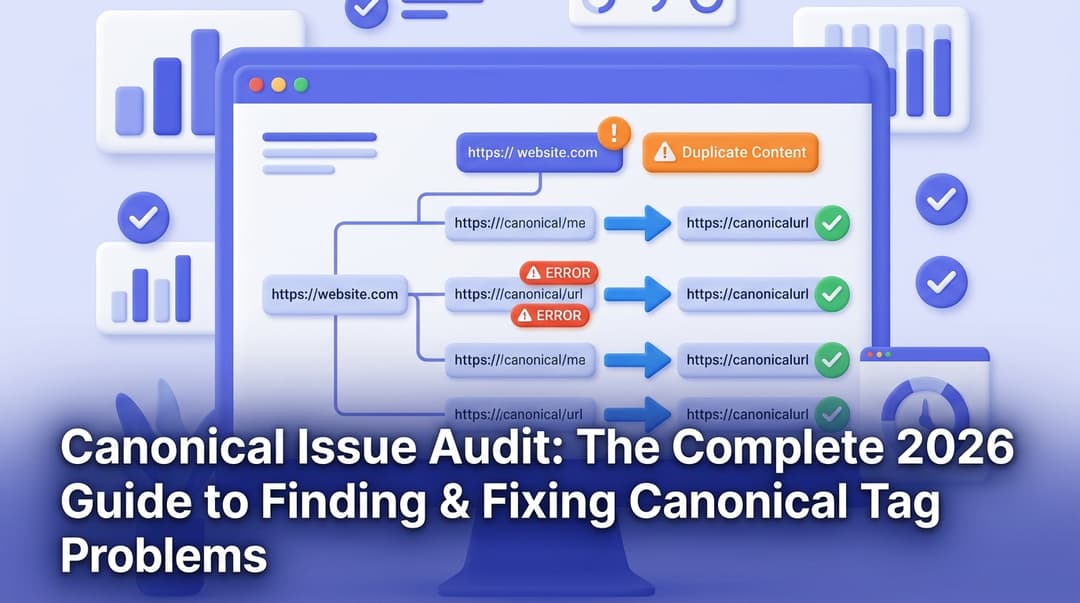
Canonical Issue Audit: The Complete 2026 Guide to Finding & Fixing Canonical Tag Problems
Learn how to run a full canonical issue audit in 2026. Discover the most common canonical tag errors, step-by-step fixes, and tools to protect your SEO rankings.
Related Tools
Generate proper canonical tags to prevent duplicate content issues.
Noindex CheckerCheck if a page is blocked from search engine indexing via noindex tags or headers.
Redirect CheckerCheck redirect chains, HTTP status codes, and detect redirect loops.
Sitemap ValidatorValidate your XML sitemap for protocol compliance and errors.