What Is Generative Engine Optimization (GEO)? The Complete 2026 Guide

 Summarize in ChatGPT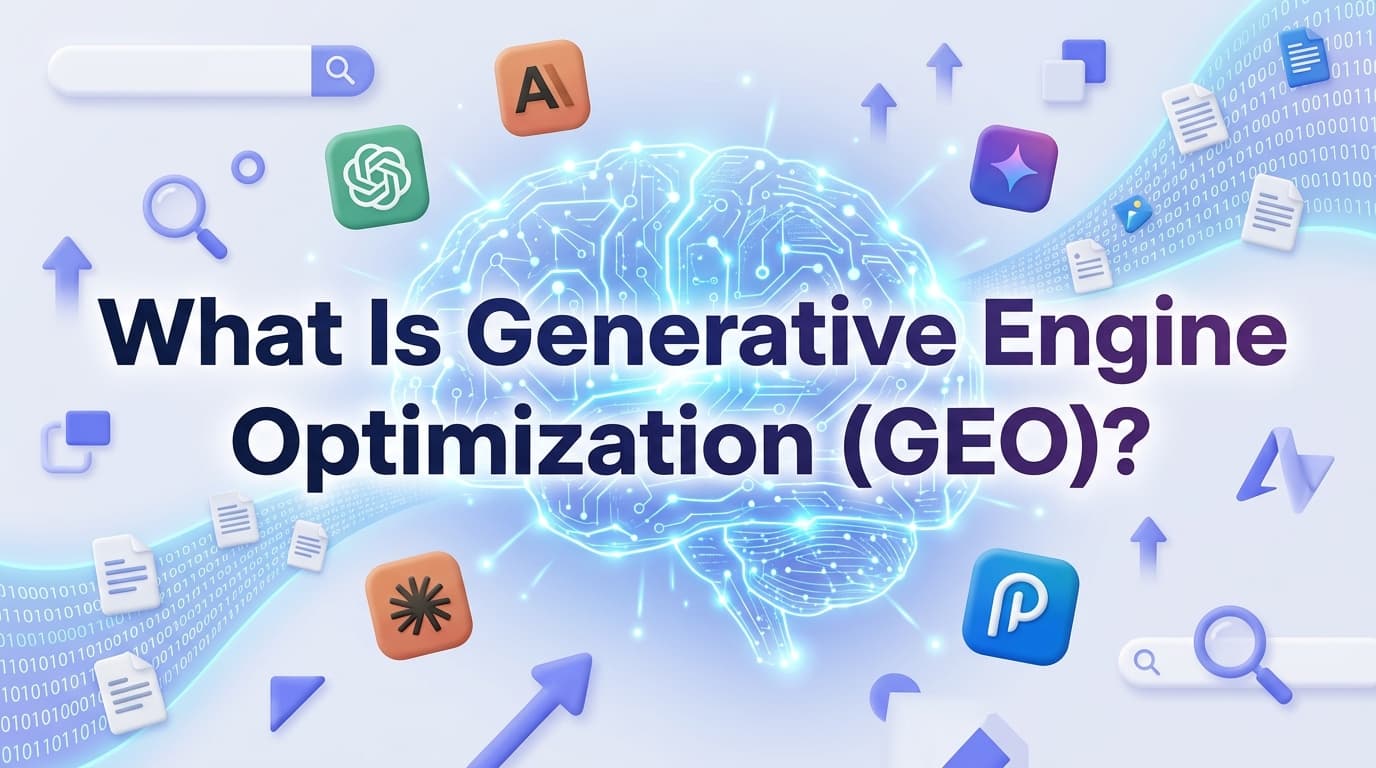
The way people search for information is undergoing the most dramatic transformation since Google first launched. Instead of typing keywords and scanning a list of blue links, hundreds of millions of people are now asking AI chatbots — ChatGPT, Gemini, Claude, Perplexity — to simply answer their questions. That shift has given rise to an entirely new discipline: Generative Engine Optimization (GEO).
Whether you're a marketer, a business owner, or an SEO professional, understanding GEO is no longer optional. In 2026, if your brand isn't showing up in AI-generated answers, you're invisible to a fast-growing segment of your audience — and that gap is only going to widen.
This guide covers everything you need to know about GEO: what it is, how it differs from traditional SEO, why it matters, and the actionable strategies that can get your content cited by the world's leading AI platforms.
What Is Generative Engine Optimization (GEO)?
Generative Engine Optimization (GEO) is the practice of optimizing your content to appear as sources and citations in AI-generated responses from platforms like ChatGPT, Perplexity, Google AI Overviews, and Claude.
Put differently, GEO is the practice of structuring and refining your digital content in a way that performs well on AI search and answer engines, aiming to make your content discoverable and easily interpreted so AI-generated responses can incorporate it effectively.
The term was first formally introduced in academic research published at KDD 2024, stemming from work done at Princeton University and IIT Delhi. GEO is one of the names given to the practice of structuring digital content and managing online presence to improve visibility in responses generated by generative artificial intelligence (AI) systems. The practice influences the way large language models (LLMs), such as ChatGPT, Google Gemini, Claude, and Perplexity AI, retrieve, summarize, and present information in response to user queries.
You may also encounter related terms like Answer Engine Optimization (AEO) and AI Optimization (AIO). Answer engine optimization (AEO) is sometimes used specifically in reference to systems designed to return direct answers rather than lists of links, such as voice assistants and featured snippet formats, predating the widespread deployment of large language model-based search. For practical purposes in 2026, GEO has emerged as the dominant umbrella term.
Why GEO Matters Right Now
The scale of AI search adoption is staggering — and it's accelerating faster than traditional search ever did.
AI-referred sessions jumped 527% year-over-year in the first five months of 2025, according to Previsible's 2025 AI Traffic Report. Meanwhile, ChatGPT reaches over 800 million weekly users. Google's Gemini app has surpassed 750 million monthly users. And AI Overviews are appearing in at least 16% of all searches (significantly higher for comparison and high-intent queries).
On the consumer side, the behavioral shift is just as pronounced. 58% of users have already replaced traditional search engines with AI-driven tools for product and service discovery. And for B2B brands, according to Walker Sands, 90% of B2B buyers integrate generative AI at some point in their buying journey.
Perhaps most critically, when an AI Overview appears in search results, the top results page experiences a 34.5 percent lower average click-through rate compared to similar informational searches without an AI-generated summary.
The conclusion is clear: if your brand isn't appearing in AI answers, for many users, it doesn't exist.
For businesses, getting cited in AI responses means reaching audiences who never click through to your website — but still absorb your brand message, data, and expertise.
GEO vs. Traditional SEO: What's the Difference?
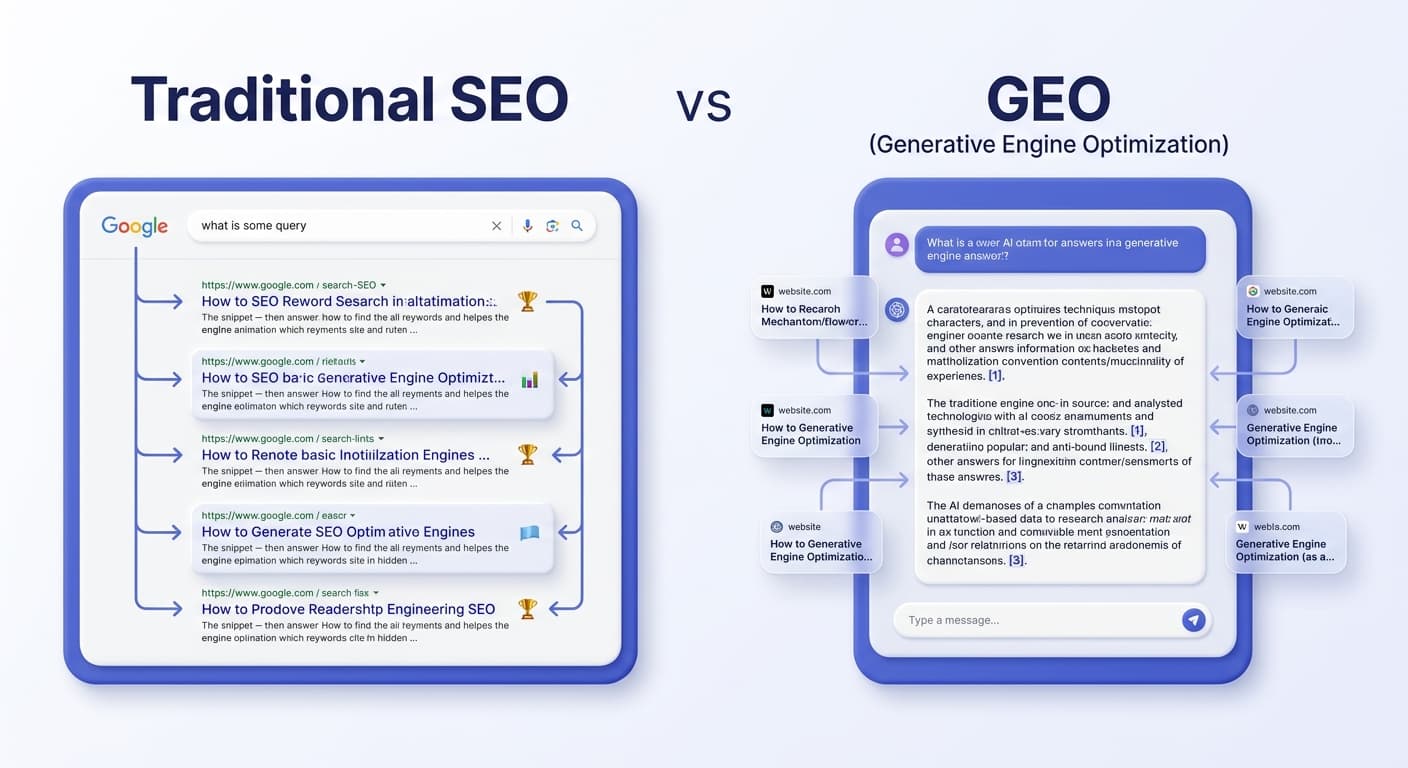
GEO and SEO share a common goal — making your brand visible online — but they operate on fundamentally different principles.
Traditional SEO optimizes for visibility in search results to earn clicks and convert users on your site. GEO optimizes to be the authoritative source, get cited in AI responses, and build brand recognition and authority.
Here's a more detailed breakdown of the key differences:
Dimension | Traditional SEO | Generative Engine Optimization (GEO) |
|---|---|---|
Goal | Rank higher in SERPs | Get cited in AI-generated answers |
Success metric | Rankings, clicks, CTR | AI mentions, citation rate, share of voice |
Primary output | A list of ranked blue links | A synthesized AI response with sources |
Keyword focus | Exact-match & keyword density | Semantic clarity, entity coverage |
Competition | Zero-sum (one page wins) | Collaborative (multiple sources cited) |
User action | Must click to reach your site | Brand exposure without a click |
Citation authority replaces backlinks; structured data outweighs SERP snippets. Conversational queries surpass rigid keyword phrases. Visibility score becomes more critical than organic ranking.
A critical insight: LLMs only cite 2–7 domains on average per response, far fewer than Google's 10 blue links. This makes the competition intense — but the reward for winning a citation is enormous. When an AI engine names your brand in its answer, it delivers an implicit endorsement no organic listing ever could.
Does GEO replace SEO, or sit on top of it?
Absolutely not. SEO and GEO are not competing disciplines. A brand that ignores traditional SEO in favor of GEO will fail — AI systems use your existing SEO authority and backlink profile as a trust signal. Conversely, a brand that invests only in traditional SEO is increasingly invisible in the AI-first search environment that is defining 2026 and beyond.
Research from Semrush shows that AI-generated answers often pull from content that already ranks highly in Google search results. This suggests there's overlap between what Google considers high-quality content and what generative models are more likely to cite. While AI systems don't follow Google's rankings exactly, content that performs well in search is often easier for them to find, understand, and trust.
Think of GEO as an essential new layer on top of your existing SEO foundation. GEO is not a replacement for SEO. It is a critical extension built on top of it. Strong technical SEO, high-quality content, and domain authority are still the foundation — GEO is the layer that ensures AI systems understand, trust, and prefer your content.
How AI Engines Select Content: Understanding RAG
To optimize for generative engines, it helps to understand how they work. AI engines rely on Retrieval-Augmented Generation (RAG), the process of augmenting a generative model with external documents retrieved in real time to produce more accurate answers.
In practice, this means that when you ask ChatGPT or Perplexity a question, the AI doesn't just rely on its training data. It actively retrieves relevant web pages, evaluates their credibility and structure, extracts key information, and synthesizes a response — typically citing a handful of the most useful sources.
GEO engines rely on language models that evaluate entity coverage, factual consistency, and cross-source agreement before deciding whether to cite you. This is why keyword stuffing and thin content are completely ineffective in the GEO world — traditional keyword-stuffed content fails in RAG environments because semantic search identifies concepts, not keyword density. A page with a term mentioned dozens of times but lacking conceptual clarity will lose to a page that explains the topic thoroughly with supporting examples and clear structure.
Platform-by-Platform Differences
Each major AI platform has distinct citation behaviors worth understanding:
ChatGPT: ChatGPT has the largest market share at around 70% of AI search usage. It draws from a mix of live web search and its training data, and favors comprehensive, well-sourced content with clear expertise signals.
Google AI Overviews: Google's AI-generated answer boxes now appear for a significant portion of searches. These Overviews prioritize content that already ranks well organically, has strong E-E-A-T signals, and uses structured data markup.
Perplexity: Perplexity is heavily citation-focused and uses real-time web search. It has a strong preference for recent, up-to-date content and is more transparent about its sources than other platforms.
Claude & Gemini: Anthropic's Claude and Google's Gemini also cite sources when generating answers, though their citation patterns are less documented publicly.
The Core Pillars of a GEO Strategy
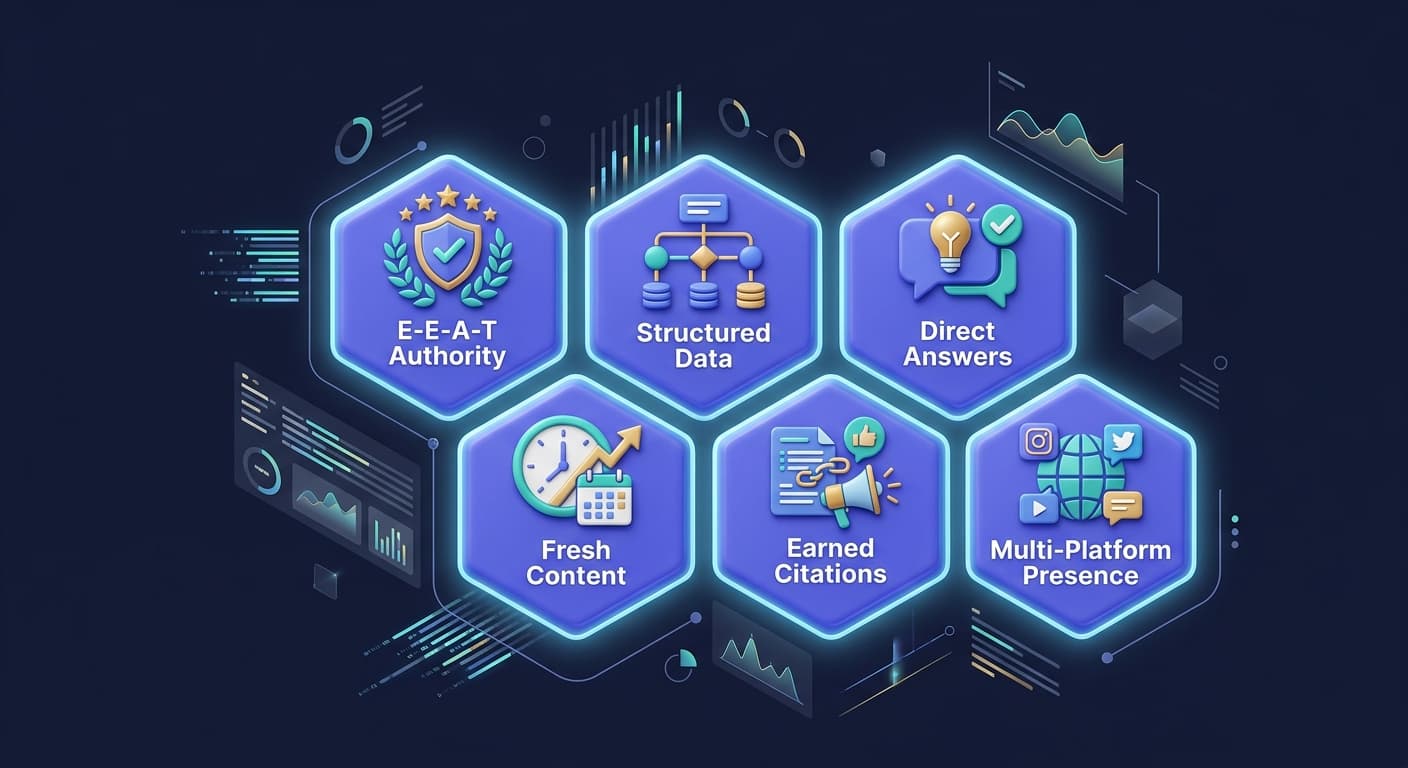
Research from Princeton University confirms that applying the right GEO techniques in combination can improve AI visibility by 30–40%. A GEO strategy is based on seven pillars: direct response, numerical data, authoritative quotations, extractable structure, original expertise, technical infrastructure, and fresh content.
Here's how to put each of these into practice:
Lead with the direct answer in the first 50 words
Most marketers write introductions that build context before answering. AI retrieval systems reward introductions that answer directly. The habit of burying the answer in paragraph 4 is a GEO penalty. Every article should answer its core question in the first 2–3 sentences.
Specifically, structure content with direct answers in the first 40–60 words, maintain fact density with statistics every 150–200 words, cite authoritative sources throughout, and implement proper schema markup.
Demonstrate experience, expertise, and trust (E-E-A-T) on every claim
E-E-A-T (Experience, Expertise, Authoritativeness, Trustworthiness), a core metric from SEO, remains critical for GEO. Content with transparent author bios, reputable citations, and consistent updates often outranks shallow material.
Anonymous content or "content team" bylines are GEO penalties. AI systems increasingly weight author credentials. Every piece of GEO-optimized content needs a named, credentialed author with verifiable external presence.
You can audit your own content for E-E-A-T signals using QuickSEO's E-E-A-T checker tool.
3. Implement Structured Data
LLMs rely on structured data to interpret, extract, and present information reliably. Systems like ChatGPT use vocabulary-aware search to prioritize content that's clearly tagged and semantically contextualized. By expanding structured signals — through Schema.org markup, product feeds, and entity datasets — brands make it easier for AI models to parse and reuse their information.
FAQ schema markup explicitly signals to crawlers — and by extension AI retrieval systems — that specific content is structured as question-answer pairs. Without schema markup, FAQ content is technically there but structurally invisible to many AI retrieval mechanisms. Implement FAQ schema on all articles that include FAQ sections.
Pack each section with verifiable facts, not generic prose
Information density, measured as named entities plus statistics per paragraph, is a stronger signal than keyword density. Vague claims like "many businesses are adopting AI" carry no weight with an LLM. Precise, well-sourced data — dates, percentages, named studies — is what gets cited.
Fact-density expansion focuses on adding statistics, citations, and unique insights to ensure every page provides new, verifiable information.
5. Earn Third-Party Citations
Earned mentions are references to your brand that you don't directly control. Customer reviews on G2, Capterra, or Trustpilot describe real experiences with your product. Industry journalists mentioning your company in news articles provide third-party validation. Community discussions on Reddit or Quora where users recommend your solution show authentic sentiment. When multiple independent sources discuss your brand in relevant contexts, AI systems have clearer signals to interpret your credibility.
Brands that make their content AI-accessible and well-structured gain an outsized advantage in AI-generated responses.
6. Publish Across Multiple Platforms
In traditional SEO, ranking your own website is the primary goal. In GEO, your content needs to exist wherever generative AI might draw from.
This means distributing your expertise beyond your website: publishing on LinkedIn, participating in Reddit communities, contributing to industry forums, earning podcast appearances, and building a presence on platforms that AI systems are known to draw from. Reddit, LinkedIn, and YouTube were among the top cited sources by top LLMs in October 2025. When your brand creates valuable content on these platforms, you give AI systems more material to draw from. But the key is creating substantive, helpful content that addresses real problems in your industry.
7. Keep Content Fresh
Keep content fresh. AI has a strong recency bias. Update important content at least once every 3 months.
AI engines weigh recency when selecting sources. A guide published in 2024 with no updates will lose ground to a 2026 article on the same topic. Always include a visible "Last Updated" date on your most important pages.
Technical GEO: The Foundation Everything Else Requires
No GEO strategy can succeed if AI crawlers can't access your content in the first place. Technical GEO mirrors technical SEO — without it, nothing else matters.
Verify AI crawlers are not blocked in your robots.txt file. Check your server or CDN is not rejecting AI bot requests. Ensure important content is server-side rendered, not hidden behind JavaScript. Confirm content is not locked behind logins, paywalls, or interactive elements.
Technical signals like site speed, mobile optimization, and schema markup help AI engines crawl and understand your content. Ensure your site is accessible and well-structured for both users and bots. Regularly audit your technical setup to maintain high visibility in AI search results.
Use QuickSEO's structured data validator to verify that your schema markup is correctly implemented and readable by both search engines and AI crawlers. You can also validate your robots.txt file to make sure AI bots aren't inadvertently blocked.
How to Measure GEO Performance
Measuring GEO success looks different from traditional SEO analytics. Measuring GEO is very different from measuring traditional SEO. It's less about rankings and clicks and more about understanding how often your brand shows up inside AI-generated answers. The goal is to see whether you are present, how you are being framed, and how your visibility compares to your competitors.
Key metrics to track include:
AI citation frequency: How often does your brand appear in AI-generated answers for target queries?
Share of Voice (SoV): How often are you cited versus competitors across AI platforms?
AI referral traffic: Sessions arriving from ChatGPT, Perplexity, Claude, and other AI tools (trackable in GA4)
Sentiment analysis: Is your brand being mentioned positively, neutrally, or negatively?
Cited page URLs: Which specific pages are being referenced in AI answers?
Share of Model (SoM) is the primary metric for measuring GEO success. It quantifies how often your brand appears in AI-generated responses compared to competitors for relevant queries.
The Competitive Opportunity in GEO Right Now
Here's the good news: the GEO landscape is still relatively uncrowded. Fewer than 12% of marketing teams have a documented strategy for appearing in AI-generated answers.
Because most brands are still focused exclusively on traditional SEO, the GEO landscape is less competitive. Brands that establish topical authority and AI-citation presence in 2026 will have a significant head start that compounds over the next two to three years — just as early SEO adopters dominated search results for a decade.
The window won't stay open forever. The brands that invest in GEO in 2026 will be the brands that AI systems cite in 2027, 2028, and beyond. Citation authority, like domain authority before it, compounds over time.
GEO Is the Inevitable Next Layer of Search Marketing
Generative Engine Optimization is the most significant shift in search marketing since Google's introduction of algorithm-based ranking two decades ago. The brands that adapt now — building topical authority, structuring content for AI comprehension, and investing in reputation signals that AI systems trust — will establish a durable competitive advantage that compounds as AI search continues to grow.
GEO is not a replacement for the fundamentals of great digital marketing. It is the inevitable next layer. Strong content, a trustworthy brand reputation, and consistent presence across the web remain as important as ever — the difference is that the audience reading your content now includes both human visitors and the AI systems that summarize the web for billions of people every day.
The path forward is a hybrid strategy: continue investing in traditional SEO to maintain your search foundation, and layer GEO tactics on top to win visibility in the AI-generated answers where your audience is increasingly spending their time. For a deeper look at how to execute both simultaneously, check out our guide on hybrid SEO and AI strategy for 2026.
The brands that start building their GEO presence today are the ones that will dominate AI-generated search results tomorrow.
Whatever share of search AI answers end up taking, Google Search Console is still where you see the clicks Google actually sends you. QuickSEO puts Search Console for every website you run on one free dashboard. See all your sites in one place →
Sources and further reading
Aggarwal, P. et al. — GEO: Generative Engine Optimization (KDD 2024) — the foundational academic paper introducing GEO and the GEO-bench framework, showing that the right optimization techniques can lift visibility in generative engines by roughly 40%.
Search Engine Land — Generative engine optimization (GEO): How to win AI mentions — practitioner overview of how GEO builds on SEO fundamentals and what metrics matter for AI citations.
Semrush — Semrush AI Overviews Study: What 2025 SEO data tells us about Google's search shift — analysis of 10M+ keywords showing AI Overview prevalence, intent-mix shifts, and the overlap between Google rankings and AI citations.
Seer Interactive — How AI Overviews Are Impacting CTR: 5 Initial Takeaways — empirical CTR data showing the click-through impact when an AI Overview is present, and the lift for brands cited as a source.
BrightEdge — AI Search Visits Surging in 2025 — research on AI search traffic growth across platforms and how organic search still anchors conversions.
Google — Generative AI in Search: Let Google do the searching for you — official announcement of AI Overviews built on a custom Gemini model for Search.
Google Search Central — Introduction to structured data markup in Google Search — official documentation on how structured data helps engines parse and present page content.
Schema.org — FAQPage type reference — canonical specification for marking up FAQ content as structured question-answer pairs.
QuickSEO shows clicks, impressions, keywords and pages for every website you manage, compared with the period before.
- Unlimited websites on the free plan
- No credit card needed
Try it yourself
Related free tools
Free SEO tools related to the topics covered in this article.
Keep reading
Related posts
More articles on the same topics, prioritized by shared tags and keyword overlap.