How AI Finds and Cites Sources: The Complete Guide for Marketers (2026)

 Summarize in ChatGPT
Every time a user asks ChatGPT, Claude, or Gemini a question, something remarkable happens behind the scenes: the AI sorts through billions of pieces of content, evaluates their trustworthiness, and decides in milliseconds which sources are worth citing. For marketers and business owners, this process is no longer just academic curiosity — it determines whether your brand is visible or invisible in the fastest-growing discovery channel on the internet.
ChatGPT alone processes 2.5 billion prompts per day, while Perplexity has surpassed 780 million monthly queries. Nearly a third of the US population (31.3%) will use generative AI search in 2026. Understanding how these platforms find and select their sources has become one of the most strategically valuable pieces of knowledge for any modern marketer.
This guide breaks down the full process — from the underlying technology to the ranking signals AI actually uses — and shows you exactly what you can do to become a cited source.
The Shift from Search Rankings to AI Citations
Before diving into how AI finds sources, it's worth understanding why this matters so urgently right now.
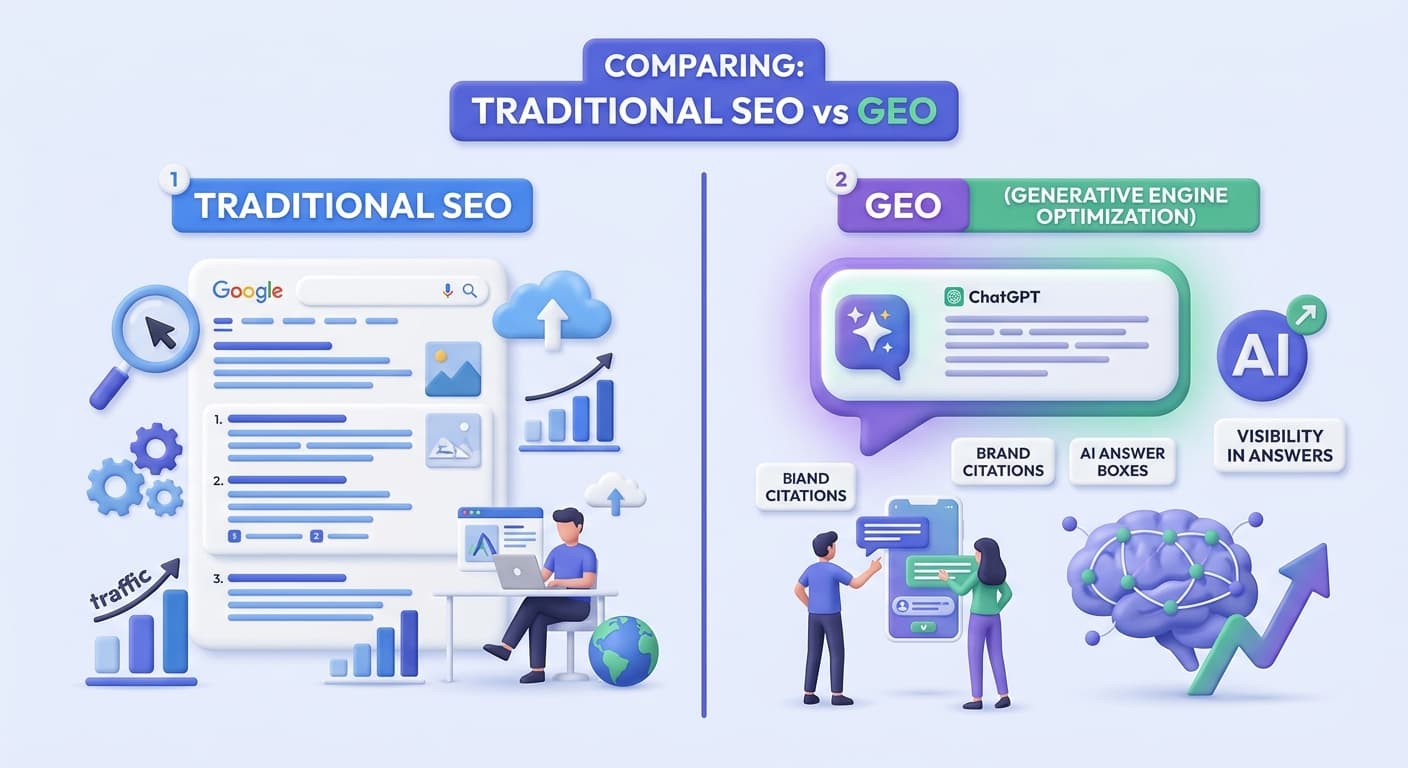
In traditional SEO, the goal was to rank among the top "blue links" on a search engine results page. With AI chatbots and generative search, the goal is to be included or cited in the answer itself.
ChatGPT prompts average around 60 words, compared to 3.4 words for a typical Google search. The user who types into ChatGPT is not the same user who types three words into a search box — they are more specific, more conversational, and significantly more likely to act on whatever the AI tells them. That user's journey no longer necessarily runs through your website. Being cited in the answer is now the conversion event.
If traditional SEO was about earning a spot among 10 blue links, GEO (Generative Engine Optimization) is about earning a place among the two to seven domains large language models typically cite in a single response. The competition is tougher, but the payoff is big: when an AI engine names your brand in its answer, it delivers an implicit endorsement no organic listing ever could.
The Core Technology: How RAG Powers AI Source Selection
The key to understanding how AI finds sources lies in a technology called Retrieval-Augmented Generation (RAG).
RAG improves large language models (LLMs) by incorporating information retrieval before generating responses. Unlike LLMs that rely on static training data, RAG pulls relevant text from databases, uploaded documents, or web sources.
Retrieval-augmented generation is a technique for enhancing the accuracy and reliability of generative AI models with information fetched from specific and relevant data sources. In other words, it fills a gap in how LLMs work.
Think of it like this: judges hear and decide cases based on their general understanding of the law. Sometimes a case requires special expertise, so judges send court clerks to a law library, looking for precedents and specific cases they can cite. Like a good judge, large language models can respond to a wide variety of human queries — but to deliver authoritative answers grounded in specific facts, the model needs to be provided that information.
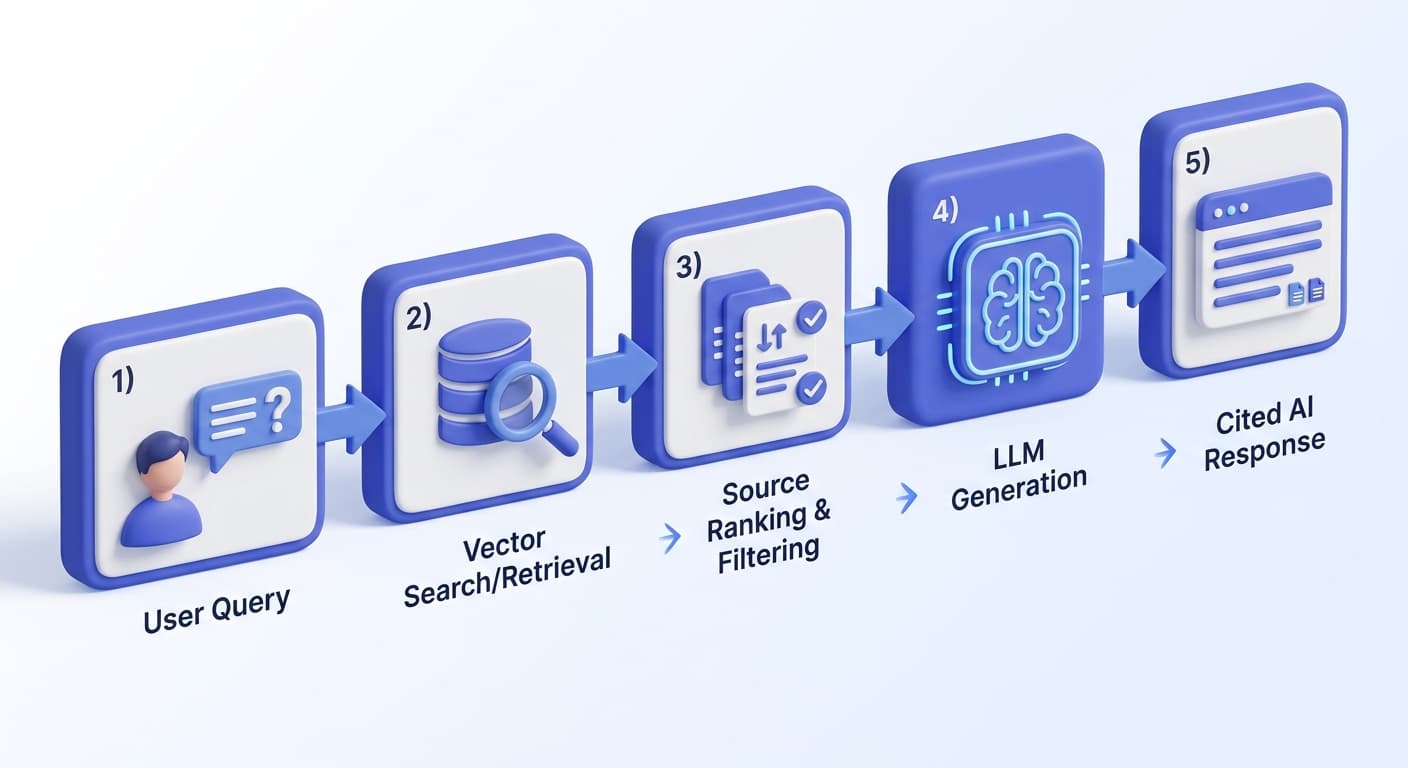
The RAG Pipeline Step by Step
Here is exactly what happens when an AI chatbot processes your question and decides which sources to cite:
Query Understanding — The user's question is parsed and converted into a vector (numerical representation) that captures its semantic meaning.
Retrieval — Given a user query, a document retriever is called to select the most relevant documents that will be used to augment the query. This comparison can be done using a variety of methods, which depend in part on the type of indexing used.
Chunking and Matching — An embedding model — an AI model that can identify semantic meaning in text — compares the text in each piece of source material, with each piece getting a score representing how relevant it is to the navigator's question. The chatbot then sends the most relevant source material to the LLM for processing and generating an answer.
Re-ranking — The retrieved documents are scored and reordered by relevance, authority, and freshness signals.
Grounded Generation — RAG uses powerful semantic search tools ("retrievers") to sift through data and find what's needed for a specific query. The RAG LLM then takes the retrieved snippets of information and incorporates them into its response generation to deliver the most relevant answer.
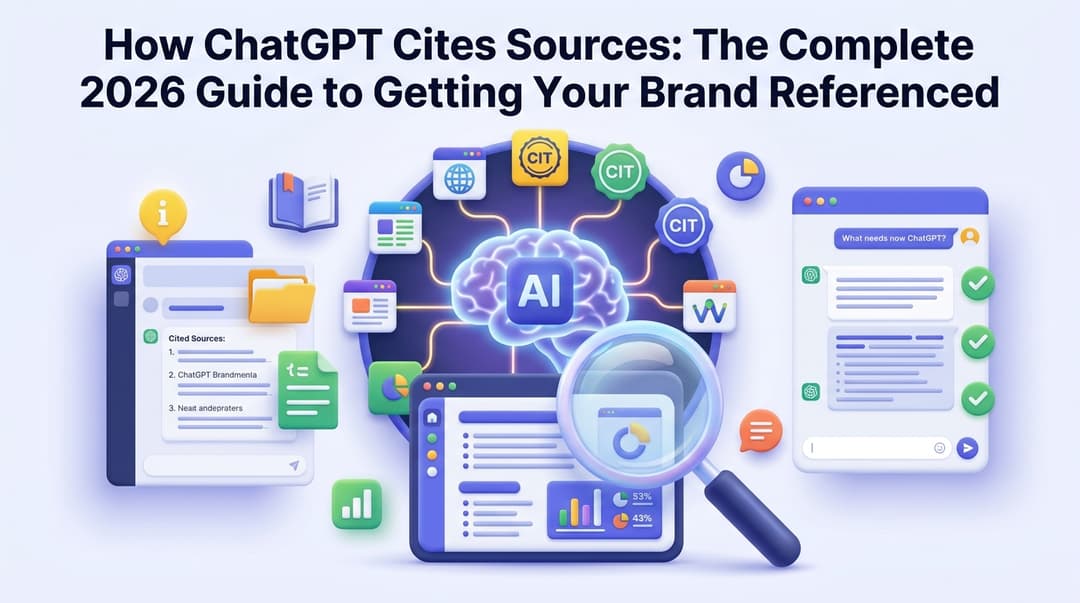
Citation Output — Retrieval-augmented generation gives models sources they can cite, like footnotes in a research paper, so users can check any claims. That builds trust.
Understanding how AI engines select content requires grasping this RAG technology. RAG combines two processes: retrieving relevant information from a knowledge base, then generating human-like responses using that retrieved context.
The 6 Key Factors AI Uses to Select Sources
AI chatbots don't randomly select information sources. Instead, they employ sophisticated algorithms that evaluate multiple factors to determine which content deserves inclusion in their responses.
Here's a breakdown of the most important signals:
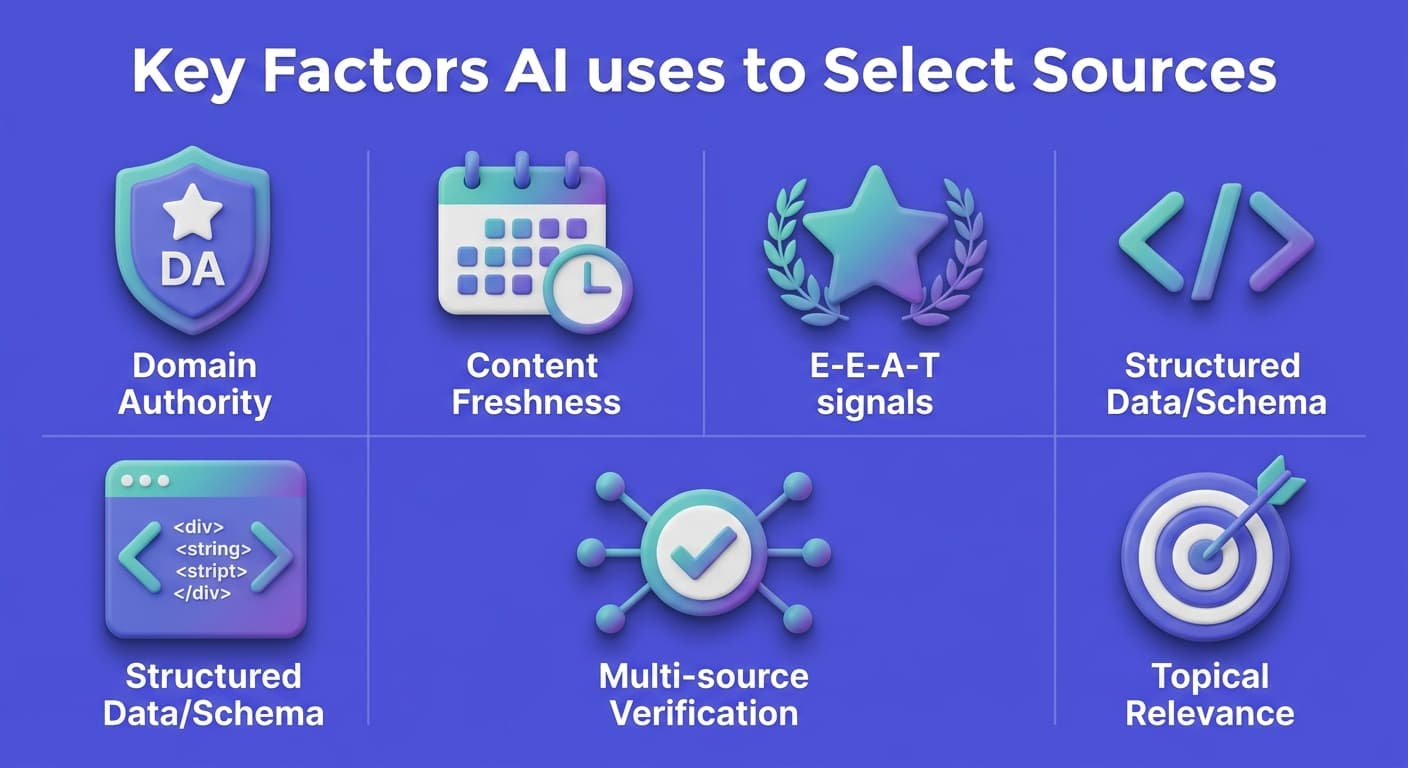
1. Domain Authority and Trust
AI chatbots prioritize sources with established credibility signals. Domain authority metrics from services like Moz and Majestic play a central role in this evaluation process. According to recent industry data, 73% of U.S. enterprise AI deployments in 2025 reference domain authority metrics when ranking external information sources. This means that traditional SEO foundations still matter, but they're now part of a more complex evaluation process.
2. Backlink Profile and Citation Networks
Backlink profiles remain crucial for AI source selection. Over 61% of chatbot-attributed links in 2025 were to sites with established citation networks — defined as having 100+ unique referring domains. This underscores the continued importance of earning quality backlinks from diverse, authoritative sources.
The quality of linking domains matters more than quantity. AI systems evaluate the relevance and authority of sites that link to potential sources. A single link from a respected industry publication carries more weight than dozens of links from low-quality directories or irrelevant websites.
3. Content Freshness
GEO has a unique problem that traditional SEO doesn't: AI citation decay. 50% of content cited in AI search responses is less than 13 weeks old, according to research by Amsive. Content that ChatGPT cited last month gets replaced by fresher sources this month.
AI engines weigh recency when selecting sources. A guide published in 2024 with no updates will lose ground to a 2026 article on the same topic. Refresh your cornerstone content regularly, add updated data, new insights, and a clear "Last updated" timestamp.
4. E-E-A-T Signals (Experience, Expertise, Authoritativeness, Trustworthiness)
AI models prioritize content that demonstrates high Experience, Expertise, Authoritativeness, and Trust (E-E-A-T). To be cited by chatbots, brands must provide clear, data-backed answers and structured data.
Even with perfect formatting and schema, the content itself must be authoritative and trustworthy to earn AI citations. Large language models have been trained to predict accurate answers, and they absorbed which sources are considered reputable.
5. Original Data and Unique Insights
Content that contains information not easily found elsewhere is highly attractive for AI citation. Inclusion of original data or "owned" insights was the second-strongest differentiator for cited pages.
Information Gain refers to adding new, unique information to a topic that isn't already there on other websites. AI models prefer to cite sources that offer original data, personal experience, or unique perspectives.
6. Cross-Web Brand Mentions
ChatGPT and Perplexity prefer sources that are mentioned often across trusted websites and social media, even if those sources don't rank high on Google.
AI tools favor brands that are mentioned often and in reliable places. The more your brand shows up on respected sites, forums, and review pages, the more likely it will be included in AI-generated answers.
How Different AI Platforms Retrieve Sources
Not all AI tools use the same retrieval approach. Here's how the major platforms differ:
ChatGPT (OpenAI)
ChatGPT's web search feature is like having someone do a quick Google search and then hand you a summary. It's great for getting quick information on recent events or anything beyond its knowledge cut-off. If you need deeper research, ChatGPT also offers a deep research feature that takes 5–30 minutes to create a report based on your request.
Claude (Anthropic)
For deep research, Claude creates concise reports that prioritize readability. Claude Projects allow users to attach files and data sources directly, incorporating them into the retrieval context.
Gemini (Google)
For real-time information, Gemini's AI mode is notably fast at web search, making it well-suited to quickly surfacing and citing up-to-date sources. Gemini benefits from deep integration with Google's own indexing infrastructure, meaning the same signals that influence Google Search rankings also influence Gemini's source selection.
Perplexity
Perplexity remains one of the leading AI options and has been praised as an alternative for specific tasks, namely research. Perplexity focuses on accuracy, offering more reliable answers to search questions than some of its competitors.
The Hallucination Problem: When AI Gets Citations Wrong
AI chatbots frequently hallucinate — producing plausible-sounding citations that aren't real. Always verify existence through Google Scholar, your library database, or the journal website before citing anything.
LLMs can generate misinformation even when pulling from factually correct sources if they misinterpret the context. For example, an AI generated the statement "The United States has had one Muslim president, Barack Hussein Obama" — retrieved from an academic book rhetorically titled Barack Hussein Obama: America's First Muslim President?. The LLM did not "know" or "understand" the context of the title, generating a false statement.
This is why RAG is described as "a way of improving LLM performance, in essence by blending the LLM process with a web search or other document look-up process to help LLMs stick to the facts." This method helps reduce AI hallucinations, which have caused chatbots to describe policies that don't exist, or recommend nonexistent legal cases to lawyers.
What Is Generative Engine Optimization (GEO)?
Generative Engine Optimization (GEO) is the practice of optimizing your content to appear as sources and citations in AI-generated responses from platforms like ChatGPT, Perplexity, Google AI Overviews, and Claude.
Traditional SEO optimizes for rankings and clicks. GEO optimizes for mentions, citations, and recommendations inside AI-generated answers. They work together.
GEO fits into a broader cross-functional strategy including SEO, content marketing, PR, and social media, all designed to drive brand visibility in AI search results.
8 Proven Tactics to Get Your Brand Cited by AI
1. Publish Authoritative, Well-Sourced Content
Ironically, one of the best ways to be cited by an AI is to cite others responsibly. AI models gauge verifiability — are the claims on this page backed by evidence? Pages that reference data from known reliable sources appear more credible.
2. Use Structured Data and Schema Markup
By marking up Q&A pairs with FAQPage structured data, you explicitly tell AI platforms: "Here are discrete question-answer pairs." Studies in 2025 showed content using FAQ schema appears in generative AI answers significantly more often.
Implement schema markup — especially Article, Organization, FAQ, HowTo, and Breadcrumb — to help AI engines parse your content. Review your robots.txt file to ensure AI crawlers like GPTBot, ClaudeBot, and PerplexityBot aren't blocked. Consider adding an llms.txt file to guide AI systems on how to interpret your site.
3. Establish a Strong Entity Presence
Include robust sameAs references to link your brand to authoritative profiles — Wikipedia, Wikidata, Google Business, social media. This solidifies your brand identity in the knowledge graph.
4. Build Digital PR and Earned Media
PR strengthens GEO by providing the external validation signals, citations, expert commentary, third-party articles, and earned media, that LLMs rely on to judge authority. These external references help generative engines recognize your brand as credible, increasing the likelihood of being surfaced or cited in AI-generated responses.
5. Invest in Community Platforms
LLMs pull heavily from Reddit, YouTube, and Wikipedia. Reddit alone has 100 million daily active users generating conversations about brands. Being present in authentic community discussions is now a direct GEO signal.
6. Keep Content Fresh
Articles with visible "Last Updated: [recent date]" signals, current statistics, and fresh examples outperform evergreen content for fast-moving topics. Pages that appear as AI Overview sources get citation visibility even when users do not click through.
7. Create Original Research and Data
Original research, proprietary data, and expert commentary attract citations. AI engines are more likely to cite a source that provides a fact no one else does — whether that's a survey result, a benchmark report, or a unique case study.
8. Write for Clarity, Not Cleverness
AI systems do not cite the most "clever" content. They cite the clearest content with the strongest trust anchors. That is why your content must read like a calm expert, not a loud ad.
AI systems that use real-time retrieval evaluate a page's relevance primarily on its opening content. The first 200 words of any article should directly and completely answer the primary query — not build up to the answer. This mirrors the TLDR-first content structure that top-performing GEO content uses consistently.
Why Tracking AI Visibility Is Now Non-Negotiable
Traditional SEO metrics (like rankings, clicks, and traffic) only tell part of the story. A user clicked, landed on your site, and either converted or didn't — you could tie that traffic directly to revenue. AI search breaks that path. When an AI tool recommends your product to a user, they might never click through to your site. The conversion may still happen — they Google your brand name later, sign up the following week — but your analytics won't connect it back to the AI mention that started it.
Reddit, LinkedIn, and YouTube ranked among the most-referenced domains by major large language models in October 2025, and between 40% and 60% of cited sources change month-to-month across Google AI Mode and ChatGPT, making visibility far less stable than organic search rankings.
This is where a unified dashboard makes the critical difference. At QuickSEO, we built our platform specifically to bridge this gap — giving you one place to track both your traditional Google Search performance and your AI visibility across ChatGPT, Claude, and Gemini simultaneously.
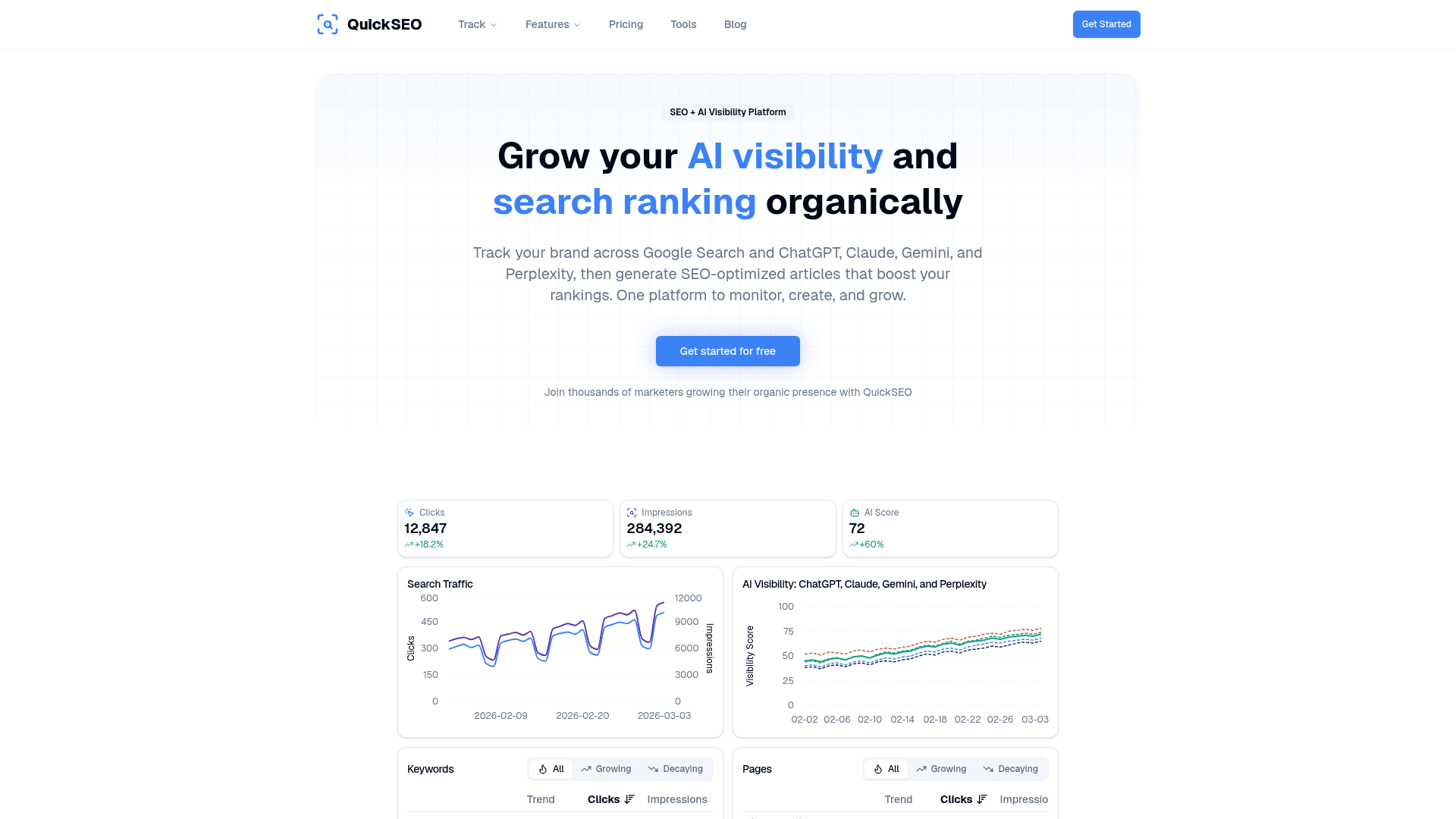
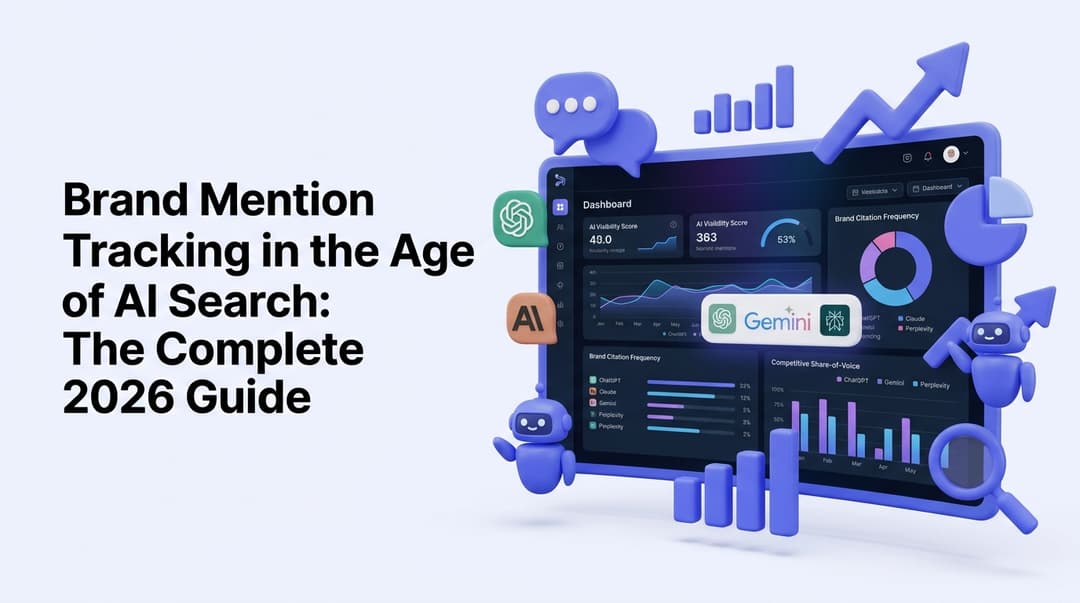
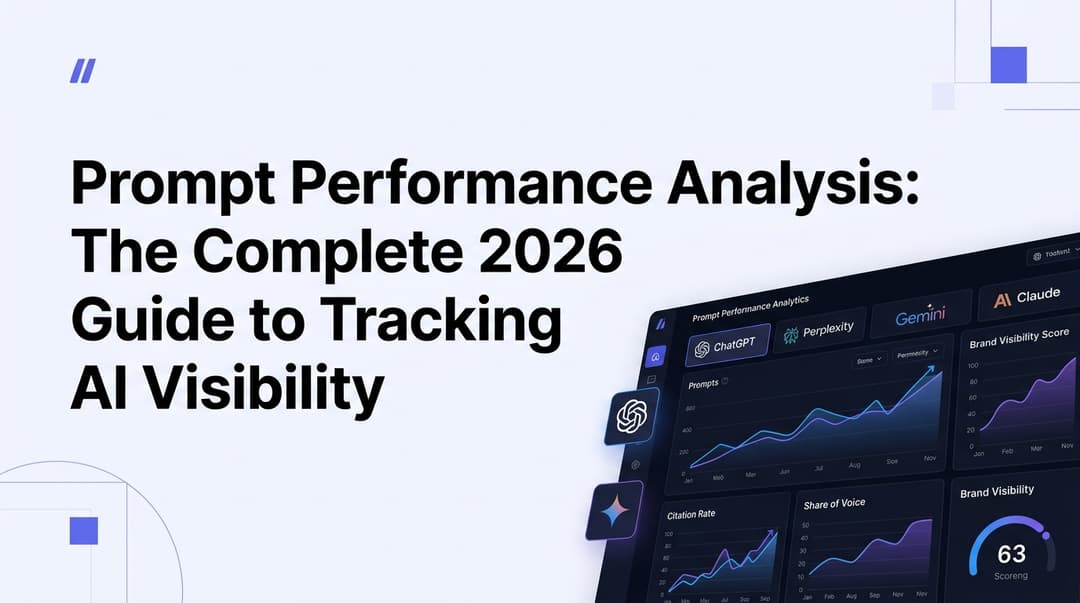
QuickSEO tracks your AI Score, Tracked Prompts, and citation rankings across all major AI platforms alongside your Google Search metrics.
With quickseo.ai, you can:
Track which prompts your brand appears in across ChatGPT, Claude, Gemini, and Perplexity
Monitor your AI Score and how it changes over time
See your citation rank for each prompt on each AI platform
Compare your AI visibility to your traditional Search traffic in one unified view
Generate AI-optimized articles to grow organic traffic to your website
Being cited in an AI-generated answer is now a conversion event, not a traffic driver. Major publishers like Reuters and The Guardian receive less than 1% of referral traffic from AI platforms despite being frequently cited — meaning AI visibility and website traffic have decoupled. You can't afford to measure only one side of the equation.
The Bigger Picture: SEO + GEO as a Unified Strategy
Brands that excel at GEO in 2026 are typically the same brands with strong traditional SEO foundations. The optimization principles overlap significantly, but GEO adds specific requirements around content structure, citation-friendliness, and data richness that SEO alone does not address.
SEO builds the foundational structure, like clarity, organization, and authoritative pages, while GEO extends that structure into LLM environments by adding completeness, citations, and broader ecosystem signals. When SEO and GEO are intentionally integrated, they reinforce each other and increase your brand visibility in both traditional and AI-based search.
GEO isn't a passing trend. It's the new foundation of digital discovery. As AI search adoption accelerates through 2026 and beyond, the gap between brands that invest now and those that wait will only widen.
Conclusion: The New Rules of Being Found
AI chatbots don't pick sources at random. They follow a rigorous, multi-layered evaluation process — powered by RAG technology — that weighs domain authority, freshness, original data, E-E-A-T signals, structured data, and cross-web brand presence. The brands that understand these rules and build their content strategies around them will dominate the AI-generated answers their potential customers are increasingly relying on.
The question for every marketer right now isn't "should I care about AI citations?" — as more consumers turn to AI chatbots for research and recommendations, businesses that understand these selection criteria gain a significant competitive advantage. Those that don't risk becoming invisible in the conversations that drive purchasing decisions.
At QuickSEO, we make it simple to see exactly where you stand — across both Google Search and AI platforms — and to track your progress as you implement your GEO strategy. Start tracking your AI visibility at quickseo.ai →
Enter your website to track its AI visibility across ChatGPT, Gemini, Claude, and Perplexity — and turn chatbot mentions into traffic.
- Set up in minutes
- Cancel anytime
Try it yourself
Related free tools
Free SEO tools related to the topics covered in this article.
Keep reading
Related posts
More articles on the same topics, prioritized by shared tags and keyword overlap.