51% of B2B Buyers Now Start in an AI Chatbot: 30+ Stats Reshaping Software Discovery

 Summarize in ChatGPT
For two decades the B2B software buyer started in Google. They typed "best CRM," opened ten tabs, hit a G2 grid, requested two demos, and built a shortlist over weeks. That motion is dying in real time.
G2 surveyed 1,076 B2B software buyers in March 2026 and found that 51% now start their software research in an AI chatbot more often than with Google — up from 29% just ten months earlier (press release). Three months earlier, 6sense had already surveyed nearly 4,000 buyers across NA, EMEA, and APAC and found that 94% used LLMs somewhere in the buying journey (6sense Buyer Experience Report 2025).
The chatbot is the new homepage. If your brand is not in the answer when a 28-year-old VP of Ops types "best vendor management software for a mid-market SaaS company," you are not on the shortlist — and the shortlist is mostly the deal. Here are 30+ stats that explain why that matters this quarter, not next year.
The number that changed the playbook
G2 calls the new state of B2B buying the "Answer Economy", and the trajectory in their data is what should make CMOs sit up:
51% start research in an AI chatbot more often than Google — up from 29% in April 2025.
71% rely on AI chatbots for software research — up from 60% just seven months earlier.
86% of buyers increased their AI chatbot use over the past year.
53% say AI research is more productive than traditional search — up from 36% in August 2025.
Nearly two-thirds now spend six or more hours per week on AI chatbots at work; 40% are self-identified daily power users.
61% use AI search and Google in tandem rather than choosing one — but the AI is now the entry point.
Tim Sanders, G2’s Chief Innovation Officer, framed it in the press release: "We’re watching the third compression era of the buyer journey unfold in real time…Now, AI chatbots are compressing it into a single answer."
Independent corroboration: Forrester’s State of Business Buying 2026 surveyed ~18,000 global business buyers and concluded that generative AI tools were the single most cited "meaningful interaction" type when researching purchases. Gartner’s March 2026 sales survey of 646 buyers found 45% used AI during a recent purchase (Gartner).
Chatbots have replaced review sites as the #1 shortlist driver
For most of the past decade, the top of the B2B shortlist funnel belonged to review sites (G2, Capterra, TrustRadius) and analyst grids (Gartner, Forrester). That ranking has flipped:
Source influencing B2B vendor shortlists | % ranked #1 | Rank |
|---|---|---|
AI chatbots (ChatGPT, Claude, Gemini, Perplexity) | 54% | #1 |
Software review sites (G2, Capterra, TrustRadius) | 43% | #2 |
Vendor websites | 36% | #3 |
Source: G2 Answer Economy 2026 (n=1,076 B2B software buyers, March 2026).
Two G2 follow-up data points sharpen this:
85% of buyers think more highly of a vendor when AI cites them in an answer. Citation isn’t a passive impression — it acts as third-party endorsement.
45% rank review-site citations as the most confidence-inspiring signal in an AI answer. Among daily AI power users that jumps to 50% (Foundation Inc analysis). The takeaway: G2 and Capterra haven’t lost importance — they’ve been swallowed into the AI answer.
One in three buyers bought from a vendor they’d never heard of
This is the stat that should keep every B2B SaaS marketing leader up at night. G2’s buyer panel:
69% chose a different software vendor than they’d originally planned, based on AI chatbot guidance.
33% bought from a vendor they weren’t familiar with before the AI surfaced it.
80% say AI accelerated their purchase decision; 83% felt more confident in their final choice.
41% top use case: comparing vendor strengths and weaknesses. 41% also use Deep Research tools regularly for structured evaluations.
Read those four numbers as one sentence: a single chatbot session can flip a half-formed preference, install a brand the buyer had never heard of, and shorten the validation process from months to minutes. The AI is no longer summarizing the shortlist — it is creating it.
The buying cycle has compressed — and most of it happens before sales
Compression is the meta-trend across every 2025–2026 buyer-behavior dataset. The hard numbers:
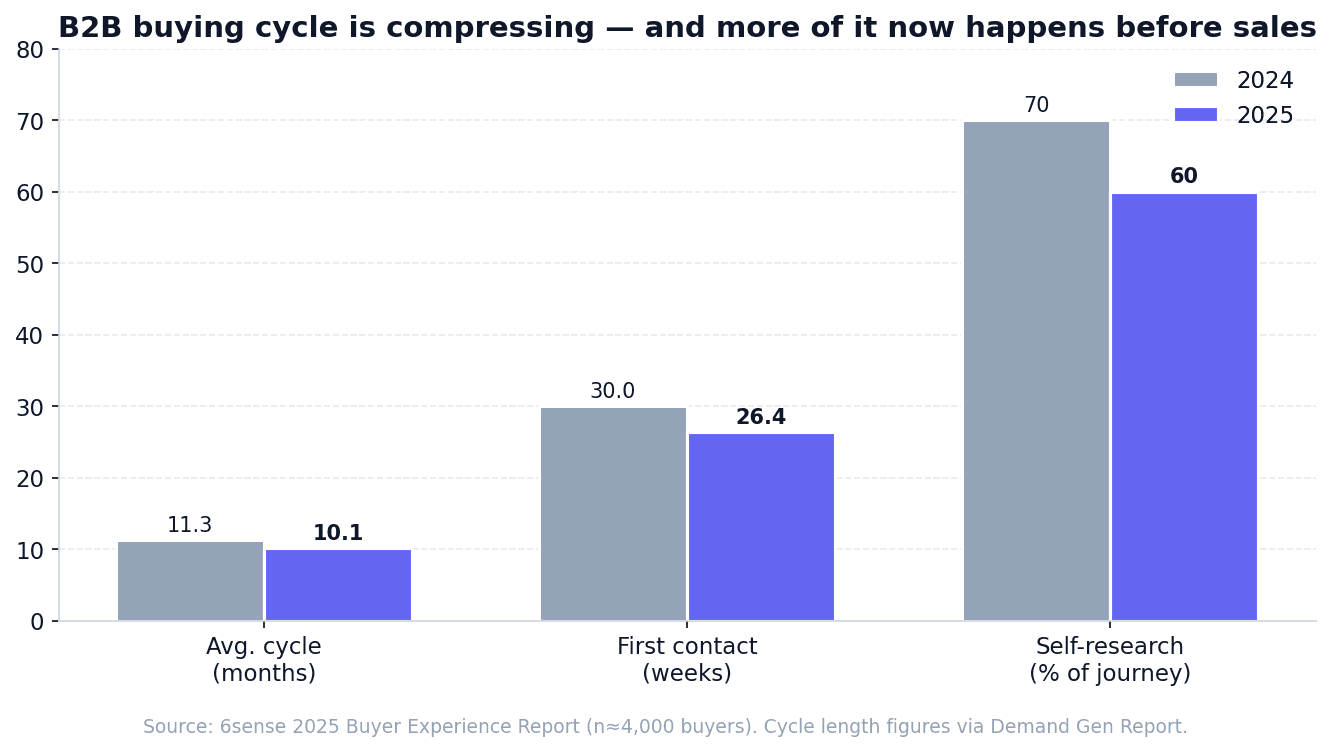
6sense’s longitudinal panel of ~4,000 buyers tracks three shifts. The average B2B sales cycle dropped from 11.3 months in 2024 to 10.1 months in 2025 (6sense Buyer Experience Report 2025). First contact with a sales rep moved from week 30 to week 26.4. The self-research vs. seller-engagement split widened from 70/30 to 60/40 — meaning 40% of the journey is now driven by sellers, but only after the buyer has already chosen their preferred answer.
That preferred answer is sticky. 6sense found that 94% of buying groups ranked preferred vendors before first contact, and the preliminary favorite won 77% of the time. Forrester’s February 2026 analysis goes further: 68% of buyers already have a front-runner vendor in mind at the very start of their purchasing process — and that front-runner wins 80% of the time. Only 19% of B2B marketing leaders realize that’s the case.
Gartner adds the disposition data: 67% of B2B buyers prefer a rep-free experience (n=646, fielded Aug–Sept 2025), and buyers still spend only 17% of their total purchase journey time with potential suppliers (Gartner). The buyer doesn’t want to talk to you. They want to ask the chatbot.
How B2B buyers actually use AI in the buying process
Responsive surveyed 350 global B2B buyers (Oct 2025) on where exactly AI shows up in their workflow. The shape of the answer is consistent with every other dataset: AI is front-loaded into research, evaluation, and shortlisting — and trusted very little for the final call.
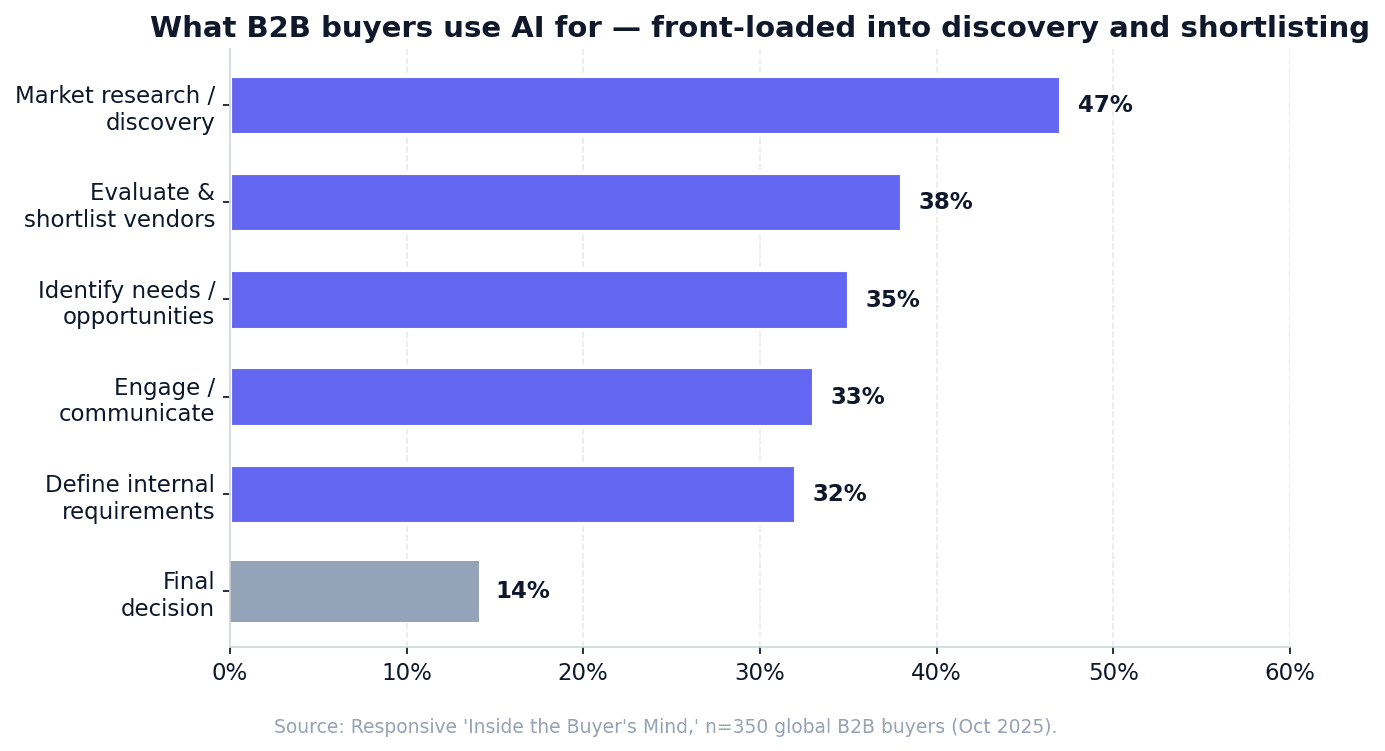
6sense’s qualitative breakdown lands in the same place: top use cases are "comparing vendor offerings, evaluating proposals, analyzing stakeholder input, creating shortlists, and summarizing content." That maps almost cleanly onto the chart above.
Buyers also actively verify what the AI tells them. TrustRadius’s Bridging the Trust Gap study (n=2,058 tech buyers) found that 90% click through to a cited source to fact-check. Omniscient Digital’s 100-decision-maker panel (From Prompt to Purchase) reported that 80% validate LLM outputs against brand websites and 60% cross-reference with third-party reviews — only 22% trust the LLM output directly.
Bain’s August 2025 AI search analysis captures the behavior plainly: "Buyers at small and medium-size businesses have already started to build their vendor short lists inside LLMs, using AI to construct the consideration set, then turning to websites, review platforms, and YouTube demonstrations to validate what the model suggests."
B2B buyers ask AI like a colleague, not a search box
The shape of an AI query is structurally different from a Google search. Nectiv’s analysis of 8,500+ ChatGPT prompts clocked the average ChatGPT search query at 5.48 words, with 77% of queries 5 words or longer — about 60% longer than a typical Google query. Semrush’s clickstream data shows the non-search prompt average is 13.5 words (Semrush). Buyers are typing full sentences with constraints, context, and budget.
Profound’s 50-million-prompt landmark study broke intent down. Transactional intent was 6.1% on ChatGPT versus 0.6% on Google — a 9× jump. Navigational intent collapsed from 32% on Google to 2% on ChatGPT, and a new "generative" intent category (37.5% of prompts) doesn’t even exist in traditional search. The top recurring tokens in B2B ChatGPT prompts: "Reviews," "Comparison," "Features," "2025." These are not the queries of someone exploring; they’re the queries of someone deciding.
That’s also why per-visit value is so high. Semrush concluded that the average LLM visitor is worth 4.4× the average traditional organic search visitor (Semrush AI traffic study).
Which platforms B2B buyers prefer — and how they cite
B2B buyers don’t treat all chatbots as interchangeable, and the chatbots themselves recommend very different vendors for the same prompt.
ChatGPT is the preferred LLM for 47% of B2B software buyers — nearly 3× any other LLM (G2).
87% of B2B software buyers say AI chatbots are changing how they research, including 80% of tech/software buyers who use AI as much as or more than search engines.
Platform | Brand mention rate | Citation tilt |
|---|---|---|
Claude | 97.3% | Most curated; high mention rate but selective on B2B SaaS (88%). |
Grok / Copilot | 90%+ | Varied; Copilot leans on Bing’s index. |
ChatGPT | 73.6% | B2B SaaS: Wikipedia 48%, Reddit 13%, Academic 7% of top-10 citations. |
Perplexity | High | B2B SaaS: Reddit 47%, Wikipedia 20%, YouTube 13%. |
Google AI Overviews | 48.5% | B2B SaaS: YouTube ~23%, Reddit ~21%, Wikipedia ~18%, Google properties ~16%. |
Sources: Spotlight, Feb 2026 (1.8M responses); Averi B2B SaaS Citation Benchmarks Report, May 2026; DerivateX, Apr 2026.
The gap between platforms is much larger than most marketers think. Superlines reports that the same brand can see citation volumes differ by 615× between Grok and Claude, and a separate analysis of 100,000 prompts found only 11% of domains are cited by both ChatGPT and Perplexity. Tracking one chatbot tells you almost nothing about how you appear in the others.
Where AI actually cites you from (and why it’s rarely your own site)
AirOps’ State of AI Search 2026 analyzed 21,000+ brands and the headline is consequential for any B2B marketer planning their owned-vs-earned mix:
85% of brand mentions in AI come from third-party domains — not the brand’s own site.
48% of citations come from UGC platforms (Reddit, YouTube, LinkedIn, Wikipedia).
Third-party mentions are 6.5× more likely to be cited than owned-domain mentions.
90% of third-party mentions appear in listicles, comparisons, and reviews.
60% of AI Overview citations come from URLs ranking outside the top 20 organic results — your old SEO equity does not automatically transfer.
The Goodie team analyzed 5.7M citations and found that over 35% of B2B SaaS citations come from just 10 sources: Reddit, G2, PCMag, Capterra, TechRadar, Gartner, Forbes, TechCrunch, GetApp, and Wikipedia (Goodie). For most B2B SaaS categories, "AI visibility" mostly means showing up well on those ten domains.
AI surfaces are also volatile. AirOps reports that only 30% of brands stay visible across consecutive AI answers, and only 20% persist across five runs. Pages that aren’t updated within 3 months are 3× more likely to lose citations. You can’t check once and assume the answer is stable.
The pipeline impact when AI does send a click
~93% of AI chatbot sessions end without a click. The 7% that do click out are wildly more valuable than anything else hitting your site. The B2B-specific data:
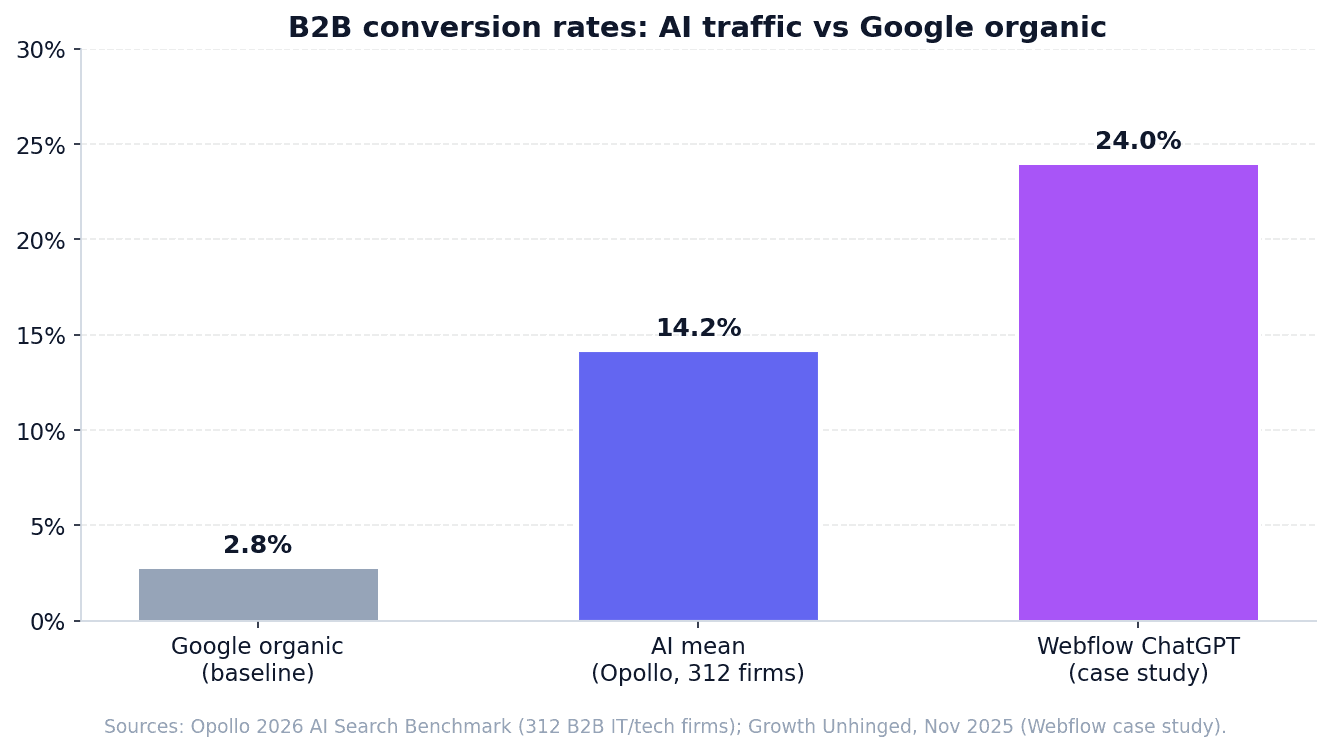
Opollo’s 2026 AI Search Benchmark Report analyzed 312 B2B IT and tech firms across NA, AU, and UK. AI search traffic converted at 14.2% on average versus 2.8% for Google organic. 74% of firms studied saw AI outperform Google organic on conversion efficiency. The equal-volume reframe Opollo offers is the cleanest way to brief a CFO: 100 Google visitors → 2–3 qualified enquiries; 100 AI visitors → 13–16.
Individual B2B SaaS case data lines up:
Webflow: ChatGPT traffic converts at 24%, about 6× Google organic. LLMs now drive 10% of signups, up from 2% — a 4× YoY jump (Growth Unhinged).
Vercel: ChatGPT now refers ~10% of new Vercel signups, up from 4.8% one month earlier and ~1% six months earlier (Vercel engineering blog).
Tally.so: ChatGPT became the #1 referral source in spring 2025, contributing ~25% of new signups and helping Tally hit $3M ARR five months ahead of plan (Foundation Inc).
Cybersecurity mid-market (Opollo case study): AI = 4% of sessions but 19% of qualified pipeline. 167 AI sessions produced 23 qualified enquiries, vs 3,840 Google sessions at 2.5% CR.
First Page Sage tracked B2B SaaS ChatGPT CR at 2.4% across 160+ clients — still ~30% above typical B2B SaaS organic (First Page Sage).
Microsoft Clarity’s 1,277-domain study: LLM sign-up CTR is 11× search, and subscription CTR is ~2.4× search (Clarity).
B2B SaaS visibility is broken for nearly half the market
DerivateX ran a B2B SaaS-specific audit across 50 B2B SaaS companies, 1,400 buyer-intent prompts, and four chatbots in April 2026. The numbers are stark:
Average AI Presence Score: 56.9 out of 100.
44% of B2B SaaS companies scored below 50 — effectively invisible to AI-assisted buyers.
Leader vs laggard spread: 87 points (Clio 89, LeadSquared 2).
Sentiment was almost universally positive: 44 of 50 companies hit 19–20/20 sentiment scores.
Translation: most B2B SaaS brands are not losing because AI dislikes them. They’re losing because the AI doesn’t mention them at all. Visibility, not perception, is the gap.
Your TAM is younger and they live inside the chatbot
The age skew on AI use in B2B buying is steep — and it’s converging, not diverging:
Leadscale: 85% of buyers aged 25–34 use AI for supplier research, vs 23% of buyers aged 55–64 (Leadscale).
TrustRadius: 15% of Gen Z buyers use AI "a lot" — nearly 2× the all-buyer average; 30% always or very often trust AI-generated content vs 20% across all buyers.
Responsive: 48% of US buyers use GenAI to find vendors vs 14% elsewhere; 56% of tech buyers vs 28% in other industries.
Forrester 2026: procurement professionals now serve as decision-makers in 53% of buying cycles — and procurement’s job is to consult tools, not relationships.
The 25–34 cohort is 3.7× more likely to use AI for supplier research than the 55–64 cohort. In 36 months that gap closes by attrition alone — the entire buying market is moving toward chatbot-first discovery.
What B2B marketers should do about it this quarter
Audit your AI visibility across all four major chatbots. Tracking one platform tells you nothing about the others — the same brand can see citation volume differ by 615× across platforms. ChatGPT, Claude, Gemini, and Perplexity recommend different vendors for the same prompt.
Win the third-party real estate. 85% of AI brand mentions come from external sites. Prioritize listings on G2, Capterra, Reddit, and category-specific listicles. Make sure your Wikipedia presence is accurate. The Goodie data shows just 10 domains drive 35%+ of B2B SaaS citations.
Build the comparison and pricing pages buyers actually prompt for. The top recurring tokens in ChatGPT prompts are "Reviews," "Comparison," "Features." If you don’t have explicit "X vs Y" pages, pricing pages, and feature matrices, the AI will cite whoever does.
Measure shortlist inclusion, not just clicks. ~93% of AI sessions don’t click out. The brand-equity layer — being recommended — precedes the traffic layer. Treat "share of answer" the way you treat share of voice in paid media.
Recheck frequently. Only 30% of brands stay visible across consecutive AI answers; only 20% persist across five runs. Visibility is a daily question, not a quarterly snapshot.
Optimize for the 25–34 cohort now. They’re 3.7× more likely to start in AI than the 55–64 cohort, and they’re your buying committee in five years. Brief your content team on the prompts they’d type, not the keywords your 2018 SEO playbook tracks.
Run an AI visibility audit before your competitor does
QuickSEO runs your brand through ChatGPT, Gemini, and Perplexity for the buyer-intent prompts a real B2B customer would type — five prompts × three chatbots = 15 live calls — and shows you exactly where you’re mentioned, where competitors appear instead, and which third-party citations are doing the work.
Start with a free AI visibility audit — paste your URL, get a multi-platform read in under 60 seconds. If you’re not in the answer when buyers ask, you’re already losing 51% of the funnel.
Enter your website to track its AI visibility across ChatGPT, Gemini, Claude, and Perplexity — and turn chatbot mentions into traffic.
- Set up in minutes
- Cancel anytime
Keep reading
Related posts
More articles on the same topics, prioritized by shared tags and keyword overlap.