SMB SEO Statistics 2026: 75+ Benchmarks on Budgets, ROI, Time-to-Result, Churn & GEO

 Summarize in ChatGPT
SEO in 2026 looks nothing like SEO in 2023. AI Overviews now appear on roughly 25–30% of US Google queries, organic click-through rates have collapsed 58–61% on those SERPs, and AI-referred sessions grew 527% year-over-year — yet most small business SEO benchmarks still circulate stats from 2018. This report compiles 75+ current data points from primary sources (BrightLocal, Ahrefs, Conductor, Semrush, Pew, Adobe, HubSpot, First Page Sage, SparkToro, Verizon, and others) covering what US small and medium-sized businesses are actually spending on SEO, what ROI they're getting, how long it takes, why they churn, and how the AI search layer is reshaping the playbook.
All figures are US-skewed where data was available; older recycled stats are flagged in context. Sources are linked inline.
TL;DR — the 10 numbers SMBs need to know
$1,500–$5,000/month — is the SMB SEO budget sweet spot; sub-$500 retainers rarely produce results.
22:1 — industry-average SEO ROI ($22 returned per $1 spent).
6–12 months — is the realistic time-to-meaningful-results window.
1.74% — of newly published pages crack Google's top 10 within a year.
38% — annual client churn at the average SEO agency.
58.5% — of US Google searches now end without a click to the open web.
25–30% — of US Google queries now show an AI Overview.
4–23× — higher conversion rate from AI search visitors vs traditional organic.
87.4% — of all AI referral traffic comes from ChatGPT alone.
70% — of US small businesses still have no formal SEO strategy.
1. SMB SEO budgets in 2026
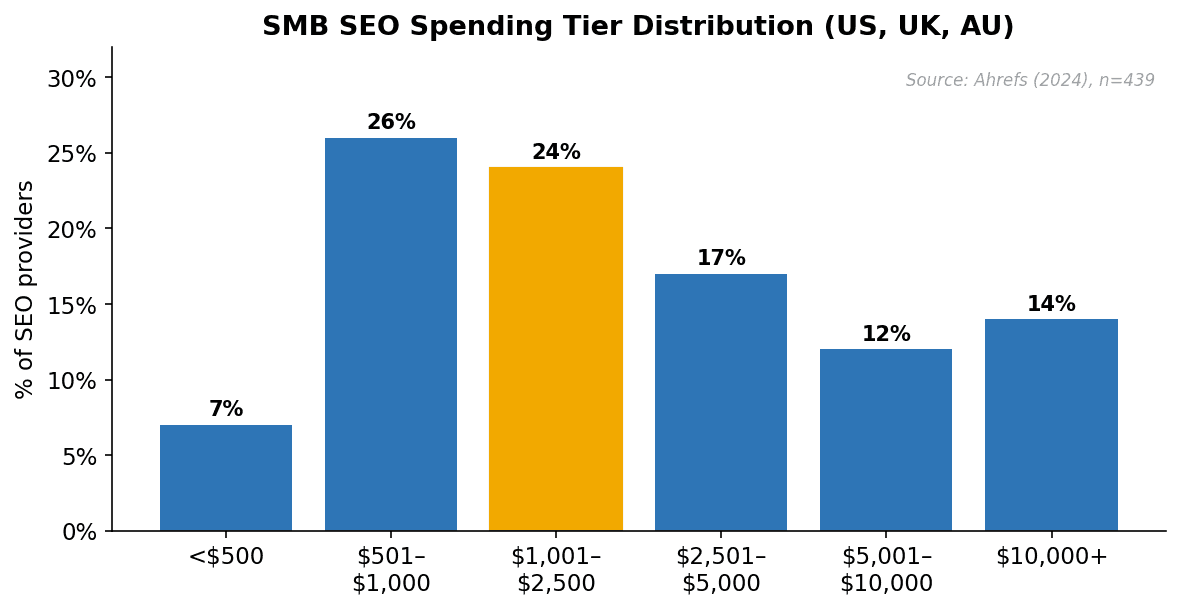
The Ahrefs 2024 SEO Pricing survey of 439 SEO providers found the industry-wide average monthly retainer is $2,917, with agency-led programs averaging $3,209/month, consultancies $3,250/month, and freelancers $1,348/month. About 63% of businesses spend $500–$5,000/month on SEO, with the modal SMB tier sitting at $1,001–$2,500/month for US, UK, and Australian providers.
Backlinko's 2026 survey of 300+ SEO professionals puts average ongoing SEO services at $1,000–$2,500/month, with AI-augmented SEO services averaging ~$3,200/month. Search Engine Journal's State of SEO Agency 2024 found that 12.96% of SEO practitioners worked with budgets above $10,000/month, and 48.9% expected client budgets to grow within 12 months.
Marketing budget context
Gartner's 2025 CMO Spend Survey: marketing budgets are flat at 7.7% of company revenue.
The US Small Business Administration recommends 7–8% of gross revenue on marketing for businesses under $5M revenue.
66.3% of US small business owners spend less than $1,000 per year on marketing (Revenue Memo 2026 analysis); source.
49% of small businesses planned to increase marketing budgets in 2025; only 16% planned to decrease (Constant Contact / Revenue Memo).
88% of SEO-using businesses plan to maintain or increase their SEO investment in the next 12 months (HubSpot 2025).
70% of SMBs plan to increase digital marketing spending in 2025–2026.
In-house vs agency vs freelancer
78.2% of SEO providers charge monthly retainers; 48.9% offer per-project work; 34.8% bill hourly (Ahrefs 2024).
62% of small businesses use in-house employees to manage SEO — but 77% of those employees do SEO on top of other duties (The Manifest, 2020).
Average US SEO specialist salary is $70,000–$90,000/year (Glassdoor 2025), making in-house SEO functionally equivalent to a $5,800–$7,500/month all-in cost — typically more expensive than an agency retainer for SMBs.
Channel mix
Email returns ~$36 per $1 (DMA/Litmus). SEO returns ~$22 per $1 (industry average, HubSpot/SmartInsights/First Page Sage).
Content marketing costs 62% less than outbound and produces ~3× the leads (DemandMetric).
SMBs invest roughly 7× more in PPC than in SEO on average (PPC Chief 2026), despite SEO converting at higher rates in most B2B verticals.
SMBs investing vs not
61% of US small businesses are NOT currently investing in SEO; 46% of those non-investors planned to start in 2025 (WordStream/LocaliQ).
70% of small businesses have no SEO strategy (The Manifest 2020 — corroborated by BrightLocal's 2025 SMB Marketing Report, which found only 35% of SMBs have a Google Business Profile and 40% have a dedicated website).
71% of SMBs that DO invest in SEO are satisfied with results (WordStream).
72% of SMBs say SEO has medium-to-high impact on their business — yet most haven't built the basics (BrightLocal 2025).
2. SEO ROI benchmarks
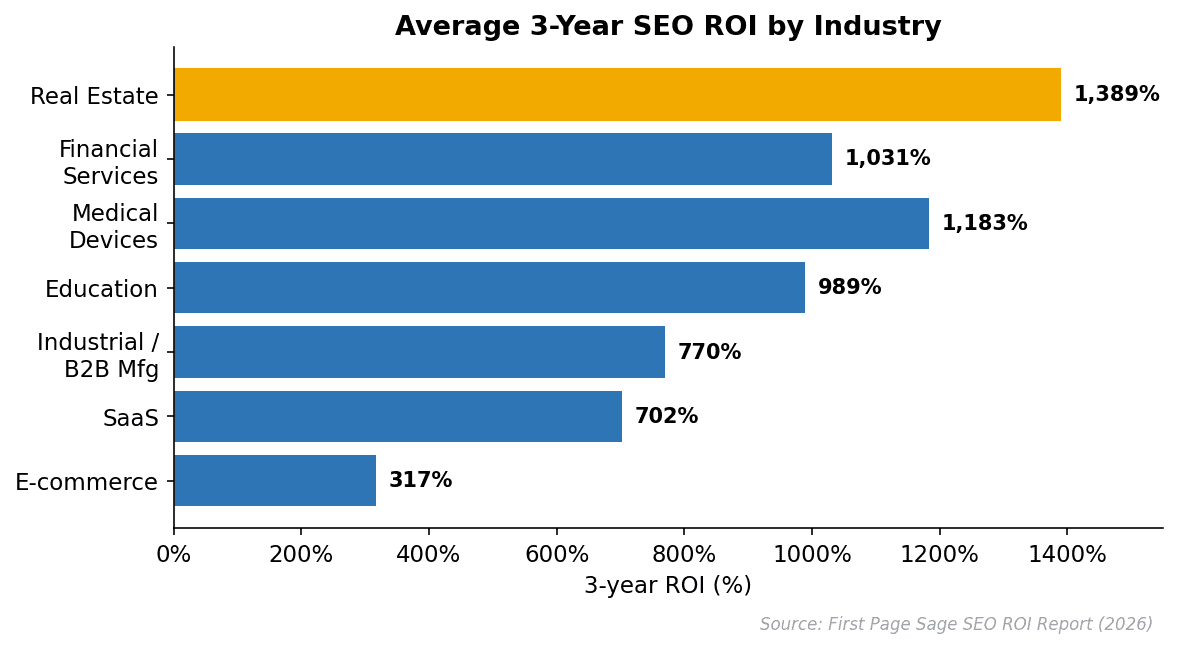
First Page Sage's 2026 SEO ROI Report — based on Q1 2021–Q3 2025 proprietary client data — finds an average SEO ROI of 748% for thought-leadership-style campaigns, with break-even at roughly 9 months. The report cites real estate at 1,389% three-year ROI (highest of any vertical), SaaS at 702%, and e-commerce in the 300–500% range depending on AOV. The widely cited 22:1 ROI figure originates with SmartInsights and is corroborated by HubSpot.
ROI vs other channels
HubSpot State of Marketing 2026: website/blog/SEO is the #1 ROI-generating channel at 27%, ahead of paid social (26%) and email (22%); source.
SEO leads close at 14.6% versus 1.7% for outbound leads (HubSpot — note this stat originates from a 2014 study and is widely re-cited; treat directionally).
SEO converts at 7.3× the rate of PPC in financial services and 3.4× in legal services (First Page Sage SEO vs PPC 2025).
Average SEO conversion rate: 1.7%; average PPC conversion rate: 0.9% (First Page Sage, 124-client dataset).
Organic SEO leads cost ~$31 versus ~$181 for PPC leads — SEO generates 5.8× more leads per dollar (HubSpot via SeoProfy).
Conversion & traffic value
Average organic-search conversion rate across industries: 3.75% (WordStream).
47.8% of all website traffic comes from organic search (BrightEdge multi-year benchmark); Conductor's 2025 figure is closer to 53%.
91% of marketers reported SEO positively impacted website performance and marketing goals in 2024 (Conductor State of SEO 2025, n=350+).
49% of marketers say organic search delivers the best ROI of any channel (Search Engine Journal).
3. Time to result — the reality check
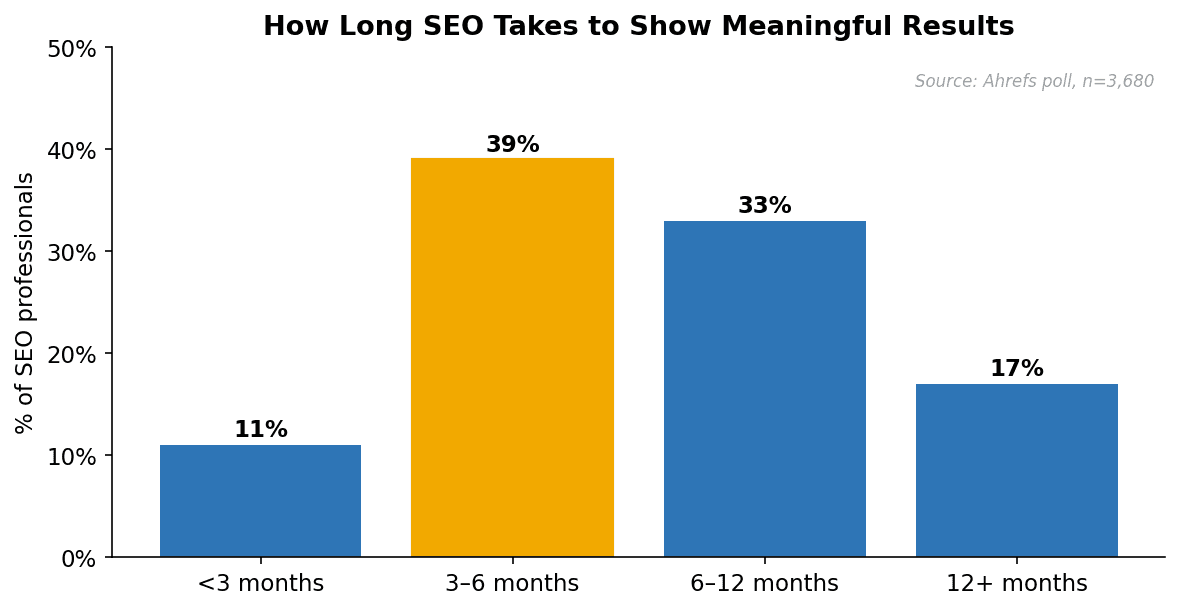
The single most-asked SMB question in SEO is also the most uncomfortably answered: 3–6 months for first signals, 6–12 months for first ROI, with compound growth in months 12–24. Ahrefs polled 3,680 SEO practitioners; the modal answer was 3–6 months. Google's own former Developer Programs Tech Lead Maile Ohye said publicly that SEOs need "4 months to a year" to implement improvements and see benefit; Ahrefs analysis.
Ranking is rare and slow
In Ahrefs' 1.3-million-keyword study, only 1.74% of newly published pages rank in Google's top 10 within a year — down from 5.7% in 2017; source.
72.9% of pages currently in Google's top 10 are more than 3 years old (vs 59% in 2017).
The average #1-ranked page in Google is 5 years old (up from 2 years old in 2017).
Only 13.7% of top-10 pages are under 1 year old.
Break-even by SEO type (First Page Sage 2026)
Thought-leadership SEO: ~9 months to break-even, ~748% three-year ROI.
Basic content marketing SEO: 12+ months to break-even, lower upside.
Technical-only SEO: fastest break-even but smallest upside.
E-commerce SEO: positive ROI in months 6–12; 5×+ ROI in higher-AOV niches by month 18.
This is why the 38% annual SEO agency churn rate (next section) matters: most cancellations cluster in months 3–6 — exactly the window before SEO has had time to compound. Most SMBs that quit SEO quit before the math works.
4. SEO agency churn & retention
Focus Digital's 2026 Average Marketing Agency Churn report puts the average annual SEO agency client churn at ~38% — better than PPC agencies (49%) but worse than full-service agencies (25%). Retainer-based SEO agencies maintain 18% annual churn vs 42% for project-based (a 2.3× retention advantage), and the average retainer client lifespan is 56 months versus 24 months for project work.
Service type | Annual client churn | Average client lifespan |
|---|---|---|
SEO (retainer) | ~18% | ~56 months |
SEO (project-based) | ~42% | ~24 months |
SEO (industry average) | ~38% | Below benchmark for top-quartile multiples |
PPC | ~49% | ~18 months |
Full-service agency | ~25% | ~36 months |
Source: Focus Digital, 2026 Average Marketing Agency Churn Report
Why SMBs cancel SEO
Across MarketersCenter, SEOmonitor, and DesignRush surveys (2024–2026), the consistent ranking is:
Lack of perceived results / stuck on page 2–3 after months of work.
Poor or slow communication and unresponsiveness.
Lack of transparency in strategy and reporting.
ROI does not appear to justify the spend.
Strategic misalignment between client goals and agency execution.
High account-team turnover at the agency.
Budget cuts and cash-flow pressure (especially in 2024–2025).
It costs 5–7× less to retain an existing client than to acquire a new one (Bain), and only 30% of businesses said they would recommend their current SEO services provider (WebFX). Agencies that establish realistic KPIs at onboarding achieve 15–20 percentage points better retention than those that overpromise — meaning expectation-setting at sale is more predictive of retention than execution quality.
5. The GEO layer — AI search statistics for 2026
Generative Engine Optimization (GEO) is the most important SMB SEO development since the introduction of mobile-first indexing — and most SMBs have no measurement of it. Only 16% of companies overall track how they show up on AI platforms (Bluefish, 2025), while AI Overviews now appear on roughly a quarter of US Google queries.
AI Overviews prevalence
Conductor (March 2026): AI Overviews appear in 25.11% of Google searches (analysis of 21.9M queries).
seoClarity (September 2025): AIOs appear for 30% of US desktop keywords, with 474.9% YoY increase on mobile; source.
Semrush 10M+ keyword study: AIO trigger rate fluctuated from 6.49% (January 2025) to peak 24.61% (July 2025), settling at 15.69% in November 2025; source.
AI Overviews now reach 1.5 billion monthly users (Google).
Local queries trigger AIOs only ~7% of the time (WordStream 2025) — most local-services SMBs are still well-protected on the SERP, for now.
CTR collapse on AIO queries
Seer Interactive longitudinal study (3,119 queries / 25.1M impressions, June 2024–September 2025): organic CTR drops 61% on AIO queries (1.76% → 0.61%); paid CTR drops 68%; Seer.
Ahrefs (December 2025, 300,000-keyword analysis): AI Overviews reduce position-1 organic CTR by 58%.
Pew Research (March 2025 browser tracking): users see traditional links clicked 8% of the time when an AI summary appears, vs 15% without — a 47% reduction. Only 1% of users click links inside the AI summary itself; Pew.
Cited brands recover most of the loss: Seer found brands cited inside AI Overviews receive 35% more organic clicks and 91% more paid clicks than uncited brands on the same queries — getting cited is the new winning condition.
Even non-AIO queries are eroding: organic CTR fell 41% on non-AIO queries comparing September 2025 to September 2024 (Seer).
AI referral traffic — small but the fastest-growing source on the web
AI referral traffic is ~1.08% of all website traffic and growing ~1% month-over-month (Conductor 2026 Benchmarks).
AI-referred sessions grew 527% from January to May 2025 across 400+ websites (Superprompt).
AI platforms generated 1.13 billion referral visits in June 2025, a 357% increase from June 2024 (Search Engine Land / Previsible).
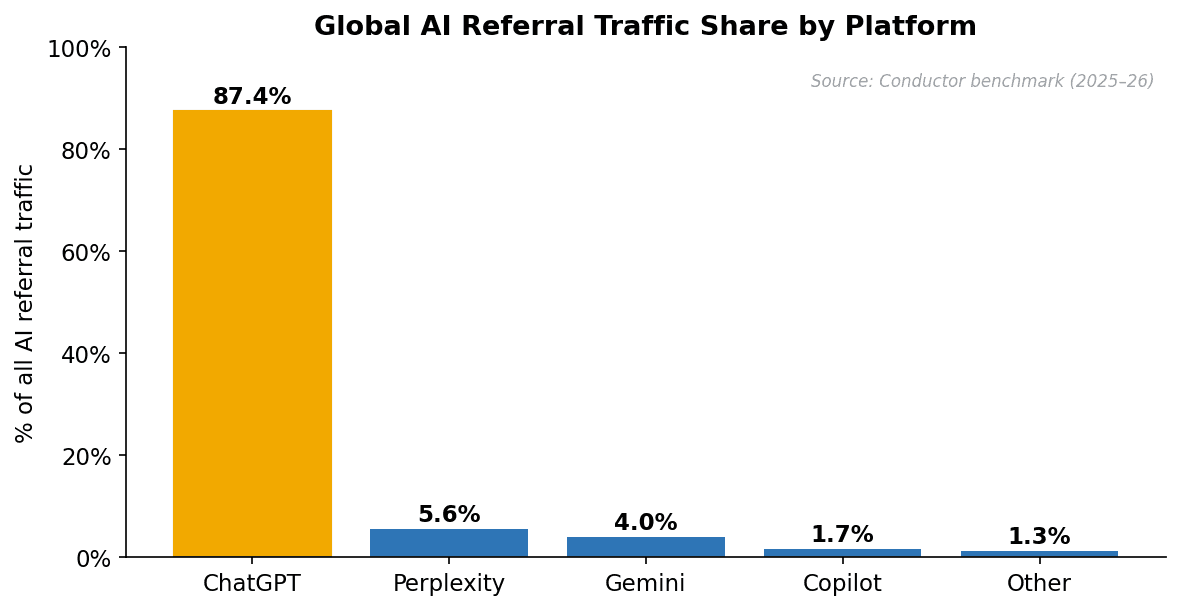
ChatGPT drives 87.4% of all AI referral traffic (Conductor benchmark).
Perplexity has 19.73% of US AI traffic share (SE Ranking 2025); Gemini saw 388% YoY growth in late 2025; Microsoft Copilot referral traffic grew 25.2× in 2025 (Superprompt).
Adobe Analytics: AI-driven traffic to US retail sites jumped 12× from July 2024 to February 2025; Adobe. AI visits had a 23% lower bounce rate, 12% more page views, and 41% longer sessions than non-AI traffic.
AI traffic conversion premium (with caveats)
Ahrefs (June 2025): AI traffic drove 12.1% of new signups despite being only 0.5% of total visitors — visitors converted at roughly 23× the rate of organic.
Seer Interactive: ChatGPT organic conversion rate 15.9%, Perplexity 10.5%, Claude 5%, Gemini 3% — vs Google organic at 1.76%.
Semrush (July 2025): LLM visitors convert 4.4× better than organic-search visitors.
ChatGPT ecommerce traffic converts 31% higher than non-branded organic search (Search Engine Land / Visibility Labs 2026).
Selection-bias caveat: these conversion-premium figures come from sites that already earn AI citations. As AI traffic mainstreams, the lift will likely compress — but for early adopters, it's currently the highest-quality referral source on the web.
What predicts AI visibility — the Ahrefs 75K-brand study
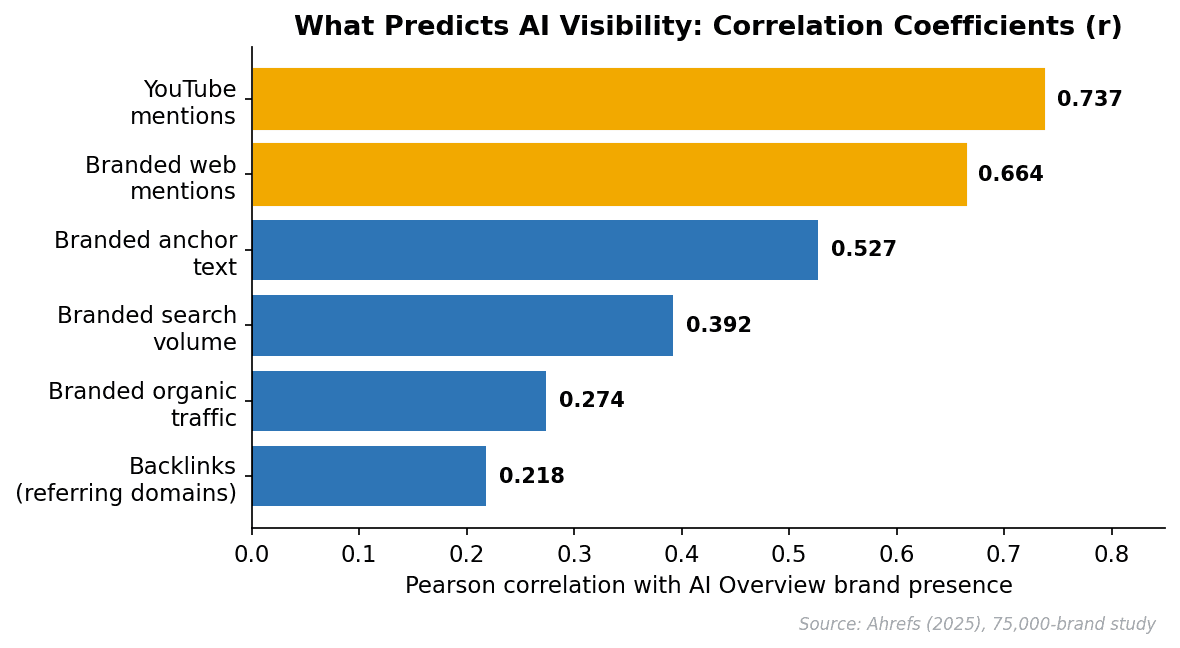
In a study of 75,000 brands, Ahrefs found that branded web mentions correlate with AI Overview visibility at r = 0.664 — more than 3× the strength of backlinks (r = 0.218); source. Their December 2025 follow-up showed YouTube mentions correlate at r ≈ 0.737 — the single strongest predictor of AI visibility across ChatGPT, AI Mode, and AI Overviews; Ahrefs. Brands in the bottom 50% of web mentions are essentially invisible to AI systems regardless of SEO performance, and across ChatGPT, Perplexity, Copilot, and AI Mode, ~80% of cited URLs do not rank in Google's top 100 for the original query — a fundamental break from traditional SEO.
SMB GEO adoption gap
Only 16% of companies overall track AI visibility (Bluefish, 2025).
40% of SMBs say they've already lost traffic from Google updates and AI-driven search (WordStream/LocaliQ 2026 SMB Website Trends Report, n=300+).
24% of marketers are exploring updating their SEO strategy for generative AI in search; 41% list "updating SEO for changes in search" as a top trend they're tackling (HubSpot State of Marketing 2026).
Half of all consumers use AI-powered search in 2026 (HubSpot).
58% of US adults conducted a Google search in March 2025 that produced an AI summary (Pew Research, 900-respondent browser-tracked study).
US Chamber of Commerce 2025: 58% of small businesses say they used generative AI, up from 40% in 2024 — but using AI ≠ being visible in AI.
6. Organic search landscape 2026
58.5% of US Google searches end without a click to the open web (SparkToro/Datos 2024).
Of every 1,000 US Google searches, only 360 result in clicks to non-Google open-web destinations.
Mobile zero-click rate: ~77% (SparkToro 2024).
Approximately 30% of US clicks stay inside Google's own ecosystem (YouTube, Maps, Shopping, Flights).
US organic search traffic is down only 2.5% YoY (Search Engine Land/Graphite, January 2026) — the apocalypse is mid-publisher specific. Top-10 sites grew organic traffic 1.6%; mid-sized publishers (rank 100–10,000) saw the steepest declines.
Google still processes ~16.4 billion searches per day (DemandSage August 2025); Google's market share dipped below 90% for the first time since 2015 in Q4 2024 but has stabilized in the high 80s.
Ads alongside AI Overviews rose from ~3% (March 2025) to ~40% (November 2025) per Semrush — Google is monetizing the AIO surface aggressively.
7. Top SMB SEO challenges and strategy gaps
Challenge | % of US SMBs reporting |
|---|---|
Generating traffic | 42% |
Creating high-quality SEO-optimized content | 32% |
Keeping up with algorithm updates | 28% |
Tracking ROI / attributing SEO value | 20% |
Obtaining and managing budget | 17% |
Source: WordStream/LocaliQ 2026 SMB Website Trends Report, 300+ US SMB respondents.
The strategy and infrastructure gap
70% of small businesses do not have an SEO strategy in place (The Manifest, 2020 — corroborated by BrightLocal 2025).
Only 40% of SMBs have a dedicated website and only 35% have a Google Business Profile (BrightLocal SMB Marketing Report 2025, n=778 US SMBs).
43% of B2B SEOs cite limited budget as the biggest hindrance to SEO objectives (Marketing LTB 2025).
57% of enterprise brands say limited in-house SEO skills is the most challenging obstacle to successful SEO.
23% of SMBs say their #1 marketing frustration is not knowing what's driving results (Constant Contact 2025).
73% of SMBs lack confidence in their marketing strategies (Constant Contact 2024–2025).
Only 47% of marketers have a clear framework for assessing AI's ROI (HubSpot State of Marketing 2025).
Verizon's 2025 State of Small Business Survey (600 US SMB respondents): 38% of SMBs are actively using AI, 28% use it for marketing and social media, and 76% say social media positively impacts business performance — but adoption of GEO/AEO measurement remains negligible; Verizon.
8. What this means — recommendations for SMBs
The data converges on seven concrete moves for any US SMB making 2026 SEO decisions:
If your budget is under $500/month, do not hire an agency. The Ahrefs and Backlinko surveys are unambiguous: sub-$500 retainers cannot deliver real work. Either DIY (Google Business Profile, on-page basics, Google Search Console) or wait until you can budget at least $1,500/month.
Target $1,500–$3,000/month for 12 months minimum. This matches First Page Sage's empirical break-even median (~9 months for thought-leadership SEO) with a 3-month safety buffer. Evaluate against business outcomes — leads, pipeline, revenue — not keyword rankings.
Allocate 10–20% of your SEO budget to GEO/AEO this year. AIOs appear on 25–30% of US queries; AI traffic converts 4–23× better; Ahrefs' r=0.664 mention-correlation means earned media now drives both SEO and AI visibility. Budget for: digital PR/branded mention building, FAQ-style answer-block content, Schema.org structured data, and at least one AI visibility monitoring tool.
Set realistic timelines in writing at contract signing. The #1 cause of agency churn is unmet expectations on results timeline. Write into your agency contract that month-1–3 is foundation, month-4–6 is first signals, month-6–12 is first ROI. If your agency promises page-1 rankings in 90 days, walk.
Track three SMB-relevant KPIs monthly, not just rankings: branded organic search volume (proxy for brand awareness, predictor of AI visibility), citations and mentions in AI responses for your top 20 buyer-intent prompts (manual testing across ChatGPT, Perplexity, Google AI Mode, Claude), and leads attributed to organic search and AI referral channels in GA4 (set up custom channel grouping for chatgpt.com, perplexity.ai, claude.ai, copilot.microsoft.com).
Lean into video and FAQ content. Ahrefs' December 2025 follow-up shows YouTube mentions are the strongest single predictor of AI visibility across all major platforms. A 60–90 second product or FAQ video plus a transcript on your site is one of the highest-leverage GEO tactics available to SMBs.
Audit for the basics most SMBs are missing. Before paying anyone for advanced SEO: claim your Google Business Profile (only 35% of SMBs have one), publish a real website (only 40% do), connect Google Search Console, and add at least one FAQ page with Schema.org markup.
Closing the SEO + GEO measurement gap
The single biggest gap surfaced by every dataset in this report is the same one: most SMBs cannot see what's actually happening in their organic channel anymore. Google Search Console shows clicks and impressions on Google. It does not show whether ChatGPT, Claude, Gemini, or Perplexity are recommending your business when buyers ask the questions you should be the answer to. That's the visibility 84% of brands are missing — and it's the visibility most directly correlated with the conversion premium AI traffic delivers.
If you want to see your brand's current visibility across Google Search and the four major AI chatbots in one place, QuickSEO offers a free AI visibility audit — it scores how often your brand appears in ChatGPT, Claude, Gemini, and Perplexity for the prompts your customers actually ask, with no setup required. You can also explore the full QuickSEO platform, which combines Google Search Console analytics with daily AI visibility tracking, sentiment analysis, competitor benchmarking, and cited-page reporting in a single dashboard.
Methodology
This report compiles 75+ data points from primary sources published between 2020 and 2026. Where US-specific data was unavailable, global figures are used and labeled. Selection bias caveats are flagged inline. Stats older than 2023 (e.g., the 14.6% close rate, the 70%-no-strategy figure) are included because they remain the most-cited benchmarks and are corroborated by current data, but readers should treat the precise numbers as directional.
Enter your website to track its AI visibility across ChatGPT, Gemini, Claude, and Perplexity — and turn chatbot mentions into traffic.
- Set up in minutes
- Cancel anytime
Keep reading
Related posts
More articles on the same topics, prioritized by shared tags and keyword overlap.