Best SEO Strategies for AI Visibility Tools: The Complete 2026 Playbook

 Summarize in ChatGPT
The way people search is changing fast. According to recent data, 44% of consumers now say AI is their primary search source — yet only 16% of businesses actively track their AI search visibility. If your brand isn’t showing up in ChatGPT, Google AI Overviews, Perplexity, and Claude responses, you’re missing a growing slice of your audience.
This guide breaks down the best SEO strategies for AI visibility tools in 2026, from foundational tactics to advanced optimization techniques. Whether you’re just getting started with Generative Engine Optimization (GEO) or looking to refine an existing strategy, you’ll find actionable steps to increase your brand’s presence across both traditional and AI-powered search.
Why AI Visibility Matters More Than Ever in 2026
The search landscape has undergone a seismic shift. AI-generated answers now appear above traditional results, reaching over 2 billion users monthly through Google AI Overviews alone. Tools like ChatGPT, Perplexity, and Claude have become go-to research assistants for millions.
Here’s the challenge: if your content isn’t being cited in these AI responses, your organic visibility will steadily decline. As BrightEdge CEO Jim Yu puts it, “Brands need to prepare now with structured data, clear content hierarchy, and machine-readable information.”
This is exactly why platforms like quickseo.ai have emerged — to help brands track and improve their visibility across both Google Search and AI chatbots from a single dashboard. Instead of guessing whether AI engines mention your brand, you can monitor it weekly with trend lines, sentiment analysis, and competitor tracking across ChatGPT, Claude, Gemini, and Perplexity.
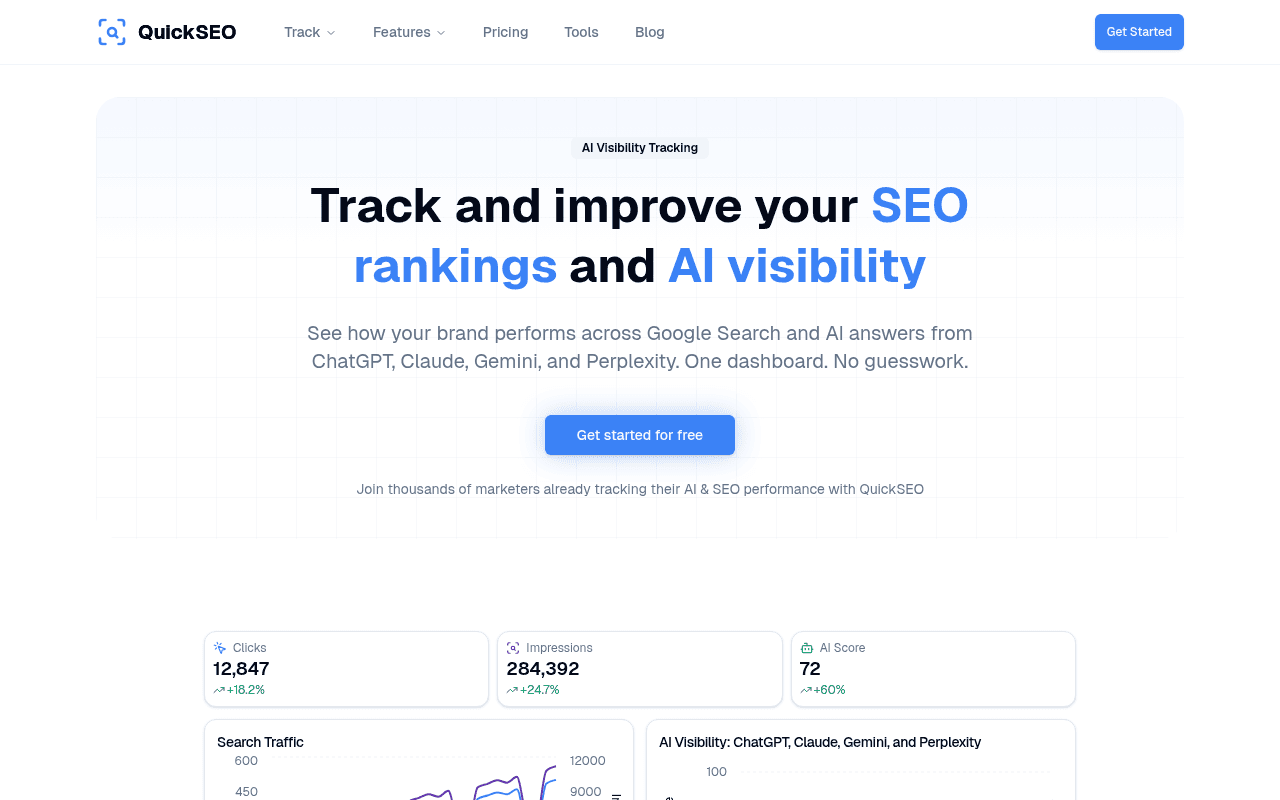
QuickSEO tracks brand visibility across Google Search and AI chatbots in one unified dashboard
The 7 Best SEO Strategies for AI Visibility Tools
1. Master Answer Engine Optimization (AEO)
Answer Engine Optimization is the foundation of AI visibility. Unlike traditional SEO that focuses on ranking pages, AEO is about structuring your content so AI engines can extract and cite it directly.
The key principles:
Write for citability, not just readability. AI engines look for concrete claims backed by data — definitions, statistics, step-by-step processes, and expert opinions are far more likely to be pulled into a generated response.
Lead each section with 1–2 sentences that directly answer the heading. Think of every H2 and H3 as a potential question an AI might answer.
Use structured data (Schema.org markup) extensively. FAQ schema, How-To schema, and Organization schema help AI engines understand your content’s purpose and structure.
Include clear, quantifiable claims. A statement like “AI search traffic grew 340% in 2025” is far more citable than “AI search is growing quickly.”
2. Build Entity-Based Authority
Large Language Models are shifting from keyword matching to entity understanding. They build mental models of brands, people, and concepts — associating them with specific domains of expertise.
To win with entity-based SEO:
Own a defensible niche. Rather than trying to rank for everything, become the definitive authority on a specific topic. Brands that own slices like “AI for HR automation” or “SEO tracking for startups” build stronger entity associations.
Create comprehensive topical clusters. Write interconnected content that covers every angle of your specialty. This helps AI models associate your brand with specific topics more strongly.
Maintain consistent brand mentions across all platforms. Use uniform naming conventions and ensure your ‘About’ pages clearly define what your brand does and who it serves.
Build proprietary data and branded metrics. As AI expert Britney Muller advises, create datasets that AI cannot synthesize without attribution — this makes your brand an unavoidable source.
3. Optimize for Platform-Specific AI Behavior
Not all AI engines work the same way. Each platform has distinct citation preferences that should inform your content strategy:
ChatGPT tends to favor authoritative, long-form content with clear expertise signals. It gravitates toward comprehensive guides and well-structured how-to content.
Google AI Overviews heavily favor content that already ranks in the top 10 organic positions. Your traditional SEO foundation directly impacts your AI Overview visibility.
Perplexity prioritizes fresh, well-cited articles with clear source attribution. It rewards content that includes specific data points and links to primary sources.
Claude focuses on balanced, well-researched content and tends to cite authoritative industry sources.
A tool like quickseo.ai makes this multi-platform optimization manageable by letting you define custom prompts — the actual questions your customers ask AI chatbots — and see your ranking position across every platform you track, side by side. This kind of tracked prompt monitoring reveals exactly where you’re winning and where you need to improve.
4. Leverage Reddit and Community Platforms
AI engines increasingly treat user-generated content — especially Reddit — as a trusted, authentic source of information. Google and AI platforms frequently draw from Reddit discussions when generating responses.
The strategy:
Identify 5–10 relevant subreddits where your target audience discusses your category.
Spend 2–3 weeks participating authentically before sharing anything about your product. Build genuine credibility first.
When you do mention your product, be honest and include it among alternatives. Authentic mentions significantly outweigh obvious self-promotion in AI evaluation.
Monitor which Reddit threads AI engines cite for your target queries. This reveals which communities and discussion formats the models trust most.
5. Secure Placements on Authoritative Listicles
“Best of” articles and comparison posts are some of the most-cited content types in AI responses. When someone asks ChatGPT or Perplexity for “the best SEO tool for X,” the AI often pulls from existing listicle articles on authoritative sites.
How to execute this:
Identify which listicle articles AI engines already cite for your target recommendation queries.
Build a hit list of publishers that appear repeatedly in AI responses for your category.
Pitch these authors with compelling differentiators and social proof — conversion data, unique features, customer testimonials.
Track results: placements can generate AI citations within weeks as engines re-scan updated content.
6. Implement Technical SEO for AI Crawlability
Technical optimization is your behind-the-scenes advantage. Schema markup is your most powerful tool for helping AI bots understand what your page contains.
Key technical actions:
Implement comprehensive Schema.org markup — especially FAQ, How-To, Product, and Organization schemas.
Ensure your site is fast and mobile-friendly. AI engines still rely on crawl data, and slow or poorly structured sites get deprioritized.
Add clear “Last updated” timestamps to cornerstone content. AI engines weigh recency when selecting sources, and a 2024 guide with no updates will lose to a freshly updated 2026 article.
Structure content with clear heading hierarchies (H1 > H2 > H3). AI models use these to link questions with answers.
7. Measure, Track, and Iterate
You can’t improve what you don’t measure. In the AI search era, your measurement framework needs to go beyond traditional analytics.
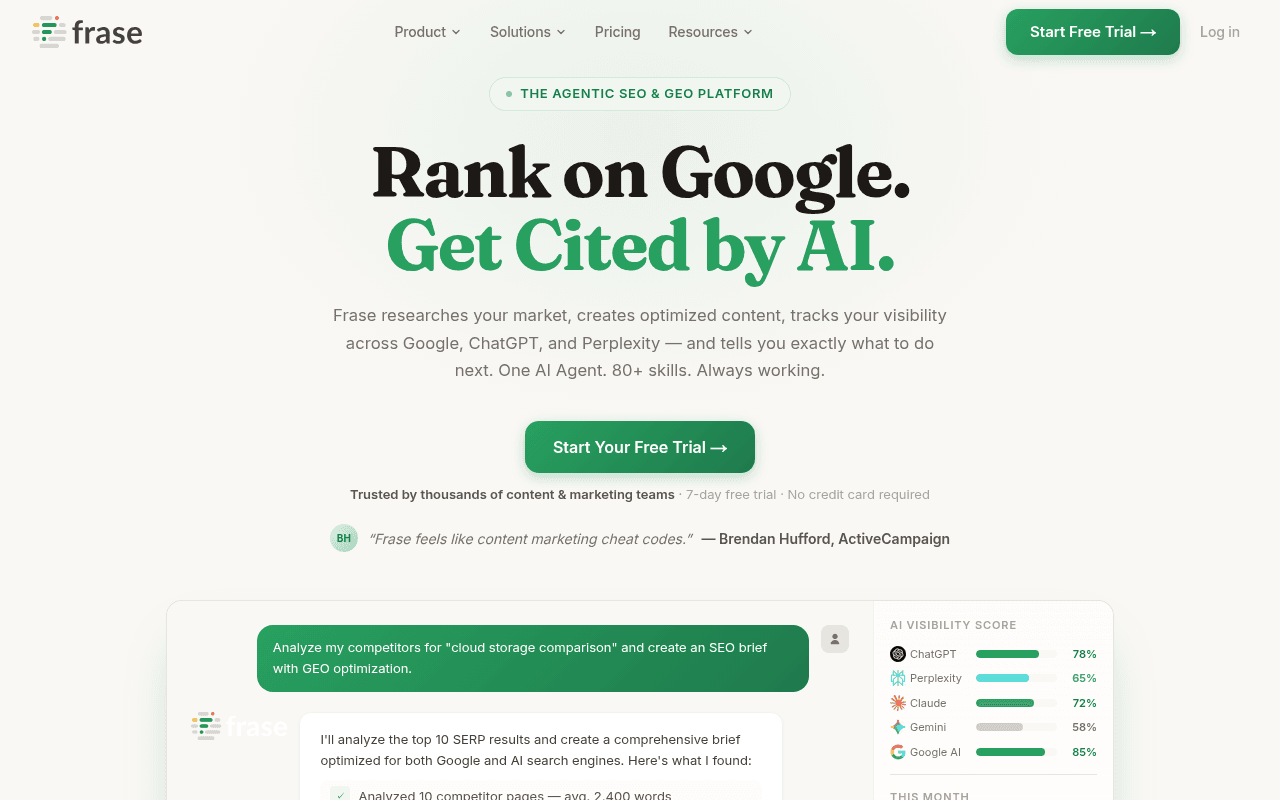
Frase combines content creation with GEO tracking across Google, ChatGPT, and Perplexity
New metrics to track:
AI Citation Share: how frequently your brand appears in AI-generated responses compared to competitors.
Sentiment analysis: whether AI engines describe your brand positively, neutrally, or negatively.
Cited pages: which specific pages on your site AI models reference most often.
Competitor mentions: which rival brands appear alongside yours in AI responses.
This is where a dedicated AI visibility platform becomes essential. With quickseo.ai, you get weekly tracking across ChatGPT, Claude, Gemini, and Perplexity — including sentiment analysis, competitor tracking, and cited page monitoring. The platform also integrates your Google Search Console data, so you can see your traditional SEO performance and AI visibility side by side and get personalized, weekly recommendations for what to optimize next.
The Dual-Strategy Approach: SEO + GEO
As iPullRank CEO Mike King predicts, SEO in 2026 is really two disciplines: traditional SEO (driving clicks from humans who want to browse, compare, and buy) and AI search optimization (supplying clean, trusted information so AI agents can find, trust, and cite your content).
The brands that will dominate are those that treat these as complementary strategies rather than competing priorities. Your traditional SEO foundation — quality content, strong backlinks, and technical excellence — remains the base layer. GEO tactics amplify that foundation by making your content easy for AI to extract, attribute, and recommend.
Don’t wait for AI search to fully mature before investing in visibility. The brands building their AI presence now are establishing the citation patterns and authority signals that will compound over the coming years.
Getting Started: Your 30-Day Action Plan
Week 1: Audit your current AI visibility.
Test 10–15 questions your customers would ask an AI engine across ChatGPT, Perplexity, and Gemini. Track which brands get mentioned and where you stand. A platform like quickseo.ai can automate this monitoring with weekly tracking and trend analysis.
Week 2: Optimize your highest-performing pages.
Take your top 10 organic pages and restructure them for citability — add clear definitions, data-backed claims, and FAQ schema markup.
Week 3: Build your community presence.
Identify relevant subreddits and industry forums. Start participating authentically and note which discussions AI engines tend to cite.
Week 4: Launch your measurement framework.
Set up tracking for AI citation share, sentiment, and competitor mentions. Establish baselines and create a monthly review cadence.
Conclusion
The shift toward AI-powered search isn’t coming — it’s already here. The brands that invest in AI visibility strategies today will own the citation patterns and authority signals that drive discovery tomorrow. Start with the fundamentals: structure your content for citability, build entity authority, optimize for each AI platform’s preferences, and measure everything.
The playbook is clear. The tools exist. The question is whether you’ll act on it now or play catch-up later.
Ready to put this playbook to work? QuickSEO is the measurement layer — define your prompts, see weekly mentions across ChatGPT, Claude, Gemini, and Perplexity, and track competitor share of voice alongside your Google Search Console data. Start tracking at quickseo.ai →
Enter your website to track its AI visibility across ChatGPT, Gemini, Claude, and Perplexity — and turn chatbot mentions into traffic.
- Set up in minutes
- Cancel anytime
Try it yourself
Related free tools
Free SEO tools related to the topics covered in this article.
Keep reading
Related posts
More articles on the same topics, prioritized by shared tags and keyword overlap.