4 Best Peec AI Alternatives for AI Visibility Tracking and Optimization in 2026

 Summarize in ChatGPT
Peec AI has earned its spot as one of the most recognized AI visibility platforms on the market. Founded in Berlin, backed by over $29M in funding from investors like 20VC and Singular, and trusted by brands like Wix, Glide, and Graphite, Peec carved out the mid-market segment early and grew fast — reaching $4M+ ARR within 10 months of launch.
But as the AI visibility space matures, more teams are searching for alternatives. Not because Peec is bad, but because specific gaps are becoming harder to ignore.
The most common frustrations we've seen across Reddit threads, G2 reviews, and conversations with SEO practitioners come down to a few recurring themes. The Starter tier starts at €85/month for 50 prompts and your choice of 3 AI models (out of 12 supported across the platform, including ChatGPT, Gemini, Perplexity, AI Overviews, Claude, DeepSeek, and Grok). There's no integration with Google Search Console, so you can't compare your traditional search performance against your AI visibility side by side. And while Peec includes prioritized Actions and source clustering, its focus stays strictly AI-native.
If any of those limitations resonate, here are four alternatives worth evaluating — each solving a different piece of the puzzle.
What to Look For in a Peec AI Alternative
Before diving into specific tools, here's a quick framework for evaluating any AI visibility platform in 2026.
Multi-platform AI coverage is table stakes. At minimum, you want ChatGPT, Claude, Gemini, and Perplexity. Some tools also track Google AI Overviews, Grok, DeepSeek, and Copilot. Single-platform tracking leaves you blind to where a growing share of your audience discovers information.
Traditional SEO integration matters more than most people realize. Research from BrightEdge found that 80% of URLs ChatGPT cites don't even rank in Google's top 100. The reverse is also true — you might rank #1 on Google and be completely invisible in AI responses. Without seeing both datasets together, you're optimizing in the dark.
Actionable insights over dashboards. Monitoring is becoming commoditized. The tools that earn their subscription are the ones that tell you what to fix, which content to create, and which sources to target for citations.
Transparent pricing without add-on traps. Know exactly what you're paying before you commit.
Daily refresh frequency. AI responses shift constantly. Weekly tracking misses critical changes, especially during product launches, PR events, or competitive moves.
1. Otterly.ai — Best Budget Entry Point for Getting Started with GEO
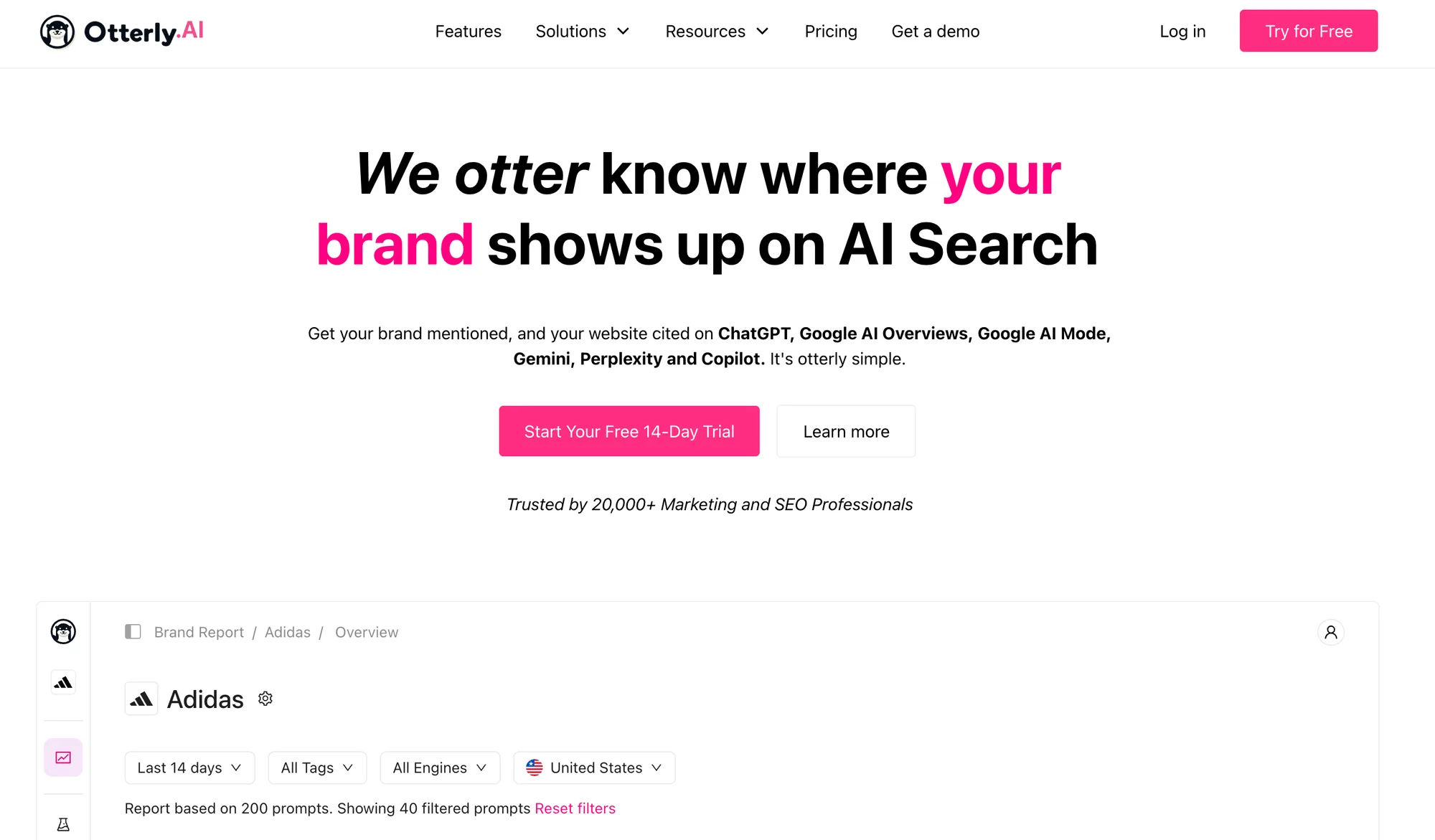
Otterly is the most accessible starting point in the category.
Founded in Austria in 2023, Otterly was one of the earliest movers in AI visibility tracking — launching its product in April 2024, months before most competitors existed. It earned a Gartner Cool Vendor designation in November 2025 and has grown to an estimated 10,000–20,000 users while staying bootstrapped with a lean 12-person team.
Otterly takes a distinctive technical approach: it uses web interface scraping rather than API calls to collect AI responses. The team calls this a "first-person perspective" — it mimics how a real user would experience the AI response, rather than hitting an API endpoint that might return different results. This can surface formatting and visual context that API-based tools miss.
Pricing starts at just $29/month for the Lite plan with 10 prompts. The Standard plan at $189/month gives you 100 prompts, and Pro runs $989/month for high-volume needs. Otterly is also available through the Semrush App marketplace at $27/month, which is a convenient option if you're already a Semrush user looking to bolt on basic AI tracking without a separate subscription.
The platform tracks 6 AI platforms and includes a GEO auditing tool, AI keyword research, and AI crawler simulation — all useful features for teams that are still learning the GEO landscape and want to experiment before scaling up.
Where it falls short: The cheaper tiers have very limited prompt counts. There's no Google Search Console integration, so you can't see the traditional-SEO-to-AI gap. Refresh frequency and depth of analytics don't match what you'd get from mid-range or enterprise tools. But for the price, it's hard to beat as a starting point.
Best for: Freelancers, indie hackers, and small marketing teams who want to dip their toes into AI visibility tracking without a significant financial commitment.
2. Semrush AI Toolkit — Best for Teams Already Using Semrush
If your team already runs on Semrush for keyword research, backlink analysis, and competitive intelligence, adding their AI Visibility Toolkit is the path of least resistance. You get AI tracking layered on top of the SEO infrastructure you already know and trust.
Semrush claims a database of over 130 million prompts across eight AI platforms — ChatGPT, Perplexity, Gemini, Google AI Overviews, AI Mode, Grok, DeepSeek, and Copilot. That's the broadest coverage and the deepest prompt database among the tools on this list. The Brand Performance Report gives you a unified view of share of voice, sentiment, and the exact domains AI models pull from when discussing your brand.
The AI Toolkit is available as a standalone add-on at $99/month per domain, or bundled into Semrush One starting at $199/month, which includes the full SEO toolkit alongside AI visibility. For teams that would otherwise pay separately for SEO tools and an AI tracker, the bundle can make economic sense.
Semrush's real advantage is infrastructure. They've spent over a decade building one of the most robust search visibility platforms in the world, and they're now applying that data infrastructure — backlink indexes, keyword databases, SERP tracking — to AI visibility. When a backlink-building article like Tim Soulo's CMO post from Ahrefs argues that "GEO without SEO is optimizing for 0.2% of traffic while ignoring the 40%," Semrush is positioned to deliver both in one subscription.
Where it falls short: Reviews consistently note that Semrush's AI data can feel disconnected from its core SEO signals. The AI visibility features are relatively new additions to a massive platform, and the recommendations tend to be less actionable than purpose-built GEO tools. It's also expensive if you're only here for the AI tracking — $99/month on top of a base Semrush plan ($139–249/month) adds up fast. And despite having GSC integration for traditional SEO, the AI-to-GSC gap view isn't a native feature.
Best for: Marketing teams and agencies already paying for Semrush who want to add AI visibility tracking without managing another vendor.
3. Knowatoa — Best Mid-Range Option for SaaS and SEO Consultants
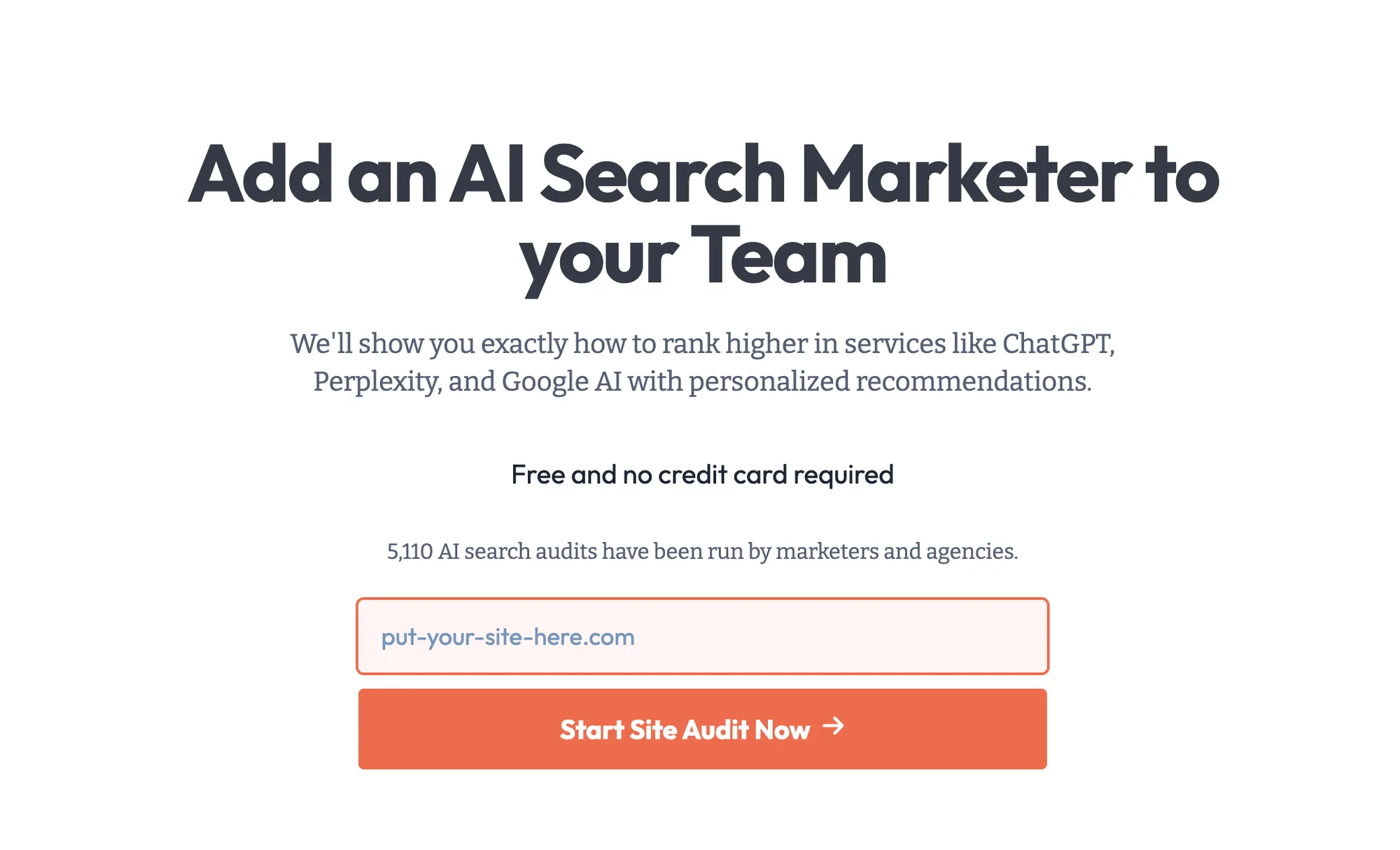
Knowatoa flies under the radar compared to the VC-funded players, but it's building a loyal following among SaaS companies and SEO consultants who want solid AI tracking without the enterprise price tag.
Co-founded by Michael Buckbee (a serial cybersecurity entrepreneur) and Ryan Castillo, Knowatoa launched publicly in January 2025 and tracks 7+ AI platforms. Its standout concept is the proprietary "BISCUIT Framework" for reverse-engineering how AI models arrive at their recommendations. Rather than just telling you whether you're mentioned, Knowatoa attempts to explain why certain brands get recommended and what content signals are driving those recommendations.
Pricing is straightforward: $59/month gets you 30 questions with daily refreshes, $199/month for the Growth tier, and $499+/month for Enterprise with custom refresh frequency. All plans include Slack and email alerts, Looker Studio connectors, and CSV exports — practical features for consultants who need to pull data into client reports.
Knowatoa positions itself as "PageRank for AI," which captures the ambition well: it's trying to make the ranking logic of AI models as legible as PageRank made Google's logic in the early 2000s. That's a tall order, but the BISCUIT framework represents a genuine attempt to move beyond surface-level monitoring into diagnostic insights.
Where it falls short: Knowatoa is bootstrapped with a smaller team, which means feature development and platform coverage may lag behind well-funded competitors. The community around the tool is still small, so you won't find as many tutorials, case studies, or third-party integrations as you would with Semrush or Peec. There's no Google Search Console integration.
Best for: SaaS companies and independent SEO consultants who want mid-range pricing with a focus on understanding why AI models recommend certain brands — not just tracking whether they do.
4. Writesonic GEO — Best All-in-One Platform for Visibility + Content Creation
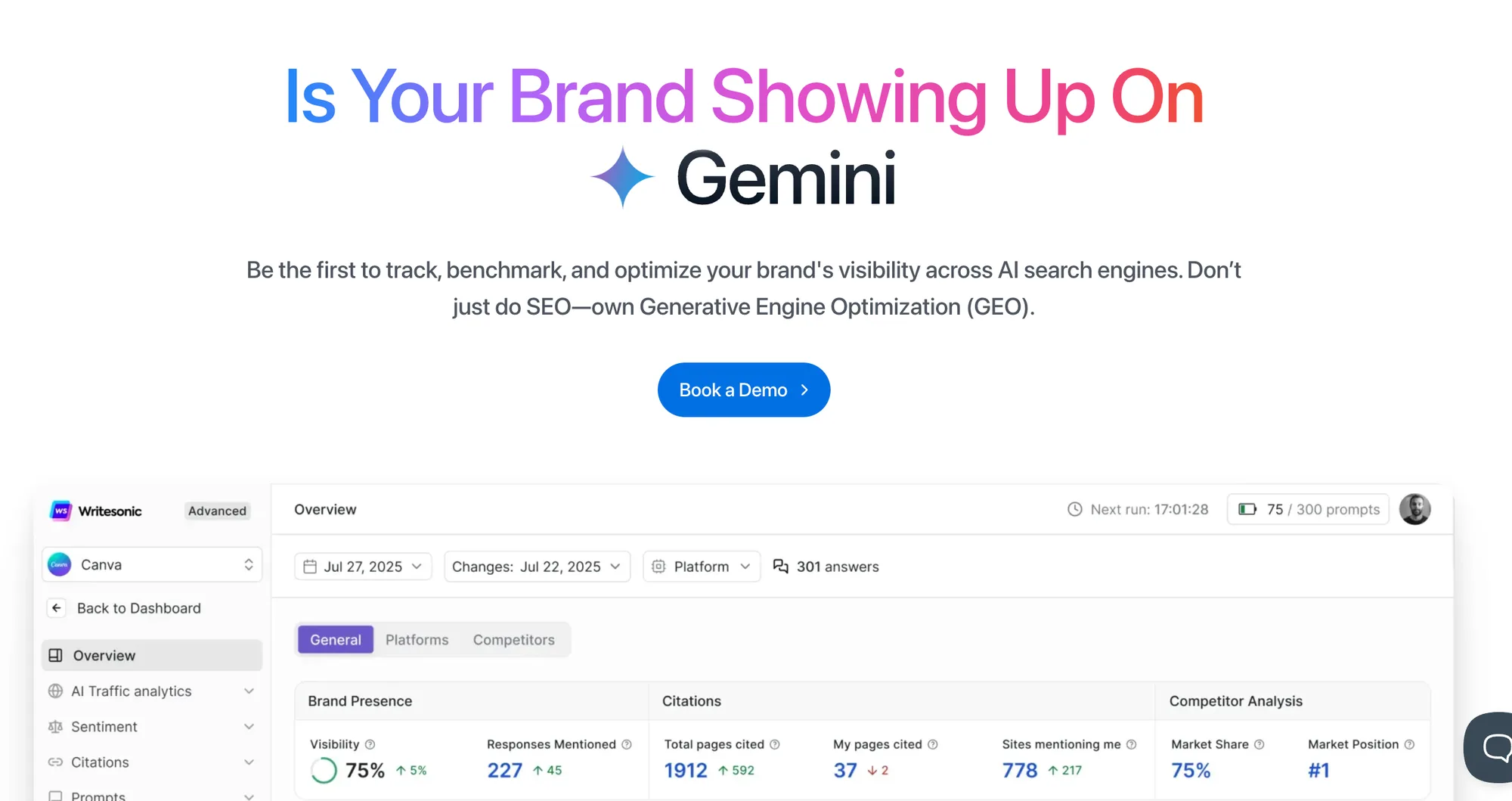
If your problem isn't just "I don't know where I stand in AI search" but "I don't know where I stand AND I need to produce the content to fix it," Writesonic GEO is the most complete single-platform solution available.
Writesonic started as a YC-backed AI writing tool and has pivoted into a full Generative Engine Optimization platform. At $249/month, it's the most expensive option on this list — but it replaces multiple tools. You get AI visibility tracking across 10+ platforms (ChatGPT, Claude, Gemini, Perplexity, Google AI Overviews, Bing AI, and more), real AI crawler monitoring via Cloudflare Worker integrations, prompt-level share of voice analysis, and citation tracking.
What sets Writesonic apart is its AI Action Center, which converts visibility insights into guided optimization workflows. Instead of showing you a dashboard and leaving you to figure out next steps, it surfaces specific recommendations: update this blog post, target that citation source, restructure this page's content for AI readability. Then its built-in content tools help you execute those recommendations without switching to a separate writing platform.
The real AI crawler tracking is a meaningful differentiator. While prompt-only tracking tools such as Otterly track AI responses by sending prompts to AI platforms, Writesonic also monitors actual visits from AI search engine crawlers to your pages. This gives you a second data layer: not just what AI says about you, but whether AI crawlers are actively reading your content.
Where it falls short: At $249/month, it's premium — roughly 2.5x the cost of Semrush's AI add-on. The breadth of features means a steeper learning curve. If you only need monitoring and already have a content workflow you're happy with, you're paying for capabilities you won't use. There's no GSC integration for comparing traditional search performance against AI visibility.
Best for: Marketing teams and content agencies that want a single platform for tracking AI visibility, identifying content gaps, and producing optimized content — without stitching together three or four separate tools.
Quick Comparison
Feature | Semrush AI | Knowatoa | Writesonic GEO | |
|---|---|---|---|---|
Starting price | $29/mo | $99/mo add-on | $59/mo | $249/mo |
AI platforms tracked | 6 | 8 | 7+ | 10+ |
GSC integration | No | Partial (SEO side) | No | No |
Refresh frequency | Varies by plan | Daily (25 prompts) | Daily | Varies |
Content creation tools | No | Limited | No | Yes (full suite) |
Best for | Budget GEO starter | Existing Semrush users | SaaS & consultants | Content-first teams |
The Gap Nobody's Talking About: Why GSC + AI Data Belong Together
Research from multiple sources paints a consistent picture. BrightEdge found that 80% of URLs that ChatGPT cites don't rank in Google's top 100 results. Ahrefs found only 38% of the pages cited in AI Overviews also rank in Google's top 10 for that query. And only 11% of domains are cited by both ChatGPT and Perplexity — meaning visibility on one AI platform doesn't predict visibility on another.
The implication is that if you only track Google rankings, you're blind to AI. And if you only track AI visibility, you're blind to where 40–60% of your traffic still comes from. Both views are incomplete on their own.
No amount of AI monitoring alone gives you the full picture. And no amount of traditional SEO tracking alone gives you visibility into the 778% year-over-year growth in AI referral traffic.
Frequently Asked Questions
Is Peec AI still worth it?
Yes, for certain use cases. If you're a global brand that needs multi-language monitoring across 115+ languages, or an EU-based company prioritizing GDPR compliance and data residency, Peec's strengths are real. The unlimited seats model is genuinely useful for larger agencies. And the Slack-based customer support gets consistently strong reviews. The limitations are most felt by SMBs who find the add-on pricing unpredictable, or teams that want traditional SEO data alongside their AI tracking.
What's the cheapest Peec AI alternative?
Otterly.ai at $29/month offers the lowest entry point with meaningful functionality. Knowatoa at $59/month gives you more prompts and daily refreshes at a still-affordable price.
How often should I refresh AI visibility data?
Daily is ideal. AI responses are non-deterministic — SparkToro found less than a 1-in-100 chance that ChatGPT will produce the same brand list for the same question asked 100 times. Weekly tracking catches broad trends but misses the volatility.
Do I need to track all five major AI platforms?
It depends on your audience and budget. At minimum, track ChatGPT (the largest user base at 900M+ weekly active users and 87% of AI referral traffic) and Google AI Overviews (embedded in the search engine most businesses depend on). Perplexity is essential if your audience skews toward professionals and researchers — its referral traffic converts at nearly 6x the rate of Google organic. Claude matters most for B2B brands, given its dominance in the enterprise LLM market. Grok is worth adding if your brand has an active X/Twitter presence, since X activity directly influences Grok's recommendations.
Whatever share of search AI answers end up taking, Google Search Console is still where you see the clicks Google actually sends you. QuickSEO puts Search Console for every website you run on one free dashboard. See all your sites in one place →
QuickSEO shows clicks, impressions, keywords and pages for every website you manage, compared with the period before.
- Unlimited websites on the free plan
- No credit card needed
Keep reading
Related posts
More articles on the same topics, prioritized by shared tags and keyword overlap.