Branded vs Non-Branded Search in the AI Era: Why the Mix Just Flipped

 Summarize in ChatGPT
In April 2025, Amsive published the results of an analysis covering 700,000 keywords across five industries. The headline number — average click-through rate down 15.49% when an AI Overview appears — got most of the attention. The number that should have changed your strategy was buried two paragraphs in. Non-branded queries lost 19.98% of clicks. Branded queries gained 18.68%.
Read that again. AI search isn't killing organic traffic in the abstract. It's redistributing it — pulling clicks away from generic informational queries and pushing them toward queries that already contain a brand name. The branded versus non-branded split, which used to be a quiet line item on a quarterly SEO report, has become the single most important strategic distinction in organic search.
This piece is a long read on what changed, why, and what to do about it. The short version is below.
Non-branded informational queries are the primary casualty of AI Overviews and LLM answers. Branded queries are the only category that gains CTR when an AI Overview appears.
Brand mentions across the web — not backlinks — are now the strongest predictor of visibility inside ChatGPT, Claude, Gemini, Perplexity, and Google AI Overviews.
The measurement stack that used to be "GSC + rank tracker" is now "GSC branded/non-branded segmentation + cross-LLM visibility tracking + branded search volume as a leading indicator."
The branded vs. non-branded distinction just became strategic again
A quick refresher, because the definitions matter. A branded query contains your company name, product name, or a unique identifier — "Notion templates," "Salesforce pricing," "Patagonia jackets." A non-branded query captures the surrounding intent universe — "best note-taking app," "CRM for small business," "waterproof hiking jackets." For two decades the SEO orthodoxy has been that branded queries are bottom-of-funnel and convert at five to ten times the rate of non-branded, while non-branded is the discovery engine that creates future branded demand.
That ratio varies dramatically by vertical. Banc Digital's benchmark study of leading B2B SaaS providers found branded search drives roughly 70% of organic traffic for the average B2B SaaS business, with category leaders skewing higher. Dreamdata's B2B GTM Benchmarks found that across hundreds of B2B accounts, branded paid search alone — only ~7% of ad budget — frequently delivers a disproportionate share of conversions. Local services and transactional ecommerce typically run 30–50% branded; consumer media and "best of"-style affiliate sites historically run 90%+ non-branded. Search Engine Watch's classic guidance pegged a healthy ratio at roughly 60% branded / 40% non-branded for established brands.
The point of tracking the split was always the same: branded traffic measures demand you've already created; non-branded measures demand you're capturing from the market. AI search has now changed both sides of that equation.
Approximate branded/non-branded mix and AI Overview exposure by vertical:
Vertical | Branded share | Non-branded share | AIO trigger rate | Risk profile |
|---|---|---|---|---|
B2B SaaS | ~70% | ~30% | 25–30% | High |
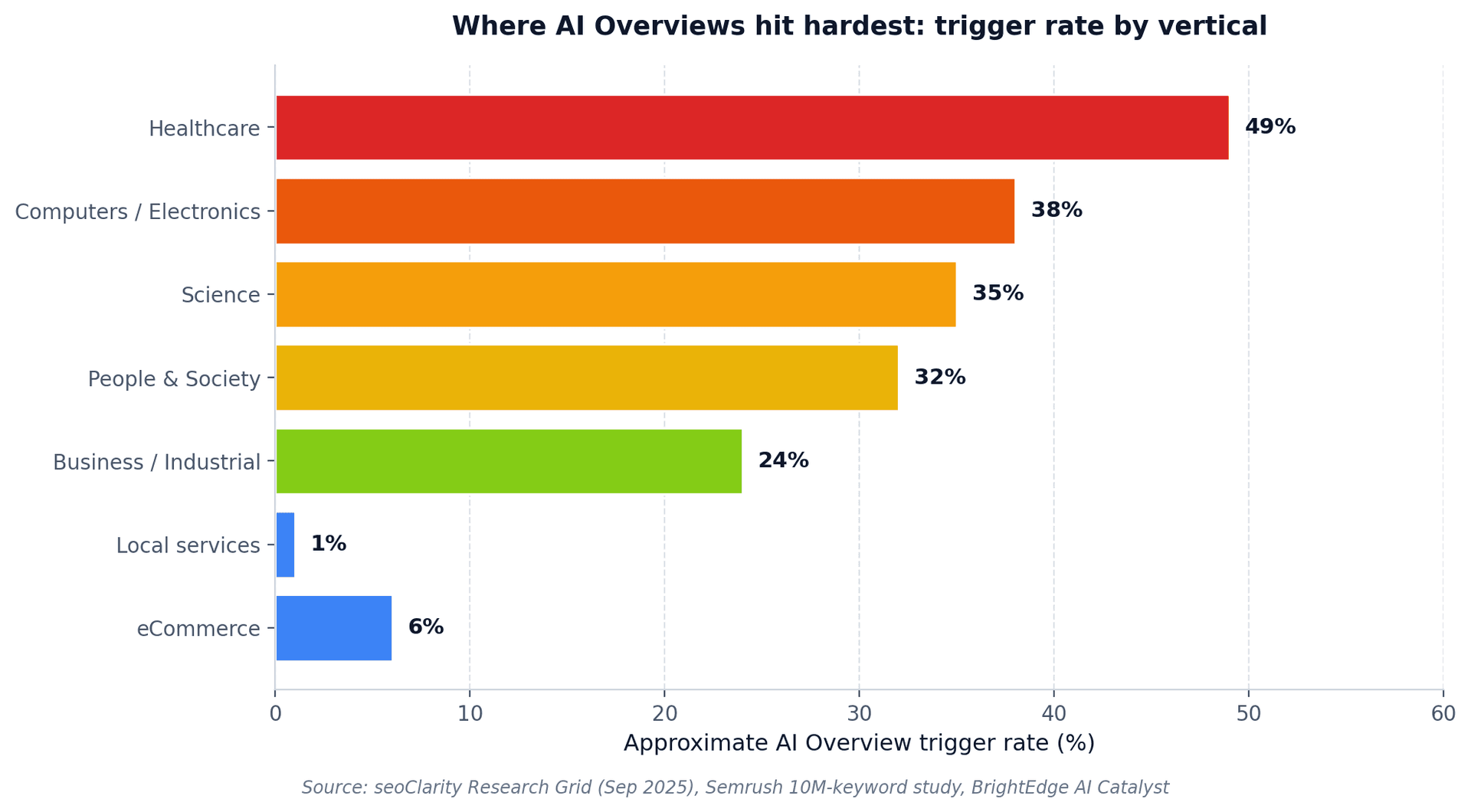
Healthcare / YMYL | 20–40% | 60–80% | 38–49% | Very high |
Consumer media | 5–15% | 85–95% | 35–49% | Very high |
Transactional ecommerce | 30–50% | 50–70% | 5–10% | Moderate |
Local services | 30–50% | 50–70% | <1% | Low |
The non-branded crisis: data on what's actually collapsing
At HubSpot's INBOUND 2025 conference, CEO Yamini Rangan said publicly what most content marketers were whispering in private — HubSpot's own blog traffic had fallen roughly 50%. She called it the "traffic apocalypse." That admission, from arguably the world's most successful content-marketing-driven business, told the rest of the industry that the asymmetry was real and large.
Eight months of independent studies have now confirmed it from every angle:
Ahrefs (December 2025): Updated 300,000-keyword study found a 58% drop in position-1 CTR when an AI Overview appears — up from 34.5% in the original April 2025 analysis.
Pew Research Center (July 2025): Across 68,879 real Google searches by 900 U.S. adults, users clicked a traditional result on only 8% of searches with an AI summary versus 15% without — a 47% relative decline. Just 1% clicked a link inside the AI summary.
Amsive (700,000 keywords): Average 15.49% CTR drop, –19.98% on non-branded queries, –37.04% when an AIO and Featured Snippet co-occur, and +18.68% on branded queries.
Seer Interactive (3,119 informational queries): 61% organic CTR decline (1.76% → 0.61%) on AIO queries. Brands cited inside the AI Overview earned 35% more organic clicks and 91% more paid clicks than non-cited competitors.
SparkToro / Datos: For every 1,000 U.S. Google searches, only 360 clicks reach the open web. Mobile sees ~77% zero-click sessions.
The structural pattern matters as much as the magnitudes. Ahrefs reports that 99.2% of keywords triggering AI Overviews are informational. Semrush's 10M-keyword study confirms 88.1% of AIO queries are informational, with only 1.43% navigational/branded. seoClarity's Research Grid found AI Overviews now appear on 30% of U.S. desktop keywords and grew 474.9% year-over-year on mobile, but 92.89% of triggers are long-tail informational. The exposure is concentrated almost entirely on the type of content that used to anchor most blog and resource sections.
The publisher casualty list reads like a who's-who of the old non-branded SEO economy: Business Insider lost 55% of organic search traffic between April 2022 and April 2025; The Planet D travel blog ceased operations after losing more than 90% of its traffic; Press Gazette / Chartbeat data showed Google Search referrals to publishers fell roughly 34% globally between December 2024 and December 2025. The brands surviving this transition are the ones with strong direct, social, and branded-search demand. The brands that were entirely dependent on ranking for category-level informational queries are mostly not surviving it.
The branded query advantage
Now the flip side, which is the most strategically important finding of the entire AI search era. Branded queries are protected — and in many cases, they're net beneficiaries of AI Overviews.
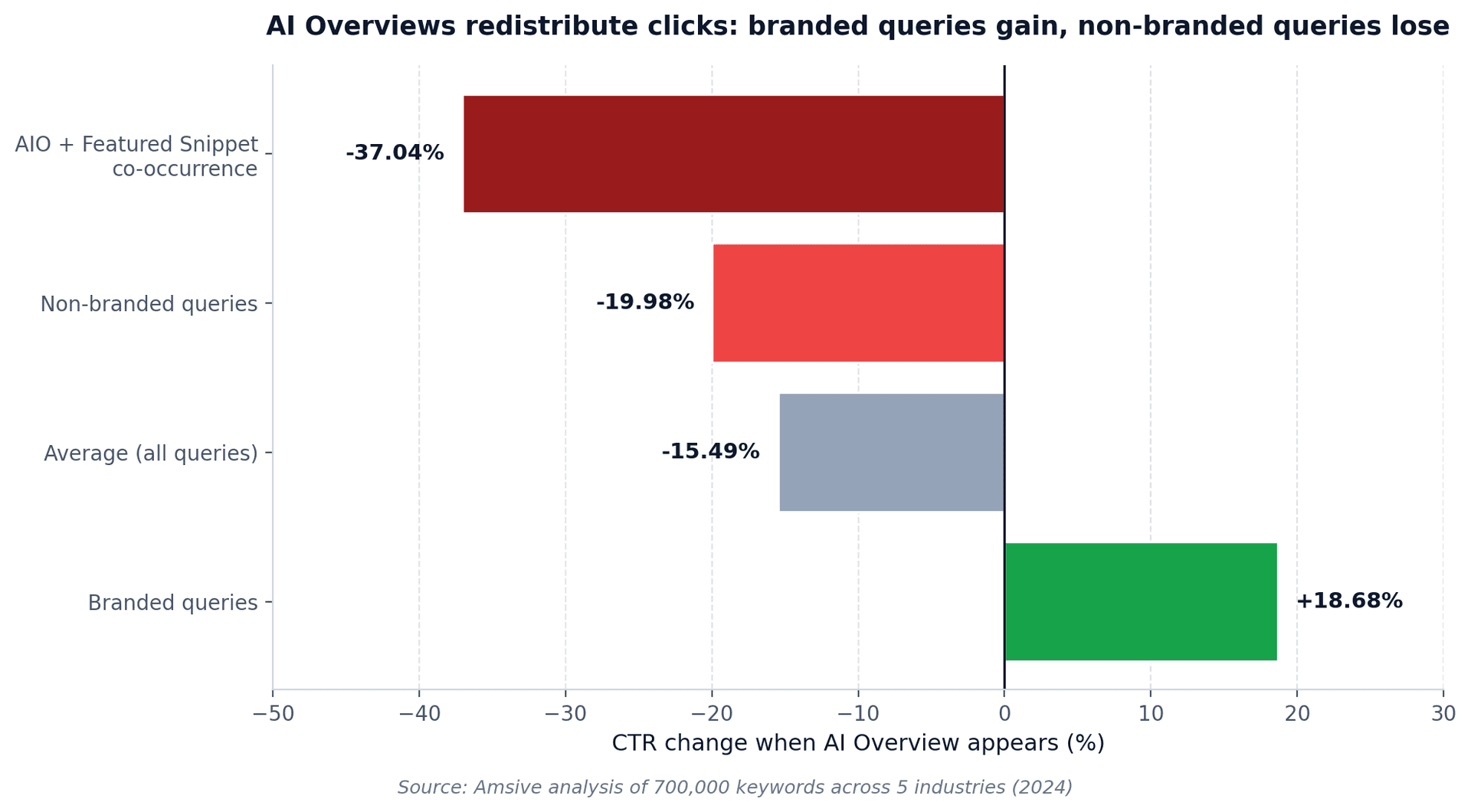
Three things are happening at once on a branded query. First, AIOs trigger far less often — Amsive found only 4.79% of branded queries surface an AI Overview at all. Second, when one does appear, it usually reinforces the brand the user was already looking for, often citing the brand's own pages. Third, the user has clear intent to reach that brand, so even with an AIO present, click-through goes up rather than down.
Underneath this, a deeper structural force is at work. AI engines converge on a small recognized brand set per category and ignore the long tail of competing pages. Kevin Indig's analysis of ~98,000 ChatGPT citations across roughly 1.2 million responses found that approximately 30 domains capture 67% of citations within a topic. Citation distribution in AI is more concentrated than traditional organic search, not less. BrightEdge's AI Catalyst separately found 76% overlap between ChatGPT and Google AI Overview brand recommendations on shopping prompts.
What this means in practice: in any given category, a few brands win nearly all the AI mentions. If you're one of them, branded queries are now more valuable than they were in classic SEO, because the AI surface is reinforcing your demand at the exact moment a buyer is researching. If you're not in that recognized set, you're invisible — and earning your way in is a brand problem, not a keyword problem.
Brand mentions are the new backlinks
The most important academic-style research in this space is Ahrefs' 75,000-brand study, which established a clear hierarchy of correlations between brand signals and AI Overview visibility:
Signal | AI Overview correlation | Notes |
|---|---|---|
YouTube mentions | ~0.737 | Strongest signal across ChatGPT, AI Mode, AIO |
Branded web mentions | 0.664 | 0.709 in Google AI Mode |
Branded anchors | 0.527 | Anchor text containing brand name |
Branded search volume | 0.392 | 0.334 ChatGPT correlation (Indig) |
Organic traffic | 0.274 | Total non-branded organic |
Backlinks (referring domains) | 0.218 | Weakest of the major signals |
The hierarchy is striking. Backlinks — the foundation of classic SEO ranking — sit at the bottom. Branded mentions and YouTube mentions sit at the top. Ahrefs' December 2025 follow-up extended the analysis to ChatGPT and Google AI Mode and found the same pattern, with AI Mode showing the strongest brand bias of all three platforms.
McKinsey's October 2025 research adds a critical structural insight: brand-owned pages comprise only 5–10% of the sources AI references. The other 90–95% comes from third-party publishers, review sites, communities, and YouTube. For consumer packaged goods, ~50% of citations come from affiliate blogs and review sites; for ecommerce, 80% come from brand and retailer sites with under 5% from affiliates. McKinsey also notes that even category leaders' GEO performance lags their SEO performance by 20–50%, meaning the leaders haven't yet locked in their position.
The mechanism behind these correlations is what practitioners are calling the "corroboration threshold." AI models converge on brands corroborated across many independent sources. Once enough Reddit threads, YouTube reviews, G2 listings, Forbes roundups, and editorial mentions say similar things about your brand, the model commits to including you in its answers. If only your own site says you're the best at X, the AI treats that as a marketing claim and discounts it.
Bluefish AI's Black Friday 2025 analysis empirically confirmed the practical version: more than 95% of AI citations during the holiday shopping period came from non-paid sources. A small set of high-signal pages — CNET, RTINGS, PCMag, Reddit threads, Vogue and Who What Wear gift guides — drove a disproportionate share of recommendations. The brands that won didn't have the largest paid budgets. They had the most consistent presence across editorial gift guides and review roundups.
Why this matters more for B2B
Forrester's 2024 Buyers' Journey Survey found 89% of B2B buyers had already adopted generative AI in their purchasing process less than two years after ChatGPT's launch. By the 2025 wave, that figure rose to 95% planning to use generative AI in at least one area of a future purchase. Forrester explicitly states that B2B buyers are adopting AI-powered search at three times the rate of consumers, and that AI-referred B2B traffic converts at 4.4x the rate of standard organic — with some Ahrefs internal case studies reporting up to 23x in specific segments.
For a B2B SaaS company where branded search already drives ~70% of organic traffic, this changes the math entirely. Non-branded informational content was historically the top-of-funnel engine that created branded search demand. With AI Overviews answering most of those informational queries directly, the engine that fed branded demand needs to shift from "rank for the keyword" to "be cited in the answer." The conversion economics still favor branded heavily — they always have. What changed is the input.
The new measurement stack
The measurement gap is the single biggest operational problem most teams face right now. Google Search Console does not separate AI Overview clicks and impressions from regular organic data. AI citations rarely produce trackable referrer data. GA4 buckets most AI-referred traffic as "direct" or misattributes it. As of early 2026, roughly 70% of AI referral traffic is invisible to default analytics setups.
The emerging stack has three layers, and most teams need all three:
Layer 1 — GSC branded vs. non-branded performance over time.
Export query data, segment by branded versus non-branded, and watch the trend lines. A healthy AI-era brand sees branded impressions and clicks holding or growing, while non-branded impressions inflate (because GSC counts AI Overview impressions even when they don't produce clicks) and non-branded clicks decline. A widening "impression-to-click gap" on non-branded informational queries is the cleanest leading indicator that AI Overviews are absorbing your traffic. This is the single most actionable diagnostic in your existing data.
Layer 2 — Cross-LLM AI visibility tracking.
Track brand mentions, citations, share of voice, and source pages across ChatGPT, Claude, Gemini, Perplexity, Google AI Mode, and AI Overviews. Per BrightEdge's research, platforms disagree on brand recommendations for 61.9% of queries, so single-platform monitoring is insufficient. Different LLMs cite different sources, surface different competitors, and attach different sentiment to the same brand.
Layer 3 — Branded search volume as a leading indicator.
Because branded search volume correlates 0.392 with AI Overview visibility (Ahrefs) and 0.334 with ChatGPT mentions (Indig), it's now the cleanest free leading indicator that brand-building work is moving the AI needle. Rising branded search volume tends to lead rising AI visibility by weeks to months. If you do nothing else, watch this number weekly.
The thesis that combining GSC's branded/non-branded performance data with cross-LLM AI visibility data is the essential measurement layer is now widely accepted. Aleyda Solís's AI Search Optimization Roadmap, Mike King's iPullRank work, BrightEdge's AI Catalyst positioning, and Forrester's recent guidance all converge on the same point: rankings are insufficient, citations and mentions are the new currency, and you need both signals reconciled in one view.
QuickSEO is built around this exact stack — Google Search Console analytics with branded vs. non-branded filtering on every query report, paired with prompt-level AI visibility tracking across ChatGPT, Claude, Gemini, and Perplexity. If you'd like to see your branded vs. non-branded performance alongside your AI visibility in a single dashboard, that's the workflow we built it for.
A tactical playbook by role
If you're an in-house SEO at an SMB
Pull the last 24 months of GSC data and segment branded vs. non-branded queries. If your branded share is trending up while non-branded clicks are falling on stable rankings, AI Overviews are eating your top-of-funnel — this is the quickest way to defend budget. Threshold to escalate: a >20% drop in non-branded clicks year-over-year despite stable rankings.
Run an AI visibility audit across ChatGPT, Claude, Gemini, and Perplexity using prompts your buyers actually use ("best [category]," "[your brand] vs. [competitor]," "alternatives to [competitor]"). If you appear in less than 30% of category prompts, you're below the corroboration threshold.
Reallocate 20–40% of net-new content budget away from broad informational pieces ("what is X," "how to Y") toward (a) branded informational pages — comparison, alternatives, integrations, pricing, ROI calculators; (b) original research and proprietary data; and (c) opinion-driven thought leadership tied to a real expert byline.
If you're an agency or consultant
Re-pitch your value proposition explicitly as "brand visibility across Google + AI" rather than "rankings." Lead with the +18.68% branded vs. –19.98% non-branded data and HubSpot's public 50% admission as the boardroom narrative — both translate instantly for non-technical executives.
Productize three new deliverables: an AI Visibility Diagnostic (cross-LLM share-of-voice baseline + competitor gap), a Citation Surface Audit (which Reddit threads, YouTube videos, G2 listings, and editorial pages need to mention the client), and a combined GSC + AI dashboard.
For clients in healthcare, finance, and other YMYL verticals where AIOs trigger 38–49% of queries, prioritize structured data, expert author bios, original research, and editorial PR. Branded mentions in major publishers are disproportionately powerful in these verticals.
If you're a founder or marketing leader
Treat branded search volume as a primary KPI alongside revenue and pipeline. It's now your best free, weekly-updating leading indicator of AI visibility.
Invest in founder-led brand building — podcast appearances, expert quoting in industry publications, original research, conference talks, and a personal point of view on LinkedIn or X. LLMs disproportionately cite recognizable expert voices, and a founder-as-spokesperson is the single biggest unused lever for early-stage and mid-market brands.
Build a citation surface map: identify the top 30 sites your target LLMs cite for your category — Reddit subs, YouTube channels, review platforms, niche publishers — and get authentic presence on each through customer-generated reviews, sponsored expert content, partnerships, or thoughtful community participation. Bluefish's data shows ~95% of AI citations come from non-paid sources, so this is a PR and community problem, not a media-buying one.
The case study that anchors all of this is Ramp's work with Profound in early 2025. Ramp identified that 6% of existing AI citations came from automation/comparison content, then published two tightly targeted pages — "Accounts Payable Software for Small Businesses" and "for Large Businesses" — plus comparison roundups. Result: 300+ new citations within one month and AI visibility from 3.2% to 22.2%, moving Ramp from the 19th- to the 8th-most-visible fintech in AP on AI engines. Branded informational content, properly distributed, is currently the highest-leverage tactic in the playbook.
Counterpoints and caveats
The strong directional findings above need a few honest caveats.
Correlation is not causation. Ahrefs explicitly flags this in their own brand-mentions research. The 0.664 correlation between branded mentions and AI Overview visibility may partly reflect that strong brands have both more mentions and more visibility because they're strong brands — not because mentions cause visibility. Strategy should follow the directional signal, but no one should claim guaranteed AI visibility from any single tactic.
The CTR studies use different methodologies and disagree on magnitude. Ahrefs (58%), Pew (47%), Seer (61%), Amsive (15.49% average / 19.98% non-branded), Authoritas (47.5%), and SISTRIX (59% in Germany) all find significant declines, but the exact figure varies based on dataset, query type, and time window. The direction is unanimous; the magnitude is contested. Google has also publicly disputed the Pew findings, calling the methodology "flawed and not representative" — although the directional pattern is corroborated by independent practitioner data from HubSpot, Business Insider, and the broader publisher economy.
Non-branded SEO is not dead — it's narrower. Local search, transactional ecommerce ("buy [specific product]"), specific long-tail navigational queries, and bottom-funnel comparison content still reward classic SEO. Per seoClarity, only 5.78% of AIO-triggering keywords have transactional intent, meaning purchase-intent traffic is largely intact. Over-rotating entirely to brand and abandoning non-branded ranking would be a mistake; the right posture is rebalancing, not abandonment.
AI search referral traffic is still small in absolute terms. Conductor's 2026 benchmark pegs AI referral traffic at just 1.08% of all website traffic — but it's growing roughly one percentage point per month, ChatGPT alone drove 206% year-over-year referral growth, and conversion rates are 2x–27x higher per visit depending on the study. Small-but-high-quality is the correct mental model. The leading indicator (branded search volume, AI mention share) matters more than the lagging indicator (referral traffic) for at least the next 12 months.
The bottom line
AI search has fundamentally changed the value of branded versus non-branded search. The non-branded informational economy that powered most of the last decade of content marketing is being absorbed by LLMs and AI Overviews. The branded query — and the brand mentions that feed it — is becoming the durable moat.
The teams winning right now are the ones treating this as a measurement-first problem. They're combining GSC's branded/non-branded segmentation with cross-LLM visibility data, watching branded search volume as a leading indicator, and reallocating budget toward earning brand mentions across the corpus AI models actually trust. The next decade of organic growth will be won by brands that build mention surfaces, not by those that chase keyword rankings.
If you want to see your own branded vs. non-branded performance alongside your AI visibility across ChatGPT, Claude, Gemini, and Perplexity in a single dashboard, QuickSEO is built for this exact workflow. Get started with a free AI visibility audit — it takes about three minutes.
Enter your website to track its AI visibility across ChatGPT, Gemini, Claude, and Perplexity — and turn chatbot mentions into traffic.
- Set up in minutes
- Cancel anytime
Try it yourself
Related free tools
Free SEO tools related to the topics covered in this article.
Keep reading
Related posts
More articles on the same topics, prioritized by shared tags and keyword overlap.