Google Search vs. AI Overviews vs. Gemini: How the Three Surfaces Differ and What SEOs Should Do About It in 2026

 Summarize in ChatGPT
When someone types "best CRM for small business" into Google in 2026, Google can serve them a classic blue-link SERP, a generative AI Overview synthesized by Gemini, or a full conversational AI Mode session inside the search results page. The same person, on the same query, can also open the Gemini app, run a Deep Research session that browses 80+ sources, and never see Google Search at all. These are not minor variants of the same product. Each surface ranks pages differently, cites sources differently, and produces dramatically different click-through and conversion behavior.
AI Overviews now appear on roughly 48% of tracked U.S. queries (BrightEdge, February 2026), reach 2 billion monthly users, and reduce position-1 organic CTR by 34–61% on the queries they invade. The Gemini app passed 750 million monthly active users by Q4 2025. Google's separate AI Mode tab posts a 93% zero-click rate. HubSpot lost 70–80% of its organic traffic between November 2024 and Q2 2025. Business Insider dropped 55%. Global publisher referrals from Google fell roughly a third in 2025 alone.
And yet, in the same year, AI-referred traffic converted at 4.4× to 23× the rate of organic visitors in independent studies. Brands cited inside an AI Overview earned 35% more organic clicks and 91% more paid clicks than uncited brands on the same SERP. The category is not collapsing — it is repricing.
This article maps the three surfaces side by side: how each one works technically, what has actually changed in SEO impact, how user behavior is splitting, and a tiered playbook SMBs, in-house SEOs, and agencies can run in 2026.
The three surfaces at a glance
Before going deep on each, here is the comparison most marketing reports skip — the side-by-side that explains why one strategy can't cover all three.
Dimension | Google Search | AI Overviews | Gemini app + AI Mode |
What it is | Classic 10 blue links, snippets, and SERP features | AI summary above the blue links | Standalone chatbot plus a dedicated tab inside Search |
Reach (early 2026) | Still the foundation; ~52% of queries unaffected by AIOs | 2B monthly users; ~48% of tracked U.S. queries | Gemini app: 750M MAU. AI Mode: 100M+ MAU in U.S./India |
Powered by | Ranking systems: RankBrain, BERT, MUM, Helpful Content | Gemini 2.5 + query fan-out (Gemini 3 for hardest queries) | Gemini 2.5 Flash → Gemini 3 Pro → Gemini 3.1 Pro |
Citation behavior | Link-based ranking; well-understood | Cites pages selectively; only 32% from organic top 10 | Variable — Gemini links 70% but names brands only 60% |
Click-through reality | Position 1: ~20% CTR baseline | 8% click-through with AIO present vs. 15% without | 93% zero-click on AI Mode; 75% never leave Google |
Best optimization lever | Classic SEO + E-E-A-T + technical health | GEO: statistics, quotations, structured passages | Brand entity + multi-format presence (YouTube, LinkedIn, Reddit) |
How each surface actually works
Traditional Google Search in 2026
Classic Google Search is, in 2026, still the foundation of the SERP — but it is a foundation increasingly buried under AI features. The ranking system is a stack: a deep-learned core that includes RankBrain, neural matching, BERT, and MUM for semantic understanding; the Helpful Content System, which Google quietly folded into core ranking in 2024; core updates that adjust the weighting of signals globally; and discrete spam, reviews, and product systems that fire periodically.
The December 2025 core update (Dec 11–29) was, by analyst consensus, one of the most volatile of the year. SE Ranking found ~15% of pages that ranked in the top 10 disappeared from the top 100 entirely. Aleyda Solís, Glenn Gabe, and Lily Ray each documented patterns in the aftermath: e-commerce and YMYL sites moved most; old-domain authority (15+ years) still dominated the top 10, with less than 2% of top rankings going to domains under two years old; E-E-A-T expanded beyond YMYL into product reviews, SaaS comparisons, and how-to content. Google's John Mueller restated in November 2025 that Google's systems do not care whether content was created by AI or by humans — only whether it is helpful for users.
Why does classic search still matter when 48% of queries trigger an AIO? Because between 32% and 54% of the URLs cited inside AI Overviews also rank in the organic top 10 (BrightEdge, 16-month analysis). Ranking is no longer the destination, but it is still one of the strongest paths to citation.
AI Overviews: query fan-out and selective citation
AI Overviews are the AI-generated summaries that appear above the classic blue links. They reach 2 billion monthly users across 200+ countries and 40+ languages, and they fundamentally rewrite what "ranking" means for the queries they cover.
Technically, AIOs use a "query fan-out" architecture. A custom version of Gemini — currently 2.5 for AIOs and Gemini 3 for AI Mode and the hardest AIO queries — breaks the user's query into 8 to 12 sub-queries, fires them in parallel against Google's search index, retrieves passages from the resulting pages, and synthesizes a grounded answer with citations. As iPullRank's Mike King put it after dissecting the architecture: a document may rank number three for one of those expanded sub-queries, but you can't see that anywhere in your tools. This is why traditional rank trackers misread AIO performance — they're measuring the wrong query.
Trigger behavior is the most actionable technical fact for marketers. Different query types invite AIOs at radically different rates:
Query type | AIO trigger rate | Source |
Comparison ("X vs Y") | 95.4% | Seer 2026 |
Question-format | 85.9% | Seer 2026 |
Review queries | 86.3% | Seer 2026 |
Informational | 36% | Seer 2026 |
Single-word | 27.3% | Seer 2026 |
Commercial | 8% | Seer 2026 |
Transactional | 5% | Seer 2026 |
E-commerce | 4–8% | Stackmatix/WebFX |
Eight-word+ queries | 7× more likely than short queries | Seer 2026 |
Industry exposure varies just as dramatically. BrightEdge's February 2026 measurement put healthcare at 88% AIO presence, education at 83%, B2B tech at 82%, restaurants at 78%, finance at ~37% (with educational finance like "what is an IRA" at 91% but stock tickers at 7%), entertainment at ~37%, and e-commerce at just 4–8%. Google has actively reduced AIO presence on transactional commerce queries since the May 2024 launch.
There is also a YMYL suppression layer worth knowing. AIOs are deliberately downgraded or blocked for severe mental health queries (suicide queries trigger a 988 Lifeline panel), most U.S. election questions, live financial price queries, and most calculators. Among health AIOs, 83% include disclaimers. Where AIOs do appear in YMYL, Google heavily prefers institutional sources — NIH (~39%), Mayo Clinic (~15%), Healthline (~15%) for health questions.
Citation behavior inside AIOs is where ranking strategy diverges from AI optimization. Surfer SEO's 173,902-URL study (December 2025) found only 32% of AIO citations come from the top 10 organic results — the other 68% come from pages that don't rank competitively at all. AIOs are designed to answer the next question after the user's, so they routinely cite deep pages, supporting documents, and passages that the broader ranking system overlooked. Across 36M AIOs and 46M citations, YouTube (~23%), Wikipedia (~18%), Google's own properties (~16%), Reddit, LinkedIn, and Facebook collectively account for the bulk of the citation pool.
AI Mode: a separate, more aggressive surface
AI Mode is a separate tab inside Google Search that reproduces a ChatGPT-style conversational interface, but is grounded in Google's index. It launched in March 2025 in the U.S., became default for U.S. users in May, reached India in June, the U.K. in July, and Europe (40+ countries, excluding France for regulatory reasons) on October 7, 2025. By Q4 2025, AI Mode reached 100M+ monthly active users, and daily AI Mode queries per U.S. user have doubled since launch.
Technically, AI Mode is more aggressive than AIOs: it fans out into more sub-queries (8–12 standard, hundreds for Deep Search), retains conversational context across follow-ups, and now generates dynamic visual UI on the fly — interactive simulations, custom calculators, comparison tables. Average session length is around 11 minutes, compared with 2–3 minutes for traditional search. The zero-click rate is 93% (Semrush, September 2025); 75% of AI Mode sessions never leave Google at all. AI Mode citations cluster heavily on Google's own properties (google.com is the #1 source in 19 of 20 niches per SE Ranking, accounting for 17.4% of citations — tripled from 5.7% in June 2025), Wikipedia, YouTube, and Reddit.
Standalone Gemini: the parallel discovery channel
Gemini is Google's consumer chatbot — gemini.google.com and the Gemini app on iOS and Android — powered by a stack that runs from Gemini 2.5 Flash through Gemini 3 Pro (released November 2025) and Gemini 3.1 Pro (February 2026). It hit 750M monthly active users by Q4 2025, up from 350M in March 2025. Demographics skew toward 25–34-year-olds (~30%) and 18–24 (~22%), with the U.S., Vietnam, Indonesia, India, and the Philippines as the largest markets. Direct traffic accounts for ~75% of visits — a strong signal of brand recall and habit formation.
Gemini grounds its answers through three layers: training data, real-time Google Search retrieval when grounding is enabled, and optional Workspace connectors (Gmail, Drive, Chat, Calendar, YouTube history) when the user opts in. It cites differently than AIOs. Kevin Indig's "ghost citation" study — across 3,981 domains, 115 prompts, and four AI engines — found that Gemini links to sources 70% of the time but only mentions brand names 60% of the time. ChatGPT, by contrast, cites 87% but names brands only 20.7%. AI Mode and AIOs sit in the middle. The implication: optimizing for one engine is not the same as optimizing for all of them, and a brand can be heavily cited but invisibly named.
Deep Research is Gemini's flagship agentic feature. Released in December 2024 and upgraded with Gemini 3 in late 2025, it autonomously plans, browses ~80 sources for a standard query (up to ~160 for Deep Research Max), and produces multi-page cited reports with native charts and infographics. As of November 2025, Deep Research integrates directly with Gmail, Drive, and Chat. Gemini Enterprise has sold 8M+ paid seats across 2,800+ companies, and Q1 2026 paid MAU grew 40% quarter-over-quarter. For B2B brands, this is the channel where buyers now do vendor research — and where citation-without-naming risks producing influence without attribution.
The SEO impact: what has actually changed
The CTR collapse — and the early 2026 floor
Twelve major studies converge on the directional finding: when an AI Overview appears, organic CTR falls. The magnitudes vary because the methodologies vary.
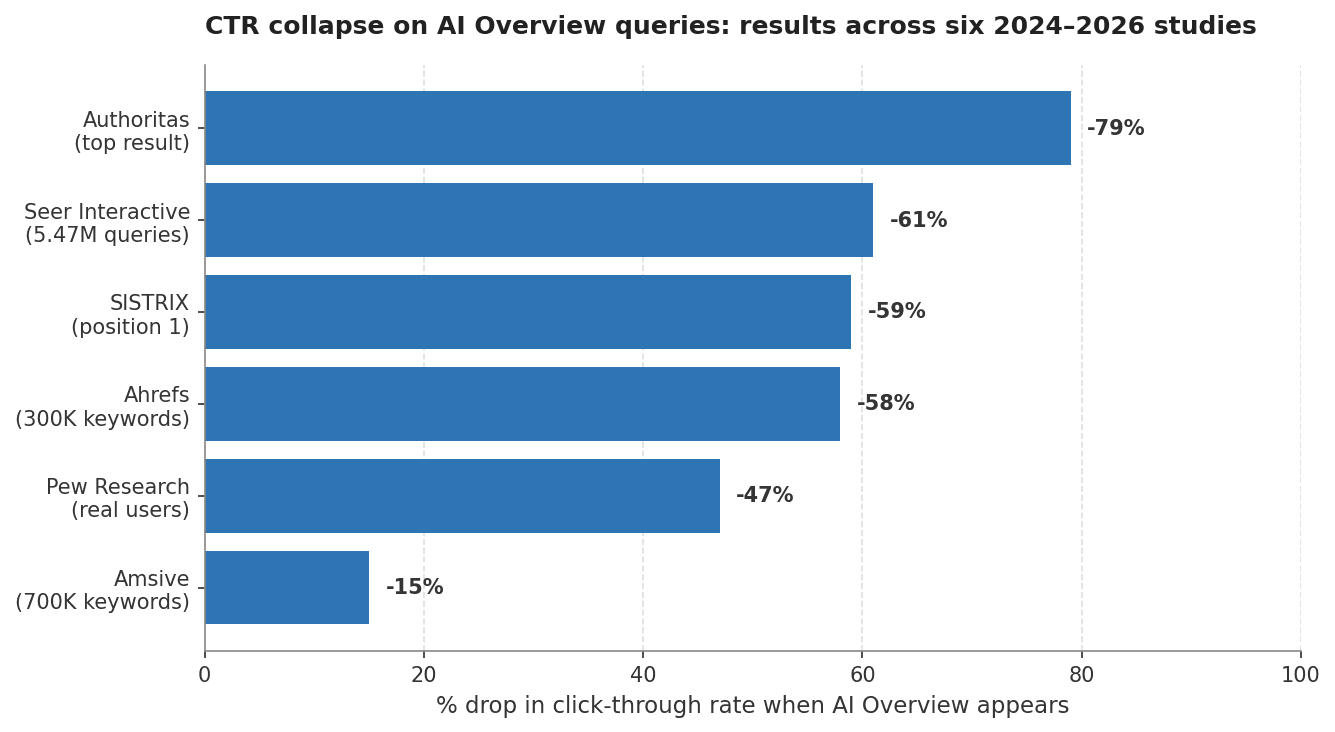
Sources: Authoritas (publisher case studies), Seer Interactive (5.47M queries, 53 brands, Q3 2025), SISTRIX (Germany), Ahrefs (300K keywords, December 2025), Pew Research (68,879 real-user searches, March 2025), Amsive (700K keywords).
Pew's real-user data is the cleanest behavioral signal: only 8% of users clicked a regular search result when an AIO appeared, compared with 15% without one. Click-through on the links inside AIOs sat at just 1%. And 26% of users ended their session entirely after seeing an AIO, versus 16% without one. The summary is functioning as a satisfying terminal answer.
Then in early 2026 the floor lifted slightly. Seer's February 2026 update found organic CTR on AIO queries climbed from a December 2025 trough of 1.3% to 2.4% in February — an 85% rebound, but still well below pre-AIO levels. Non-AIO query CTRs rose modestly too (2.8% to 3.8%). This is not a recovery to baseline; it is a leveling-off as users adapt and as Google iterates the surface.
For broader context: Similarweb tracked overall Google zero-click rates climbing from 56% in May 2024 to 69% in May 2025. AI Mode's 93% zero-click rate is a different category entirely — and as Google ships more Gemini features into AI Mode first, the question for SEOs is no longer whether zero-click expands, but how fast.
The brand case studies: who lost and who won
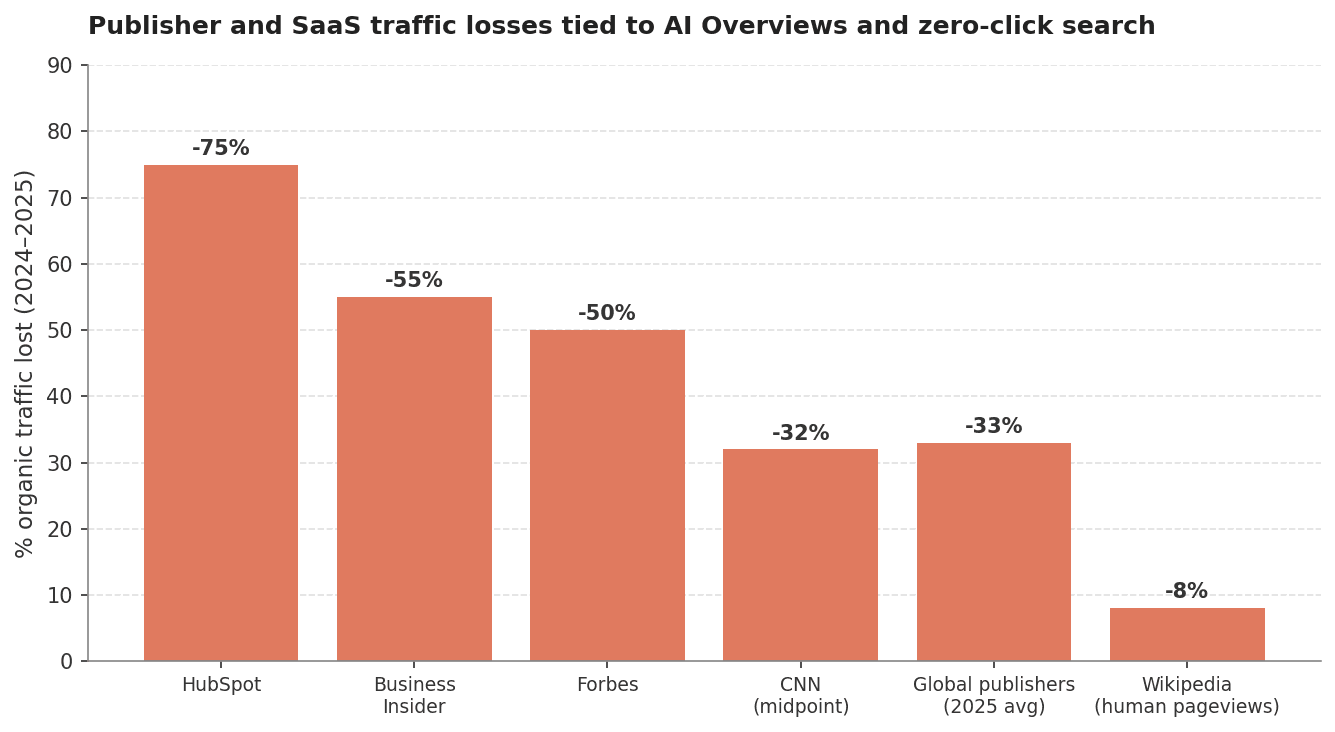
Sources: HubSpot Q1 2025 earnings (Yamini Rangan), Business Insider (April 2022 to April 2025), Forbes Digital, CNN (March–July 2025), Press Gazette/Chartbeat (global publisher data, 2025), Wikimedia Foundation human-pageview data.
HubSpot is the most-cited case. Organic visits dropped from 13.5M in November 2024 to roughly 6–7M in early 2025 — a 70–80% loss. CEO Yamini Rangan acknowledged on the Q1 2025 earnings call that organic search traffic was declining globally and that AI Overviews were giving users answers, with fewer people clicking through to websites. HubSpot launched its own Answer Engine Optimization tool in April 2026 in response.
Business Insider lost 55% of organic search traffic between April 2022 and April 2025, then announced a 21% staff reduction in May 2025. CNN dropped 27–38%, going from 351M to 323M monthly visits between March and July 2025. Forbes lost roughly 50% despite ranking for thousands of keywords. Press Gazette and Chartbeat data showed global publishers down roughly a third in Google referrals across 2025. Chegg filed an antitrust suit in February 2025; Penske Media followed in September; the European Commission opened a formal AI Overviews investigation on December 9, 2025.
But there were winners. Substack rose 40% year-over-year by July 2025 (67.7M visits) and became the 19th most-visited U.S. news site. Reddit hit 1.4 billion monthly visits and saw 450% growth in AI citations between March and June 2025, driven by its Google AI training data deal and the durability of authentic UGC. YouTube overtook Reddit as the #1 social citation source in AIOs, accounting for ~23% of all AIO citations. Industries that grew organic traffic in 2025 — apparel (+22%), beauty (+20%), food (+1%), retail (+1%) — were generally visual, product-driven verticals less exposed to AIO substitution.
What actually predicts AI visibility
This is the most surprising finding in the dataset for traditional SEOs. Three independent studies — Ahrefs (75,000 brands), Digital Bloom, and Semrush (7,000+ citations) — converge on the same result: brand search volume and brand web mentions predict AI visibility far better than backlinks do.
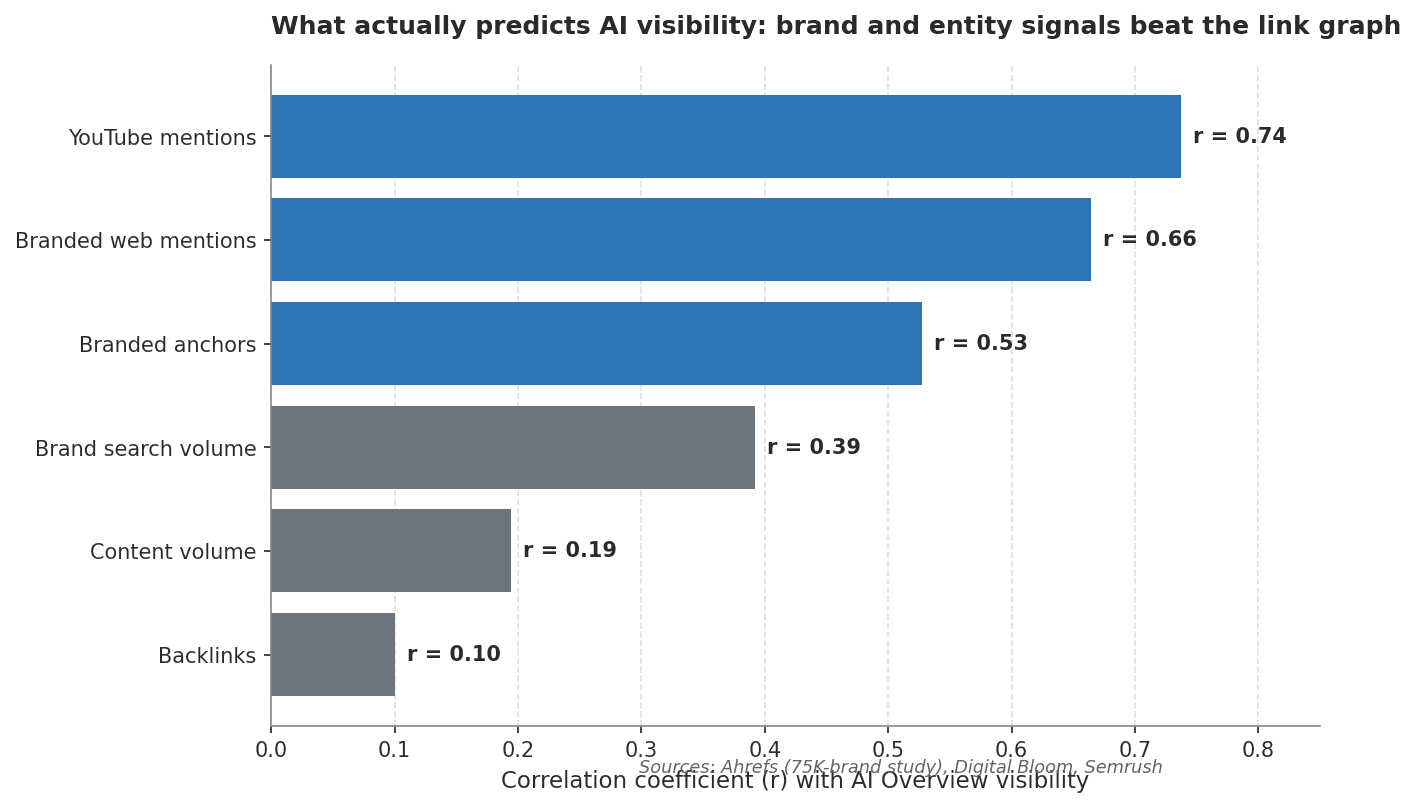
Pearson correlations between visibility factors and AI Overview citation share, across three independent 2025 studies.
YouTube mentions correlate with AIO visibility at r = 0.737 — the single strongest predictor. Branded web mentions sit at r ≈ 0.66. Branded anchor text comes in at r = 0.527. Brand search volume at r ≈ 0.39. Backlinks — the foundation of classic SEO — correlate at only r ≈ 0.10. Content volume correlates at r ≈ 0.19, essentially noise.
The actionable read: the work that increases your branded search demand — PR, partnerships, podcast appearances, conference talks, original research, multi-format presence — flows directly into AI visibility. The work that traditionally moved rankings (link velocity from low-authority blogs) does not. Note the caveat: high-authority brands also tend to do everything else right, so the correlation is directionally clear but not causally proven.
Layered on top of the brand layer is the tactical content layer. The Princeton/Georgia Tech GEO study (KDD 2024) tested specific content modifications across 10,000 queries on Perplexity and found that adding statistics lifted citation visibility by 22–37%, adding direct quotations from credible sources by 41%, adding source citations by up to 115% for mid-ranked pages, and that fluency and "easy-to-understand" rewrites added 15–30%. Keyword stuffing performed 10% worse than baseline — it actively hurts AI visibility.
Kevin Indig's NLP analysis of 1.2 million search results and 18,012 ChatGPT citations identified the "ski ramp" effect: 44.2% of citations come from the first 30% of a document. Citation winners use 36.2% definitive language ("is defined as," "refers to") versus 20.2% in non-cited content; entity density in cited paragraphs is 20.6% vs. a baseline of 5–8%. Practical implication: front-load the canonical answer in definitive language, then build context — the inverse of the classic SEO long-form intro.
The conversion premium that reframes the story
Reading the CTR and traffic numbers in isolation produces a panic narrative. Reading them alongside conversion data produces a different one.
Multiple independent sources find that AI-referred traffic converts at a dramatic premium over organic search. Semrush's analysis of 500+ topics found AI search visitors worth 4.4× more than traditional organic visitors by conversion rate. An Ahrefs internal case study reported AI visitors converting at 23× the organic rate — 0.5% of traffic drove 12.1% of signups. Pixelmojo's analysis of 12 million visits showed AI referral traffic converting at 14.2% versus 2.8% for Google organic. Visibility Labs (94 e-commerce sites, 12 months of GA4 data) found ChatGPT traffic converted 31% higher than non-branded organic search.
There is meaningful counter-evidence. Amsive's statistical analysis found no significant overall difference in conversion rates (p = 0.794), with B2B sites showing only a slight edge. Translation: the conversion premium is real and large for research-intensive verticals (B2B SaaS, finance, legal, health, education) but is not universal across pure-impulse e-commerce. Volume is also still small — Semrush's 2026 industry analysis shows AI traffic grew 66% in 2025 but is still less than 0.15% of total visits for most sites.
The compounding finding from Seer is the closest thing to a "position zero" payoff in the AI era: brands cited inside an AIO get 35% more organic clicks and 91% more paid clicks than uncited brands on the same SERP. Citation, in other words, is no longer a vanity metric — it directly amplifies both organic and paid performance for the queries where it appears.
The Search Console blind spot
Operationally, the most painful gap in 2026 is measurement. Google confirmed in late 2025 that AI Overview clicks and impressions are counted in Search Console under "Web," but they are not broken out separately. There is no AI Mode segmentation. There is no Gemini-app data. Aleyda Solís has publicly called the lack of AI tracking in Search Console "a big regret"; Glenn Gabe has been calling for a separate AI Search Console for over a year. Until Google ships one, the workarounds are manual prompt testing, branded search lift in GA4 and GSC as a leading indicator, and third-party AI visibility platforms that bridge GSC data with the major AI engines.
User behavior: who uses what, and when
Splits by query type
The key behavioral split in 2026 is by query type, not by user type. Informational, comparison, and "how to" queries now default to AI Overviews and AI Mode, and users rarely click through. Commercial and transactional queries are still classic Google territory — only 5–8% of commercial queries trigger AIOs, and only 4% of e-commerce queries do, down from 29% at AIO launch. Google preserves the commercial SERP because that's where conversion happens. Multi-step research has migrated to Gemini and AI Mode; sessions are 11 minutes on average and queries are 3× longer than traditional search. Local queries trigger AIOs 68% of the time, but Google still preserves the local pack on 39% of local queries.
Generations behave differently
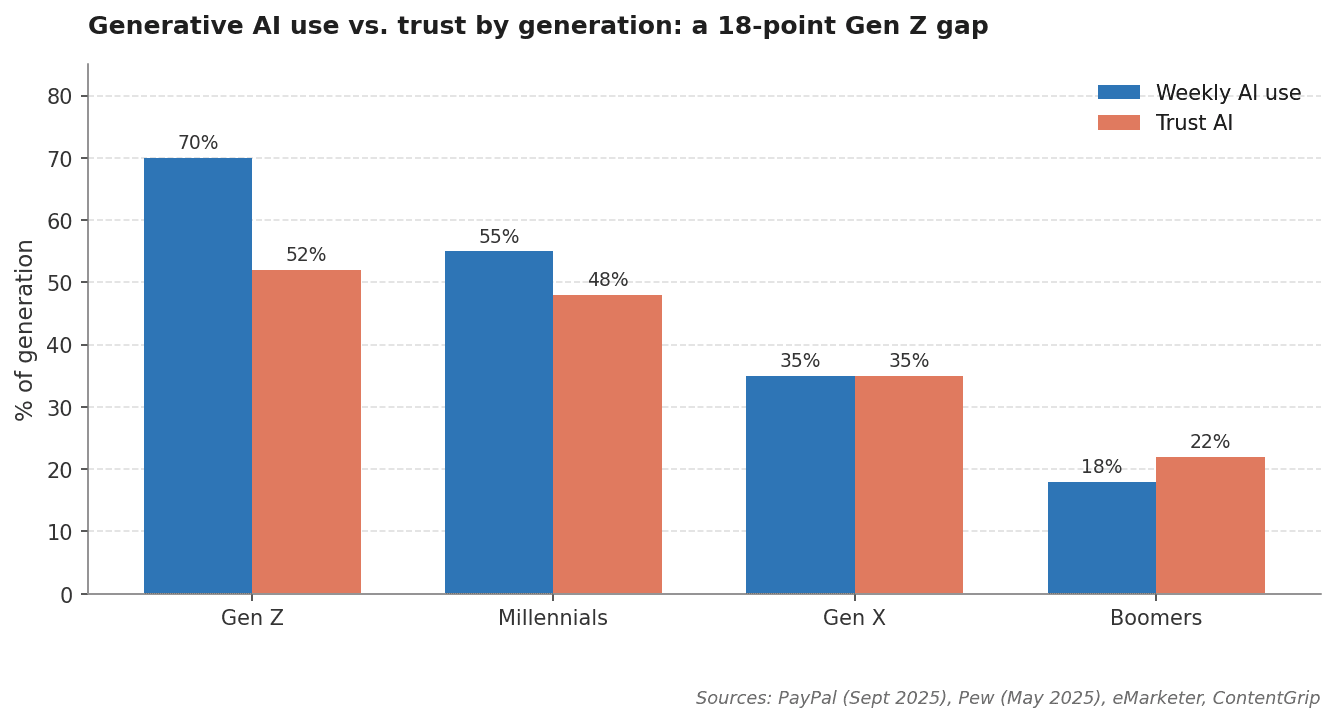
Generative AI weekly use compared with reported trust levels, by generation. The gap is largest for Gen Z.
About 70% of Gen Z reports weekly use of generative AI, and 61% used AI to help with a purchase in the last year (PayPal, September 2025). Forty-two percent use AI tools daily (eMarketer). But trust runs 18 points behind usage — Gen Z trusts AI at only 52%, and Pew (May 2025) found Gen Zers were 11 points less likely than Millennials to "highly trust" AI. The implication for marketers: Gen Z encounters AI summaries constantly but verifies more often than they're given credit for. Recognized brand names in citations get clicked. Unfamiliar names don't.
Older users still default to traditional search at >95% rates. SparkToro's August 2025 panel found that 95% of Americans still use traditional search engines monthly, with overall use essentially flat over 2.5 years. Traditional search isn't shrinking; AI is layering on top.
Session psychology
The Indig–Van Buskirk usability study (70 users, 400+ AIO encounters, 29 hours of think-aloud) was the first large UX study on AIO behavior. Users skim AIOs heavily, often verifying with one source link. Users do click when (a) the AIO doesn't fully answer the query, (b) the source name has high recognition, or (c) the question is high-stakes (health, finance, large purchase). Users disengage entirely when AIO confidence reads as "good enough" — which Pew confirmed at the population scale: 26% of users ended their session entirely after an AIO versus 16% without one. The AI summary is functioning as a satisfying terminal answer for routine queries, and as a routing layer (to a recognized source) for everything else.
B2B and shopping shifts
For B2B, Forrester reported a 45% increase in B2B decision-makers relying on generative AI for vendor research over a 12-month period. Gemini Enterprise alone has sold 8M+ paid seats across 2,800+ companies. The implication: when buyers research a SaaS purchase, an increasing share of that journey now happens inside Gemini, ChatGPT, or AI Mode rather than on Google's blue links — and the brands cited inside those answers are the ones making shortlists.
For commerce, Adobe observed a 1,100% YoY increase in AI traffic to U.S. retail sites by September 2025. Google's Universal Commerce Protocol (announced January 2026) and AI Mode checkout (with Wayfair, Chewy, and Target as launch partners) collapse the search-to-purchase funnel inside Google. Half of Gen Z and 49% of Millennials say they'd hand over gift-buying to AI to avoid stress (Mastercard/Harris Poll, November 2025); 42% of U.S. shoppers would let agents purchase on their behalf if it guarantees the best price.
The 2026 playbook: a three-layer strategy
The mistake most marketing leaders are making in 2026 is treating "SEO" and "AI SEO" as a binary choice. The three surfaces overlap. Roughly half of all queries still run through classic Google. The other half run through AIOs and AI Mode, but those surfaces still cite organic top-10 results 32–54% of the time. Standalone Gemini sits parallel to all of this. The right strategy is layered, not substitutional.
Layer 1: Classic SEO foundations
E-E-A-T, technical health, top-10 rankings, server-side rendering, internal linking, schema implementation — these are still table stakes. Roughly 52% of queries are unaffected by AIOs, and even on AIO-triggering queries, ranking in the organic top 10 is one of the strongest paths to citation. The December 2025 core update reinforced this: old-domain authority still dominates, content is evaluated against Search Quality Rater Guidelines, and helpful content with demonstrated experience wins. Don't abandon the foundation.
Layer 2: Generative Engine Optimization
GEO is the citation game inside AIOs and AI Mode. Six tactical moves, in priority order:
Front-load the canonical answer in the first 30% of every priority page (Indig's "ski ramp" finding: 44.2% of citations come from this region).
Use definitive language — "is defined as," "refers to," "is calculated by" — at a roughly 36% rate in cited paragraphs. Hedging language ("might be," "could potentially") gets cited less.
Add statistics, direct quotations, and citations to credible sources. The Princeton/Georgia Tech findings reproduce: +22% to +41% visibility lift, and up to +115% for mid-ranked pages that add source citations.
Implement Article, FAQPage, Organization (with sameAs), Person, and HowTo schema where relevant. A controlled Search Engine Land experiment showed 47% higher AIO citation rates for tables with proper schema.
Verify server-side rendering for AI crawlers. AI bots ingest raw markup, not JavaScript-rendered DOM. Heavy client-side rendering hides product details from AI ingestion entirely.
Audit your robots.txt for GPTBot, ClaudeBot, PerplexityBot, and Google-Extended. 62% of news publishers block GPTBot and 69% block ClaudeBot — self-inflicted invisibility that creates opportunity for those who don't.
Layer 3: Entity and brand authority
This is the long-term moat and the highest-leverage work in 2026. Branded search volume correlates with AI visibility at r ≈ 0.39–0.66; YouTube mentions at r ≈ 0.74. Backlinks correlate at r ≈ 0.10. Where does brand demand come from? PR, partnerships, podcast appearances, conference talks, original research, co-marketing, community participation — all the activities Rand Fishkin, Aleyda Solís, and Kevin Indig have collectively been describing as zero-click marketing.
A practical multi-format checklist: a YouTube channel with substantive product or service videos (the single strongest AI citation predictor); a LinkedIn article cadence (LinkedIn rose from rank 11 to rank 5 on ChatGPT citations between November 2025 and February 2026); strategic Reddit participation in your category subreddits (heavy in AIO and Perplexity citations); review platform profiles on G2, Capterra, and Trustpilot (brands with profiles have 3× higher ChatGPT citation rates); and Wikipedia/Wikidata coverage if you meet notability thresholds.
Sequencing by audience
The same three layers, but the order changes by team type.
Audience | Recommended sequence |
SMB owners | Start with the entity layer (Google Business Profile, NAP consistency, review platforms, Wikipedia presence if eligible). Then GEO on your top 10–20 buyer-intent pages. Technical SEO last unless your site has obvious crawl/render issues. |
In-house SEOs | Rebuild reporting first — citation share, branded search lift, conversion rate by source, revenue per visit. Segment your keyword universe by AIO exposure × intent. Run GEO and entity work in parallel; use Search Console for the half of your traffic that still runs on classic ranking. |
Agencies | Reset client expectations explicitly with the HubSpot, Press Gazette, and Pew data alongside the 4.4×–23× conversion premium counter-data. Reframe contracts around citation share and revenue per visit. Standardize a monthly AI visibility report across your portfolio. Price citation share as a deliverable. |
Why traffic-only reporting will keep showing losses
The hardest conversation many SEO leaders will have in 2026 is the one about what success looks like. If a client or executive measures performance only by raw organic sessions, every quarter looks worse than the last — because the structural displacement is real. But the same brand may be earning more revenue per visit, more high-intent traffic, and more AI citations that compound over time.
The metrics that actually matter in 2026:
Citation share across the major AI engines (AI Overviews, AI Mode, ChatGPT, Gemini, Perplexity), tracked monthly.
Branded search volume — the strongest single leading indicator of AI visibility (r ≈ 0.39–0.66).
Conversion rate by traffic source, with AI sources tracked separately via UTM parameters or referrer analysis.
Revenue per visit, not sessions. AI traffic is smaller in volume but converts at 4.4× to 23× organic in research-intensive verticals.
Branded vs. non-branded organic ratio. As non-branded informational queries get absorbed into AIOs, the branded share of remaining organic traffic should rise — that's a feature of the new SERP, not a regression.
Google Search Console alone won't give you most of these. The brands that build a parallel reporting layer — combining Search Console for the ranking half of the world with AI visibility tools that monitor citations across the four to five major engines — are the ones positioned to absorb the displaced demand.
This is the gap
This is exactly the gap QuickSEO was built to close — bringing your Google Search Console performance and your AI visibility across ChatGPT, Claude, Gemini, and Perplexity into a single dashboard.
Conclusion
Three Google surfaces. Three different ranking games. Three different user behaviors. The marketers who will thrive in 2026 are the ones who stop asking "is SEO dead?" and start asking "what fraction of my queries run through which surface, and what's my citation share inside each one?"
Classic Google Search isn't dead — it's now one layer of three. AI Overviews aren't a temporary feature — they're the default surface on roughly half of U.S. queries and the source of a 35% organic and 91% paid click amplifier when you're cited. Gemini and AI Mode are parallel discovery channels with 850M+ combined monthly users where the unit of visibility is citation, not ranking. The brands winning in 2026 are tracking citation share alongside ranking, investing in entity authority over link velocity, and building reporting that surfaces the AI-driven conversion premium their executives haven't been told about yet.
The honest version of the story is not collapse. It's repricing — and the brands that get measurement right will absorb the displaced demand.
Enter your website to track its AI visibility across ChatGPT, Gemini, Claude, and Perplexity — and turn chatbot mentions into traffic.
- Set up in minutes
- Cancel anytime
Try it yourself
Related free tools
Free SEO tools related to the topics covered in this article.
Keep reading
Related posts
More articles on the same topics, prioritized by shared tags and keyword overlap.