How to Show Up in Google AI Overviews: The Data-Backed SEO Playbook for 2026

 Summarize in ChatGPT
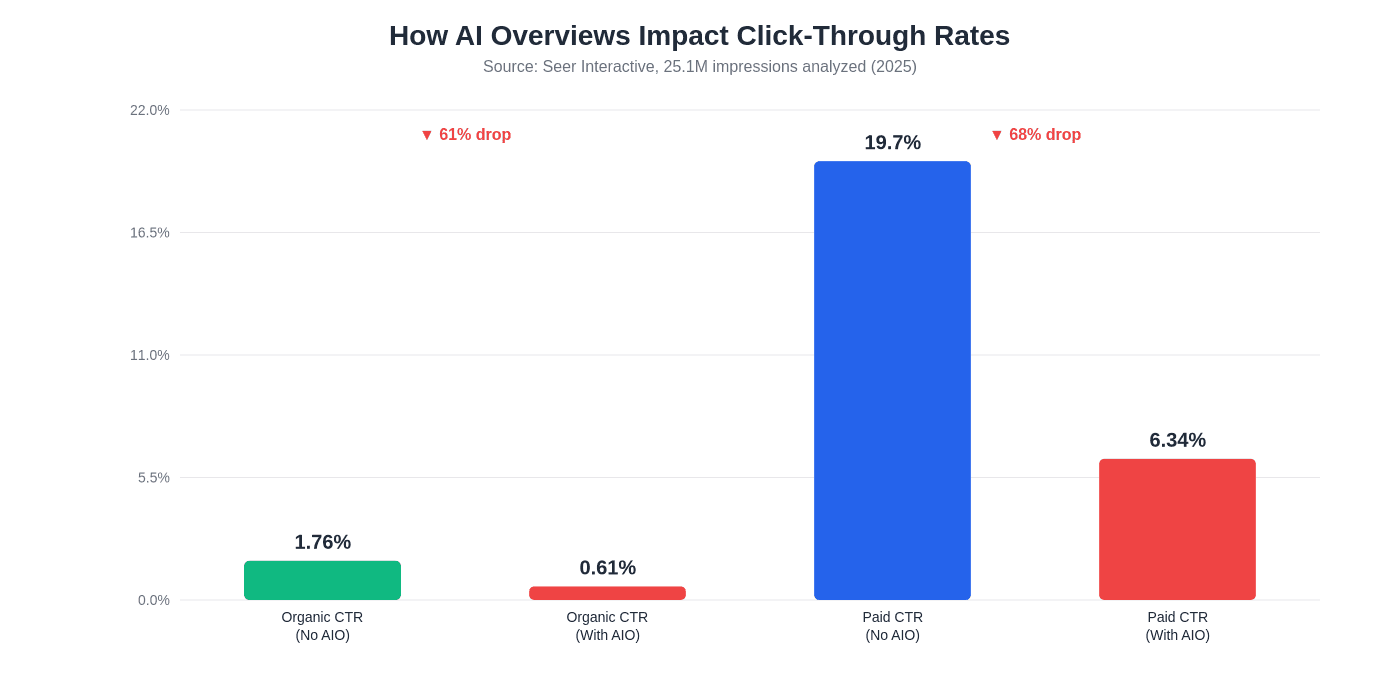
Google AI Overviews now appear on 25–50% of all search queries, and they’re fundamentally changing which websites get clicks. Organic CTR drops 61% when an AI Overview appears—but brands cited inside them earn 35% more clicks than before. This guide breaks down exactly what drives AI Overview citations in 2026, backed by data from studies analyzing millions of queries, and gives you a practical optimization playbook.
The stakes: why AI Overviews demand your attention now
AI Overviews are Google’s AI-generated summaries that appear at the top of search results for an increasing share of queries. Powered by Google’s Gemini model, they pull information from multiple web pages, synthesize it into a cohesive answer, and link to cited sources. Unlike featured snippets that pull from a single page, AI Overviews draw from several sources simultaneously—which means the competition for citation is fierce.
The numbers tell the story of why this matters:
AI Overviews now appear in 25.11% of Google searches, up from 13.14% in March 2025. Conductor’s analysis of 21.9 million queries confirms the trend is accelerating.
When AI Overviews appear, organic click-through rates collapse. Seer Interactive’s study of 25.1 million impressions found organic CTR dropped from 1.76% to just 0.61%—a 61% decline. Paid CTR fared even worse, crashing 68% from 19.7% to 6.34%.
But here’s the crucial flip side: brands that are cited inside AI Overviews earn 35% more organic clicks and 91% more paid clicks than uncited competitors on the same query. Citation is becoming the new ranking.
The conversion story adds urgency. AI Overview traffic converts at 14.2% compared to just 2.8% for traditional organic search—a 5x quality premium, according to multiple 2025–2026 studies compiled by Superlines. ChatGPT referral traffic converts at 11.4%, Perplexity at 10.5%. Visitors arriving through AI-generated answers come pre-researched and further along the buyer journey.
The rules have changed: ranking #1 no longer guarantees citation
The most important shift for SEO practitioners in 2026 is this: the correlation between organic rankings and AI Overview citations is collapsing.
In mid-2025, Ahrefs found that 76% of pages cited in AI Overviews also ranked in the top 10 for the same query. By early 2026, that number had plummeted. Ahrefs’ February 2026 study shows it dropping to roughly 38%, while BrightEdge independently measured just 17% overlap. Both studies use different methodologies, but both point in the same direction: Google’s AI is increasingly pulling citations from sources that don’t rank highly in traditional organic results.
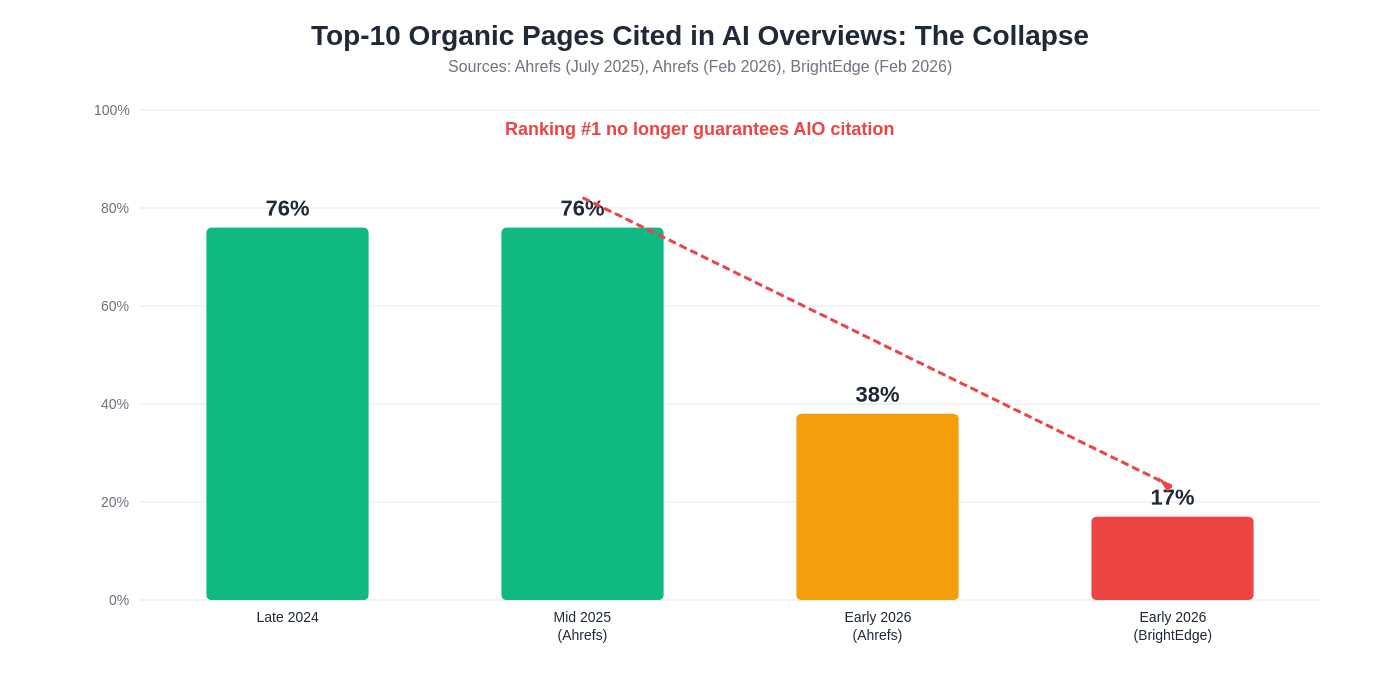
This decoupling was accelerated by Google’s upgrade to Gemini 3 in January 2026 and the growing role of query fan-out—the process where the AI decomposes a single user query into multiple sub-queries and retrieves sources for each. ALM Corp’s detailed analysis documents how this shift unfolded. A page that answers one facet of a complex question can earn a citation even if it doesn’t rank for the main keyword.
The practical implication is clear: a traditional SEO strategy focused solely on ranking in the top 10 is no longer a complete AI visibility strategy. You need to optimize specifically for the signals AI Overviews use to select sources.
What AI Overviews actually cite: the source landscape
Understanding which sources Google’s AI trusts helps you model what to aim for. Surfer’s AI Tracker analyzed 36 million AI Overviews and 46 million citations between March and August 2025, revealing a concentrated citation landscape:
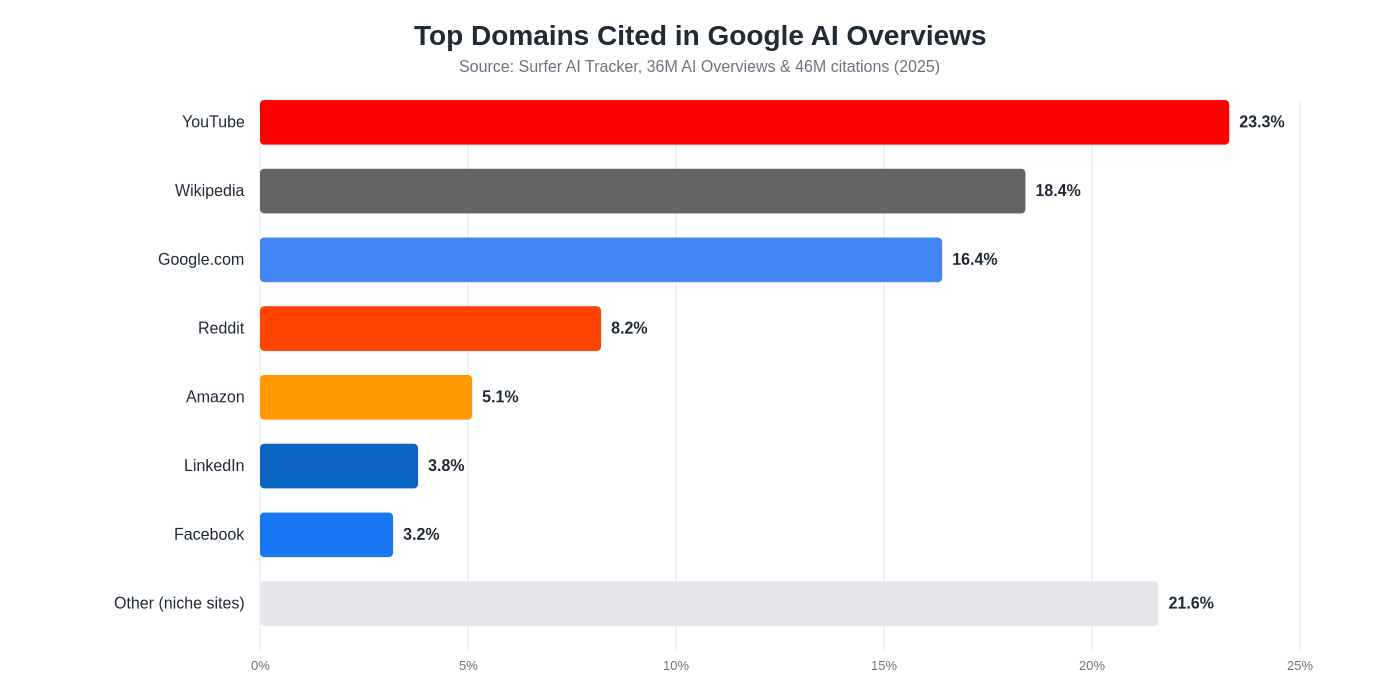
YouTube’s dominance is the standout finding of 2026. ALM Corp reported YouTube’s citation share grew 34% in six months, with 18.2% of all citations from pages outside the top 100 organic results pointing to YouTube URLs. Ahrefs’ research on 75,000 brands found that brand mentions in YouTube video titles, transcripts, and descriptions correlate more strongly with AI Overview visibility than almost any other signal studied.
Beyond YouTube, the pattern favors sources the AI considers “reference-grade”: Wikipedia for encyclopedic authority, Reddit and community forums for contextual depth, and niche-authoritative sites within specific verticals. OtterlyAI’s study of over one million citations found that news and media represent 20–30% of citations, brand sites get mentioned often but linked rarely (except in AI Overviews, where Google shows the strongest brand preference at 59.8% of citations), and community forums capture 5.9–16.9%.
Key insight: Google AI Overviews show stronger brand preference (59.8% of citations) than ChatGPT (44.7%) or Perplexity (28.9%). If you’re optimizing for AIO specifically, your own website has a better shot than on other AI platforms.
The 10-point optimization playbook
Google’s official position is that there are “no additional requirements” beyond standard SEO fundamentals. That’s technically true—but it’s also misleading. The data shows that specific patterns dramatically increase citation probability. Here’s what actually works.
1. Lead with the answer, then expand
AI Overviews use a retrieval-augmented generation (RAG) approach: they retrieve relevant passages from indexed pages and use them to construct the summary. Research from Wellows analyzing 15,847 AI Overview results found the optimal passage length for extraction is 134–167 words—self-contained chunks that fully answer a sub-question without requiring external context.
Structure every section of your content so it could stand alone as an answer. Start with a direct, definitive statement, then provide supporting detail. Avoid pronouns that reference earlier content (“this,” “these,” “that approach”)—each passage should make sense if extracted in isolation.
Growth Memo’s February 2026 analysis found that 44.2% of all LLM citations come from the first 30% of an article’s text. Front-loading your most important answers isn’t just good UX—it’s where AI systems look first.
2. Target long-tail, question-based keywords
Informational keywords trigger AI Overviews at dramatically higher rates. Ahrefs found that informational search intent keywords produce AIOs 99.2% of the time, while commercial and navigational queries trigger them less frequently (though this is changing fast—commercial AIO triggers grew from 8% to 18% through late 2025).
Queries of 8 words or longer have a 57% chance of triggering an AI Overview. Focus your content on the specific, multi-faceted questions your audience actually asks rather than short head terms. A page targeting “how to choose running shoes for flat feet and long distance” has a far better chance of AIO citation than one targeting just “running shoes.”
3. Build topic clusters, not isolated pages
The query fan-out mechanism means Google’s AI decomposes complex queries into sub-queries and retrieves sources for each. Surfer’s study of 173,902 URLs found that pages ranking for multiple fan-out queries are significantly more likely to earn AI Overview citations than pages ranking for only the parent query.
In practice, this means building comprehensive topic clusters: a pillar page covering the broad topic, linked to detailed sub-pages that cover specific facets. When the AI fans out a query into 4–6 sub-queries and your site ranks for several of them, you’re much more likely to earn citations than a competitor with a single page.
4. Use structure that machines can parse
AI systems use heading hierarchy as structural signals to understand what each section answers. Clear H2/H3 subheadings, bulleted and numbered lists, comparison tables, and short paragraphs all improve extractability. Content that uses structured heading tags matching real questions (“How much does X cost?” as an H2 rather than “Pricing Details”) aligns directly with how AI queries are formed.
The data backs this up: pages with multi-modal elements (text plus images, tables, or structured data) show 156% higher selection rates versus text-only content in AI Overview results, according to Wellows’ ranking factors study. Add data tables for comparisons, embed relevant images with descriptive alt text, and include FAQ sections.
5. Implement structured data markup
While Google says no special schema is “required,” the evidence suggests structured data provides a meaningful edge. Research shows pages with FAQPage, HowTo, Article, and VideoObject schema in JSON-LD format see a +73% selection rate for AI Overview citation. Author schema specifically correlates with a 3x increase in AI answer appearances, according to BrightEdge.
At minimum, implement Article schema with author information, FAQ schema for question-and-answer sections, and Organization schema on your homepage. For e-commerce, add Product, Review, and MerchantReturnPolicy schema—AI Overviews increasingly surface these for commercial queries.
6. Double down on E-E-A-T signals
A striking 96% of AI Overview citations come from sources with strong E-E-A-T (Experience, Expertise, Authoritativeness, Trustworthiness) signals, per Wellows’ analysis. This isn’t just about having a well-known brand—it’s about making your expertise machine-readable.
Practical steps: add detailed author bios with credentials on every article. Link to and cite authoritative external sources within your content. Include original data, case studies, or proprietary research that other sites can’t replicate. The Princeton GEO research paper found that adding statistics and specific data citations to content boosted AI visibility by up to 40%.
7. Keep content fresh (the 60-day rule)
BrightEdge data shows that pages updated within 60 days are 1.9x more likely to appear in AI answers than older content. AI Overviews prioritize freshness, particularly for topics where information changes frequently.
But superficial updates won’t work. Adding a new date without substantive changes doesn’t fool the system. Refresh cornerstone content with updated data points, new examples, current statistics, and a visible “Last updated” timestamp. For evergreen content, set a 3–6 month refresh cadence.
8. Build brand mentions and cross-platform presence
SE Ranking’s study of 2.3 million pages found that domain traffic is the #1 predictor of AI citations (SHAP value: 0.63). But brand mentions across the broader web matter enormously too. Domains with mentions on platforms like Reddit, Quora, Trustpilot, G2, and Capterra are 3x more likely to be cited by AI systems, as documented in Position Digital’s AI SEO statistics roundup.
The Digital Bloom study found that brands mentioned on 4 or more platforms are 2.8x more likely to appear in AI responses. This means your AI visibility strategy must extend beyond your own website to include guest posts, community engagement, review platform presence, and social media activity—particularly on YouTube, where the citation correlation is strongest.
9. Ensure AI crawler access
This is the most overlooked technical issue. OtterlyAI’s 2026 citation report emphasizes that crawlability problems prevent 73% of sites from being properly accessed by AI crawlers. Before worrying about content optimization, verify that your robots.txt allows Googlebot (and ideally GPTBot, ClaudeBot, and other AI crawlers), your pages aren’t blocked by CDN or hosting rules, JavaScript-dependent content is properly rendered for crawlers, and your pages load quickly—SE Ranking found that pages with First Contentful Paint under 0.4 seconds average 6.7 citations versus just 2.1 for pages over 1.13 seconds.
10. Create content YouTube and the AI can cite together
Given YouTube’s position as the most-cited domain in AI Overviews, a video strategy is no longer optional for serious AIO optimization. Create companion YouTube videos for your most important content, using keyword-rich titles, detailed descriptions, and full transcripts. Ahrefs found that YouTube mentions—in titles, transcripts, and descriptions—are the strongest correlating factor with AI Overview visibility among all signals studied across 75,000 brands.
Embed these videos within your written content. Pages that combine text, video, and structured data align with the multi-modal content pattern that drives the 156% higher selection rate.
Why this traffic is worth fighting for
The conversion data makes the ROI case unambiguous. Across every major AI platform, referral traffic converts at multiples of traditional organic search:
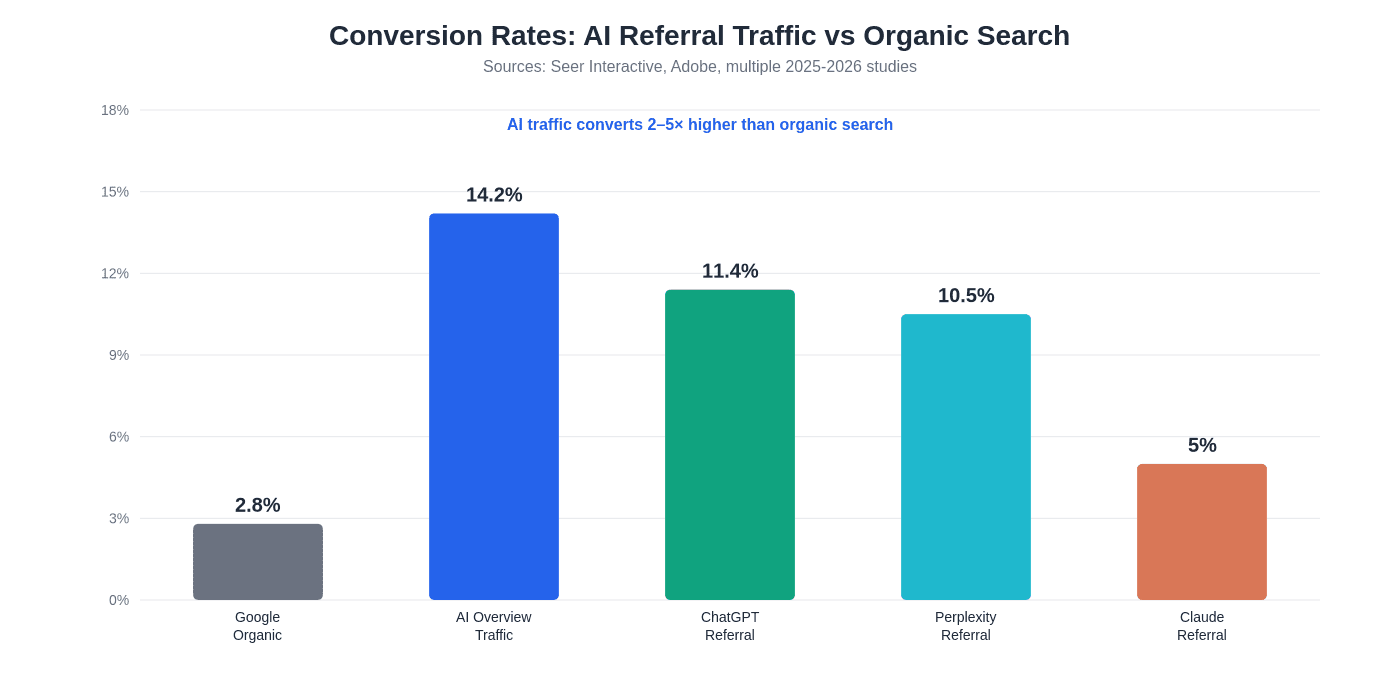
Adobe’s holiday 2025 data showed AI-referred traffic converting 31% higher than other sources. During Prime Day 2025, AI referral traffic to U.S. retail sites surged 3,300% year-over-year. These visitors arrive further along the buyer journey—pre-researched, pre-compared, and ready to act.
The volume is growing fast too. AI platforms collectively sent over 2 billion referral visits to websites in Q3 2025, growing 778% year-over-year, as tracked by Superlines’ AI search statistics report. Yet AI referral traffic still represents only about 1% of total web traffic—meaning the growth runway remains enormous.
The measurement gap: you can’t optimize what you can’t see
Here’s the uncomfortable truth about AI Overview optimization: most brands have no idea whether they’re being cited or not.
Google Search Console started including AI Overview data in its Performance report as of June 2025, but it does not separate AI Overview impressions and clicks from traditional organic results. You can see aggregate traffic changes, but you can’t tell which queries triggered AI Overviews or whether your pages were cited.
This matters because AI Overview content is wildly volatile. AirOps research found that AIO content changes roughly 70% of the time for the same query, and when the answer updates, nearly half of the citations get replaced with new sources. Only about 30% of brands remain visible in back-to-back AI responses for the same query. Without continuous monitoring, you’re optimizing blind.
Only 16% of brands currently track their AI search visibility systematically. The other 84% are flying blind while competitors quietly capture AI-driven traffic.
Going beyond AI Overviews: the multi-platform reality
AI Overviews are just one piece of the AI search landscape. The same users asking Google also ask ChatGPT, Claude, Gemini, and Perplexity—and each platform uses different sources and different ranking signals.
The divergence is striking: Ahrefs found only 13.7% citation overlap between AI Overviews and Google’s AI Mode. Only 11% of domains are cited by both ChatGPT and Perplexity. Only 20% overlap exists between Claude and ChatGPT results. Superlines found the same brand can see citation volumes differ by 615x between platforms.
This fragmentation means optimizing for AI Overviews alone isn’t enough. The brands building lasting AI visibility are tracking their presence across all major platforms simultaneously.
How to track your AI visibility
A complete monitoring approach combines several layers. Google Search Console gives you aggregate search performance data, including traffic from AI Overview-enhanced results, but can’t tell you specifically about AIO citations. Manual sampling—searching your target keywords regularly in incognito mode—helps you spot-check citation status but doesn’t scale.
For systematic tracking across AI platforms, tools like QuickSEO bring your Google Search Console analytics and AI visibility tracking into a single dashboard. You can track how your brand scores across ChatGPT, Claude, Gemini, and Perplexity, see which of your pages get cited, monitor sentiment, and identify which competitors appear alongside you in AI answers—all connected to your actual GSC performance data. This is particularly valuable because it lets you see where your Google rankings and AI visibility diverge, revealing optimization opportunities that neither dataset shows on its own. Learn more at quickseo.ai.
Your action plan: what to do this week
The gap between brands that invest in AI visibility now and those that wait will compound over time. AI systems tend to reinforce their source selections across related queries, creating winner-takes-most dynamics. Here’s how to start:
Immediate actions (this week)
Audit your AI crawler access. Check robots.txt, CDN rules, and JavaScript rendering. Fix any blocks immediately.
Search your top 10 target keywords in incognito mode. Note which trigger AI Overviews and whether you’re cited.
Identify your highest-traffic pages and restructure them with answer-first formatting, self-contained passages, and clear heading hierarchy.
Add Article and FAQ schema to your top content pages if they don’t already have it.
This month
Refresh your top 5 cornerstone pages with updated data, new examples, and visible “Last updated” timestamps.
Build or expand topic clusters around your most important keywords, creating sub-pages that cover specific facets.
Create at least one YouTube video for your highest-value topic, with keyword-rich title, description, and transcript.
Set up systematic AI visibility monitoring across Google, ChatGPT, Claude, Gemini, and Perplexity.
Ongoing
Refresh key content every 60 days with substantive updates—not just date changes.
Build brand mentions across platforms: guest posts, community engagement, review sites, YouTube.
Monitor AI visibility weekly. AIO citations shift fast—70% of answers change between checks—so continuous tracking is essential.
Track both your traditional SEO metrics and AI metrics (citation frequency, share of voice, sentiment) side by side. The brands winning in 2026 are the ones that excel at both.
—
QuickSEO tracks your brand’s performance across Google Search and AI answers from ChatGPT, Claude, Gemini, and Perplexity—one dashboard, no guesswork. See where your Google rankings and AI visibility diverge, and get actionable recommendations to close the gap.
Start tracking at quickseo.ai
Enter your website to track its AI visibility across ChatGPT, Gemini, Claude, and Perplexity — and turn chatbot mentions into traffic.
- Set up in minutes
- Cancel anytime
Keep reading
Related posts
More articles on the same topics, prioritized by shared tags and keyword overlap.