Link Building Statistics 2026: 70+ Data Points (Including AI Search)

 Summarize in ChatGPT
Link building entered 2026 in the strangest position it's ever held. The classic correlations are intact: the #1 result on Google still has 3.8× more backlinks than positions #2–10. But everything around those links has shifted. Costs are up 20–35% since 2022. Cold outreach reply rates have collapsed from 8.5% to 3.43%. And for the first time, AI search engines are using a different signal entirely — branded mentions outweigh backlinks by roughly 3× in predicting whether you show up in Google's AI Overviews.
This guide pulls together 70+ verified statistics from primary sources — Ahrefs, Backlinko, BuzzStream, Authority Hacker, McKinsey, Princeton's GEO research paper, and others — to give you the most current view of what's actually working in 2026, what costs what, and how AI search is rewriting the rules.
Every number below links to its primary source.
The 10 Most-Cited Link Building Statistics for 2026
If you only remember ten numbers from this guide, make it these. Each is sourced from a primary study and is currently being cited across the SEO industry.
Statistic | Source | Year |
|---|---|---|
$508.95 average cost of a high-quality backlink | 2025 | |
8.5% average cold outreach reply rate | 2024 | |
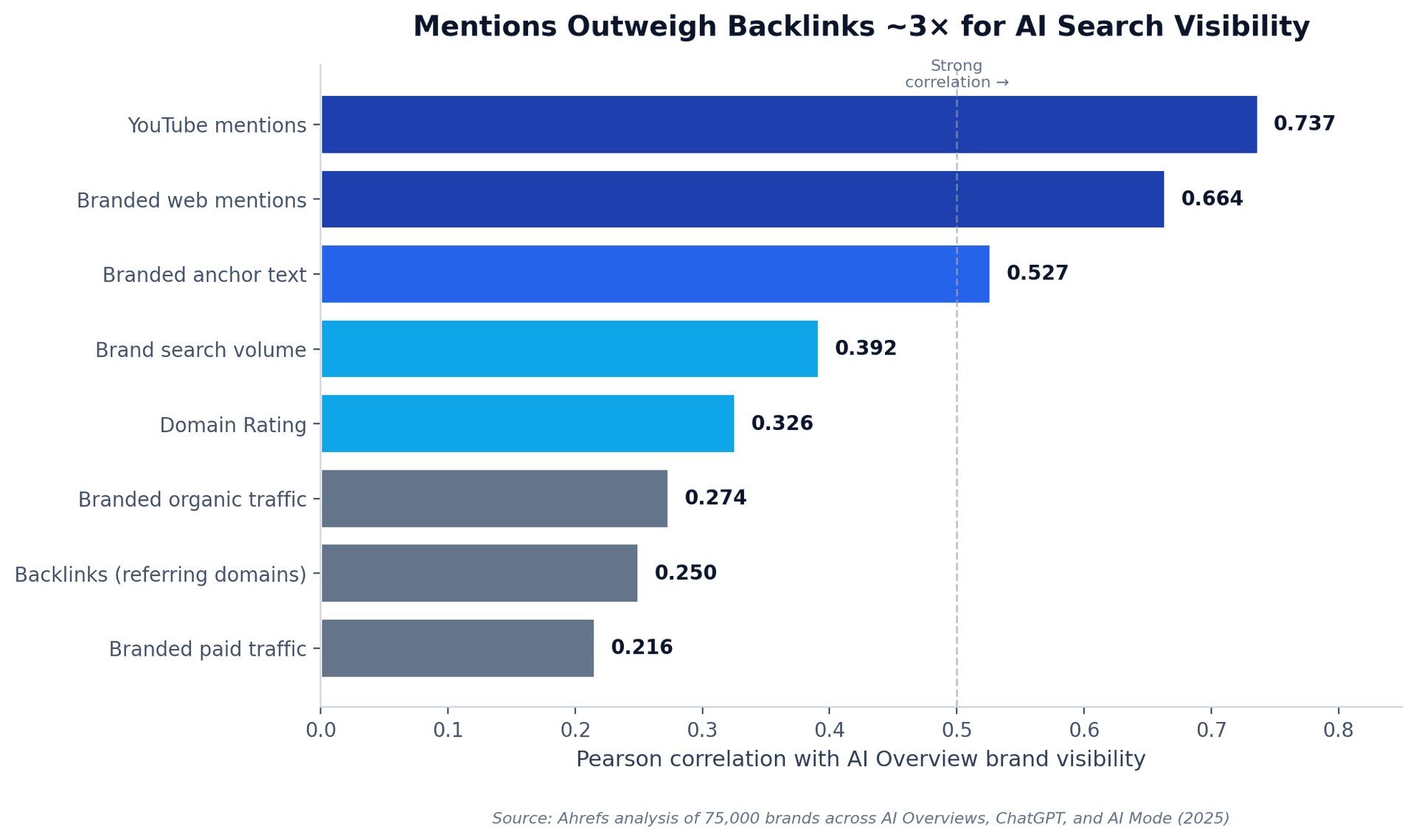
0.664 correlation between brand mentions & AI Overview visibility | 2025 | |
44% of consumers say AI is their primary search source | 2025 | |
78.1% of SEOs report positive ROI from link building | 2025 | |
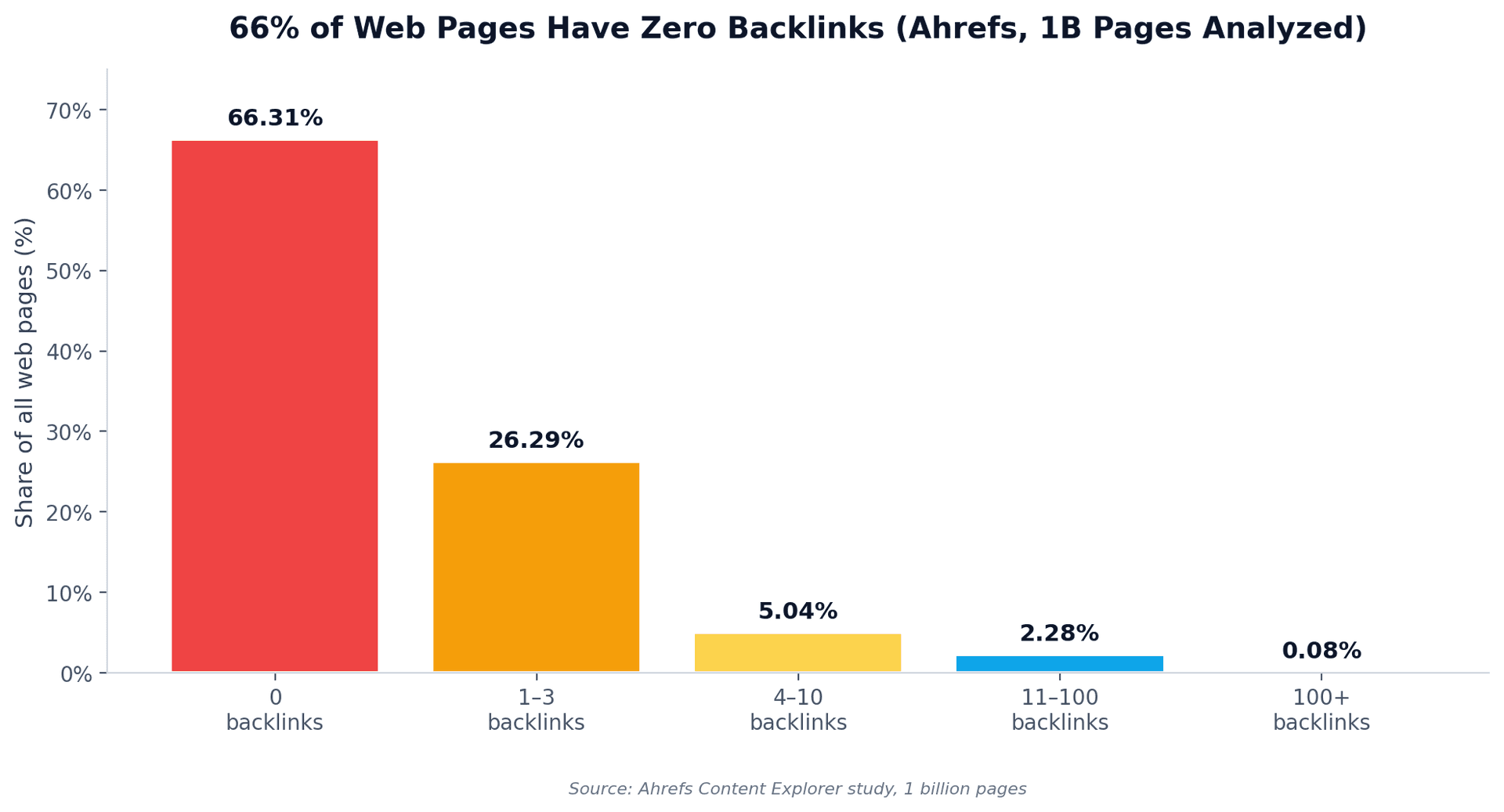
66.31% of web pages have zero backlinks | 2023 | |
The #1 Google result has 3.8× more backlinks than #2–10 | 2025 | |
805% YoY increase in AI-driven retail traffic on Black Friday | 2025 | |
56% of companies plan to increase link budgets in 2025 | 2025 | |
76% brand overlap between ChatGPT and Google AI Overviews | 2025 |
How Much Does Link Building Cost in 2026?
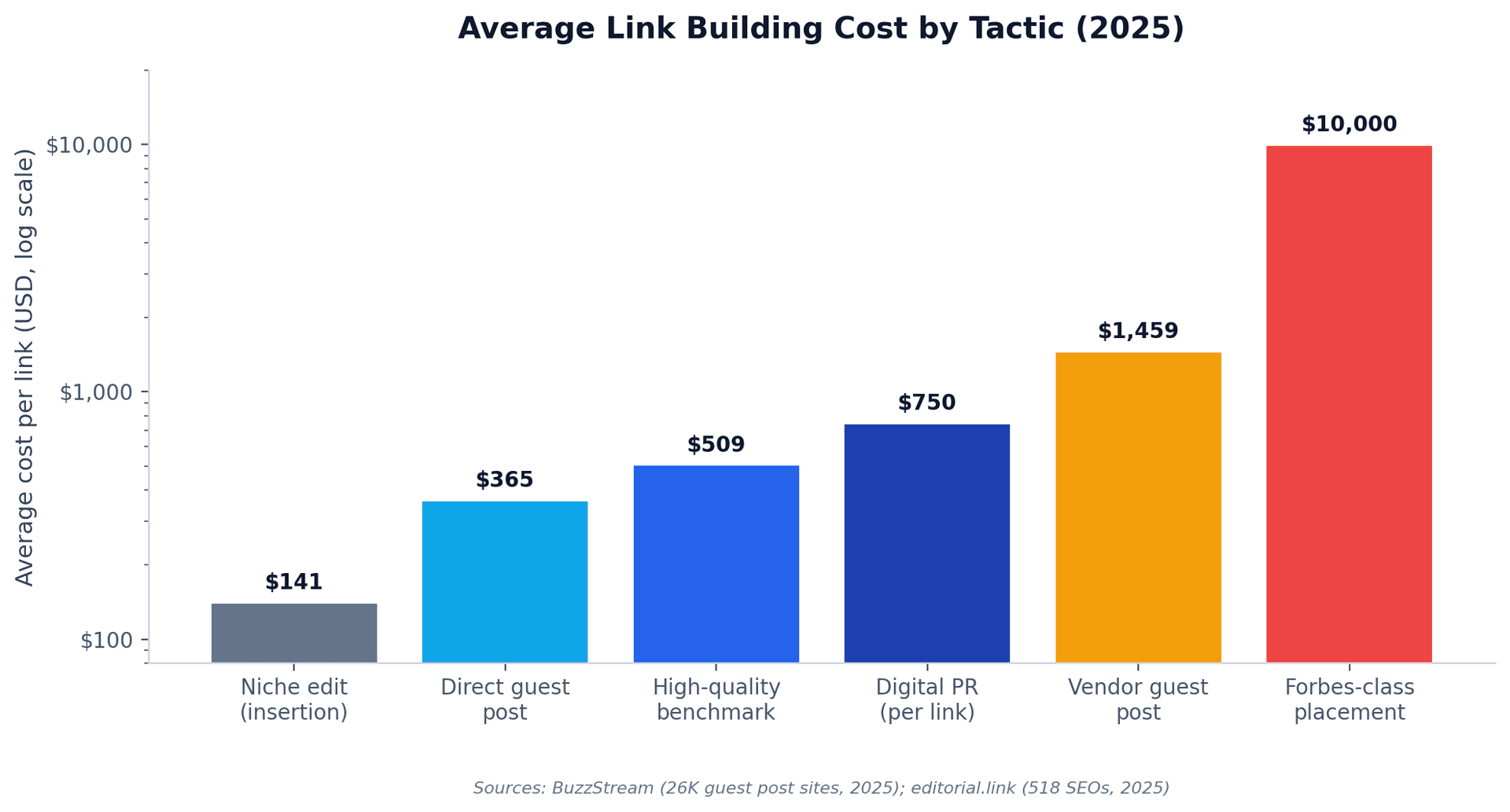
The single most-cited 2026 cost benchmark comes from editorial.link's survey of 518 SEO professionals: the average price SEOs consider acceptable for a high-quality backlink is $508.95. That number masks enormous variation by tactic.
Per-link benchmarks by tactic
Average direct guest post cost: $364.76 — based on BuzzStream's 2025 analysis of 26,000+ guest post sites. When you go through a vendor, the average rises to $1,459.06.
Quality guest post tier (DR 71+, 50K+ traffic): $692–$957 before vendor markup, $1,211–$1,675 through vendors. Forbes-class placements routinely hit $10,000+.
Average link insertion (niche edit): $141 per BuzzStream — though quality niche edits typically run $200–$400.
Digital PR average cost-per-link: $750. Full earned-media campaigns commonly push $1,250–$1,500 per unique linking domain (BuzzStream State of Digital PR).
Average monthly digital PR retainer: $5,458 across 70+ surveyed agencies and freelancers. Agencies charge ~50% more than freelancers ($6,357 vs. $4,200).
Cost-per-link by Domain Rating tier
Pricing scales steeply with the linking site's authority. These are composite benchmarks across multiple 2025 surveys (uSERP, editorial.link, Stellar SEO):
DR Tier | Direct cost per link | Through vendor / agency |
|---|---|---|
DR 20–40 | $130–$220 | $300–$450 |
DR 40–60 | $220–$400 | $450–$800 |
DR 60–80 | $400–$700 | $800–$1,500 |
DR 80+ | $700–$1,200+ | $1,500–$3,800+ |
.gov / .edu | $3,000+ | $5,000+ |
Budgets, allocation, and ROI
46.5% of SEOs spend $5,000–$10,000/month on link building; 18% spend $10,000+/month (uSERP State of Backlinks).
Agencies allocate 32.1% of total SEO budget to link building; in-house teams allocate 36.03% (editorial.link, 2025).
80.9% of SEOs expect link building costs to rise over the next 2–3 years. AI-generated content saturating editor inboxes is a primary driver.
78.1% of SEOs report positive ROI from link building. Median SEO ROI sits at 748% per First Page Sage's 2026 ROI analysis (B2B SaaS specifically: 702% ROI with a 7-month break-even).
74.3% of link builders pay for links — and 92% of SEOs believe their competitors do too (Authority Hacker, survey of 755 link builders).
Outreach Reality: What Actually Works in 2026
Backlinko's analysis of 12 million outreach emails is still the most-cited dataset in the industry, and its headline number — an 8.5% average reply rate — has been repeated for years. But the more recent benchmarks tell a harsher story.
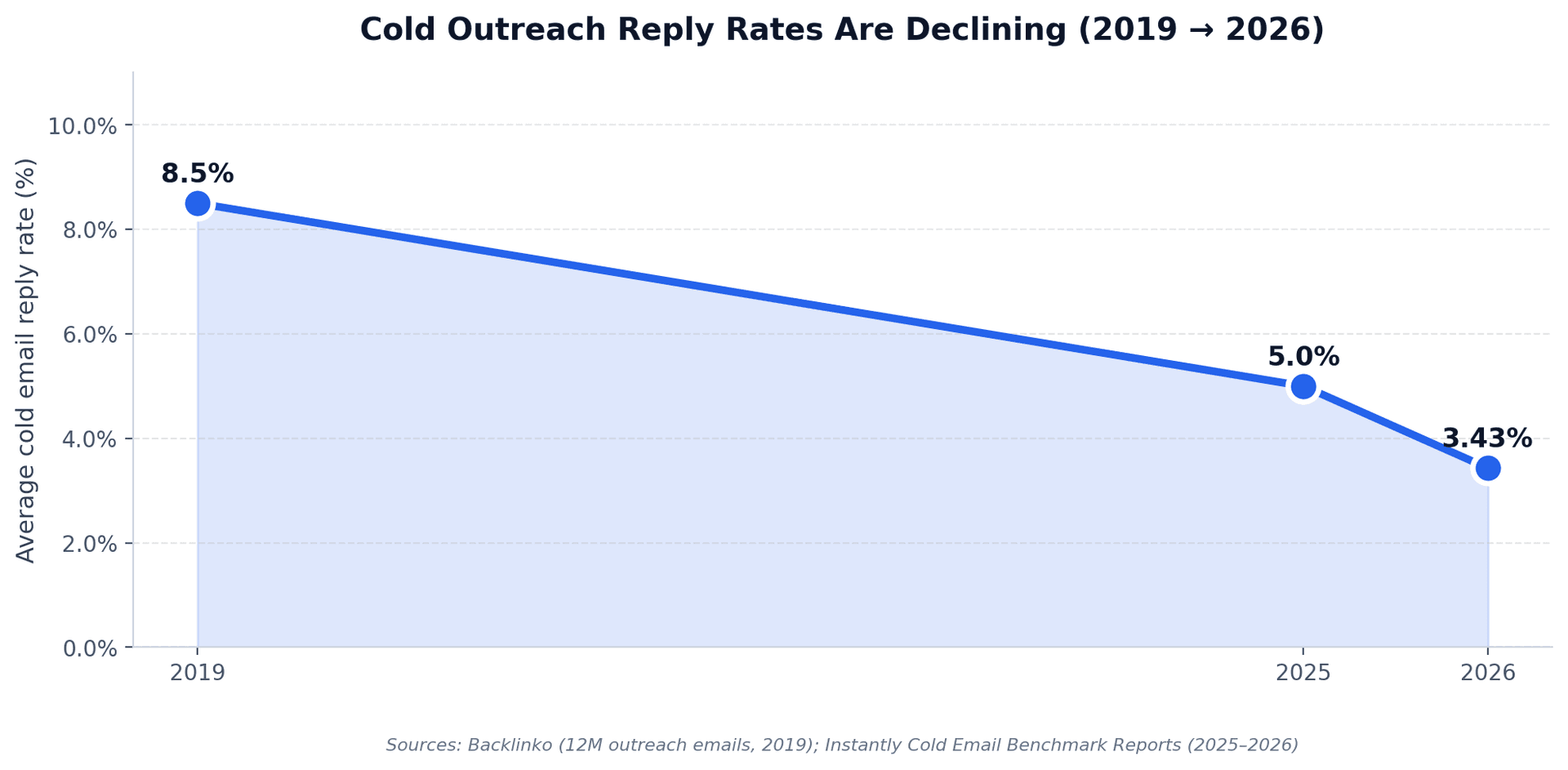
By 2026, Instantly's Cold Email Benchmark Report puts the average reply rate at just 3.43%, down from 5% in 2025 and 8.5% in 2019. Inbox saturation, AI-generated outreach, and stricter spam filters have all compressed the baseline. Plan your campaigns accordingly.
What still moves the needle
Personalized subject lines lift reply rates by 30.5%; personalized email bodies by 32.7% (Backlinko, 12M-email study).
A single follow-up increases replies by 65.8%. Emailing the same contact twice yields 2× more responses; reaching multiple contacts at one company yields 93% more responses.
Long subject lines (36–50 chars) get 24.6%–32.7% higher response rates than short ones (Backlinko).
Email-to-link conversion: 3–5% for well-run programs. uSERP's broader figure says only 8.5% of cold outreach generates an actual link end-to-end.
Time to secure a link: 3.1 months on average, with 89.2% of link builders saying ranking impact appears within 1–6 months (Authority Hacker).
Spray-and-pray penalty: large-volume outreach (>1,000 emails) reply rates average ~0.85% — roughly 3× worse than tightly targeted small-batch outreach (BuzzStream's 31M-email study).
60.7% of digital PRs say finding relevant journalists is harder than 12 months ago, and 73% of journalists reject pitches as irrelevant to their beat (Cision + BuzzStream, 2025).
How Many Backlinks Do You Actually Need?
The most-cited modern study on this question is Backlinko's analysis of 11.8 million Google search results (updated April 2025). The headline finding: the #1 result has 3.8× more backlinks than positions #2–10, and 96% of first-page results have 1,000+ referring domains.
The reality of the long tail
66.31% of pages have zero backlinks; 26.29% have 3 or fewer; only 0.08% have 100+ (Ahrefs Content Explorer, 1 billion pages analyzed).
94% of all online content gets zero external links; only 2.2% earns links from more than one site (Backlinko/BuzzSumo, 912M-blog-post study — older but still the most-cited figure).
90.63% of pages get zero Google traffic; 96.55% get less than ~10 visits/month (Ahrefs, 14B-page study).
Top-ranking pages acquire backlinks at +5% to +14.5% per month from new referring domains (Ahrefs link velocity study). Ahrefs explicitly notes correlation ≠ causation here.
92.3% of top-100 ranking sites have at least one backlink (Semrush).
73.5% of link builders build fewer than 10 links/month. Experienced builders (5+ years) produce 3.57× more links than beginners — 25/mo vs. 7/mo (Authority Hacker).
Link Quality Signals That Still Matter
Quantity gets you a baseline. Quality is where 93.8% of link builders say the actual ranking impact lives (Authority Hacker).
Average DR of a real-world backlink: ~41 (BuzzStream synthesis, 2025). The average isn't the goal — it's the floor.
78.8% of SEOs believe nofollow links impact rankings; 80.9% believe unlinked brand mentions influence organic rankings (editorial.link).
Anchor text preferences: 41.7% of SEOs prefer partial-match anchors; 25.1% exact-match; 20.5% branded (editorial.link, 2025).
90% of guest post acceptances come from same-niche sites. 85.3% of guest-posting marketplace sites fail BuzzStream's basic quality threshold (DR <40 AND <10K monthly traffic).
Top quality red flags: 89% spammy outbound links; 86.3% low-quality content; 72.2% poor domain authority metrics (editorial.link).
Link decay: the silent budget killer
Most SEOs underweight this. Ahrefs' 9-year link rot study across 14 billion links found that 66.5% of links across 2 million sites had rotted since January 2013, and 74.5% are considered "lost" by Ahrefs' SEO definition. Roughly 1.3% of links die per week, and ~7% disappear within the first year. Some monitoring datasets put first-year loss closer to 17%.
Translation: a non-trivial chunk of every link building program goes to replacing inventory that quietly disappeared.
And to the eternal question of "do links still move rankings?" — Ahrefs ran a controlled disavow study in 2024: removing links via disavow caused traffic drops of 13.3%–18% on test pages; restoring them recovered 99–144% of traffic. Yes, they still work.
The AI Search Shift: Mentions Are Becoming the New Links
This is where 2026's link building diverges sharply from every prior year. Google's AI Overviews, ChatGPT, Perplexity, and Gemini are using a partly different signal — and that signal weights branded mentions much more heavily than backlinks.
The Ahrefs 75,000-brand correlation study
The most defensible dataset on this question to date is Ahrefs' analysis of 75,000 brands across AI Overviews, ChatGPT, and AI Mode, published in 2025.
Branded web mentions correlate with AI Overview visibility at r = 0.664 — the strongest signal Ahrefs identified.
Backlinks correlate at only r ≈ 0.218–0.295, and Domain Rating at r ≈ 0.326. Mentions outweigh backlinks by roughly 3× for AI Overview presence.
Brands in the top 25% of web mentions earn 10× more AI Overview mentions than the next quartile. Brands in the bottom 50% are essentially invisible to AI.
In Ahrefs' December 2025 follow-up study, YouTube mentions emerged as the strongest single signal at r ≈ 0.737, with branded web mentions at 0.66–0.71. AI Mode rewards branded signals most heavily of all three engines.
Pairwise brand-output overlap across the three engines: 0.779. The same brands tend to win across ChatGPT, AI Overviews, and AI Mode.
Independent corroboration
Princeton's GEO research paper (Aggarwal et al., KDD '24) found that adding citations, statistics, and quotations to source content boosts visibility in generative engines by up to 40%. Adding sources alone produced a 115% visibility increase for sites ranked #5 in SERPs.
Semrush's 1,000-domain study on backlinks and AI search (September 2025) found Authority Score correlates with AI mentions at 0.334 Pearson — and nofollow links perform almost identically to dofollow for AI visibility (0.340 vs. 0.341). Image links outperformed text links at higher authority tiers.
Seer Interactive (2025): organic CTR fell 61% (from 1.76% to 0.61%) for queries with AI Overviews. But brands cited inside AI Overviews earn 35% more organic clicks and 91% more paid clicks vs. non-cited brands at the same position.
73.2% of SEOs already believe backlinks influence the chance of appearing in AI search results (editorial.link, 518-expert survey).
Where AI engines actually pull citations from
Profound's 30-million-citation analysis (August 2024 – June 2025) shows the source mix differs sharply by engine:
AI Engine | Top Source | #2 Source | #3 Source |
|---|---|---|---|
ChatGPT | Wikipedia (47.9%) | Reddit (11.3%) | Forbes (6.8%) |
Google AI Overviews | Reddit (21.0%) | YouTube (18.8%) | Quora (14.3%) |
Perplexity | Reddit (46.7%) | YouTube (13.9%) | Gartner (7.0%) |
This is why the 2026 link building playbook can't just be "buy editorial links." The platforms your buyers use to research products are pulling answers from Wikipedia, Reddit threads, YouTube reviews, and category review sites at least as much as from traditional editorial domains.
McKinsey's 2025 analysis confirms it: in many B2C and CPG verticals, 65%+ of sources cited in AI answers are publishers, UGC, and affiliate sites — and only 5–10% are the brand's own domain.
AI Search Adoption: Why This Matters Right Now
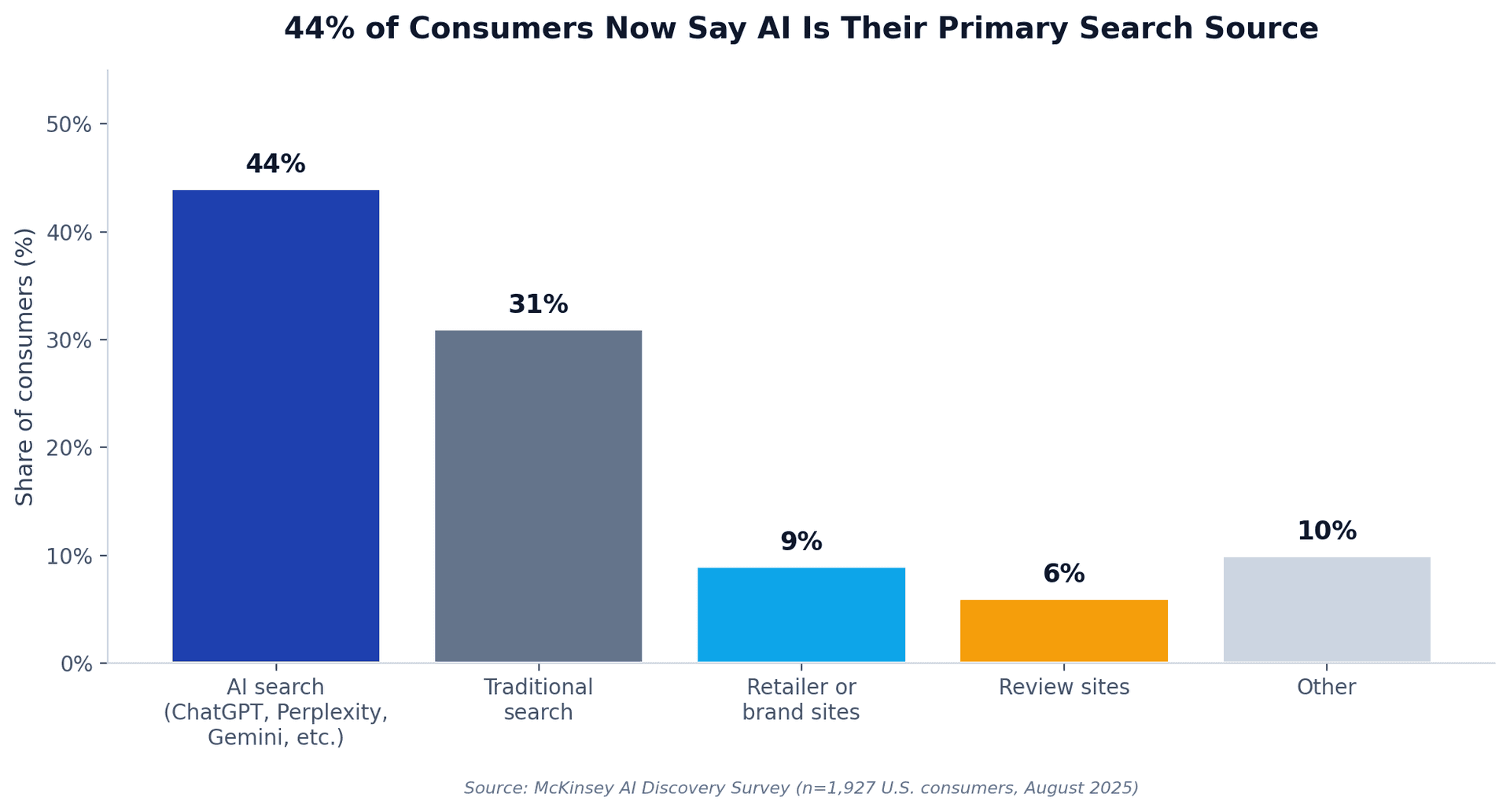
The most-cited consumer adoption number for 2026 comes from McKinsey's August 2025 AI Discovery Survey (n=1,927 U.S. consumers): 44% of AI-search users now call AI their primary and preferred source of insight, versus 31% for traditional search, 9% for retailer/brand sites, and 6% for review sites.
40–55% of consumers across consumer electronics, grocery, travel, wellness, apparel, beauty, and financial services now use AI search to make purchase decisions (McKinsey).
McKinsey projects $750B in U.S. consumer revenue will flow through AI-powered search by 2028, with traditional search traffic declines of 20–50% for unprepared brands.
Only 16% of brands systematically track AI search performance (McKinsey CMO survey, 2025). The other 84% are flying blind.
About 50% of Google searches now include an AI summary, expected to exceed 75% by 2028.
Bluefish AI / Adobe Analytics (Black Friday & Cyber Monday 2025): 805% YoY increase in AI-driven traffic to retail sites; ~95% of AI citations during the holiday season came from non-paid sources.
BrightEdge (2025): 76% brand overlap between ChatGPT and Google AI Overviews on shopping queries; AI Overview presence has grown 58% YoY.
Pew Research Center (July 2025): when an AI Overview appears, only 8% of users click a traditional search result (vs. 15% without one), and 26% end their session entirely.
Ahrefs (February 2026): AI Overviews correlate with a 58% reduction in CTR for top-ranking pages — nearly double the 34.5% drop measured in April 2025.
Industry State: What SEOs Are Actually Doing
The gap between what SEOs use and what they think actually works is one of the most striking findings of the 2025–2026 surveys.
Tactic | % Using It Regularly | % Rating Most Effective |
|---|---|---|
Guest posting | 64.9% | 16.0% |
Link exchanges | 51.6% | low |
HARO / Connectively | 46.3% | moderate |
Digital PR | 17.7% | 48.6% |
Link insertions / niche edits | ~10% | moderate |
Broken link building | 5% | low |
Press releases | 4% (rising) | low |
Sources: Authority Hacker (755-builder survey) and editorial.link (518-expert survey), both 2025.
Other state-of-the-industry numbers
79.7% of SEOs consider link building an important part of their SEO strategy (Authority Hacker).
71.7% of link builders say link building is harder than 12 months ago. 52.3% of digital marketers say it's the hardest part of SEO.
94.8% of digital PR practitioners use original data; 92.5% use expert commentary. 87.3% report they never pay for placements (BuzzStream).
Press release usage is rising in 2026 specifically because PR distribution seeds AI training data and AI-citation pools.
65% of SEOs use AI tools for outreach prospecting and personalization; 83% of link-building platforms now use AI for quality assessment (DemandSage).
Tool of choice: Google Search Console is the #1 most-used link building tool (25%), followed by Semrush (21%) and Ahrefs (15%) (uSERP).
Penalty and Risk Data
Google's link-related penalty machinery hasn't gone away — it's just gotten quieter, with more enforcement happening algorithmically rather than via manual actions.
Google issues approximately 750,000 manual actions per month (industry estimate). In its last detailed public webspam report, Google said it generated 4.3 million manual action messages to webmasters in 2019 alone.
Average manual action recovery time: ~67 days with corrective action and a reconsideration request. Algorithmic recoveries average 4–6+ months because they require the next core update.
Self-recovery success rate: ~30% of penalized sites regain rankings within a year. Professional recovery services report ~78% success vs. ~45% for DIY.
Google now mostly devalues low-quality links algorithmically rather than penalizing them. The disavow tool is now recommended only when a manual action exists or is imminent (Search Engine Land penalty guide).
56% of SEOs do not believe Google can effectively detect and discount paid links (Authority Hacker) — explaining why ~74% of link builders still pay for links despite Google's explicit guidelines.
What This Means For Your 2026 Link Building Strategy
Five takeaways the data supports:
Bake AI search signals into link building from day one. Stop measuring success purely in links acquired. Track branded web mentions, presence on AI-cited domains (Wikipedia, Reddit, YouTube, G2/Capterra), and appearances in ChatGPT/AI Overviews/AI Mode for unbranded category prompts. The Ahrefs r=0.664 finding and McKinsey's 5–10% own-domain share in AI sources are the two stats that justify this shift.
Rebalance budget toward digital PR and data-led content. The data is consistent across editorial.link, BuzzStream, Authority Hacker, and Aira: digital PR delivers more brand mentions, more relevant editorial links, and more AI-citation pickups per dollar than guest posting at competitive tiers. Aim for 30–40% of your link budget in digital PR / earned media.
Set realistic 2026 outreach KPIs. Plan for 5–10% reply rates on cold outreach and 3–5% email-to-link conversion. Anything higher than ~12% reply rate is exceptional; below 3% conversion suggests prospect-list quality issues. Always ship at least one follow-up.
Cap your cost-per-link tolerance against 2025 benchmarks. Use $508.95 as the fair-market target for a high-quality link, $700–$2,000 for premium editorial / digital PR placements. Treat anything below $300 as a relevance/quality risk. Avoid the 85.3% of guest-posting inventory BuzzStream identified as low quality.
Build a corroboration footprint, not a backlink dump. For AI visibility, prioritize getting your brand mentioned across at least 4 independent third-party platforms: a Wikidata entry, presence in 1–2 category-relevant Reddit threads, profiles on G2/Capterra/Trustpilot, YouTube mentions or reviews, and 3–5 editorial mentions per quarter on AI-cited domains.
A Note on Methodology
A few important caveats every reader of stats roundups should keep in mind:
Correlation is not causation. Ahrefs explicitly notes this in the 75K-brand study. Large brands have more web mentions and more AI visibility — the underlying cause may be brand strength itself, not the mentions in isolation.
AI search citation patterns are highly volatile. Reddit's share of ChatGPT citations dropped from ~60% to ~10% over a six-week window in September 2025 after Google removed the num=100 parameter. Any AI-visibility playbook must be revisited at least quarterly.
Some popular figures are aging. The "94% of content gets zero links" stat comes from a 2017 study; "95% of pages have zero backlinks" derives from a 2020 analysis. Still the most-cited and broadly accepted figures, but the underlying datasets are several years old.
Survey self-report bias. ROI numbers like "78.1% positive ROI" and the "748% median SEO ROI" are practitioner self-reports or proprietary client datasets, not independent audits. Treat as directional rather than absolute.
Google Search Is Only Half the Picture Now
If you only act on one finding from this guide, make it this one: the brands winning AI search aren't the ones with the most backlinks. They're the ones being mentioned across the platforms AI engines actually cite — Wikipedia, Reddit, YouTube, editorial press, and category review sites. Backlinks remain a foundational SEO signal, but they're no longer sufficient on their own.
And right now, only 16% of brands track their AI search visibility systematically. The other 84% are running 2026 link building programs against 2022 dashboards.
If you want to see where your brand actually stands across ChatGPT, Claude, Gemini, and Perplexity — alongside your full Google Search Console data in one view — try the free QuickSEO AI visibility audit. Two minutes to set up, no credit card, and you'll see exactly which AI prompts your brand appears in and which competitors keep getting picked instead.
Enter your website to track its AI visibility across ChatGPT, Gemini, Claude, and Perplexity — and turn chatbot mentions into traffic.
- Set up in minutes
- Cancel anytime
Keep reading
Related posts
More articles on the same topics, prioritized by shared tags and keyword overlap.