Free Anchor Text Generator
Generate natural, diverse anchor text variations for your internal and external links. Enter your target URL, topic, and context to get AI-powered suggestions with distribution recommendations.
Generate Anchor Text Suggestions
QuickSEO shows clicks, impressions, keywords and pages for every website you manage, compared with the period before.
- Unlimited websites on the free plan
- No credit card needed
What Is Anchor Text?
Anchor text is the visible, clickable text in a hyperlink. When you see a blue underlined link on a webpage, the words that make up that link are the anchor text. Search engines like Google use anchor text as a signal to understand what the linked page is about, making it a critical element in both on-page and off-page SEO.
Well-crafted anchor text helps users understand where a link will take them and helps search engines associate relevant keywords with the target page. Poor or over-optimized anchor text can look spammy and may even trigger search engine penalties.
Types of Anchor Text
- Branded: Uses the brand or company name as the link text. Example: "QuickSEO" or "according to QuickSEO".
- Exact Match: Uses the exact target keyword as the anchor. Example: "anchor text generator". Use sparingly to avoid over-optimization.
- Partial Match: Includes part of the target keyword in a natural phrase. Example: "tools for generating anchor text".
- Generic: Uses non-descriptive phrases like "click here", "learn more", or "read this guide".
- Naked URL: Uses the raw URL as the anchor text. Example: "https://quickseo.ai/tools".
- Image:When an image is linked, the image's alt text serves as the anchor text for search engines.
Why Anchor Text Diversity Matters for SEO
Search engines analyze your anchor text profile — the distribution of different anchor text types pointing to a page — to assess the naturalness of your link profile. A healthy, diverse anchor text profile signals that links to your page were earned organically from various sources.
- Avoids penalties:An anchor text profile dominated by exact match keywords is a red flag to Google's Penguin algorithm and can lead to ranking penalties.
- Looks natural: Real websites naturally link using a mix of branded, generic, and contextual anchors — not just keywords.
- Broadens relevance:Diverse anchors help search engines understand your page's topic from multiple angles, potentially ranking it for a wider range of queries.
- Improves user experience: Descriptive, varied anchor text helps users understand what to expect when they click a link.
How to Use This Tool
- Enter your target URL — the page you want to link to. This helps the AI understand the destination and suggest relevant branded anchors.
- Enter your topic or keyword — the main keyword or topic associated with the target page.
- Add context (optional) — describe the page content or the context where the link will be placed for more tailored suggestions.
- Click "Generate Anchor Texts" to receive AI-powered suggestions organized by type with distribution recommendations.
Anchor Text Best Practices
- Keep it relevant: Anchor text should accurately describe or relate to the content of the linked page.
- Be concise: Most effective anchor texts are 2-8 words. Avoid using entire sentences or paragraphs as anchors.
- Vary your anchors: Never use the same anchor text for every link pointing to a page. Mix branded, partial match, generic, and contextual variations.
- Limit exact match anchors: Keep exact match keyword anchors under 10% of your total anchor text profile to avoid over-optimization penalties.
- Write for humans first: Anchor text should read naturally within the surrounding content. If it sounds forced, rewrite it.
- Consider internal links too: Anchor text best practices apply to internal links as well — use descriptive anchors to help search engines understand your site structure.
Frequently Asked Questions
What is anchor text?
Anchor text is the visible, clickable text in a hyperlink. It is usually displayed in a different color (often blue) and underlined. Search engines use anchor text to understand the context and relevance of the linked page, making it an important factor in SEO.
Why does anchor text matter for SEO?
Anchor text helps search engines understand what the linked page is about. Well-optimized anchor text can improve the linked page's rankings for relevant keywords. However, over-optimizing with too many exact-match anchors can trigger penalties, so a diverse and natural anchor text profile is essential.
What is a natural anchor text distribution?
A natural anchor text distribution typically includes a mix of branded anchors (30-40%), partial match anchors (15-25%), generic anchors (15-20%), exact match anchors (5-10%), naked URLs (5-10%), and long-tail or contextual anchors (10-15%). The exact ratio varies by niche and link type.
What are the different types of anchor text?
The main types of anchor text are: exact match (uses the target keyword exactly), partial match (includes part of the keyword), branded (uses the brand name), generic (uses phrases like "click here" or "learn more"), naked URL (uses the raw URL), and image anchor (alt text of a linked image).
How can I avoid anchor text over-optimization?
To avoid over-optimization, vary your anchor text types, keep exact match anchors under 10% of your total profile, use natural language that fits the surrounding content, include branded and generic anchors regularly, and monitor your anchor text distribution over time using SEO tools.
QuickSEO shows clicks, impressions, keywords and pages for every website you manage, compared with the period before.
- Unlimited websites on the free plan
- No credit card needed
From the blog
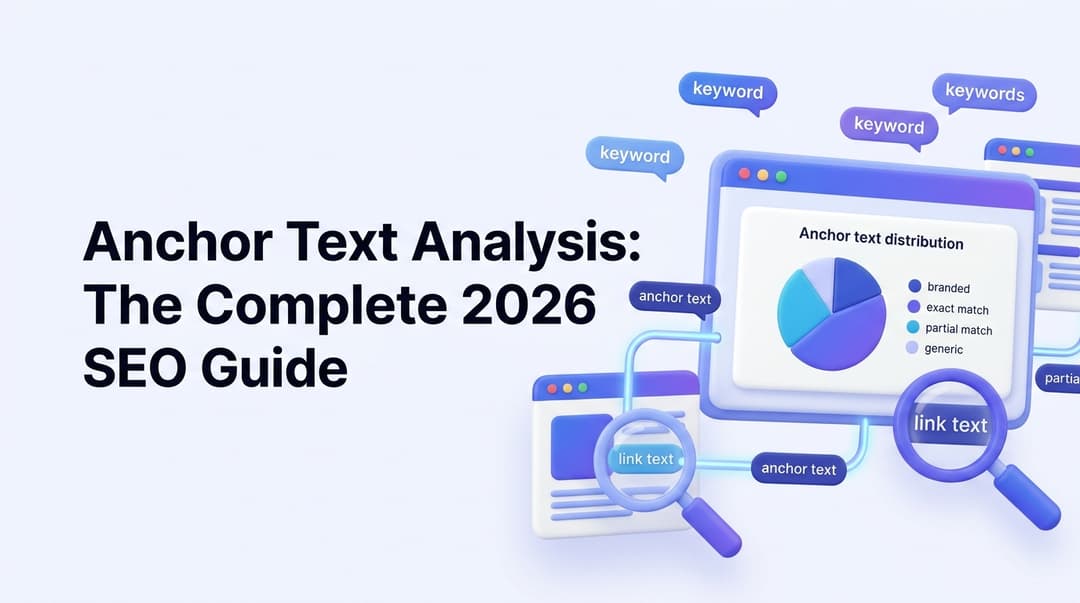
Anchor Text Analysis: The Complete 2026 SEO Guide
Master anchor text analysis in 2026. Learn the 7 anchor types, safe distribution ratios, internal vs external strategy, audit steps, and how to avoid penalties.

AI Traffic Conversion Benchmarks: Why AI Visitors Are 4–6× More Valuable Than Organic
AI search traffic is small in volume (~1% of total) but converts at 14.2% vs Google's 2.8% — a 4–6× lift confirmed across Adobe, Semrush, Microsoft Clarity, and Opollo benchmarks. Here's the per-platform, per-vertical breakdown and what to do about it.
Related Tools
Audit your internal link structure to find orphan pages, broken links, and optimization opportunities.
Anchor Text Distribution AnalyzerAnalyze the anchor text distribution across your site to identify over-optimization risks.
Keyword Density CheckerCheck keyword density and distribution across your page content to optimize for target keywords.