AI Traffic Conversion Benchmarks: Why AI Visitors Are 4–6× More Valuable Than Organic

 Summarize in ChatGPT
AI search traffic is small. Conductor pegs it at 1.08% of enterprise web traffic, growing about a percentage point each month. Similarweb says the whole-internet share is 0.15–0.25%. So you can dismiss the channel on volume, the way most marketers still do.
That's the wrong question. The right question is what each visitor is worth. On that axis, AI traffic is the highest-converting channel most companies have ever had, and the per-visit lift over Google organic is widening, not closing.
Here are the benchmarks you can take to a quarterly review.
The headline you can quote in a board meeting
The cleanest cross-channel number comes from the Opollo 2026 AI Search Benchmark Report, which looked at 312 B2B IT and tech firms across North America, Australia, and the UK: AI search traffic converted at 14.2% in Q1 2026, versus 2.8% for Google organic. That holds for firms with 100+ AI sessions per month, so it isn’t a small-sample artifact (Opollo).
Other independent benchmarks land in the same neighborhood:
Semrush, across 500+ digital-marketing topics: AI visitors convert 4.4× higher than classic organic (study).
Microsoft Clarity, 1,277 domains: LLM signup CTR 1.66% versus Search 0.15%. That’s an 11× multiplier (Clarity).
Adobe Digital Insights, US retail: AI-referred traffic converted 42% better than non-AI in March 2026 — a flip from being 43% worse in July 2024 (Adobe).
So: small share, but on a per-visitor basis the channel is worth four to six times what Google organic is worth today. If you only look at session counts, you’re undervaluing it by an order of magnitude.
Per-platform conversion rates: how the big four stack up
Not all AI traffic is created equal. The most-cited per-platform breakdown comes from a 7-month Seer Interactive case study across mixed verticals. Superprompt’s 2025 dataset confirms the pattern with slightly different per-platform numbers:
Platform | Conversion rate | Notes |
|---|---|---|
Claude | 16.8% | Highest per-visit value ($4.56). Skews technical/enterprise. |
ChatGPT | 14.2–15.9% | Broadest reach. ~78–87% of all AI referrals. |
Perplexity | 10.5% | Research-skewed audience. Second only to ChatGPT in the same study. |
Gemini | 3.0% | Volume growing fast (2.3% → 8.7% of AI referrals YoY). |
Google organic | 1.76–2.8% | Reference baseline. |
Sources: Seer Interactive (2025); Superprompt 2025; Opollo Q1 2026.
Two things to notice. First, per visit, Claude beats ChatGPT — but Claude is roughly 3% of AI referrals while ChatGPT is 78–87%, so ChatGPT still dominates absolute pipeline. Second, Perplexity’s ~6× lift over Google (10.5% vs 1.76%) is corroborated by Microsoft Clarity’s independent measurement of 7× subscription CTR. That number is real.
The Adobe retail gap is closing — and then it flipped
Skeptics of "AI traffic converts better" usually point at a single-month spike from a vendor with skin in the game. Adobe’s Digital Insights team has now released 18 consecutive months of US retail data, and the curve is the answer:
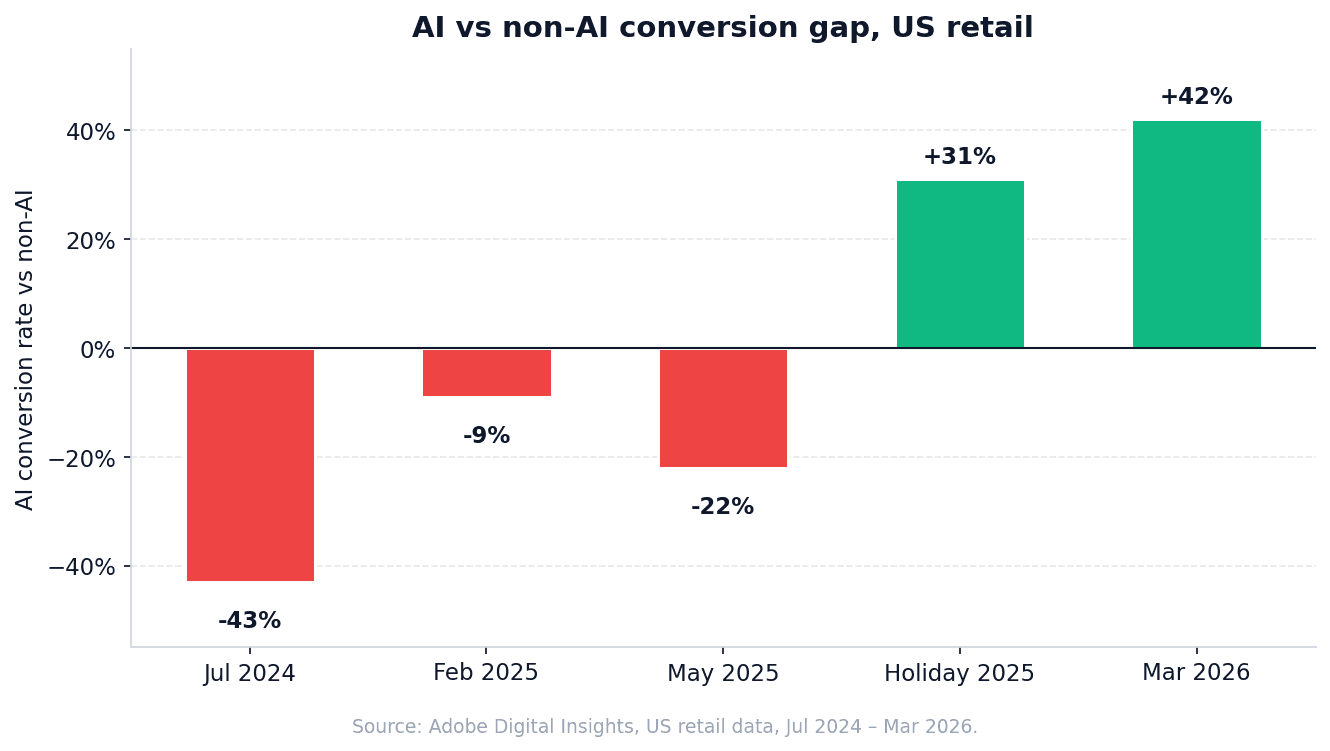
July 2024 was the bottom: AI traffic was 43% less likely to convert than non-AI. By February 2025 the gap was 9 points. Through Q2 it widened slightly to 22% lower as AI volume scaled. Then the 2025 holiday season inverted it — AI converted 31% above non-AI — with Thanksgiving 2025 at +54% and Black Friday 2025 at +38%. By March 2026 AI was 42% better than non-AI on a sustained basis (Adobe Q1 2026 report).
You can argue with the absolute numbers in any one month. You can’t argue with a 20-month trend across trillions of visits.
Vertical breakdowns: where AI traffic is most valuable today
First Page Sage tracked ChatGPT conversion rates across 160+ clients from May 2025 through April 2026. The vertical spread is wide:
Industry | ChatGPT CR | Type |
|---|---|---|
Hotels & Resorts | 7.0% | B2C |
Legal Services | 5.6% | Mixed |
Higher Education | 4.9% | B2C |
Healthcare | 4.5% | Mixed |
eCommerce | 3.0% | B2C |
B2B SaaS | 2.4% | B2B |
Financial Services | 1.9% | Mixed |
Source: First Page Sage, ChatGPT conversion rates across 160+ clients, May 2025–Apr 2026.
B2B SaaS looks low at 2.4% — but that's still ~30% higher than typical B2B SaaS organic. And the B2B story is louder when you measure pipeline rather than raw signups:
Webflow case study: ChatGPT traffic converts at 24% — about 6× Google organic. LLMs now drive 10% of signups, up from 2%, a 4× YoY jump (Growth Unhinged).
Opollo mid-market cybersecurity client: AI was 4% of sessions but 19% of qualified pipeline (Jan 2026).
Siege Media B2B: ChatGPT visitors show 2× session duration and +33% conversion over the average (Siege Media).
In travel and banking the lift is even cleaner: Adobe reports AI travel visitors generating 80% more revenue per visit than non-AI, and AI-referred banking users are 23% more likely to start an application (Adobe).
Why AI visitors convert better: four mechanisms
A 4–6× lift this consistent isn’t an accident of measurement. Four mechanisms explain it.
1. Funnel compression — visitors arrive late
Profound’s study of 50 million ChatGPT prompts found transactional intent at 6.1% on ChatGPT vs 0.6% on Google — a 9× jump. Informational intent collapses the other way (32.7% vs 52.7%). OpenAI’s own Signals report categorizes 40% of ChatGPT messages as "Doing" (action) rather than "Asking" (information).
Combine that with the fact that about 93% of AI sessions end without a click to an external site, and the picture clears up: the AI absorbs awareness and most of comparison. The 7% who actually click through have self-selected as needing more than the chatbot’s synthesized answer. They’re late-funnel almost by definition.
2. Citation acts like a third-party recommendation
AI surfaces frame brands as the answer to a question, often alongside neutral competitor comparisons. AirOps’ 2026 State of AI Search found 85% of brand mentions in AI come from third-party pages — not the brand’s own site. Yext’s data shows 62% of consumers trust AI recommendations more when sources are linked. That’s structurally closer to a peer referral than to an organic SERP listing, and referrals always convert above search.
3. B2B buyers have wholesale shifted to AI for evaluation
The most decisive evidence sits in G2’s Answer Economy 2026 report (n=1,076 B2B software decision-makers, March 2026):
51% start research in an AI chatbot — up from 29% in April 2025.
71% use AI somewhere in the research process; 86% increased AI use YoY.
54% rank AI as the #1 source shaping their vendor shortlist.
69% chose a different vendor than they’d originally planned due to AI chatbot guidance.
33% bought from a vendor they’d never heard of before the AI surfaced it.
80% say AI accelerated their purchase decision.
The #1 declared use case is comparing vendor strengths and weaknesses (41%) — pure consideration-stage work. The AI-referred B2B visitor is essentially mid-RFP.
4. Query length encodes intent
Semrush’s clickstream analysis pegs the average ChatGPT non-search prompt at 13.5 words, and the average internal-search query at 5.48 words — 61% longer than Google’s 3.4-word average. 77% of ChatGPT queries are 5+ words. Long queries encode use-case, constraint, budget. They’re the qualification a sales rep would otherwise do.
Engagement metrics back it up
If AI visitors really are higher-intent, you’d expect them to behave differently on-site. They do.
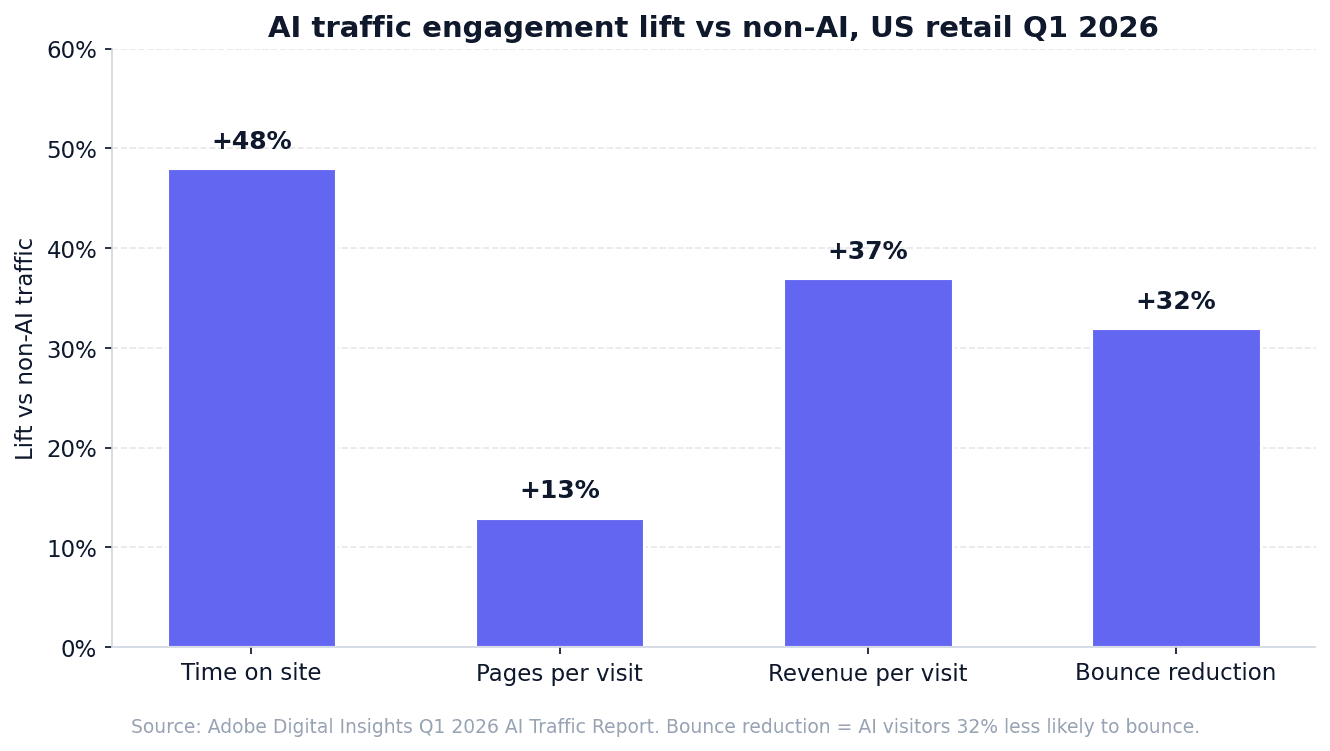
Across Adobe’s Q1 2026 US retail panel, AI traffic spent 48% more time on site, viewed 13% more pages, generated 37% more revenue per visit, and was 32% less likely to bounce. Travel and banking show similar shapes (Adobe travel: 25% longer sessions; banking: 45% longer sessions). SE Ranking’s 63,987-site study put it even more bluntly: AI visitors spend 67.7% more time on site than organic search visitors on average.
The per-platform session-length breakdown is striking: Claude 19 minutes, ChatGPT 10 minutes, Perplexity 9+ minutes, Google organic ~4 minutes. Similarweb saw the same with ChatGPT referrals at 15 min on site and 12 pageviews per visit, versus Google’s 8 min and 9 pageviews (Similarweb).
Revenue per visit is the metric that actually matters
Conversion rate is comforting because it’s a single number. Revenue per visit (RPV) is the one your CFO cares about, and it tells the same story:
Adobe US retail RPV reached parity with non-AI in December 2024, hit 70% of non-AI by May 2025, then went +84% above non-AI across Jan–Jul 2025 (Adobe).
AI RPV grew +254% YoY during the 2025 holiday season.
Q1 2026 retail: AI visitors generated 37% more revenue per visit than other channels.
Adobe travel: AI RPV +80% vs non-AI (Feb 2025).
AOV is the one place AI doesn’t always win. ALM Corp’s 94-brand ecommerce study clocked ChatGPT AOV $204 vs organic $238 — 14% lower. But Alhena.ai found Perplexity AOV 57% higher than ChatGPT AOV, so platform mix matters. Salesforce’s 2025 holiday data shows global average selling price +7%, partly attributed to higher-intent AI-influenced purchases (Salesforce).
LTV data is the gap in the public record — nobody has published clean cohort LTV split by AI vs organic source. The best proxy: Adobe’s 2025 holiday survey found AI-using shoppers were 68% less likely to return products, and online returns dropped 1.2% YoY. Higher purchase confidence sticks.
Volume is small. Growth is the story.
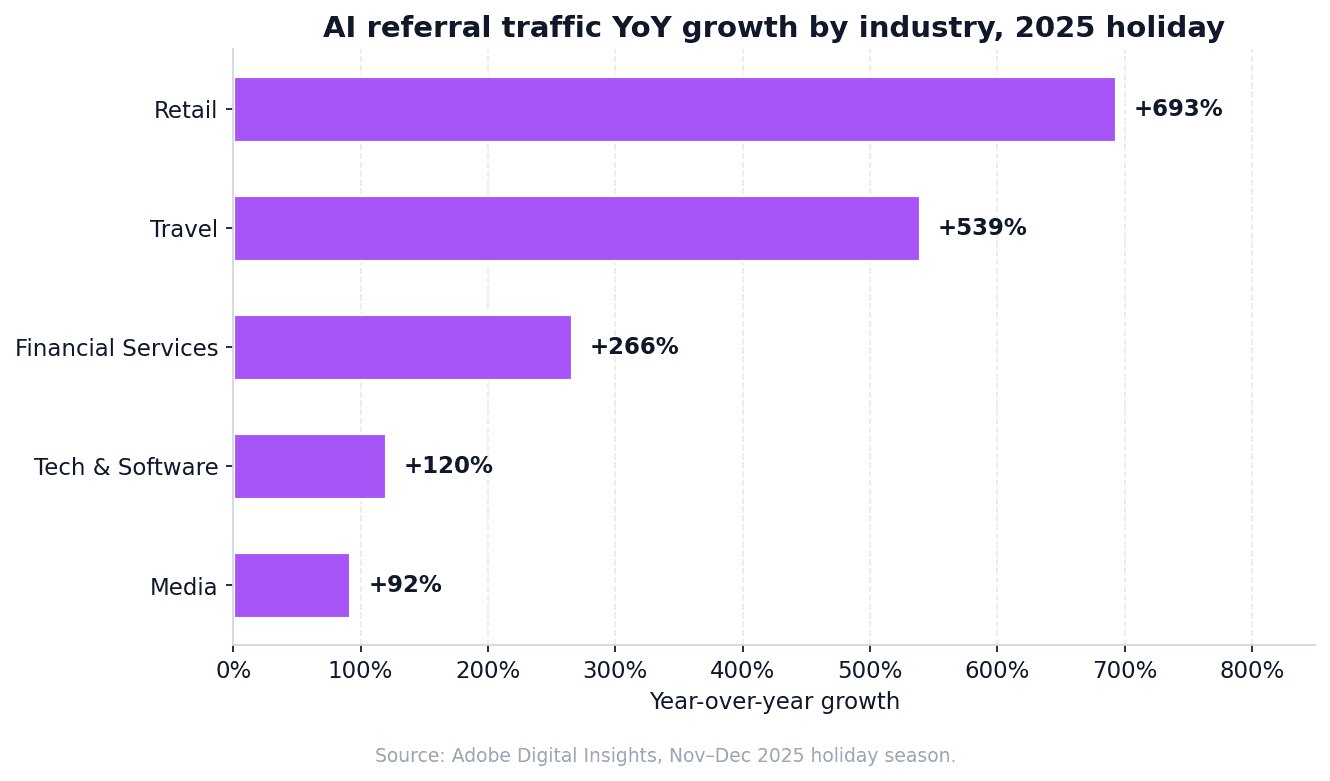
The reason CFOs still wave off AI traffic is the volume number, and on the surface they’re right: AI referrals are roughly 1.08% of total enterprise web traffic per Conductor, or 0.15–0.25% on Similarweb’s whole-internet view. But the YoY shape is unlike any channel you’ve seen:
Adobe US retail: +393% YoY in Q1 2026, after peaking at +1,151% YoY in December 2025. July 2025 was +4,700% YoY.
Similarweb: 1.13 billion AI referral visits in June 2025, +357% YoY. ChatGPT-to-news referrals +770% YoY in June 2025.
Statcounter platform mix (March 2026): ChatGPT 78% of all AI referrals, Gemini 8.7%, Perplexity 7.1%, Copilot 3.2%, Claude 2.9%. Claude went from 0.3% to 2.9% in 12 months — a 10× shift.
Gartner forecasts 50% of all online searches will involve AI assistants by 2028 and a 25% drop in traditional search by 2026.
The interpretation is simple: AI is a 1% channel today and a 20–30% channel by end of decade on most credible projections. Per visitor it’s already worth 4–6× organic. If you wait for it to be "material" on volume, you’ll be optimizing for it while a competitor is already cited.
The counter-evidence — and why it doesn't break the thesis
Two studies push back hard on the optimistic numbers, and you should know about them:
Kaiser & Schulze, Marketing Science: 973 ecommerce sites, $20.6B in revenue, 50,251 ChatGPT transactions over Aug 2024–Jul 2025. ChatGPT converted 13% below organic search on raw averages, 32% below paid search, 54% below affiliate. The only channel ChatGPT beat was paid social.
Ahrefs 82,000-site AI Traffic Quality Study: AI bounce rate 67.8% vs Search 63.7% (AI slightly worse); AI pages/session 2.27 vs Search 2.79.
How do you square these with the Adobe and Webflow numbers? Two things. First, vendor cohorts (Adobe, Salesforce, Similarweb, ALM) skew enterprise and mid-market with engagement-optimized sites. The academic and Ahrefs samples are broader and include long-tail stores that haven’t built AI-optimized landing pages yet. Second — critically — Kaiser & Schulze themselves note that ChatGPT conversion rates were rising over the period, exactly matching Adobe’s gap-closing curve. The optimistic numbers are the trend; the academic numbers are an older snapshot of a noisier population.
Honest framing: if you’re a small unoptimized store, the AI conversion premium isn’t automatic. If you have a real landing page and a comparison or pricing page worth linking to, the per-visitor lift is real — and it’s widening.
What to do about it this quarter
Get AI referrals broken out as a real channel in GA4. Most stacks still bucket ChatGPT, Perplexity, Gemini, Claude, and Copilot under "Direct" or "Other." If you can’t see them, you can’t value them.
Track citations, not just clicks. ~93% of AI sessions don’t click out. The brand-equity layer (being recommended) precedes the traffic layer. Measure it like share of voice.
Compare AI vs organic on conversion and RPV, not just sessions. A sessions-only view undersells AI by 5–10×. Build a dashboard that puts CR and RPV side by side.
Invest in bottom-funnel content. Comparison pages, pricing pages, integration pages, and concrete how-to guides are what AI cites for high-intent queries. Top-of-funnel awareness content is increasingly being eaten inside the chatbot answer.
Watch the gap by platform. Claude and Perplexity convert higher per-visit; ChatGPT carries volume; Gemini is growing fastest. Your competitive position can be very different across the four — measure each separately.
Track AI visibility before the volume catches up
QuickSEO tracks your brand presence across ChatGPT, Gemini, Claude, and Perplexity alongside your Google rankings, in one dashboard. If you’re not measuring where AI surfaces are citing you today, you’ll be optimizing for it when your competitors are already in the answer.
Start with a free AI visibility audit — see how your brand shows up in the major chatbots and where the citation gaps are.
Enter your website to track its AI visibility across ChatGPT, Gemini, Claude, and Perplexity — and turn chatbot mentions into traffic.
- Set up in minutes
- Cancel anytime
Try it yourself
Related free tools
Free SEO tools related to the topics covered in this article.
Keep reading
Related posts
More articles on the same topics, prioritized by shared tags and keyword overlap.