
 Summarize in ChatGPT
Anchor text is one of the oldest ranking signals in SEO — and also one of the most consistently misused. It's the clickable text in a hyperlink that directs users to another webpage, and the words you choose carry more strategic weight than most marketers realize.
Backlinks remain one of the most powerful ranking factors in SEO — but not all backlinks are created equal. The deciding factor between a link that moves rankings and one that gets ignored (or penalized) often comes down to anchor text strategy.
In 2026, anchor text optimization is no longer just about picking the right keywords to link. It is a sophisticated balancing act of Search Engine Optimization and risk management. This guide walks you through everything: the seven anchor text types, healthy distribution ratios, internal vs. external strategy, how to audit your current profile, and the modern mistakes that kill rankings.
What Is Anchor Text and Why Does It Still Matter?
Anchor text is the clickable text that houses a hyperlink. Search engines read it as a relevance signal — the words you use tell Google what the destination page is about, and an unnatural or over-optimised anchor text distribution is one of the clearest signals of manipulative link building.
When Google's founders Larry Page and Sergey Brin developed the original PageRank algorithm in 1998, anchor text was one of the core signals they used to understand what a linked page was about. Nearly three decades later, anchor text remains one of the most powerful on-page and off-page ranking signals in Google's algorithm.
Despite many algorithm updates, anchor text remains in Google's top five ranking factors. Ahrefs' analysis of millions of search results confirms that the anchor text of backlinks is one of the clearest correlating factors between a page's backlink profile and its rankings for specific keywords.
Here's the critical shift for 2026: anchor text does not manipulate ranking — it signals classification. The surrounding context carries as much or more weight than the anchor text itself.
Google's algorithms now analyze anchor text as part of a broader contextual framework. The days of keyword-heavy anchors driving rankings on their own are long gone. What matters now is how naturally an anchor fits within the surrounding content, where the link comes from, and whether it aligns with search intent.
The 7 Types of Anchor Text (and Their SEO Impact)
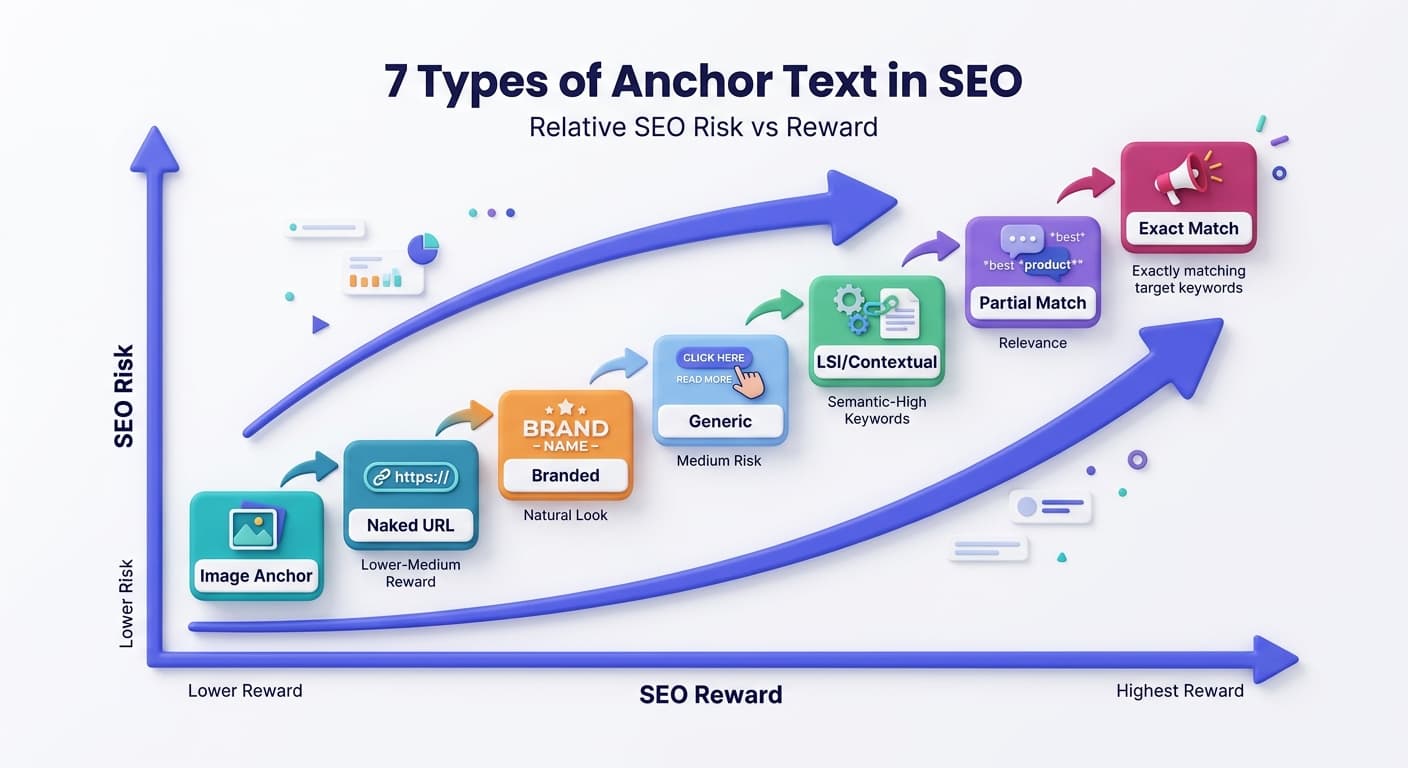
Understanding the different types of anchor text is essential to building a natural, effective, and safe link profile. Each type serves a different purpose and carries different risk levels.
Here's a breakdown of all seven:
1. Exact Match
Uses the precise keyword you want to rank for (e.g., "SEO tools"). Exact-match anchor text on external links should stay below 5% for most sites — higher creates detectable over-optimization patterns.
2. Partial Match
A variation of the target keyword woven naturally into a sentence (e.g., "the best SEO tools for agencies"). The most important type in 2026 is partial match and LSI anchors — they provide relevance without the Penguin risk.
3. Branded
Uses your brand name as the anchor text (e.g., "QuickSEO" or "QuickSEO.ai"). Branded anchors are naturally occurring, reinforce trust, and align well with Google's context-based evaluation. They balance keyword anchors and reduce over-optimization risk across internal and external links.
4. Naked URL
Links using the raw URL (e.g., "https://quickseo.ai"). These look natural and are a common part of editorial linking, with no manipulation risk.
5. Generic
Phrases like "click here," "read more," or "learn more." These are missed opportunities for SEO and GEO. Generic text provides zero context to a search engine about the destination page.
6. LSI / Contextual
Descriptive, semantically related phrases built organically into a sentence (e.g., "top-rated keyword tracking platform"). These are descriptive phrases built organically into a sentence, providing clear topical links.
7. Image Anchor
Image alt text functions as anchor text — it is a missed optimization opportunity most sites ignore. When an image is linked, its alt attribute becomes the de facto anchor text for search engines.
The Healthy Anchor Text Distribution for 2026
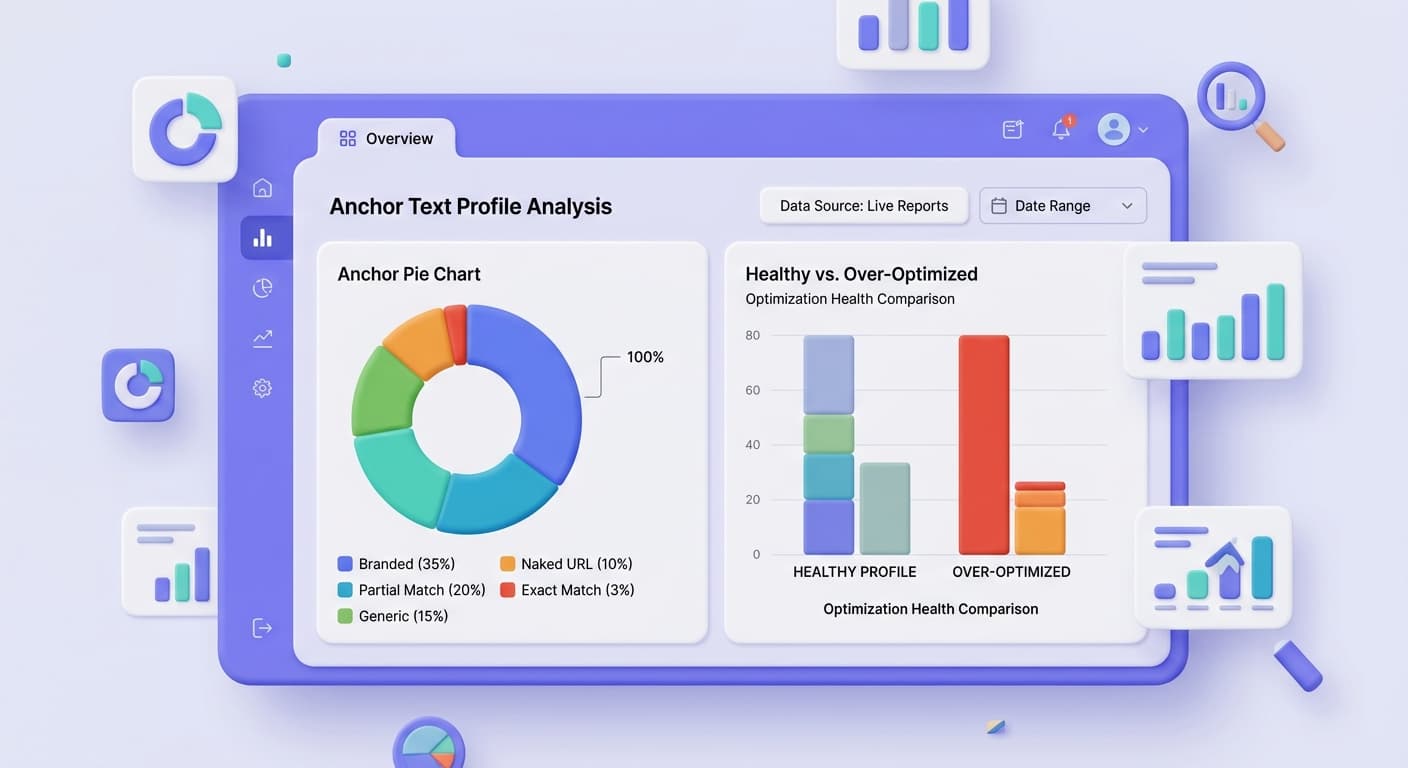
There's no single perfect ratio — but there are evidence-based targets. A safe external anchor profile typically includes 30–50% branded, 15–25% partial match, 10–20% generic, 5–15% naked URL, and 1–5% exact match anchors.
Research from Ahrefs shows top-ranking pages usually have very low exact-match anchor usage, relying instead on natural and diverse link profiles.
Why does velocity matter? Building 50 new backlinks with partial-match anchors within a single week looks unnatural regardless of anchor quality — velocity matters as much as distribution.
The Penguin Danger Zone
The most dangerous type is exact match at scale. A single exact-match anchor is not a problem. A pattern of 20+ exact-match anchors for the same keyword on the same page is a clear manipulation signal.
If your profile is heavily manipulated with artificial, keyword-stuffed anchors, you may receive a "Manual Action" notification in Search Console, which can remove your site from search results entirely.
Pro tip: Competitor anchor analysis is a more reliable ratio target than any generic benchmark table. Always benchmark your profile against top-ranking competitors in your niche.
Context Is King: Why the Words Around Your Anchor Matter
Modern search systems do not evaluate anchor text as a keyword string. They evaluate context. The link, the surrounding sentence, and the destination page must align. If they do not, the link is ignored. Not penalized. Ignored.
The 15 to 25 words surrounding a link often carry more relevance weight than the anchor itself. Context distributes meaning more safely than repetition.
Strong alignment example: A SaaS comparison guide references "2026 SEO tracking data" and links to a page with original statistics. The anchor accurately describes the destination and the destination delivers on the promise.
Weak alignment example: A generic marketing article links with "best CRM software" to a thin affiliate list page. The sentence does not discuss CRM systems. The page provides no original insight. This link may pass metrics checks. It fails contextual coherence.
Before placing or accepting any link, apply these three filters:
Does the anchor accurately describe the destination?
Does the surrounding sentence logically justify the link?
Would a human editor naturally write this sentence and link?
If the anchor promises something the page does not deliver, the signal weakens. Links do not fix weak assets. They amplify strong ones.
Internal vs. External Anchor Text Strategy
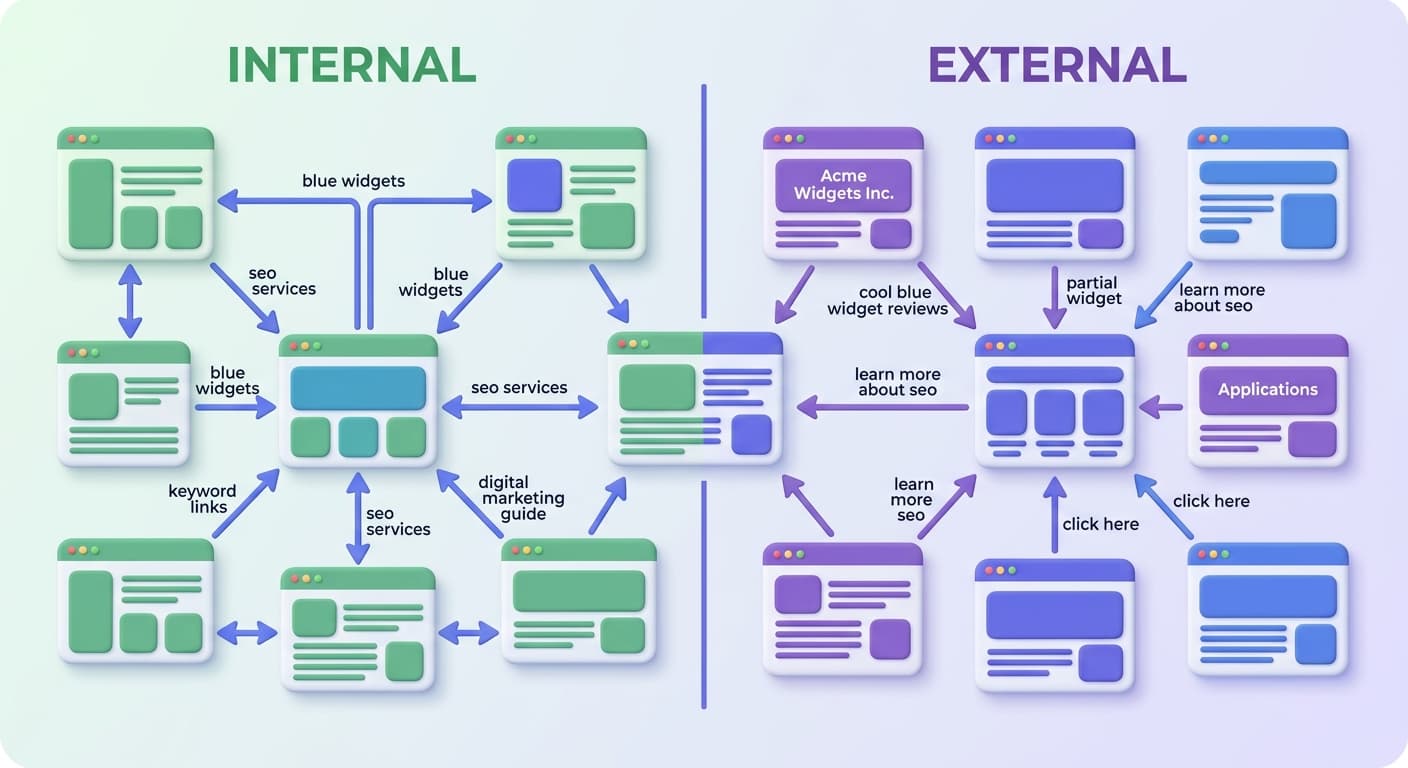
Internal and external anchor text follow fundamentally different rules.
Internal Links: Your Most Controllable SEO Lever
Internal anchor text is one of the most underused SEO levers for most sites. Because you control your own site architecture, you can afford to be more deliberate with keyword-rich anchors internally.
Internal anchors define structure. Exact-match anchors are acceptable internally when they clarify hierarchy and topical mapping. Internal linking communicates architecture. Precision is beneficial here because you control the system.
Best practices for internal anchor text:
Point internal links from high-authority pages toward your highest-value commercial pages — category pages, money pages, and product pages.
Never link to the same destination twice in one article using different anchors. Pick the most relevant anchor and use it once.
Avoid generic anchors ("click here," "read more") — they waste link equity.
You can use QuickSEO's anchor text distribution analyzer to audit how your internal anchor profile is distributed across your site.
External Links: A Less Controllable Ecosystem
External anchors exist in an uncontrolled ecosystem. If you are scaling exact-match anchors externally, you are creating footprints.
For external backlinks, keep exact-match keywords below 5–10%. For internal links, you can be more aggressive, but always prioritize the user's reading experience.
How to Audit Your Anchor Text Profile (Step-by-Step)
Anchor text auditing is a foundational part of any complete SEO audit. Here's how to run one systematically:
Step 1: Export Your Backlink Data Use tools like Ahrefs or Semrush to download your full list of backlink anchors. Google Search Console also surfaces incoming anchor data.
Step 2: Categorize Your Anchors Export the anchors and categorize them: branded, exact match, partial match, naked URL, generic. Calculate the percentage of each.
Step 3: Identify the Danger Zone If exact-match exceeds 15% of your profile, prioritize branded and partial-match anchor placements before targeting exact-match anchors again. If you have received a manual action or seen an unexplained traffic drop, anchor text over-optimisation should be the first thing you investigate.
Step 4: Benchmark Against Competitors Competitor analysis is not about copying anchor text. It is about identifying patterns. If your anchor profile looks radically different from top-ranking competitors, Google may treat it as an anomaly.
Step 5: Build Offset Links Where Needed If your exact-match ratio is too high, build "offset" branded and generic links to dilute the profile. If you see a spike in a specific keyword, pivot your content engine to build branded links and maintain a natural balance.
Anchor Text and AI Search in 2026
The rise of AI-powered search engines adds a new dimension to anchor text strategy. Voice search and AI tools rely on natural language processing to find the best answers. When your anchor text uses conversational phrases or directly mirrors common questions, it becomes easier for these systems to identify your content as a relevant source. Clear, descriptive links help these "answer engines" understand the relationship between different topics on your site.
People often ask full questions like "how often to post blogs for SEO" rather than just typing keywords. To stay ahead, try to use anchor text that mirrors these natural language patterns. When your link text matches the way people actually talk, you increase your chances of being the source cited by an AI or featured in a voice search result.
AI-driven algorithms analyze natural language and semantic relevance, valuing user-oriented, contextual anchor text over keyword-rich links.
This is especially relevant for brands tracking their presence across AI platforms like ChatGPT, Claude, and Gemini. Understanding how your internal linking and anchor structure feeds into AI citations is a growing frontier in generative engine optimization (GEO). Our anchor text distribution analyzer can help surface which pages are best positioned to attract AI citations based on their link equity.
Common Anchor Text Mistakes That Kill Rankings
Overcoming common missteps, like overusing exact-match phrases, low-quality backlinks, or neglecting contextual relevance, can significantly boost rankings. Watch out for these frequent errors:
Over-relying on exact-match anchors: Over-reliance on exact-match text raises red flags for Google, triggering penalties for over-optimization.
Ignoring image alt text: Alt texts in linked images serve as anchor text substitutes, impacting SEO — and most sites completely overlook this.
Forcing keywords: If you cannot write a natural sentence that introduces the link without it feeling forced, the link placement is wrong — not the anchor text.
Uniform anchors across many links: The biggest mistake in SEO is over-optimizing anchor text. Search engines expect a natural distribution, not repetition.
Ignoring velocity: Building dozens of links with identical anchor patterns in a short window triggers algorithmic scrutiny regardless of anchor type.
Generic internal anchors: Avoid generic internal anchors like "click here" or "read more." Every internal link is an opportunity to reinforce a page's relevance for a specific keyword.
Anchor Text Analysis Checklist for 2026
Use this checklist to keep your anchor text strategy on track:
Exact-match external anchors are below 5–10% of total backlink profile
Branded anchors make up 30–50% of external backlink profile
Internal anchors are keyword-rich and avoid generic phrases
Each anchor accurately describes the destination page
Surrounding context logically justifies the link (15–25 word window)
No single page receives 20+ identical exact-match anchors
Image alt text is optimized for linked images
Competitor anchor distribution has been benchmarked
Anchor velocity is steady (no unnatural spikes)
Manual anchor audit completed at least quarterly
🚀 Track Your SEO & AI Visibility in One Place
Anchor text is just one piece of the puzzle. The real competitive edge in 2026 comes from tracking how your brand performs across both Google Search and AI chatbots like ChatGPT, Claude, and Gemini. QuickSEO gives you clicks, impressions, and AI visibility scores in a single dashboard — so you can see exactly how your linking strategy is translating into real search and AI citations, with no guesswork. 👉 Get started for free at quickseo.ai — join thousands of marketers already tracking their AI & SEO performance.
Conclusion
Anchor text analysis in 2026 is no longer a simple keyword placement exercise. Anchor text does not manipulate ranking. It signals classification. The goal is to build a profile that looks the way a genuinely authoritative, editorially linked site would look — diverse, contextual, and intent-aligned.
Sites that focus on natural linking, contextual placement, and long-term content structure will continue to rank well through 2026 and beyond. If you want anchor text optimization that aligns with modern search evaluation and avoids long-term risk, the strategy must be intentional, contextual, and data-driven.
Run your audit, benchmark your competitors, fix your internal anchors, and remember: the 15–25 words surrounding every link you place matter just as much as the anchor text itself. Master that, and you'll have an edge most SEOs still overlook.
Enter your website to track its AI visibility across ChatGPT, Gemini, Claude, and Perplexity — and turn chatbot mentions into traffic.
- Set up in minutes
- Cancel anytime
Try it yourself
Related free tools
Free SEO tools related to the topics covered in this article.
Keep reading
Related posts
More articles on the same topics, prioritized by shared tags and keyword overlap.


