Free Canonical Loop Detector
Catch canonical chains and loops across your pages. Enter a sitemap URL or paste a list of URLs to follow each canonical tag chain up to 10 hops and detect circular references, broken targets, and chain issues.
Detect Canonical Chains and Loops
Enter a sitemap URL (e.g. https://example.com/sitemap.xml) or paste a list of page URLs (one per line, up to 50). The tool will follow each canonical chain up to 10 hops.
QuickSEO shows clicks, impressions, keywords and pages for every website you manage, compared with the period before.
- Unlimited websites on the free plan
- No credit card needed
What Are Canonical Chains and Loops?
A canonical chain occurs when the rel="canonical" tag on a page points to another page, which in turn has its own canonical pointing to yet another page. Instead of a direct one-hop signal telling search engines which URL is the preferred version, the canonical must be followed through multiple intermediate pages.
For example: Page A canonicalizes to Page B, Page B canonicalizes to Page C, and Page C has a self-referencing canonical. This is a 2-hop chain. While Google may follow short chains, the signal degrades with each hop, and longer chains may be abandoned entirely.
A canonical loop is worse: Page A canonicalizes to Page B, and Page B canonicalizes back to Page A. This creates an infinite circular reference that search engines cannot resolve. Neither page can serve as the definitive canonical, forcing search engines to guess.
What This Tool Detects
For each URL you provide, the tool follows the canonical tag chain and reports:
- Self-referencing canonicals (clean): The canonical tag points to the page itself. This is the ideal setup and marked as clean.
- Canonical chains: The canonical tag points to a page that has its own canonical pointing elsewhere. Chains of any length greater than 1 hop are flagged as warnings.
- Canonical loops: The canonical chain forms a circular reference, visiting the same URL twice. Flagged as a critical issue.
- Broken canonical targets: A page in the canonical chain returns a 404, 5xx, or is unreachable. Flagged as a critical issue.
- Cross-domain canonical chains: The canonical chain crosses domain boundaries. Google treats cross-domain canonicals as hints, not directives.
- Missing canonical tags: The page has no canonical tag at all. While not an error, adding a self-referencing canonical is recommended.
Why Canonical Chains and Loops Are Harmful
Search engines use canonical tags to consolidate ranking signals for duplicate or similar pages. When canonical chains and loops exist, this consolidation breaks down:
- Signal degradation: Each hop in a canonical chain dilutes the signal. Google has confirmed that they may stop following chains after a few hops, meaning the intended canonical may never be reached.
- Wasted crawl budget: Search engines must fetch multiple pages to resolve a chain. A 3-hop chain requires 4 page fetches just to determine the canonical.
- Unpredictable indexing: When Google abandons a chain, it picks whichever page it considers best, which may not be your intended canonical URL.
- Split link equity: If the chain is not followed, backlinks and internal links pointing to different pages in the chain may not be consolidated, diluting ranking power.
- Loops prevent resolution: Canonical loops have no valid endpoint. Search engines must break the loop by choosing one page, but the choice is unpredictable and may change over time.
How to Fix Canonical Issues
- Flatten chains to direct canonicals— Update every page to point its canonical tag directly to the final canonical URL. If Page A chains through B to C, change Page A's canonical to point directly to C.
- Break loops by choosing a canonical — Pick one URL as the definitive version. Update all other pages in the loop to point their canonical to that URL, and give the chosen page a self-referencing canonical.
- Fix broken canonical targets — If the canonical target returns an error, either fix the target page, update the canonical to a valid URL, or replace the canonical with a self-referencing tag if the page has unique content.
- Use 301 redirects for true duplicates — If a page is a complete duplicate, a 301 redirect is a stronger signal than a canonical tag and eliminates chain risk entirely.
- Add self-referencing canonicals — Every indexable page should have a self-referencing canonical tag. This prevents other pages from accidentally canonicalizing to it through chains.
How to Use This Tool
- Enter your URLs — Paste a sitemap URL to scan all listed pages, or enter individual page URLs (one per line, up to 50).
- Click "Detect Loops" — The tool fetches each page, extracts the canonical tag, and follows the chain up to 10 hops to find the final canonical or detect a loop.
- Review the score and summary — The overall score reflects how clean your canonical configuration is. Summary cards show loops, broken targets, chains, and clean pages.
- Inspect the chain path — Each page shows the full canonical chain path with visual arrows showing each hop. This makes it easy to see where chains form and where loops circle back.
- Filter and export — Use filters to focus on specific issue types, and export results as CSV for your audit report.
Frequently Asked Questions
What is a canonical chain?
A canonical chain occurs when Page A has a canonical tag pointing to Page B, and Page B has a canonical tag pointing to Page C (or beyond). Instead of directly telling search engines which URL is canonical, the signal passes through one or more intermediate pages. Search engines may not follow long chains, potentially causing the wrong page to be indexed.
What is a canonical loop?
A canonical loop is a circular reference where Page A canonicalizes to Page B, and Page B canonicalizes back to Page A. This creates an infinite cycle where search engines cannot determine the true canonical URL. Loops are critical issues because neither page can serve as the definitive version.
How do canonical chains and loops hurt SEO?
Canonical chains dilute the canonical signal with each hop. Google may stop following the chain after 5 or fewer hops, resulting in the wrong page being indexed. Canonical loops are even worse — they create an unresolvable circular reference that forces search engines to guess which page is canonical, leading to unpredictable indexing and wasted crawl budget.
What is a broken canonical target?
A broken canonical target is when a canonical tag points to a URL that returns a 404, 5xx error, or is otherwise unreachable. Search engines will likely ignore the canonical tag entirely, and the original page may be indexed on its own URL. This wastes crawl budget and creates indexing uncertainty.
How many URLs can I check at once?
You can check up to 50 URLs at once by pasting them directly (one per line) or entering a sitemap URL. For each URL, the tool follows the canonical chain up to 10 hops, detecting chains, loops, broken targets, cross-domain canonicals, and missing canonical tags.
QuickSEO shows clicks, impressions, keywords and pages for every website you manage, compared with the period before.
- Unlimited websites on the free plan
- No credit card needed
From the blog

XML Sitemap Checks: The Complete 2026 Guide to Auditing & Fixing Your Sitemap
Learn how to run thorough XML sitemap checks in 2026. Discover common errors, how to fix them, and best practices to improve crawling and indexing.
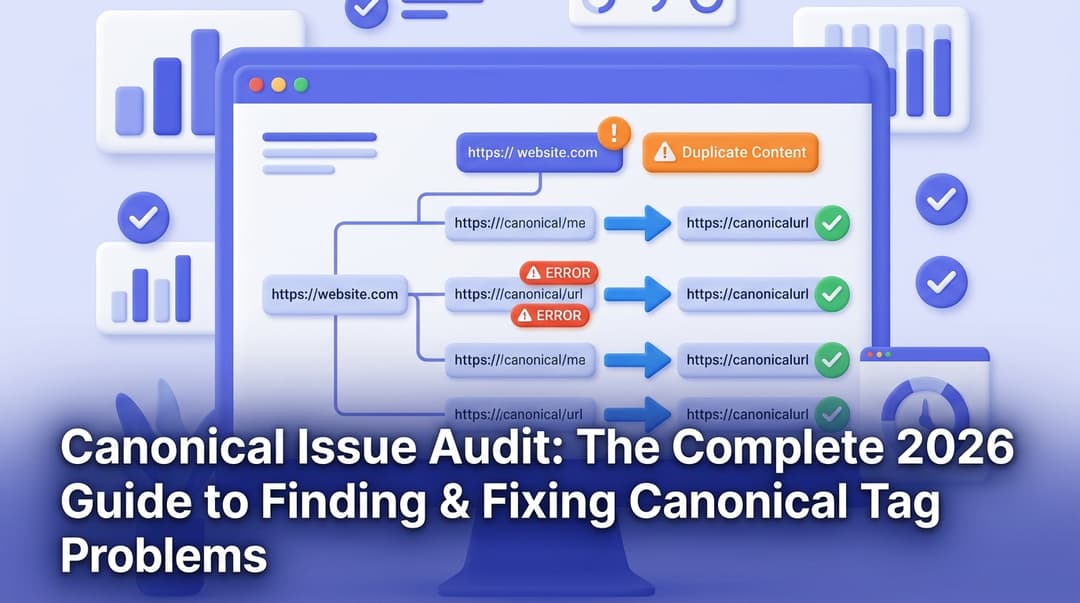
Canonical Issue Audit: The Complete 2026 Guide to Finding & Fixing Canonical Tag Problems
Learn how to run a full canonical issue audit in 2026. Discover the most common canonical tag errors, step-by-step fixes, and tools to protect your SEO rankings.
Related Tools
Flag mismatches between HTML canonical, HTTP header canonical, and sitemap URLs.
Indexable-but-Noncanonical FinderFind indexable pages with canonical tags pointing to different URLs.
Redirect CheckerCheck redirect chains, HTTP status codes, and detect redirect loops for any URL.