Free Faceted Navigation Trap Detector
Detect crawl traps caused by faceted navigation and URL parameter explosions. Enter a category or listing page URL to analyze all internal links, identify filter and sort parameters that generate duplicate URLs, and check whether proper canonical and noindex signals are in place to protect your crawl budget.
Detect Faceted Navigation Traps
QuickSEO shows clicks, impressions, keywords and pages for every website you manage, compared with the period before.
- Unlimited websites on the free plan
- No credit card needed
Why Faceted Navigation Is a Crawl Budget Killer
Faceted navigation is one of the most common technical SEO problems on e-commerce and listing sites. Every filter option (color, size, brand, price range) and every sort parameter (price low to high, newest, popularity) generates a unique URL that search engines will attempt to crawl. A single category page with 10 filters and 3 sort options can produce thousands of crawlable URL combinations, most of which contain duplicate or near-duplicate content.
This URL explosion has three damaging effects: it wastes crawl budget on low-value pages, dilutes link equity across parameter variants, and can trigger duplicate content issues that suppress rankings. Sites with hundreds of categories and deep filter trees can generate millions of parameterized URLs, overwhelming Googlebot and causing important pages to go weeks without being crawled.
Common Faceted Navigation Crawl Traps
Watch for these patterns that indicate crawl budget waste:
- Filter parameters: URLs like
/shoes?color=red&size=10&brand=nikecreate thousands of unique URLs from a single category page. - Sort parameters: URLs like
/shoes?sort=price_ascgenerate exact duplicate content in a different order, wasting crawl resources. - Price range filters: Open-ended parameters like
/shoes?price_min=50&price_max=100can create infinite URL combinations. - Multi-select filters: When users can select multiple values per facet, the URL combinations grow exponentially.
- Pagination + filters: Combining page parameters with filter parameters multiplies the problem further.
How to Fix Faceted Navigation SEO Issues
The goal is to allow search engines to find and index valuable filtered pages while blocking access to low-value parameter combinations. There is no single solution — the best approach combines multiple techniques based on your site architecture.
Start by identifying which filter combinations have genuine search demand. Pages like "red Nike running shoes" may deserve indexing, while "shoes sorted by price ascending page 3" does not. Use canonical tags to consolidate ranking signals, noindex to prevent indexing of low-value variants, and robots.txt rules to block crawling of parameter patterns entirely. For new builds, consider AJAX-based filtering that updates content without changing the URL.
How to Use This Tool
- Enter a URL — Paste the URL of a category or listing page. These pages typically have the most filter options and are the primary source of crawl traps.
- Click "Detect Traps" — The tool fetches the page, extracts all internal links, and analyzes URL parameters across every link.
- Review the risk score — A score from 0 to 100 indicates the severity of potential crawl trap issues. Higher scores mean more wasted crawl budget.
- Check parameter breakdown — See which parameters create the most URL variants, whether they are filter or sort parameters, and how many unique values each one generates.
- Verify canonical and noindex — The tool checks whether the page has proper canonical tags and noindex directives to mitigate parameter-based crawl waste.
- Follow recommendations — Actionable suggestions tell you exactly which parameters to address and how to fix them.
Frequently Asked Questions
What is a faceted navigation crawl trap?
A faceted navigation crawl trap occurs when filter parameters on category pages (like color, size, price, sort) generate thousands of unique URLs that search engines attempt to crawl. Each filter combination creates a new URL, exponentially multiplying the number of pages Googlebot needs to process. This wastes crawl budget and can dilute page authority across near-duplicate pages.
How does faceted navigation waste crawl budget?
Every URL parameter combination creates a new crawlable URL. A page with 5 color options, 8 sizes, and 3 sort orders generates 120+ unique URLs from a single category page. Multiply this across hundreds of categories and you can have millions of low-value URLs competing for Googlebot's attention, leaving important pages undiscovered or rarely crawled.
What is the best way to handle faceted navigation for SEO?
The most effective approach combines multiple techniques: use canonical tags on filtered pages pointing back to the main category URL, add noindex to parameter combinations that should not appear in search results, block specific parameter patterns in robots.txt, and implement JavaScript-based filtering (AJAX) that does not create new server-side URLs. Google also recommends using the URL Parameters tool in Search Console.
Should I noindex all filtered pages?
Not necessarily. Some filtered pages have genuine search value, such as "red running shoes" or "women's size 8 boots." The key is to identify which filter combinations users actually search for and allow those to be indexed, while noindexing low-value combinations like sort order variants, multi-filter combinations, and price range pages that create duplicate content without unique search demand.
How do canonical tags help with faceted navigation?
Canonical tags tell search engines which version of a URL is the "primary" one. When a filtered page like /shoes?color=red&sort=price has a canonical tag pointing to /shoes, it signals that the filtered version is a variant of the main page. This consolidates ranking signals to the canonical URL, prevents duplicate content issues, and helps search engines understand which pages deserve to be indexed.
QuickSEO shows clicks, impressions, keywords and pages for every website you manage, compared with the period before.
- Unlimited websites on the free plan
- No credit card needed
From the blog

XML Sitemap Checks: The Complete 2026 Guide to Auditing & Fixing Your Sitemap
Learn how to run thorough XML sitemap checks in 2026. Discover common errors, how to fix them, and best practices to improve crawling and indexing.
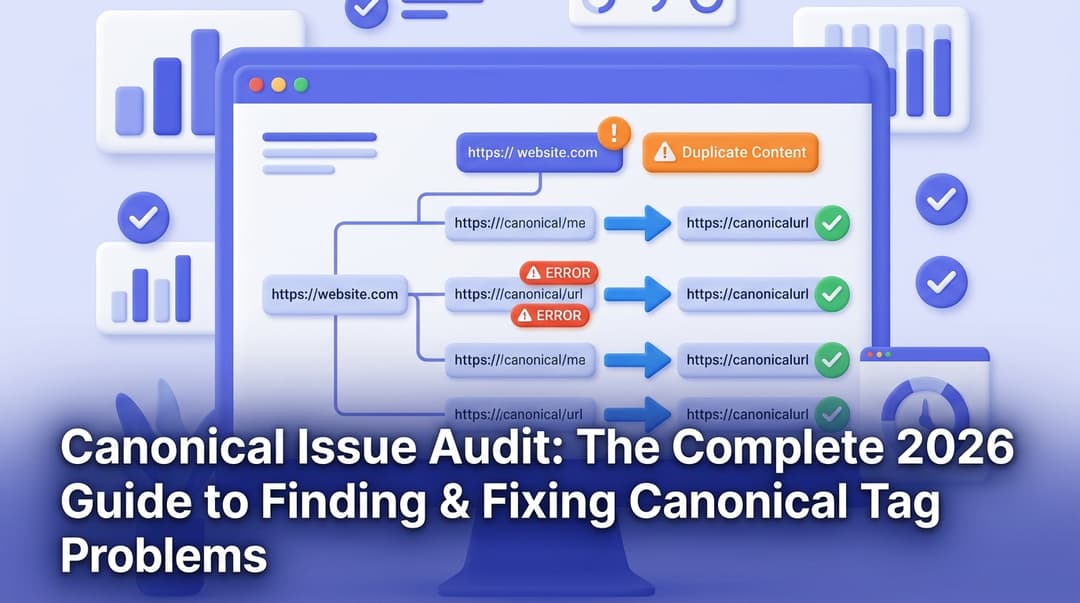
Canonical Issue Audit: The Complete 2026 Guide to Finding & Fixing Canonical Tag Problems
Learn how to run a full canonical issue audit in 2026. Discover the most common canonical tag errors, step-by-step fixes, and tools to protect your SEO rankings.