How ChatGPT Cites Sources: The Complete 2026 Guide to Getting Your Brand Referenced

 Summarize in ChatGPT
Getting cited by ChatGPT is quickly becoming one of the most valuable forms of digital visibility in 2026. For a decade, position zero meant a featured snippet at the top of a Google results page. In 2026, it means something harder to earn and more valuable to hold: a citation inside an AI-generated answer. As more users turn to ChatGPT to research products, brands, and solutions, the question isn't just "can I rank on Google?" — it's "will ChatGPT cite me?"
The two questions have very different answers. ChatGPT doesn't rank pages — it extracts claims. When a user asks a question, ChatGPT's web search retrieves candidate pages, evaluates their relevance, and cites the ones it can confidently attribute specific information to. This is fundamentally different from Google — and it requires a different editorial approach.
This guide breaks down precisely how ChatGPT selects its sources, the ranking factors that influence citations, and actionable steps you can take to start showing up in AI-generated answers.
How ChatGPT's Citation System Actually Works
Before you can optimize, you need to understand the mechanics. ChatGPT doesn't cite sources the same way every time it responds — the process depends on the type of question asked.
The Two-Layer System
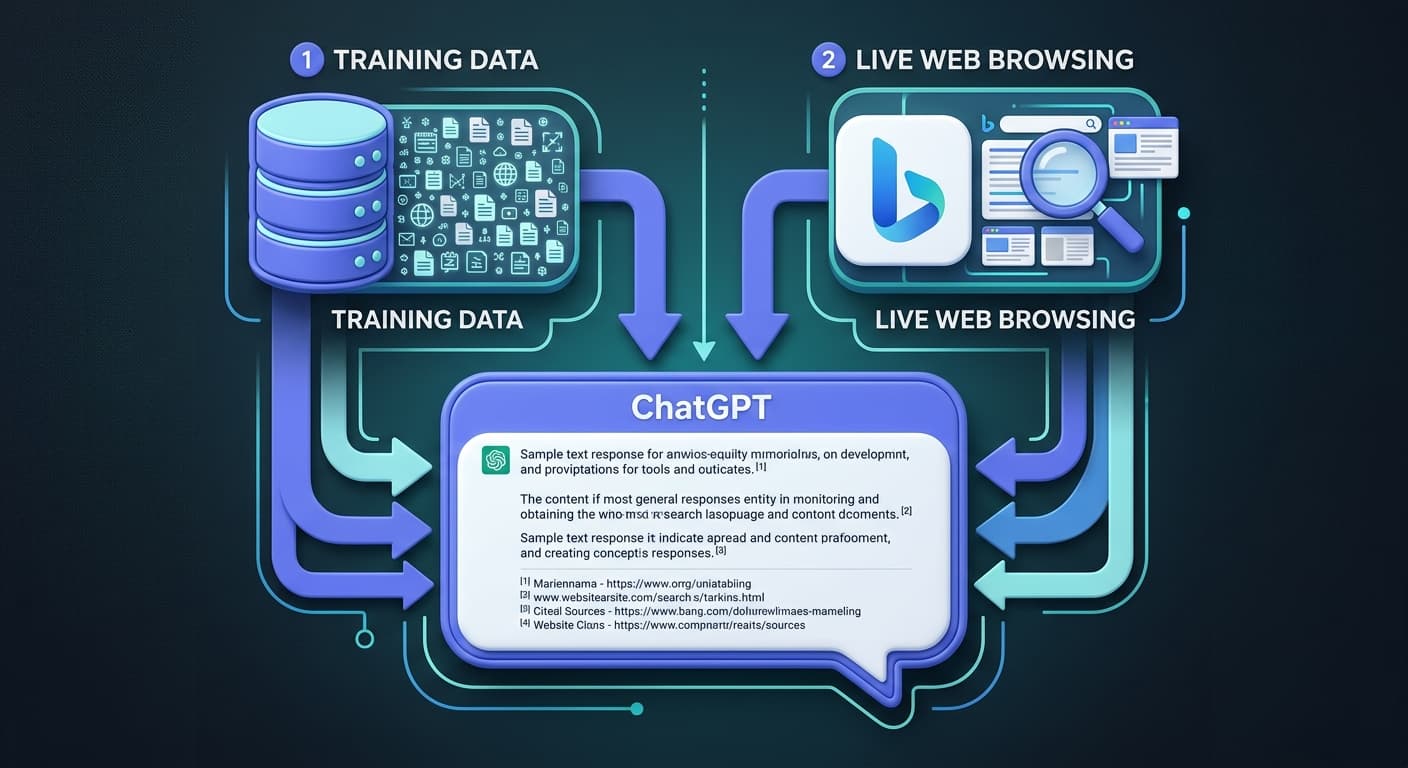
ChatGPT Search operates on a two-layer system. The base layer is its training data — vast, static, and built from web content crawled before the model's cutoff. The retrieval layer is Bing-powered, activated primarily for commercial-intent queries: searches that include terms like "reviews," "comparison," "features," or a year like "2026."
The browsing mode is where citations happen. Training data produces mentions without attribution. This is why you might see your brand mentioned by ChatGPT without a direct link or source — but that's very different from being cited.
Mentions vs. Citations: A Critical Distinction
Many brands confuse these two very different outcomes:
Mention: ChatGPT names your brand in its response (e.g., "Popular CRM options include Salesforce, HubSpot, and Pipedrive.")
Citation: ChatGPT references your content as a source (e.g., "According to [your website], the average implementation takes 6 weeks.")
ChatGPT mentions brands 3x more than it actually cites them. Getting cited by AI is harder than getting mentioned, but citations carry more weight. They indicate your content is being used as a trusted reference, not just a passing mention.
How Often Does ChatGPT Actually Search the Web?
About 18% of ChatGPT conversations trigger at least one web search — a rate that held steady across multiple months of analysis. But timing matters enormously: Turn 1 is everything. Users' opening questions trigger web searches; follow-ups rarely do. Turn 1 is 2.5× more likely to trigger citations than turn 10, and nearly 4× more likely than turn 20. If you want to be cited, you need to win the "first question" — the query that kicks off a research journey, not the clarifying follow-up.
The Top Factors That Influence ChatGPT Citations
Data from SE Ranking's landmark study — which analyzed 129,000 unique domains across 216,524 pages in 20 niches — combined with analyses from Search Engine Journal, Beamtrace, and others paints a clear picture of what actually drives citation likelihood.
1. Referring Domains (Backlink Diversity)
Referring domains — the number of unique websites linking to yours — are the single strongest signal influencing whether ChatGPT cites a domain. Generative models rely heavily on signals that reflect broad, ecosystem-level trust. When many different sites link to a domain, AI models learn that the content is widely referenced and dependable.
The data is stark:
Websites with up to 2,500 referring domains receive an average of 1.6–1.8 citations, while those with over 350,000 referring domains receive 8.4 citations on average. The biggest growth spike occurs when crossing the 32,000-link mark, where citations nearly double from 2.9 to 5.6.
2. Domain Traffic (With a Catch)
Beyond traditional authority factors, a site's overall visibility on Google (measured by traffic and average ranking) also significantly affects its chances of being cited by ChatGPT. Domain traffic ranks as the second most important factor for ChatGPT citation, but it remains less influential than backlinks.
Crucially, however, low- to medium-traffic websites don't gain much advantage in ChatGPT citations. A site receiving 20 organic visitors and another receiving 20,000 visitors tend to receive roughly the same "score" from ChatGPT. In such cases, other factors (like content quality, relevance, and authority) likely outweigh raw traffic numbers, so even smaller websites have a chance of being cited.
3. Content Structure and "Extractability"
ChatGPT's process is: Retrieve (crawl the web for relevant pages), Evaluate (assess for extractable claims, source credibility, and structural clarity), and Cite (select ~4 sources per response). The key insight: ChatGPT doesn't cite the "best" page — it cites the page it can most confidently extract and attribute a specific claim from. This means editorial quality — how you write — matters more than domain authority.
Structural factors that correlate with higher citations include:
Articles under 800 words averaged 3.2 citations, while those over 2,900 words averaged 5.1.
Structure mattered beyond raw word count. Pages with section lengths of 120–180 words between headings performed best, averaging 4.6 citations. Extremely short sections under 50 words averaged 2.7 citations.
Pages with expert quotes averaged 4.1 citations versus 2.4 for those without. Content with 19 or more statistical data points averaged 5.4 citations, compared to 2.8 for pages with minimal data.
4. Content Freshness
Content updated in the past three months averages 6 citations versus 3.6 for outdated pages. By refreshing existing articles quarterly with new statistics, examples, or sections, you can nearly double your chances of being cited by ChatGPT.
Content freshness is a significant factor in ChatGPT's source selection, particularly for queries about evolving topics. Update your most important pages regularly and make the update dates visible. A page last updated in 2024 competes poorly against a page updated in 2026 for the same query. Adding a "last updated" date in both your frontmatter metadata and visible page content signals recency to both crawlers and AI browsing tools.
5. E-E-A-T and Entity Signals
The E-E-A-T framework (Experience, Expertise, Authoritativeness, Trustworthiness) that Google has emphasized for years turns out to matter for ChatGPT too. Sites with strong E-E-A-T alignment see 45% higher citation rates, especially when implemented through structured data.
Entity recognition — how well AI understands who you are and what you're an expert in — has emerged as a critical factor that many brands overlook. AI systems evaluate entities through several signals: author credentials and professional affiliations (especially when marked up with schema), and organization entity validation against authoritative sources like Wikipedia and Wikidata.
What ChatGPT Cites (and What It Skips)
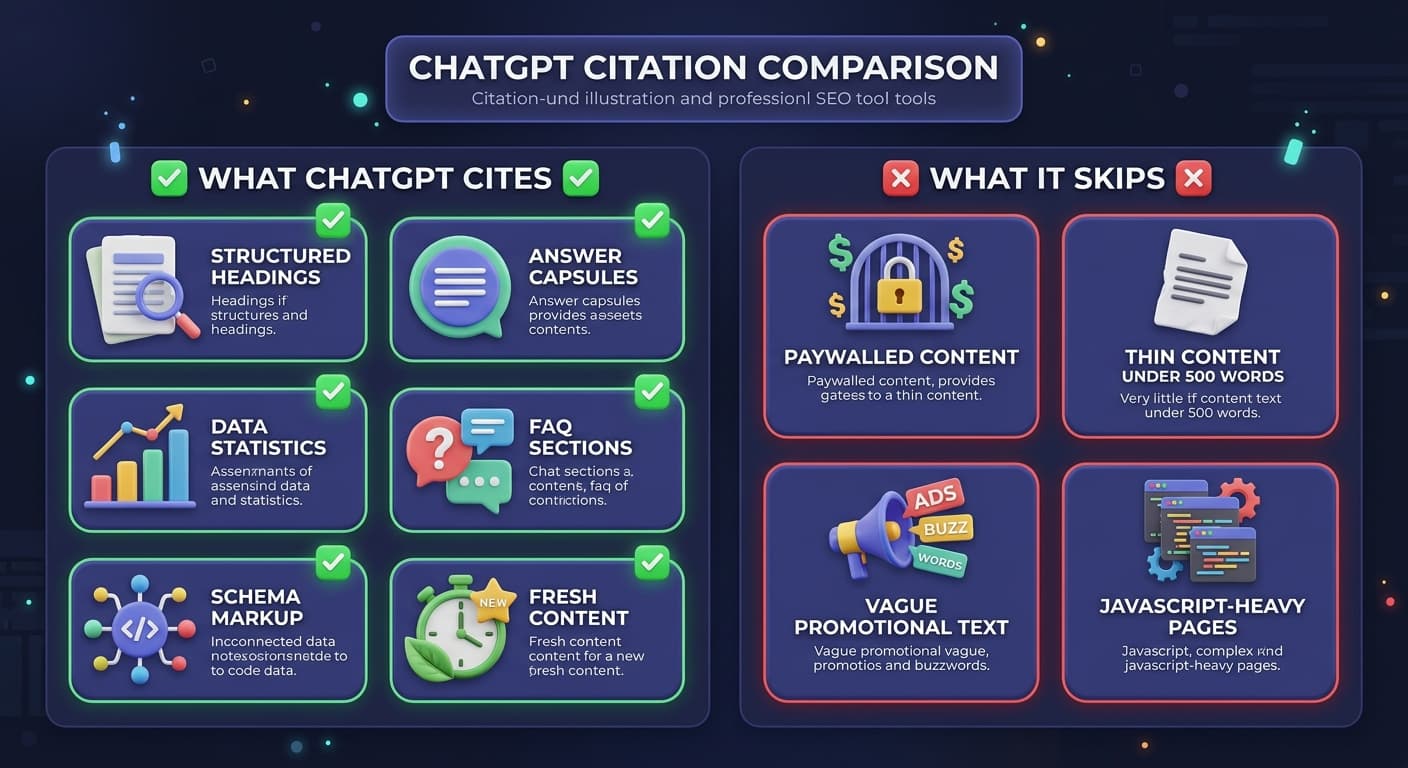
Understanding what ChatGPT actively avoids is just as valuable as knowing what earns citations.
ChatGPT Favors:
Answer capsules — An answer capsule is a self-contained, quotable block of text that directly answers a specific question in 40–80 words. Answer capsules are the single most consistent predictor of ChatGPT citation.
Front-loaded answers — AI systems don't favor pages that require a reader to scroll for the answer — they favor pages that front-load it. Research confirms that 44.2% of all LLM citations come from the first 30% of page content.
High fact density — ChatGPT uses retrieval-augmented generation (RAG) to select citations, typically citing 4 sources per response. Pages with a fact-to-word ratio above 1:80 are 4.2x more likely to be cited.
Tables and lists — ChatGPT lifts tables — not paraphrases them — often cell by cell.
Question-based headings — H2 and H3 headings phrased as questions create natural extraction points. When a ChatGPT query matches your heading, the content beneath it becomes a strong citation candidate.
ChatGPT Skips:
AI cannot cite content behind login walls. Your most citable content should be publicly accessible.
500-word pages rarely get cited. Comprehensive coverage that actually answers questions wins.
Pages that rely on heavy JavaScript rendering — AI tools read HTML directly. Pages that rely heavily on JavaScript or dynamic rendering sometimes fail to expose key sections to crawlers. A simple test: view your page with JavaScript disabled. If the main content disappears, AI tools may struggle to access it as well.
Vague, promotional content — Pages that are vague, promotional, or internally inconsistent are less likely to be reused safely.
Where ChatGPT Sources Its Citations: The Platform Breakdown
ChatGPT's analysis reveals a heavy reliance on authoritative, encyclopedic sources for general queries. The platform demonstrates a clear preference for established information repositories: Wikipedia dominates with 43% of all citations.
Wikipedia appears in nearly 1 in 6 conversations with citations. It's the de facto knowledge layer, the place ChatGPT goes first for baseline facts. The strategic implication: don't try to outrank Wikipedia — position your content to be the next trusted source after it, answering what it can't.
Beyond Wikipedia, sources travel in packs. ChatGPT doesn't pick one winner — it cites competitors side by side. This means you should aim to co-appear alongside other trusted domains in your niche, not try to monopolize every citation slot.
Reddit is heavily represented in LLM training corpora. When a brand or page is mentioned across Reddit threads, the model becomes more familiar with it, and this familiarity improves trust signals indirectly.
Practical Strategies to Get Cited by ChatGPT in 2026
Build Topical Authority, Not Just Individual Pages
Create topical clusters so your site looks like the "best source" on a subject, not a one-off article. Use a pillar page for the main theme, then supporting posts that answer narrower questions (definitions, checklists, comparisons, case studies) with clear internal links between them. This reinforces topic authority and helps AI systems understand relationships across your content.
Sites that cover a topic comprehensively across multiple pages build topical authority that individual pages cannot achieve alone. ChatGPT is more likely to cite a page from a site with 20 articles on a topic than a site with just one.
Use Schema Markup Strategically
Structured data AI search optimization has evolved from a nice-to-have SEO enhancement to a critical requirement for AI visibility. In 2026, AI systems like ChatGPT, Perplexity, and Google AI Overviews rely heavily on structured data to understand, verify, and cite content accurately. Content with proper schema markup has a 2.5x higher chance of appearing in AI-generated answers.
The five schema markup types that AI assistants like ChatGPT, Perplexity, and Gemini actively use for citations are: (1) Organization Schema for entity recognition, (2) FAQPage Schema for Q&A-style citations, (3) Article/BlogPosting Schema for content attribution, (4) Product/Service Schema for commercial recommendations, and (5) BreadcrumbList Schema for understanding site structure and topical authority.
You can validate and generate your schema markup quickly using QuickSEO's free AI Schema Markup Generator — no coding required.
Pro tip from the data: Structured data is a nice-to-have, not a game-changer. LLMs seem to care more about whether the information is structured (via headings) than whether it's technically marked up. Focus on content organization first; schema markup is icing on the cake.
Optimize for Bing (Not Just Google)
ChatGPT doesn't crawl the web itself. When you ask a question that needs current information, it runs a search in the background — for most queries, through Microsoft Bing. The results become the candidate pool. ChatGPT reads the top pages, extracts whatever it can lift cleanly, and links to the ones it quotes.
If your site has never been verified in Bing Webmaster Tools, your ChatGPT visibility is likely near zero regardless of how well you rank on Google. Submit your sitemap to Bing immediately — you can also validate it with QuickSEO's Sitemap Validator to make sure it's error-free before submission.
Build Community Signals Authentically
On-page content restructuring matters but it's only about 30% of the equation. Community sites (Reddit, Quora, forums) capture 52.5% of all AI citations across ChatGPT, Perplexity, and Google AI Overviews. Brand-owned domains account for the remaining 47.5%. AI engines trust what others say about you more than what you say about yourself.
Authentic community discussion of your product, brand, or topic now functions as a ranking input. This doesn't mean astroturfing — which gets caught and punished — but it does mean genuine community engagement, helpful answers, and real conversations about your space have measurable AI-visibility value.
Keep Content Fresh and Visible
Refreshing content is one of the highest-ROI tactics available. AI visibility changes faster than most teams expect. Pages that teams fail to refresh at least once per quarter are three times more likely to lose AI citations over time. Structure creates the first opportunity and ongoing review protects it.
The Citation Economy: Wide but Unequal
One of the most important strategic insights from recent research: Getting cited once doesn't guarantee prominence. You're competing for share of voice within a set of sources, not for sole ownership of an answer. No single source dominates — but the distribution is highly unequal. A small number of domains capture disproportionate share while hundreds of thousands split the rest.
ChatGPT's decision to cite a source depends much more on alignment and structure than on reputation or link profile. This may seem counterintuitive from a classic SEO perspective, but it reflects how language models process trust. They do not rank based on backlinks. Instead, they favor content that maps cleanly onto how they construct answers.
This creates a genuine opportunity for smaller, specialized brands: Domain authority increases retrieval probability but citation rates plateau after mid-range domain ranks. A smaller site that matches the expected answer pattern can outperform a well-known domain that does not. In simple terms, authority opens the door, but it does not guarantee a seat at the table.
How to Track Your ChatGPT Citation Performance
Optimizing for ChatGPT citations without tracking them is like running an SEO campaign without checking your rankings. If you can't measure it, you can't improve it — and that's exactly why learning how to track ChatGPT rankings over time is a core part of sustained AI visibility.
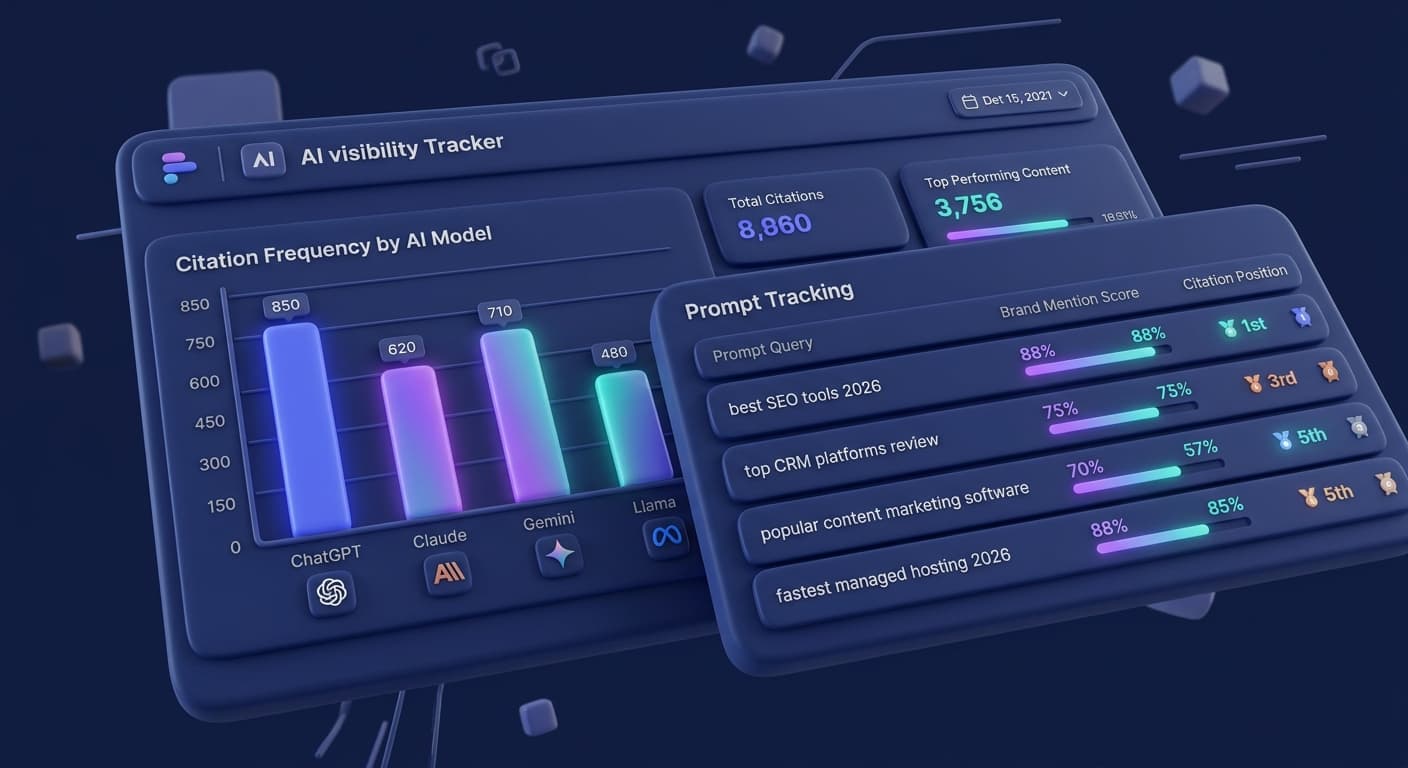
Key metrics to monitor include:
Citation frequency — How often ChatGPT cites your domain for target queries
Prompt-level tracking — Which specific questions trigger citations of your content
AI share of voice — Your brand's citation share relative to competitors across platforms
AI-referred traffic — Actual sessions arriving from ChatGPT (trackable in GA4)
You can also check out QuickSEO's AI Visibility Audit to get a clear picture of where your brand stands across ChatGPT, Claude, and Gemini today.
AI responses are non-deterministic — the same query can cite different sources each time. This is why consistent content quality matters more than one-time optimization. Check citation status regularly, not just once.
ChatGPT Citation Checklist: 10 Quick Wins
Use this checklist to audit your most important pages today:
✅ Answer capsule in the first paragraph — 40–80 words, direct answer to the query
✅ Question-based H2/H3 headings — mirrors how users prompt ChatGPT
✅ 3+ statistics per 1,000 words — cited, specific, and sourced
✅ At least one comparison table or numbered list — ChatGPT lifts these directly
✅ FAQ section — maps content to user intent signals
✅ Visible "last updated" date — freshness signal for both crawlers and AI
✅ Article + Organization schema markup — machine-readable identity layer
✅ Submitted and indexed in Bing — required for ChatGPT's retrieval layer
✅ No robots.txt blocks on GPTBot — ensure AI crawlers can access your content
✅ Topical cluster coverage — multiple pages supporting your core topic
🚀 Track Your AI Citations with QuickSEO
Stop guessing whether ChatGPT, Claude, or Gemini is citing your brand. QuickSEO gives you a single dashboard to track your AI visibility scores, monitor tracked prompts across every major AI chatbot, and measure your share of voice — all alongside your traditional Google Search analytics. Join thousands of marketers already tracking their AI & SEO performance. 👉 Get started for free at quickseo.ai
Conclusion
The rules of search visibility are being rewritten. Getting cited by ChatGPT in 2026 requires a fundamentally different mindset than traditional SEO — one focused on extractability, authority, freshness, and structural clarity rather than keyword density and blue-link rankings.
The brands winning AI citations aren't necessarily the biggest or most well-known. The sites winning citations in 2026 aren't the ones with the most content — they're the ones with the most quotable content.
Start with your best-performing pages, restructure them with answer capsules and question-based headings, build your topical authority, and — critically — measure everything. The ChatGPT citation patterns are trackable, the optimization tactics are proven, and the opportunity to outperform larger competitors on extractability is very real.
The question is: will ChatGPT cite you — or your competitor — the next time a potential customer asks?
Enter your website to track its AI visibility across ChatGPT, Gemini, Claude, and Perplexity — and turn chatbot mentions into traffic.
- Set up in minutes
- Cancel anytime
Keep reading
Related posts
More articles on the same topics, prioritized by shared tags and keyword overlap.