LLM Citation Sources: How AI Chatbots Choose What to Cite (and How to Get Included)

 Summarize in ChatGPT
When someone opens ChatGPT, Perplexity, Claude, or Gemini and asks a question that your business should answer — does your brand show up? If you're not actively thinking about LLM citation sources, the answer is probably no.
AI chatbots are no longer just novelties. ChatGPT alone processes 2.5 billion queries daily from over 800 million weekly users, while Google AI Overviews now appear on 48% of all Google queries as of March 2026 — up 58% year over year. The brands that get cited in these AI-generated answers receive outsized visibility, trust, and traffic. The ones that don't are effectively invisible to a fast-growing segment of their potential audience.
Understanding how LLMs decide which sources to cite — and how to engineer your content to earn those citations — is one of the most critical SEO and marketing skills of 2026. This guide breaks it all down.
How LLM Citation Actually Works: The 4-Stage Pipeline
LLM citations work through a multi-stage pipeline: the model retrieves candidate pages via a search index (RAG), ranks them by relevance and structure, extracts facts from the top results, and attributes those facts to the source.
Most marketers picture a simpler process — the AI searches, finds your page, and cites it. But that mental model misses several critical steps.
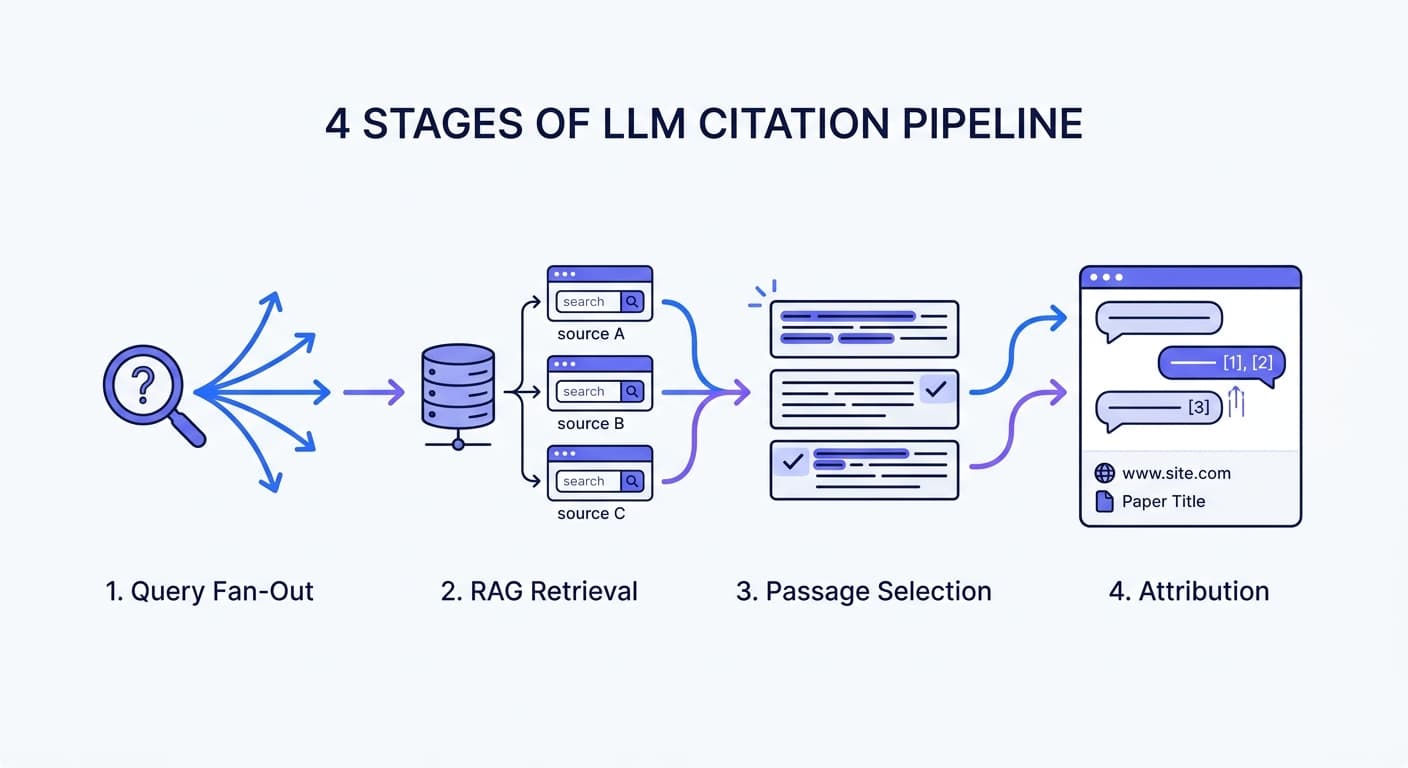
Here's what actually happens under the hood:
Stage 1: Query Fan-Out
A user types one sentence. The model turns it into 8 to 12 parallel sub-queries before a single search result is touched. Your content needs to be discoverable across all these variants, not just the exact phrase the user typed.
Stage 2: Retrieval (RAG)
LLMs run on two knowledge systems: parametric memory (training data) and real-time retrieval (RAG). Critically, 60% of ChatGPT queries never trigger retrieval at all. When retrieval is triggered, your content needs to surface at this stage to even be considered.
Stage 3: Passage Selection
Content structured for LLMs is built for extraction, not for narrative flow. The atomic paragraph — 2 to 4 lines, one idea — is the base unit of AI-readable content. An answer that needs three other paragraphs for context will not be cited as a chunk.
Stage 4: Attribution
The LLM generates its response, incorporating information from the selected sources and attributing specific claims to specific sources through inline citations. Only pages that survive all four stages earn that citation link.
Citation selection is a multi-step process, and your content can drop out at any point. Understanding each stage is what separates deliberate citation engineering from passive optimization.
Each AI Platform Has a Different Citation Logic
Here's the finding that surprises most brands: analysis of 680 million citations found that only 11% of domains are cited by both ChatGPT and Perplexity. This means a strategy that works brilliantly for one platform may leave you invisible on another.
Conductor tracked citation behavior across ChatGPT, Perplexity, Google AI Overviews, Google AI Mode, Gemini, and Claude from September 2025 through March 2026, producing over 1,056 data points — and the result tells a clear story: a single content strategy can no longer cover the full AI search ecosystem.
ChatGPT
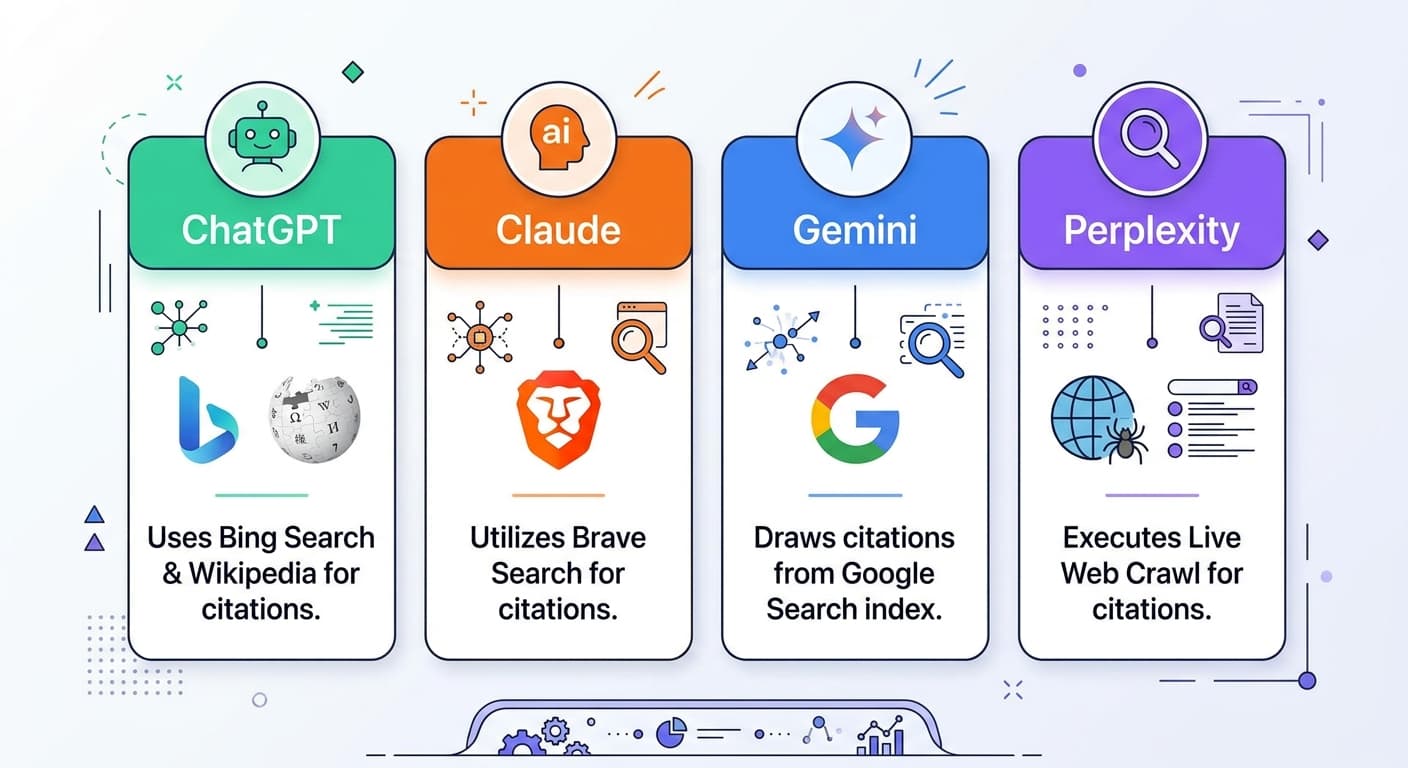
ChatGPT pulls from Bing and rewards Wikipedia presence, broad web authority, and editorial press. It strongly favors comprehensive, long-form pillar content. ChatGPT (with Browse/Search enabled) weights topic authority over recency. It looks for "pillar" content — comprehensive, long-form guides that synthesize multiple sub-questions into one authoritative answer. If your site has a 3,000-word guide on a category topic that covers definitions, comparisons, use cases, and FAQs, ChatGPT is likely to treat that page as a canonical source.
ChatGPT cited URLs that were on average 458 days newer than Google's organic results — the strongest freshness preference of any platform Ahrefs tested across 17 million citations. Its most cited domains for U.S. users are Reddit, Wikipedia, Amazon, Forbes, and Business Insider, based on 9.6 million queries.
Claude
Claude retrieves through Brave Search and rewards high-authority, well-sourced content that ClaudeBot can actually reach. Claude is 30% more likely to cite bullet-pointed pages — making structured, scannable content especially important for Anthropic's model. One critical technical note: Claude currently shows limited web citation compared to other platforms, with an exceptionally high crawl-to-referral ratio of approximately 500,000 to 1. Make sure ClaudeBot isn't blocked in your robots.txt.
Gemini
Gemini uses Google's index and favors schema-marked-up brand-owned domains. Its citation behavior has shifted dramatically in recent months. Pre-2026 research showed over 92% of citations from top-10 domains, but after the Gemini 3 upgrade in January 2026, Ahrefs found only 38% of citations come from top-10 pages. Traditional ranking still helps but is no longer sufficient on its own.
Perplexity
Perplexity searches the live web and leans on Reddit, vertical directories, and data-dense content. It is the most citation-generous platform: Perplexity cites nearly 3× more sources per response than ChatGPT, reflecting its strategy of citing multiple sources per claim, rather than selecting a single "best" source. Perplexity works like a research engine: it cites generously and prizes passages it can lift and attribute, so self-contained statements outperform buried points.
The 5 Key Signals LLMs Use to Select Citations
LLMs don't cite at random. They use 5 specific signals: entity clarity, coverage depth, parsability, third-party mentions, and result proof.
Here's how each signal works in practice:
1. Entity Clarity
Entities make content machine-understandable, not just readable. LLMs build knowledge graphs around entities. When you properly structure entity relationships, your content becomes citable across multiple AI platforms.
2. Coverage Depth (Topical Authority)
The more interesting shift happening in 2026 is the rise of topical authority. A small site that exclusively covers industrial drone repair can genuinely outcompete a massive general tech publication for those specific LLM citations. AI models are getting better at recognizing that a focused, specialized source is often more accurate and reliable than a broad site that covers everything at the surface level. Depth of focus is becoming a real competitive advantage for smaller publishers.
3. Parsability (Content Structure)
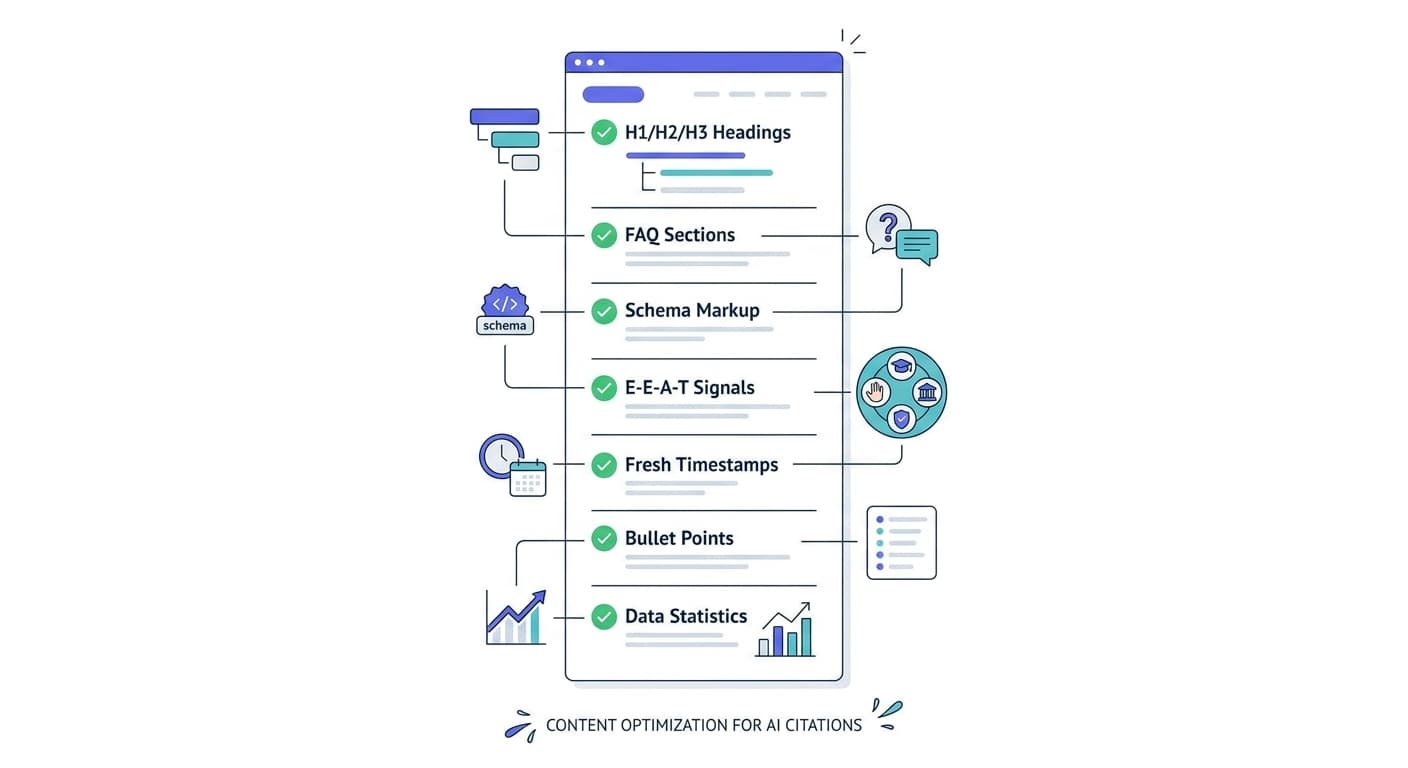
Pages with direct answers, structured data, tables, and clean headings are cited far more often because they are easier for the model to extract from and attribute confidently. AI models favor semantically clear, authoritative content with logical hierarchies — H1-H3 headings, short paragraphs of 2-4 sentences, and lists that deliver direct answers. Keyword density plays little role; instead, the focus should be on entity consistency, original data, and E-E-A-T signals like expert quotes or unique metrics.
4. Third-Party Mentions
The teams succeeding at AI visibility are the ones treating it as a third-party-mention problem, not a content production problem. Your own site matters, but it accounts for roughly 25% of the citation equation. The other 75% lives on third-party domains. Getting your brand mentioned in authoritative publications, Reddit threads, LinkedIn articles, and industry directories is as important as optimizing your own pages.
5. Brand Search Volume
Brand search volume is the strongest single predictor of AI citations (0.334 correlation) — not backlinks or domain authority. The more people actively search for your brand by name, the more likely LLMs are to surface you in their answers. Building brand awareness and consistent online presence pays dividends in AI citation rates.
How to Optimize Your Content for LLM Citations
Use Answer-First Structure
Dense, meandering prose that eventually gets to the point is harder for AI models to extract reliably. Content that leads with the answer and then expands is far more citation-friendly. Start every section with its core takeaway, then provide supporting detail.
According to a Princeton study, content with clear questions and direct answers was 40% more likely to be cited by AI tools like ChatGPT. This makes question-answer formats essential for LLM visibility.
Format for Extraction
Favor structured formats over dense prose wherever your content permits. Numbered lists, comparison tables, and clearly labeled steps are easier for AI models to parse and extract than unbroken paragraphs.
Use our AI FAQ Generator to automatically generate question-and-answer sections optimized for AI extraction — one of the fastest ways to increase your citation potential.
Implement Schema Markup
Make entity relationships explicit in your copy and markup. Use Organization, Product, FAQPage, and Article schema. Schema markup helps AI systems understand what your content is about, not just what keywords it contains.
Prioritize Content Freshness
Include timestamps (e.g., "Updated July 2026"), refresh content quarterly, and maintain unified facts everywhere. Content updated in the past three months averages 6 citations versus 3.6 for outdated pages. AI models strongly weight recency signals.
Build Strong E-E-A-T Signals
E-E-A-T (Experience, Expertise, Authoritativeness, Trustworthiness) strongly influences AI chatbot citations. AI systems evaluate author credentials, demonstrated expertise, brand recognition, and consistency across the web. Content that establishes clear expertise and is published on trusted platforms gets cited more frequently.
Use the E-E-A-T Checker on QuickSEO to audit how well your pages signal expertise and authority to both Google and AI systems.
Ensure AI Crawlers Can Access Your Site
The most common technical blockers are robots.txt rules that exclude AI-specific crawlers. Before investing in content optimization, make sure none of the major AI bots — GPTBot, ClaudeBot, Google-Extended, PerplexityBot — are accidentally blocked on your site.
The Multi-Platform Citation Gap: Why You Can't Rely on One AI
One of the most important findings for any brand pursuing LLM visibility is this: less than 11% of cited domains overlap across platforms for identical queries, so a multi-platform approach is not optional.
The biggest mistake brands make in AEO is treating all AI engines the same. They are not. Each one has a distinct philosophy for how it finds, evaluates, and presents sources.
Semrush data shows 62% brand disagreement exists across ChatGPT, Google AI Mode, and AI Overviews — meaning no single brand dominates everywhere. This actually creates opportunity: you don't need to be the biggest brand to win citations. You just need to be the most citable on your specific topic, on each specific platform.
For a deeper dive into how individual platforms work, check out our analysis of how ChatGPT, Claude, Gemini, and Perplexity cite sources differently — including platform-specific tactics for each.
The Third-Party Mention Layer: Often Overlooked, Always Critical
The durable citation strategy is being genuinely present across the third-party layer, not exploiting one quirk. Low-quality listicles are on borrowed time. Google's recent core updates have already hit thin, self-promotional list content, and LLM providers are actively working to filter "slop." The affiliate content that keeps getting cited is specific, opinionated, and first-hand.
Specifically:
Reddit: Perplexity leans heavily on Reddit (46.7% of top citations) and real-time sources.
LinkedIn: For B2B, professional services, or enterprise software, LinkedIn ranks higher per the SEMrush 325K-prompt study.
Wikipedia & Editorial Press: These are consistently among the highest-cited sources across ChatGPT and Gemini.
A presence in the right third-party ecosystems is not optional — it's structural to how LLMs find and validate your brand.
Tracking Whether You're Getting Cited
Getting cited is the goal, but knowing whether you're getting cited — and in what context — requires active monitoring.
Understanding citation patterns is only half the equation — you also need to monitor whether AI systems are actually citing your content. LLM citation tracking has become essential for content strategists in 2026.
50-90% of LLM citations do not fully support the claims they are attached to. Getting cited is not the same as being accurately represented. You need to monitor not just whether you're cited, but how — the context, sentiment, and accuracy of how AI describes your brand matter enormously.
Quick-Start Action Plan: Getting Cited Faster
Here's a prioritized sequence to improve your LLM citation rate within 30–90 days:
Audit your crawl accessibility — Check
robots.txtfor accidentally blocked AI crawlers (GPTBot, ClaudeBot, PerplexityBot, Google-Extended).Run an AI visibility baseline — Test 20 prompts across ChatGPT, Claude, Gemini, and Perplexity. Document where you appear and where you don't.
Restructure high-traffic pages — Add answer-first formatting, question-based H2/H3s, bullet lists, and standalone factual paragraphs.
Add schema markup — Implement FAQPage, Article, and Organization schema on key pages.
Build third-party mentions — Create genuine, opinionated content on Reddit and LinkedIn in your category.
Refresh stale content — Update publish dates, add new statistics, and revise conclusions on pages older than 3 months.
Monitor citations weekly — Track how your brand appears in AI answers and adjust your content strategy accordingly.
Conclusion
The rules of search visibility have fundamentally changed. LLMs pull content from their training data and real-time indexes, making visibility dependent on semantic clarity, structured markup, and third-party validation — rather than backlink volume alone. If traditional SEO is like getting your book on a library shelf, LLM SEO is like having librarians memorize and quote your book when answering questions.
The brands that win in AI-generated answers will be the ones that invest in being genuinely citable — with structured content, clear expertise signals, and a strong third-party presence.
Whatever share of search AI answers end up taking, Google Search Console is still where you see the clicks Google actually sends you. QuickSEO puts Search Console for every website you run on one free dashboard. See all your sites in one place →
QuickSEO shows clicks, impressions, keywords and pages for every website you manage, compared with the period before.
- Unlimited websites on the free plan
- No credit card needed
Try it yourself
Related free tools
Free SEO tools related to the topics covered in this article.
Keep reading
Related posts
More articles on the same topics, prioritized by shared tags and keyword overlap.