The Complete AI Search Audit Guide for 2026: How to Find and Fix Your Brand's Invisible Gaps

 Summarize in ChatGPT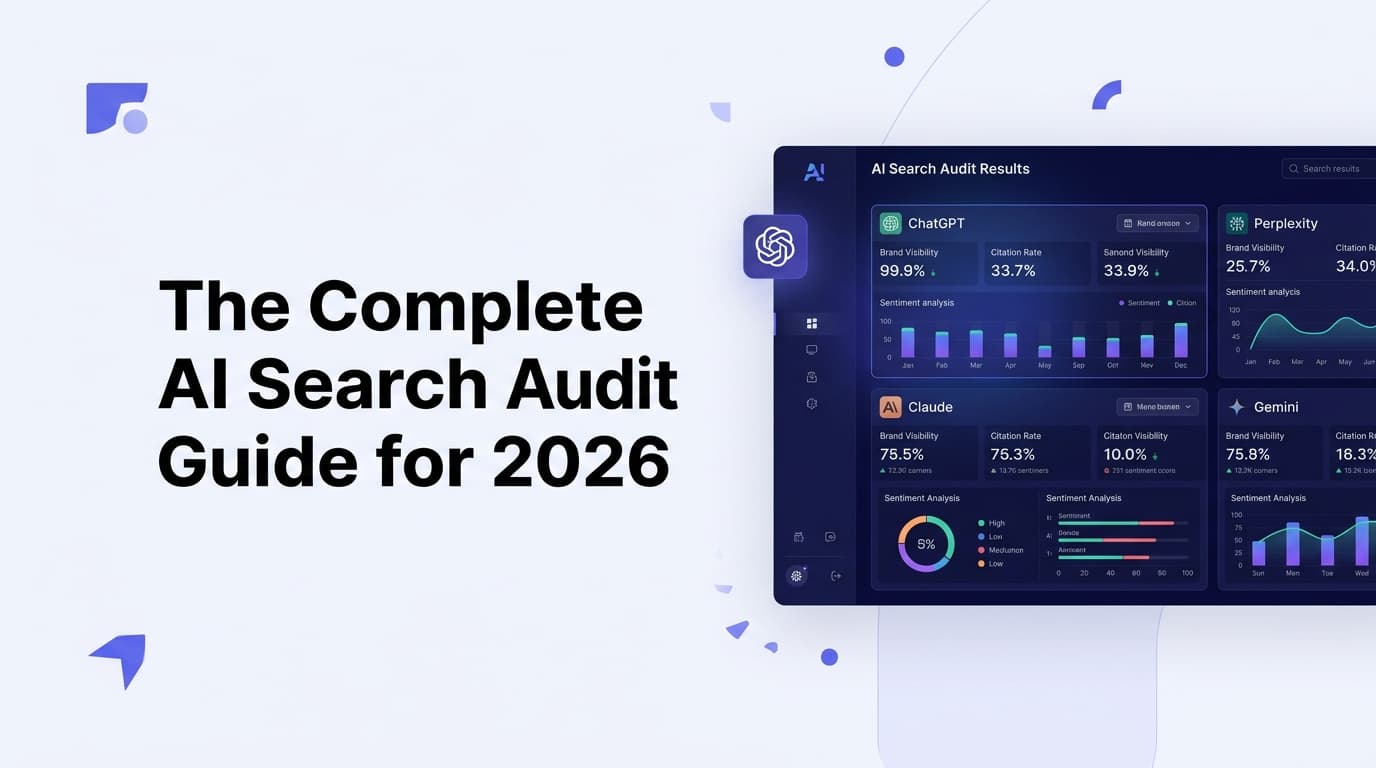
Right now, a potential customer is asking ChatGPT or Perplexity who the best option is in your category. If your brand isn't in that answer, you've already lost the sale — and you won't see it in Google Analytics, Ahrefs, or any other tool you check every Monday.
That's the core problem an AI search audit is designed to solve. Unlike a traditional SEO audit that tracks rankings and clicks, an AI search audit measures something more elusive: how often, how accurately, and how favorably your brand appears when AI systems synthesize answers on behalf of your buyers.
An AI visibility audit is a comprehensive review that assesses how often and how accurately your brand appears across AI search platforms such as ChatGPT, Google AI Overviews, Perplexity, and Gemini. Think of it as your brand's report card for the new search paradigm — and in 2026, it's a report card you can no longer afford to skip.
Why AI Search Audits Are Non-Negotiable in 2026
The numbers tell the story clearly. ChatGPT reached about 900 million weekly active users in February 2026, and Google's Gemini app has passed 750 million monthly active users, while Gemini-powered AI Overviews in Search reach an estimated 2 billion-plus people each month.
And yet, the vast majority of brands are completely invisible on these platforms. 53% of brands are invisible in AI answers. According to the 2X AI Visibility Index from April 2026, 96% of B2B companies are effectively invisible during the earliest stages of AI-driven buyer discovery.
The traffic that does come through AI channels is extraordinarily valuable. AI engines accounted for 4.7% of session volume to commercial sites in Q1 2026 — but those sessions converted at 2.1x the rate of organic search baseline. ChatGPT delivered 2.4% of sessions; Perplexity 1.4%; Gemini 0.6%; Claude 0.3%. Average conversion rate from AI referral was 5.4% vs 2.6% from organic search and 1.8% from paid social.
Why the high conversion rate? Users arriving via AI engines have completed substantial pre-research inside the AI conversation. They land on the site with intent already qualified, often with a specific product or query in mind. The session is rarely top-of-funnel — it's frequently the final hop before a conversion event.
AI Search vs. Traditional Search: A Fundamentally Different Game
AI search operates on a different logic. Google ranks pages. AI systems synthesize answers, often without requiring a click. A brand can rank in Google's top ten and still be absent or misrepresented in AI answers for the same query. Research from Ahrefs analyzing citation overlap found only around 6.82% URL overlap between what ChatGPT cites and what ranks in Google's top 10.
This means your existing SEO investment — however strong — gives you almost no guarantee of AI visibility. You need to audit, measure, and optimize for this new surface separately.
What an AI Search Audit Actually Measures
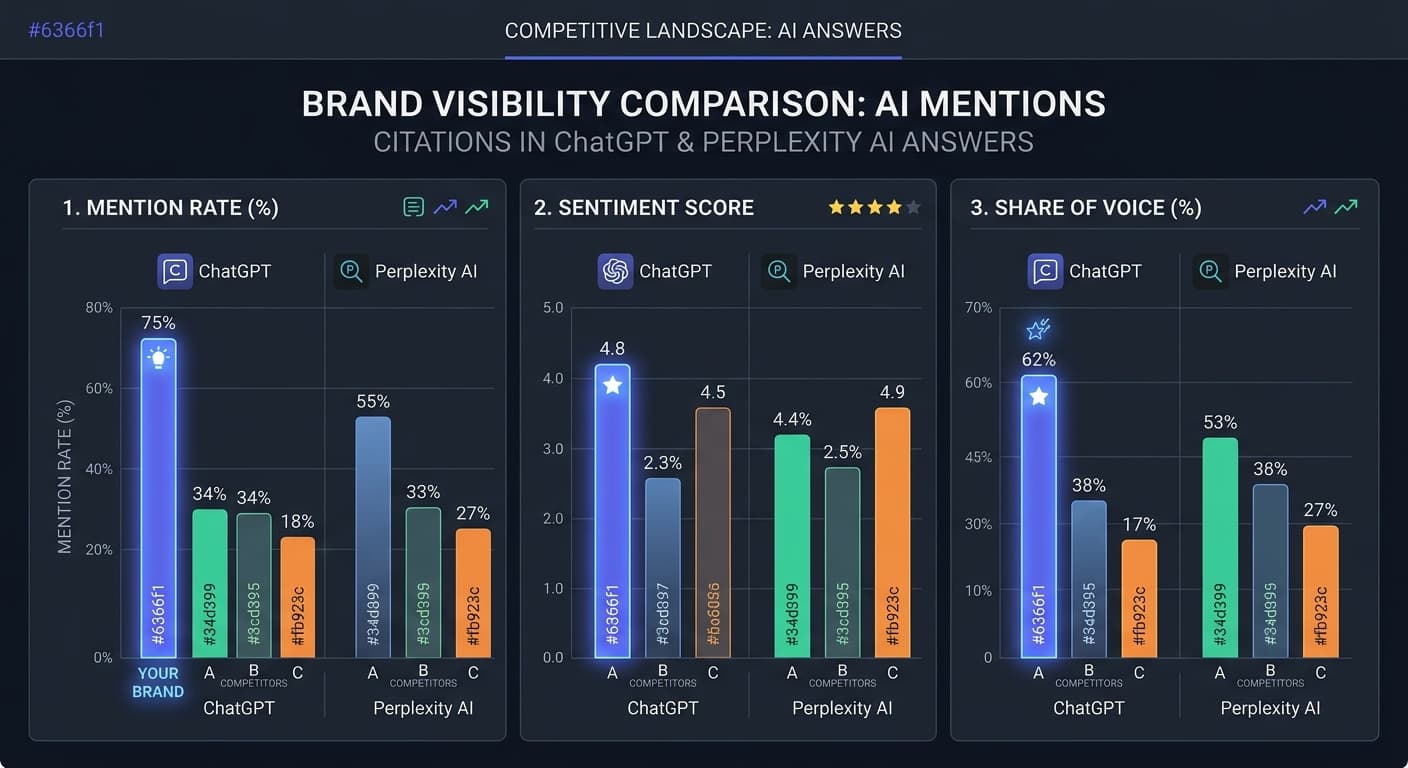
A well-structured AI search audit goes beyond simply asking "does my brand appear?" The audit measures five key areas: mentions, citations, sentiment, share of voice, and technical accessibility to AI crawlers.
Here's what each dimension means in practice:
Mention rate — The percentage of relevant prompts where your brand appears. A 20% mention rate means you show up in 1 of every 5 queries.
Citation sources — Which specific pages, third-party sites, and publications AI engines are pulling from when they reference your brand.
Sentiment — Whether the AI's framing of your brand is positive, neutral, or subtly negative. Even when your brand is mentioned by an AI model, the framing can be neutral, positive, or subtly negative. An AI response that says "Brand X is an option, though it has a steeper learning curve than alternatives" is technically a mention, but it's working against you.
Share of voice — Your brand's proportion of all mentions within your competitive category.
Position within responses — The first five sources are the whole game. 98.8% of all citations sit in positions 1–5 of an AI answer, and brand-mention rates peak in the top two slots. There is no "page two" in AI search, so your audit must record not just whether you appear, but where.
Step 1: Define Your Prompt Library
The foundation of any AI search audit is a well-constructed set of prompts. These prompts should cover awareness, direct brand comparisons, and recommendations — all themes that are likely to produce brand mentions on AI platforms. Remember that recent research has shown that AI chatbots are in the habit of people-pleasing, so try and keep your questions direct and as neutral as possible to avoid confirmation bias.
Your prompt library should include at least three categories:
Category-level discovery prompts — e.g., "What are the best [your product category] tools in 2026?"
Problem-solution prompts — e.g., "How do I solve [core problem your product addresses]?"
Comparison prompts — e.g., "What's the difference between [your brand] and [top competitor]?"
Branded prompts — e.g., "Tell me about [your brand name]"
Aim for 30–50 prompts covering your key topics, product areas, and buyer questions. Tag each prompt by category and intent — you'll reuse this set for every re-audit.
Step 2: Choose Your AI Engines
Not all AI search engines behave the same way, and a single-platform audit will give you a dangerously incomplete picture.
ChatGPT carries a brand mention in 7.6% of its citations and names brands explicitly in 2.4%, while Perplexity is the stingiest on explicit mentions at just 1.5% (AI Overviews 6.5%, Gemini and AI Mode 6.3% sit between). ChatGPT explicitly names brands about 65% more often than Perplexity, so a single-engine audit distorts the picture.
Here's how each engine behaves differently:
ChatGPT draws on a mix of training data and web browsing and is less consistent about linking, so it tends to favor brands with a strong, established presence across the web rather than a single fresh page.
Perplexity leans heavily on live, search-backed results and cites them openly, so it rewards content that is well-structured, recently updated, and already ranking, and its visible source links make it the easiest engine to learn from.
Gemini is wired into Google's ecosystem, so traditional search strength and structured data carry weight there.
Claude leans toward primary sources and careful, technical framing, rewarding depth and precision over marketing copy.
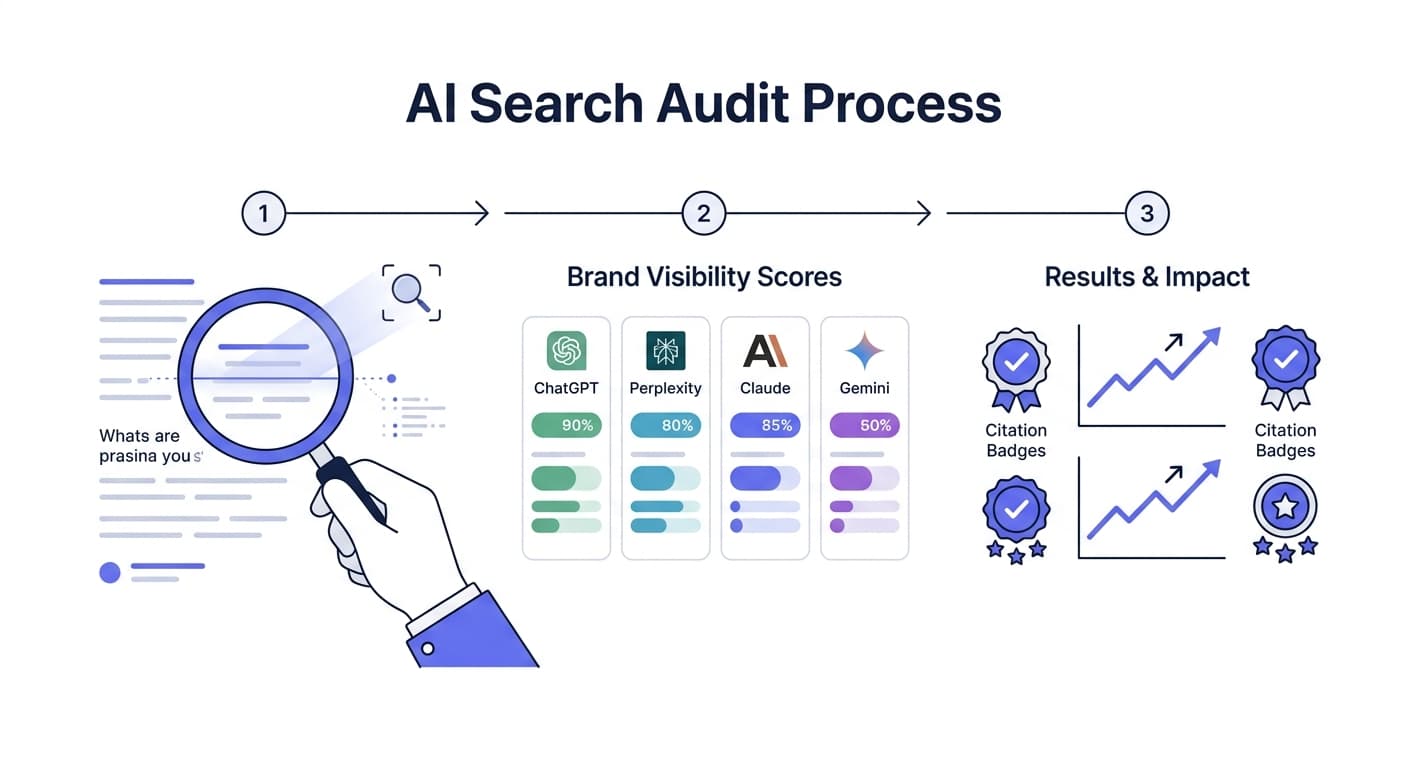
Run your full prompt library across all four major platforms. Record the raw responses, note citation sources, and log where your brand appears (or doesn't) in each response.
Step 3: Score Your Visibility and Sentiment
Once you've run your prompts, it's time to quantify what you found. Create a scoring spreadsheet with the following columns for each prompt × engine combination:
Metric | What to Record |
|---|---|
Brand appeared? | Yes / No |
Position | 1st, 2nd, 3rd mention, or absent |
Sentiment | Positive / Neutral / Negative |
Citation source | URL cited by the AI |
Competitor appearing instead | Competitor brand name |
Accuracy | Is the information about your brand correct? |
The reputational risk point deserves direct attention. An audit is not only about being present. It's about catching misinformation and negative framing before it costs you. Inaccurate AI mentions are another issue to catch at this stage. AI models sometimes surface outdated information, incorrect pricing, or wrong feature descriptions.
When you've scored all your responses, calculate:
Overall mention rate (% of prompts where your brand appeared)
Average position across mentions
Sentiment breakdown (% positive, neutral, negative)
Competitor share of voice vs. your own
Step 4: Audit Your Technical AI Accessibility
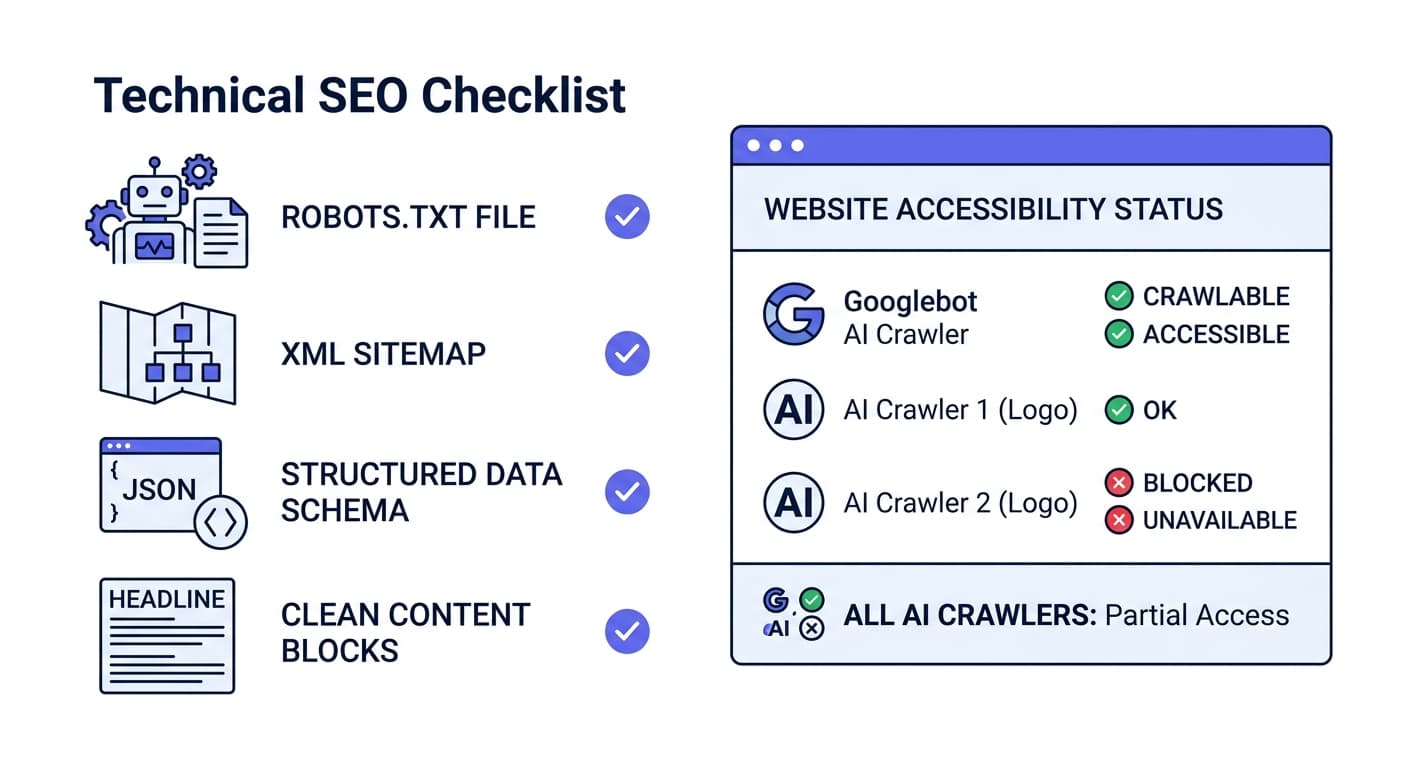
Even the best content strategy fails if AI crawlers can't access your pages. The first part of an AI SEO audit is access. If a key page is blocked, not indexed, duplicated, or unable to show a useful snippet, it will struggle to appear anywhere important. Review robots.txt, noindex tags, canonical tags, redirects, and sitemap coverage.
Check whether AI crawlers can read your site at all. The common blockers are overly restrictive robots.txt rules, CDN bot filtering, JavaScript-only rendering, and aggressive WAF settings. Any one of these can hide your best pages from AI systems entirely.
Use the following QuickSEO tools to run this technical layer of your audit:
Robots.txt Validator — Confirm no AI crawler user-agents are inadvertently blocked
Sitemap Validator — Make sure all important pages are included and accessible
Noindex Checker — Find pages accidentally excluded from indexing
Structured Data Validator — Confirm your schema markup is clean and complete
A significant portion of your site's search impressions in 2026 are generated by machines researching on behalf of humans. Those machines don't care about your keyword rankings. They care whether they can extract a clean, accurate, well-structured answer from your content quickly.
Step 5: Analyze Your Content for AI Extractability
Technical access is necessary but not sufficient. AI engines need to be able to extract a clear, citable answer from your content. Of 2,225 pages analyzed, 36% were thin or non-extractable, 77% carried no visible date, and only 21.2% showed author signals. AI systems cite pages they can extract, date, and attribute — and the most-cited format is the brand's own site.
For each high-priority page, check:
Does the page answer a specific question clearly and completely? Keywords still matter, but the page must answer the real question behind the search. A good page explains the topic, handles objections, gives examples, and guides the reader to the next step.
Does the page have visible dates and author signals? AI engines weight freshness and E-E-A-T signals heavily.
Is the content structured with clear headings, bullet points, and concise answers? Use QuickSEO's Heading Structure Analyzer to check heading hierarchy across your key pages.
Does the page carry appropriate schema markup? Structured data helps AI systems understand exactly what type of content they're reading.
Step 6: Audit Your Off-Site Authority Signals
One of the most underappreciated findings from 2026 AI visibility research: third-party mentions matter more than your own content alone. Brand mentions in third-party sources are among the strongest predictors of AI visibility. Research has shown that they're much more important than backlinks and even a site's domain authority for AEO. Specifically, Ahrefs' study of 75,000 brands found a 0.664 correlation between brand mentions and AI visibility, compared to just 0.218 for backlinks.
During your audit, identify:
Which third-party sources (review sites, industry publications, directories, forums) AI engines are citing about your category
Whether your brand appears in those sources — and how
Which sources your competitors are mentioned in that skip you
Look for the specific gaps: the Reddit threads they're in and you're missing, the third-party listicles that skip you. Those gaps become your work queue for the next quarter.
Brands referenced positively across four or more independent sources are 2.8x more likely to appear in ChatGPT responses. That's compared with brands mentioned only on their own website.
Step 7: Benchmark Against Competitors
An AI search audit without competitive context is incomplete. Score your top three competitors against the same prompt library and the same audit criteria. Every visible difference is a tactical opportunity.
For every query where a competitor appears and the brand does not, examine what content, format, and authority signals are driving that citation. The gap is rarely about SEO. It is usually content depth, third-party mentions, or entity authority.
Pay particular attention to co-occurrence patterns: note which brands consistently appear alongside yours in AI responses. Co-occurrence reveals how AI platforms are categorizing the brand within its competitive set and whether that positioning is accurate.
What to Do After Your Audit: Fixing the Gaps
Finding gaps is only half the work. Here's how to act on your audit findings:
Fix Technical Blockers First
Technical clarity comes first because content improvements will not help if search engines cannot properly access and process the page. Address any robots.txt conflicts, crawl errors, or JavaScript rendering issues before investing in new content.
Build Content That Answers the Questions Where You're Absent
For every category of prompts where competitors appear and you don't, create or update content that specifically addresses those questions. Make it structured, dated, and clearly attributed to a real expert or author.
Earn Third-Party Mentions Strategically
Focus on getting your brand mentioned accurately in the specific third-party sources that AI engines trust in your category: industry review sites, comparison pages, authoritative publications, and community forums.
Monitor Continuously — AI Answers Drift
Once a brand wins a citation for a given query, that citation persists at the same brand for an average of 41 days before drifting. This means a one-time audit is the start, not the finish. Auditing at scale across ChatGPT, Gemini, and other LLMs is really a question of cadence, not a one-off scan. Set up a weekly or bi-weekly prompt monitoring workflow to track changes over time.
You can also check our AI Visibility Audit tool to get an automated baseline of where your brand currently stands across AI platforms.
The AI Search Audit Frequency Question
How often should you run a full audit? The answer depends on your category velocity:
High-competition categories (SaaS, finance, marketing tech): Monthly full audits with weekly spot-checks on your 10 most important prompts
Medium-competition categories (professional services, B2B): Quarterly full audits with monthly spot-checks
Lower-competition categories: Semi-annual full audits
A weekly prompt-based audit will capture changes before they compound into a significant visibility deficit. Treat AI visibility monitoring the same way you treat rank tracking in traditional SEO — as an ongoing operational task, not a periodic project.
For a deeper look at the metrics involved, our guide on AI visibility metrics walks through exactly what to track and how to interpret the numbers.
Common Audit Mistakes to Avoid
Auditing only one AI engine. Share of voice is not one number but several, and a page that earns a citation in one engine can be invisible in another. Independent audits in 2026 have found the overlap between the sources different AI engines cite can be strikingly low.
Ignoring sentiment. Appearing in AI answers in a negative or hedged context can actively damage purchase intent.
Treating your audit as a one-time event. AI answers change constantly as models update their training data and retrieval behavior.
Publishing low-quality AI content to fill gaps. Don't flood your site with AI-generated posts just because a prompt audit found gaps. Test ideas before publishing. Build a presence in the sources AI systems cite. Create content that demonstrates real expertise.
The Payoff: What Winning AI Visibility Looks Like
Brands cited in AI Overviews see a 23% branded search lift in 30 days. Winning in AI search compounds: better AI visibility drives more branded searches, which drives stronger traditional SEO signals, which drives more AI citations.
The strategies that build AI search visibility — including structured authoritative content, strong off-site presence, clean technical foundations, and consistent topical depth — also make you better at traditional SEO. The investment compounds in both directions.
The window to establish a strong position is still open, but it's narrowing. Only 14% of brands have an AI visibility strategy. That means running a rigorous AI search audit today still puts you ahead of 86% of your competitors.
Stop Flying Blind in AI Search
QuickSEO finds every place your brand is invisible — in Google and across ChatGPT, Claude, Gemini, and Perplexity — then writes and publishes on-brand, research-backed articles designed to rank and get cited. Every day, on autopilot. Start your free AI visibility audit at quickseo.ai →
Final Thoughts
An AI search audit isn't a luxury for forward-thinking marketers — it's a basic diagnostic that every brand needs in 2026. The buyers asking AI chatbots for recommendations in your category are qualified, ready to convert, and choosing between you and competitors based entirely on what AI says. You may have invested years into building your website, ranking on Google, and growing your social media presence. But AI search is a completely different game and if you haven't played it yet, you're likely losing ground without even knowing it.
The good news: the audit process is learnable, the gaps are fixable, and the brands that move decisively in the next 90 days will be the ones that AI engines cite by default for years to come.
Enter your website to track its AI visibility across ChatGPT, Gemini, Claude, and Perplexity — and turn chatbot mentions into traffic.
- Set up in minutes
- Cancel anytime
Keep reading
Related posts
More articles on the same topics, prioritized by shared tags and keyword overlap.