Free Click Depth Estimator
Enter a website URL to estimate how many clicks it takes to reach each page from the homepage. The tool crawls outward using BFS (breadth-first search), tracking click depth for every discovered page and comparing against your sitemap to find unreachable content.
QuickSEO shows clicks, impressions, keywords and pages for every website you manage, compared with the period before.
- Unlimited websites on the free plan
- No credit card needed
What is Click Depth?
Click depth (also called crawl depth) measures the minimum number of clicks required to navigate from the homepage to any given page on your website. It is determined by the actual internal link structure, not the URL path. A page at /blog/category/post might have a URL depth of 3, but if the homepage links directly to it, the click depth is just 1.
This metric matters because search engine crawlers follow links to discover pages. Pages that require many clicks to reach from the homepage are further from the main source of link equity and may be crawled less frequently or not at all.
Why Click Depth Matters for SEO
Search engines allocate crawl budget based on site structure. Pages closer to the homepage receive more frequent crawls and accumulate more internal link equity. Google's John Mueller has stated that pages deeper in a site's architecture may be seen as less important. Here is why click depth matters:
- Crawl frequency: Pages at depth 1-2 are typically crawled daily or weekly, while pages at depth 4+ may only be crawled monthly or less.
- Link equity distribution: Internal link equity (PageRank) flows from the homepage outward. Each additional click level dilutes the equity reaching that page.
- Indexing speed: New pages linked from shallow-depth pages get indexed faster than those buried deep in the site architecture.
- User experience: Users expect to find important content quickly. If a key product or article requires 5+ clicks from the homepage, most visitors will never reach it.
Click Depth Best Practices
Follow these guidelines for optimal site structure:
- Keep important pages within 3 clicks: Product pages, key blog posts, and conversion pages should be reachable in 3 clicks or fewer from the homepage.
- Use hub pages: Create category or topic hub pages that link to all related content. This flattens the site structure and reduces click depth for deep pages.
- Link from the homepage strategically: Your homepage carries the most link equity. Link to your most important sections and pages directly from it.
- Add breadcrumb navigation: Breadcrumbs create additional internal link paths that reduce effective click depth for deep content.
- Use contextual internal links: Link to related content within your body text. These contextual links carry more weight than navigation links and create shorter paths between pages.
- Audit regularly: As your site grows, click depth naturally increases. Run this tool periodically to catch pages that have drifted too deep.
How to Use This Tool
- Enter your website URL — Paste any URL from your site. The tool automatically identifies the homepage and starts the crawl from there.
- Click "Analyze" — The tool fetches your sitemap to find known pages, then crawls outward from the homepage using breadth-first search, following internal links up to 5 levels deep (max 30 pages).
- Review the score — The score reflects what percentage of your sitemap pages are reachable within 3 clicks. A score of 80+ is healthy.
- Check the depth distribution — The horizontal bar chart shows how many pages are at each click depth level. Green bars (depth 0-2) are ideal, yellow (depth 3) is acceptable, and red (depth 4+) needs attention.
- Examine crawled pages — The table lists every discovered page with its click depth and the page that linked to it, so you can trace the exact path from the homepage.
- Check unreachable pages — Pages in your sitemap that were not found within 5 clicks may need additional internal links to become discoverable.
Frequently Asked Questions
What is click depth in SEO?
Click depth is the minimum number of clicks it takes to reach a page from the homepage. A page linked directly from the homepage has a click depth of 1, a page linked from that page has a click depth of 2, and so on. Lower click depth means the page is easier for both users and search engine crawlers to find and access.
How does click depth affect SEO rankings?
Pages with lower click depth tend to receive more internal link equity and are crawled more frequently by search engines. Google has confirmed that pages deeper in a site structure may be crawled less often. Keeping important pages within 3 clicks of the homepage helps ensure they are discovered, indexed, and ranked for relevant search queries.
What is the difference between click depth and URL depth?
URL depth is based on the number of path segments in the URL (e.g., /blog/category/post has a URL depth of 3). Click depth is based on the actual link structure — the minimum number of clicks needed to reach the page from the homepage. A page with a deep URL can have a shallow click depth if the homepage links to it directly.
What is a good click depth for SEO?
Ideally, all important pages should be reachable within 3 clicks of the homepage. Pages at click depth 4 or more may be crawled less frequently. For large sites, keeping the most valuable content within 2-3 clicks is a best practice that improves both crawl efficiency and user experience.
How do I reduce click depth on my website?
You can reduce click depth by improving your internal linking structure. Add links from the homepage or top-level pages to important deeper content. Create hub pages that link to related content clusters. Use breadcrumb navigation, related post sections, and contextual links within body content to shorten the path from homepage to any given page.
QuickSEO shows clicks, impressions, keywords and pages for every website you manage, compared with the period before.
- Unlimited websites on the free plan
- No credit card needed
From the blog
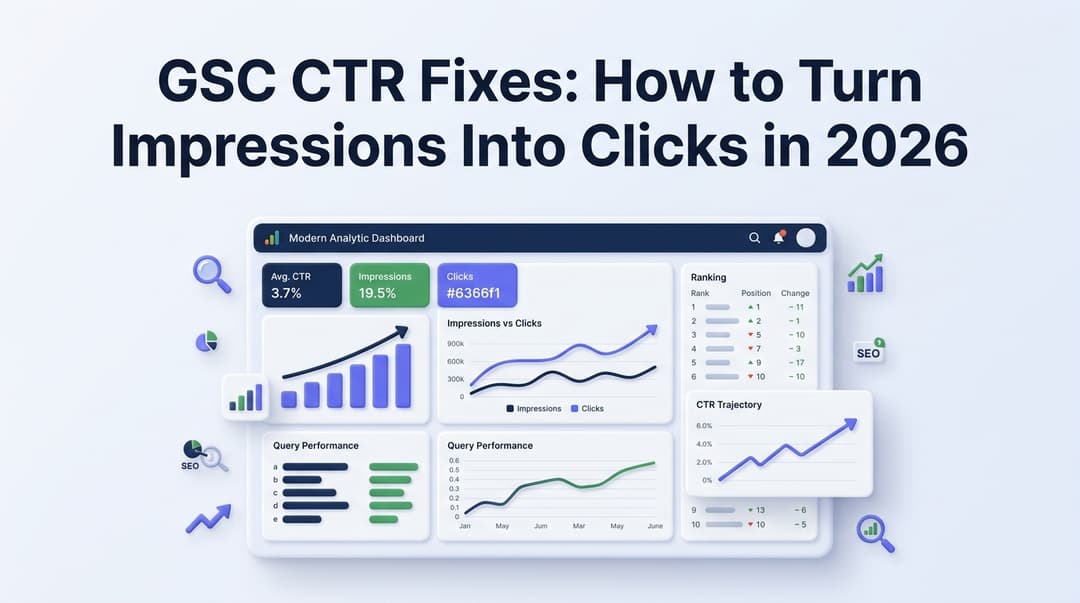
GSC CTR Fixes: How to Turn Impressions Into Clicks in 2026
Discover actionable GSC CTR fixes for 2026. Learn how to identify low click-through rate pages in Google Search Console and turn impressions into real traffic.

Zero-Click Search Hit ~65% in 2026: The Stats Every Marketer Should Cite
Zero-click is no longer one rate. SparkToro pegs Google at 58.5%/59.7% (US/EU), AI Overviews push specific-query zero-click to 83%, and Google AI Mode hits 92-94%. 40+ stats and what to do about each surface.
Related Tools
Map URL depth distribution from your sitemap and flag deep pages that may be hard to crawl.
Internal Link Graph MapperBuild a directed graph of internal links with in-degree and out-degree stats per page.
Internal Linking AuditAudit internal links on any page. Analyze anchor text distribution, dofollow vs nofollow ratio, and link depth.