Zero-Click Search Hit ~65% in 2026: The Stats Every Marketer Should Cite

 Summarize in ChatGPT
Every SEO talk in the last 18 months has cited the same headline: roughly 65% of Google searches now end without a click. The number is conceptually right and technically misleading. Zero-click is no longer one rate — it is a different ceiling for every search surface, and the gap between "Google with no AI Overview" and "Google AI Mode" is now wider than the gap between Google in 2019 and Google in 2024.
The most defensible all-device measurement we have is SparkToro and Datos’ 2024 study: 58.5% of US Google searches and 59.7% of EU searches end without a click to the open web (SparkToro 2024 zero-click study). When an AI Overview appears on the SERP, the zero-click rate jumps to ~83% (Similarweb). Inside Google AI Mode it is 92–94% (Semrush analysis of ~69M Google sessions, Semrush). Below are 40+ stats, organized by which surface and which audience is actually losing the click — and what the brands still winning are doing differently.
The headline number and what it actually means
The zero-click climb spans seven years and three methodologies. The four anchor measurements:
2019: 50.33% of US Google searches ended without a click (Jumpshot clickstream, US, all-device, SparkToro).
2020: 64.82% globally, 68.3% in the US (Q4) (Similarweb, ~5.1T searches, SparkToro).
2024: 58.5% US, 59.7% EU (Datos clickstream, weighted mobile + desktop, SparkToro). For every 1,000 US Google searches, only 374 clicks reach the open web; 330 end with no click anywhere and ~296 clicks stay on Google’s own properties (YouTube, Maps, Hotels, Flights, refined searches).
2025: 69% on news content post-AI Overviews (Similarweb publisher-side data, May 2025).
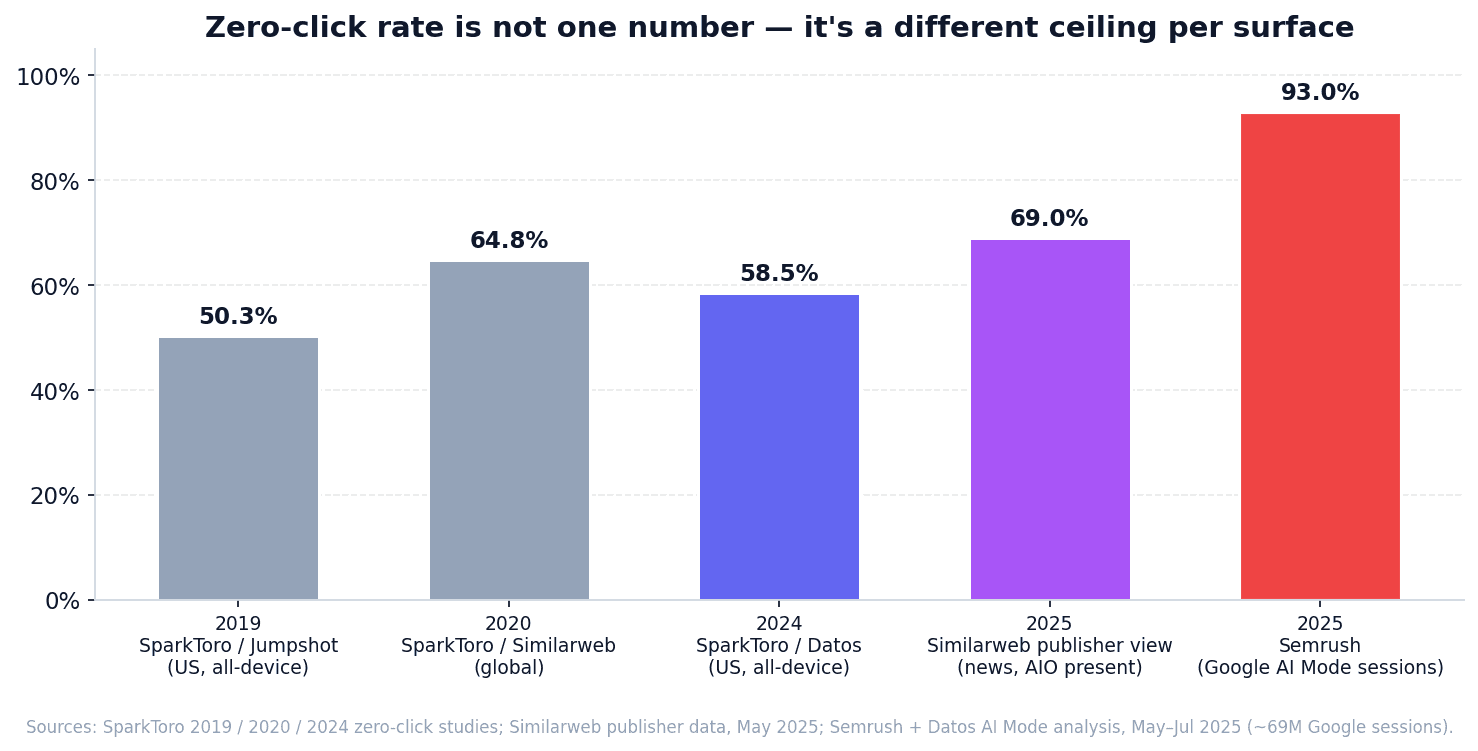
The "65% in 2026" framing most decks reach for is technically a composite — the 64.82% global figure is from Similarweb 2020, recycled into 2026 talks because no comparable global all-device study has been re-run. The cleanest live number is still the SparkToro/Datos 2024 read: high-50s on Google overall, EU and US within 1.2 points of each other. Methodology matters: Datos’ Q1 2026 desktop-only narrow definition (searches with no click at all, desktop only) is just 22.4% in the US and 19.6% in the EU/UK (Datos / SparkToro Q1 2026 State of Search). Same world, different definition, very different number.
And here is the 2026 surprise: on desktop, narrow-definition zero-click is actually declining — 24.5% in December 2025 to 22.4% in March 2026 (US, Datos). Rand Fishkin’s read is that info-lookup queries are migrating to ChatGPT, so what’s left on Google is more click-driven commercial intent. Zero-click isn’t going up linearly. It’s being redistributed across surfaces.
Where the climb actually happens: AI Overviews and AI Mode
Two AI surfaces dominate the zero-click conversation in 2026. AI Overviews sit on top of a normal Google SERP. AI Mode replaces the SERP entirely. The math is wildly different.
The Pew Research real-user data is the cleanest read on AIO behavior we have: 900 US adults sharing real browsing data, 68,879 unique Google searches, March 2025. When an AI Overview appeared:
Click rate on a traditional result fell from 15% (no AIO) to 8% (with AIO) — roughly halved.
Click rate on any citation inside the AIO itself: 1%. The little blue numbers are almost decorative.
Session-end rate (user leaves Google entirely): 26% with AIO vs 16% without. AIO presence adds 10 points to full-session abandonment.
AIO trigger rate: 18% of all real-user searches. 58% of users encountered at least one AIO in a month.
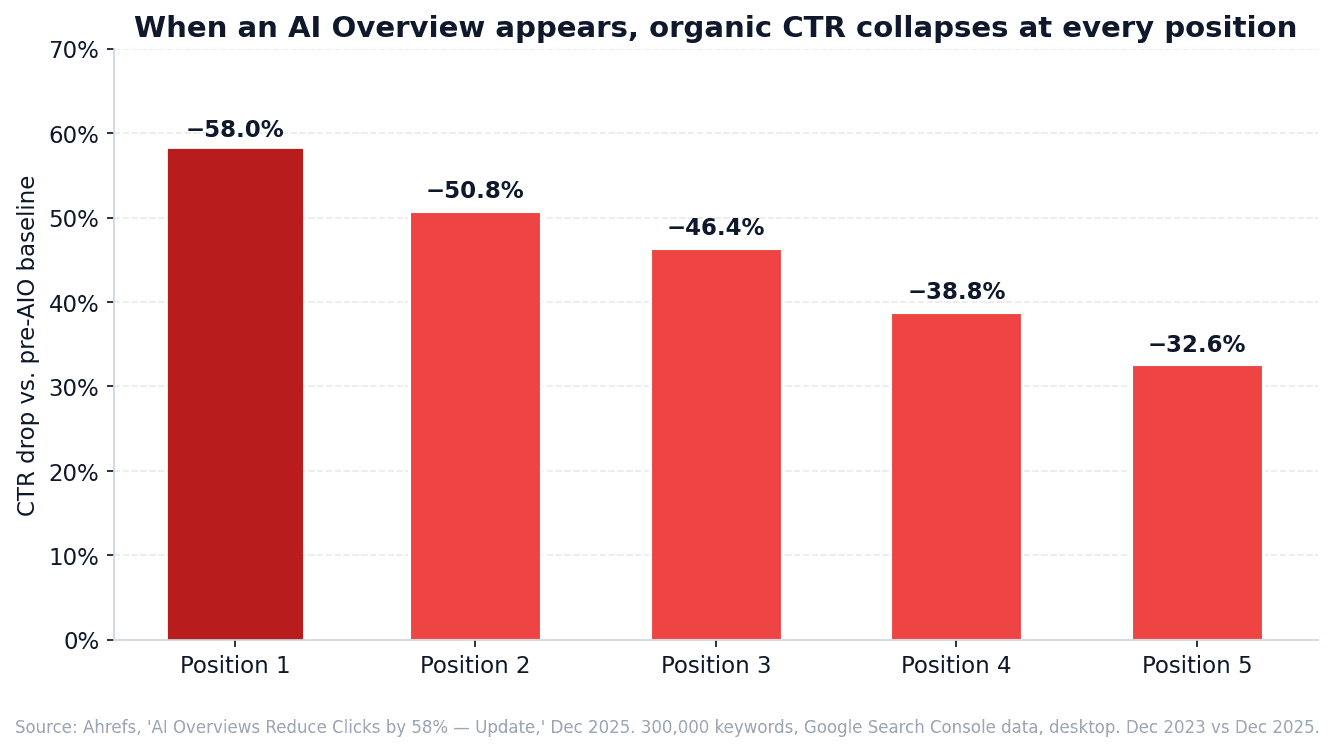
Ahrefs ran the same question against position-level Search Console data. Their December 2025 update (300,000 keywords, desktop GSC, Dec 2023 vs Dec 2025) found the position-1 CTR drop has widened from -34.5% in their original 2024 study to -58.0% in late 2025. "For every 100 clicks you could historically earn for a top-ranking page, Google now keeps 58."
Then there is Google AI Mode — a separate surface, opt-in for now, and the real ceiling on zero-click. Semrush’s Datos clickstream analysis of ~69 million Google Search sessions (US desktop, May 1–July 5, 2025):
92–94% of AI Mode sessions are zero-click. Only 6–8% lead to an external-domain visit.
AI Mode users average 2–3 queries per session vs ~5 for traditional search — the conversation collapses what used to be multiple SERPs.
Average query length: 7.22 words vs 4.0 for traditional Google. Users paste full prompts, not keywords.
Dwell time inside Google in AI Mode: 49 seconds average vs 21 seconds on AIO interactions. Users stay 2.3× longer.
Ads now appear in 25.5% of AI Mode results, up +394% YoY. Google is monetizing the zero-click pane directly.
AIO trigger rates have been volatile, not monotonic. Semrush’s 10M-keyword tracker shows AIO presence climbed from 6.49% (Jan 2025) to 24.61% (July) and then pulled back to 15.69% (Nov). Google is actively tuning the feature. Don’t treat AIO coverage as a one-way ratchet — treat it as a moving target you re-check monthly.
The zero-click map by industry
Zero-click breaks down cleanly into three bands: high-zero-click verticals (the AI can give you the answer), middle verticals (the AI helps you decide), and resilient transactional verticals (money has to change hands, so a click is still required).
Vertical | Zero-click rate | AIO trigger rate | YoY change |
|---|---|---|---|
Definitions / dictionary | 89% | Near-universal | +3pp |
Health / medical | 78% | 88% (treatment queries: 100%) | +8pp |
Education | ~60% | 83% (was 18% in May 2024) | Largest YoY swing |
Finance (educational queries) | 74% | 67% (overall finance: 21%) | +5pp |
Technology / SaaS | 62% | 82% | +7pp |
Legal services | 58% | Moderate | +4pp |
Real estate | 53% | Low | +3pp |
Travel / booking | 41% | Growing fast (+381% post Mar 2025 update) | +2pp |
eCommerce / retail | 38% | ~4% (was ~29% at launch — Google retreated) | +3pp |
Sources: digitalapplied 2026 zero-click compilation; BrightEdge weekly AI search insights (Feb 2025 – Feb 2026); WebFX 130k+ health-query analysis.
Healthcare is the canary. BrightEdge tracks AI Overviews on 88% of healthcare queries (up from 72% in May 2024), and WebFX’s 130,000+ health-query analysis found 100% AIO presence on treatment and procedure queries, 98% on pain queries, 93% on symptoms and conditions (WebFX). Education has caught up the fastest: AIO trigger rate climbed from 18% to 83% in twelve months (BrightEdge).
Finance is bifurcated. Overall finance triggers AIO only ~21% of the time — high-volume real-time queries (stock tickers, mortgage rates) pull AIO down. But educational finance queries trigger AIO 67% of the time, and sub-topics like reverse mortgages (82%) and credit scores (71%) are already near-saturation.
eCommerce got a temporary reprieve: Google retreated from shopping AIOs after pricing/availability accuracy issues, dropping coverage from ~29% at launch to ~4% by late 2025. Don’t bank on the reprieve lasting — agentic commerce and Shopify’s reported 15× AI-driven order growth suggest Google will be back.
News and publishers carry their own zero-click curve. Press Gazette’s May 2025 analysis of the top 100 news sites: global zero-click rose 50.5% → 52.7% YoY, US 52.8% → 55.2%. When AIO appears on news content, the spike is brutal: Mail Online 68.8%, People.com 71.2%, Yahoo News 78%, Politico 77.1%. Google does not trigger AIO on hard news — but lifestyle and evergreen content is exposed.
Mobile, desktop, geography — the splits that explain the headline
The single biggest factor in any zero-click number is whether the underlying sample is mobile-heavy or desktop-only. Mobile is the dominant zero-click surface, and 63% of US searches and 64.7% of EU searches happen there.
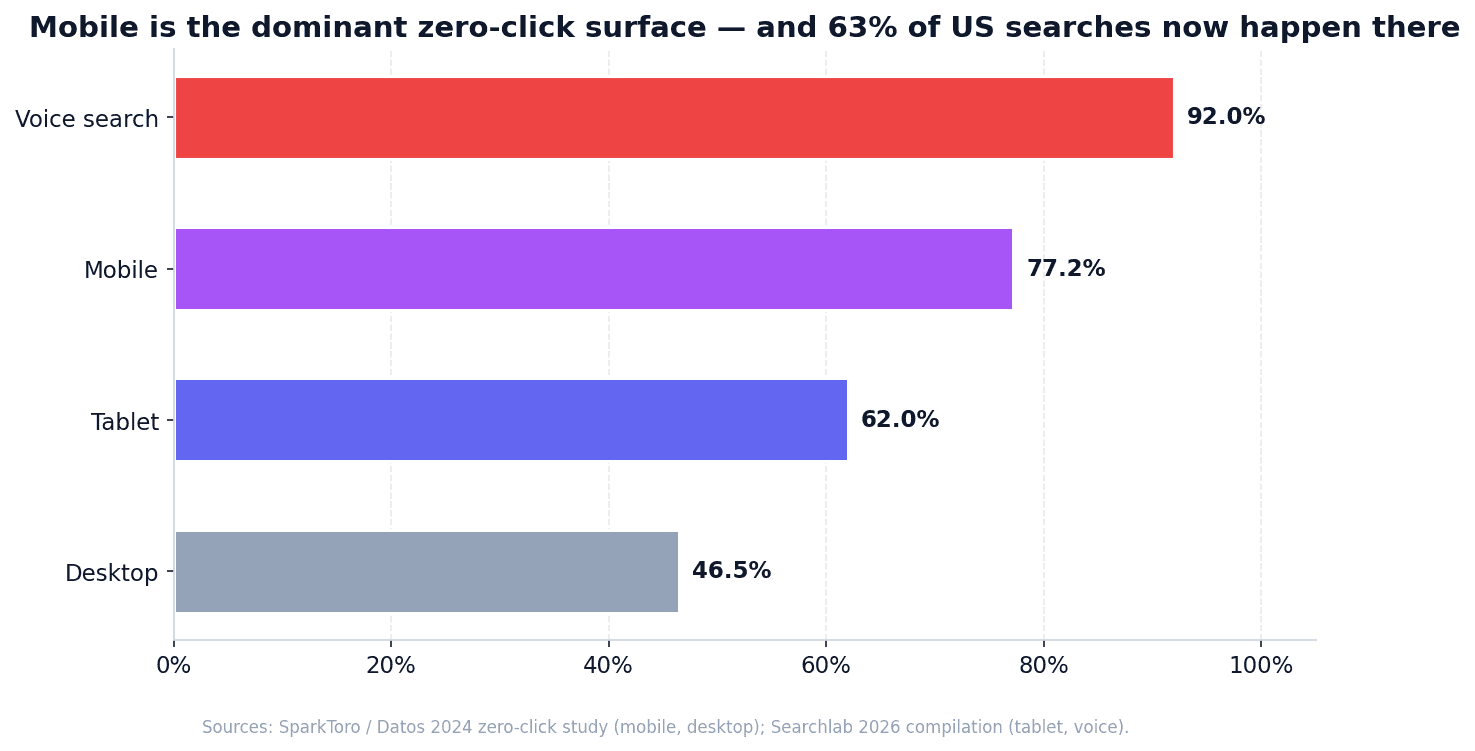
Desktop organic CTR is 40.8%, mobile is 17.1% — when a click does happen, it is roughly half as likely on mobile. Mobile users end the browsing session entirely on ~50% of searches vs ~25% on desktop. If your traffic mix is mobile-heavy, your effective zero-click rate is already in the high-70s.
Geography is not the differentiator most marketers assume. US 58.5% vs EU 59.7% (SparkToro/Datos 2024) is a 1.2-point gap. The geo split that does matter is publisher referrals: Google referrals to publishers dropped 33% globally and 38% in the US YoY through November 2025, according to the Reuters Institute 2026 Digital News Trends report and Chartbeat data tracking 2,500+ publishers. Google Discover referrals are down 21% globally, 29% US.
Branded queries are the one quadrant of search still gaining clicks
The most useful single chart in the 2026 zero-click literature is Amsive’s branded vs non-branded CTR split. They analyzed 700,000 keywords across 10 sites in finance, education, SaaS, healthcare, and pets:
When AIO appears on a branded query: +18.68% CTR.
When AIO appears on a non-branded query: -19.98% CTR.
Branded queries trigger AIO only 4.79% of the time — Google still treats brand intent as navigational.
AIO + Featured Snippet stacked: -37.04% CTR on non-branded (Amsive).
Read those four numbers together: branded search is the one quadrant of search still gaining clicks. Every other intent type is bleeding to AIO and AI Mode.
The zero-click ladder by query intent: informational 74%, local 72%, navigational 68%, commercial investigation 46%, transactional 31% (Searchlab / Semrush 2025 compilation). Long-tail informational is the hardest hit — a 7+ word informational query triggers AIO 73.9% of the time vs 35.8% for a 1–2 word query.
And the carve-out is closing. The composition of what AIO triggers has shifted hard: informational queries fell from 91.3% of all AIOs (Jan 2025) to 57.1% (Oct 2025), while commercial AIOs grew +127%, transactional +604%, and navigational +1,295% over the same window. The "AI is just for facts" assumption you used to plan 2024 content is already wrong.
Being cited is the new ranking — with a caveat
The most-cited counter-narrative stat in 2026 is Seer Interactive’s AIO Impact on CTR study: across 3,119 search terms, 42 client organizations, and 25.1M organic impressions (Jun 2024–Sep 2025), brands cited in an AIO see +35% organic CTR (0.70% vs 0.52%) and +91% paid CTR (7.89% vs 4.14%) versus same-query non-cited brands. The honest caveat Seer themselves flag: this is correlation, not proven causation — brands that get cited may share quality characteristics that also drive CTR. And cited queries are still down 49.4% YoY, vs -65.2% for non-cited. Citation softens the blow. It does not reverse it.
A second, more disorienting finding: the link between rank and citation has decoupled. Ahrefs’ March 2026 Brand Radar study (863,000 SERPs, 4 million AIO URLs) found only 38% of AIO citations now come from top-10 organic pages — down from 76% in July 2025. Gemini 3 and Google’s "query fan-out" mechanism now expand the original query into sub-questions, pull citations from those sub-query SERPs, and return them in the AIO. Your pos-1 organic position increasingly does not transfer.
AirOps’ State of AI Search 2026 analyzed 21,000+ brands and lands on a brutal mix:
85% of brand mentions in AI come from third-party domains, not the brand’s own site.
48% of AI citations come from UGC platforms (Reddit, YouTube, LinkedIn, Wikipedia).
Third-party mentions are 6.5× more likely to be cited than owned-domain mentions.
60% of AI Overview citations come from URLs ranking outside the top 20 organic. Old SEO equity does not auto-transfer.
Only 30% of brands stay visible across consecutive AI answers, and only 20% persist across five runs. Pages not updated in the last 3 months are 3× more likely to lose citations.
If you want to know what gets cited by ChatGPT, Claude, Gemini, and Perplexity the short answer is: third-party listicles, comparison pages, Reddit threads, YouTube videos, and Wikipedia. The longer answer is per-platform and changes monthly.
When AI does send a click, it is worth more
~93% of AI sessions end without an external click. The 7% that do click out are wildly more valuable than anything else hitting your site — with one important caveat about action type.
Semrush’s AI search traffic study (500+ digital marketing and SEO topics) concluded that AI visitors are 4–6× more valuable than organic — specifically, the average AI search visitor converts at 4.4× the rate of a traditional organic visitor on average, with per-platform CR up to ~9× on ChatGPT.
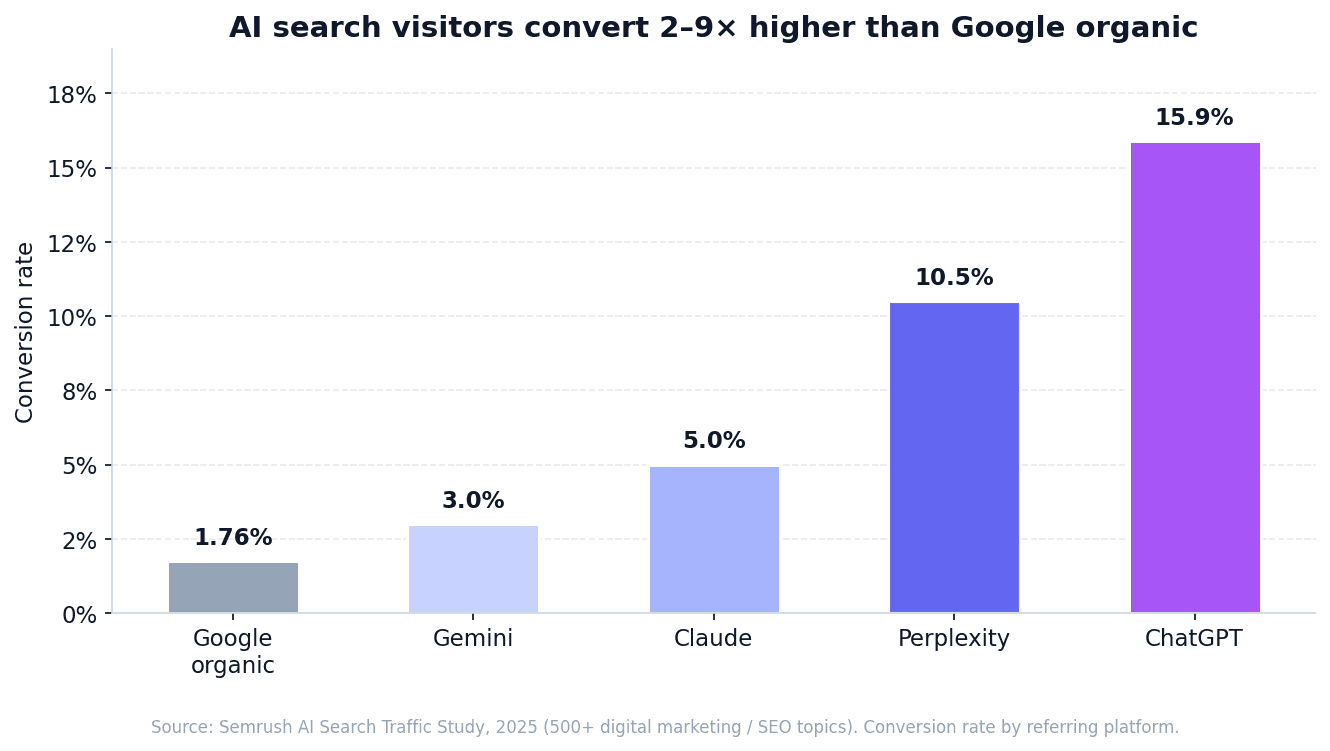
On per-site engagement metrics, Ahrefs’ ~82,000-site traffic quality study put AI vs Search at: bounce 67.8% vs 63.7%, pages/session 4.0 vs 5.2, time on site 86s vs 78s. AI visitors stay longer and bounce slightly more — but the conversion side is what matters. Ahrefs’ own site recorded 12% conversion on AI traffic vs ~0.5% on organic. Vercel reported ChatGPT now refers ~10% of new signups, up from ~1% six months earlier.
The counter-evidence matters. Search Engine Land’s analysis of 973 e-commerce sites ($20B revenue, Aug 2024–Jul 2025, 50K+ ChatGPT transactions) found ChatGPT actually converted 13% worse than organic search, and affiliate beat ChatGPT by +86%. The reconciliation: AI traffic wins on signups, trials, and low-friction information-seeking actions (the SaaS/tools pattern). Traditional organic still wins on high-commitment first-session e-commerce. Pick your conversion definition before quoting either headline.
Volume reality: ChatGPT now has roughly 12% of Google’s search volume but sends 190× less referral traffic (Ahrefs, Sep 2025). AI sources combined are less than 1% of all web referrals. The traffic is rare. Per-visit, it is the most valuable channel in your dashboard.
Who is already getting hurt — and who is quietly winning
Publisher pain is named and quantified now:
HubSpot: -70% to -80% organic traffic YoY — the most public collapse, mostly top-of-funnel content with weak product relevance.
DMG Media (UK): filed evidence to the UK Competition and Markets Authority that CTRs fell up to 89% when AI Overviews appeared above their content.
CNN: -27% to -38% organic traffic.
Aggregate across 2,500+ publishers tracked by the Reuters Institute / Chartbeat 2026 trends report: global Google referrals -33% YoY; US -38%; Google Discover -21% global, -29% US.
Cloudflare’s crawl-to-refer ratios: Google crawls 18 pages per visitor sent in 2024 (was 2:1 in 2014). OpenAI: ~1,500:1. Anthropic: ~60,000:1 (was 6,000:1 six months earlier). The directional trend is unambiguously worse.
The counter-examples matter just as much. Similarweb’s 2026 Generative AI Brand Visibility Index calls out specialist sites beating much larger competitors: NerdWallet, Travelmath, WhoWhatWear, CeraVe, Apple in retail/electronics, Ramp / Carta / Webflow in B2B. People.com is +27% organic; Men’s Journal is +415% organic — lifestyle and entertainment intent resists summarization. AirOps reports Angi built longtail AI-optimized content that converts 79% better than its baseline pages.
Rand Fishkin’s read: "Zero-click results are not the death of SEO — they are the shift of SEO toward visibility and reputation. The click is no longer the conversion; the mention is." Lily Ray adds the mechanic: "If three unrelated credible sites converge on a fact, the model’s confidence rises exponentially." Cloudflare’s Matthew Prince has said publicly that users are not clicking through to AI chatbot source links at meaningful rates, which is why his company is pushing publishers to renegotiate the economic model of AI crawling.
What every marketer should do this quarter
Recheck which of your queries actually trigger AIO and AI Mode. Pew puts AIO at ~18% of real-user searches; in healthcare or education-heavy verticals it is already 80–90%. Spending another quarter optimizing pos-1 organic on a fact query is throwing money at -58% CTR.
Lean into your branded SERPs. Branded queries are the only quadrant where CTR is still going up (+18.68%). Build branded comparison and pricing pages — they catch the click that AIO cannot intercept.
Optimize for citation, not rank. 60% of AIO citations come from URLs outside the top 20 organic. 85% of brand mentions in AI come from third-party domains. Track citation share alongside (or instead of) rank.
Invest where the model is pulling from. Brand mentions correlate 0.664 with AI citation probability vs 0.218 for backlinks (Ahrefs 75k-brand study). Digital PR plus UGC presence (Reddit, YouTube, G2, Wikipedia) is the load-bearing tactic. Only 6% of GEO practitioners prioritize PR; 25% of LLM citations come from it.
Update content more often. 76.4% of ChatGPT citations come from pages updated in the last 30 days. Pages not updated in 3 months are 3× more likely to lose citations. Treat content like perishable goods.
Track every chatbot, not just Google. Only 30% of brands persist across consecutive AI answers; only 20% across five consecutive runs. Daily multi-chatbot monitoring is the new rank tracker.
Run an AI visibility audit before you re-plan your SEO budget
QuickSEO runs your URL through ChatGPT, Gemini, and Perplexity for the buyer-intent prompts a real customer would type — five prompts × three chatbots = 15 live calls in about 60 seconds. You see exactly where you appear, where competitors show up instead, and which third-party citations are doing the work.
Start with a free AI visibility audit. If your brand isn’t in the answer when 93% of AI Mode sessions are zero-click, you are not losing rank — you are losing the share of answer that decides whether the click ever happens.
Enter your website to track its AI visibility across ChatGPT, Gemini, Claude, and Perplexity — and turn chatbot mentions into traffic.
- Set up in minutes
- Cancel anytime
Try it yourself
Related free tools
Free SEO tools related to the topics covered in this article.
Keep reading
Related posts
More articles on the same topics, prioritized by shared tags and keyword overlap.