GSC CTR Fixes: How to Turn Impressions Into Clicks in 2026

 Summarize in ChatGPT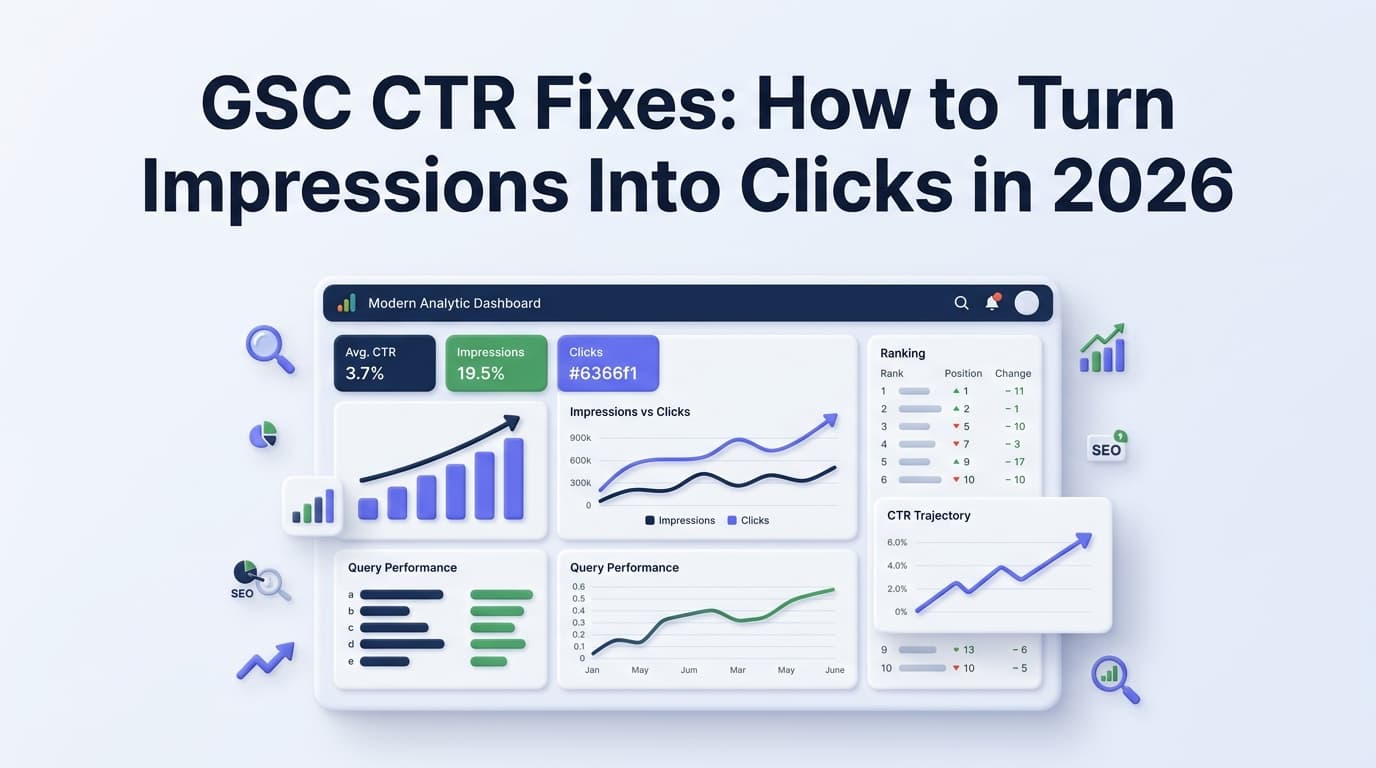
You open Google Search Console and see thousands of impressions. Your pages are showing up — Google is doing its job. But the clicks? They're barely there.
This is one of the most frustrating problems in SEO: high impressions, low click-through rate (CTR). You've earned the visibility, but users aren't choosing you over competitors. The good news is that a low CTR is almost always fixable — and the fixes are often faster and cheaper than trying to rank higher in the first place.
A page with 5% CTR at position 5 gets roughly 500 clicks per 10,000 impressions. Improve the CTR to 8% and you get 800 clicks at the same position — a 60% traffic increase without any change in rankings.
This guide covers every major GSC CTR fix you should be implementing in 2026, including the tactics that account for today's increasingly complex SERP landscape.
Why Your GSC CTR Matters More Than Ever
RankBrain, Google's machine learning component, uses engagement signals to calibrate rankings. CTR is one of those signals. If users consistently skip your result in favour of others and then don't return to the search results page, Google learns that your result wasn't satisfying for that query and adjusts your position accordingly.
The reverse is equally powerful. A page ranking in position four that earns a disproportionately high CTR relative to its position gets noticed. Google will test it higher. You can earn ranking improvements without a single new backlink, just by making your snippet more compelling than the pages above you.
CTR isn't just a vanity metric to track in Search Console. It's a ranking input — which means every poorly written title tag is a quiet drag on your position, not just your traffic.
The 2026 CTR Landscape Has Shifted
Before you start optimizing, it helps to understand what "good" CTR actually looks like in 2026, because the benchmarks have changed dramatically.
According to GrowthSRC's study of 200,000+ keywords, position 1 CTR dropped 32% (from 28% to 19%) and position 2 dropped 39% (from 20.83% to 12.60%). Surprisingly, positions 6–10 increased 30% as users scroll past AI Overviews to find alternative sources.
In 2026, for position 1 without AI Overviews, 35–40% is strong. With AI Overviews present, 15–20% is more realistic. Position 2 typically sees 12–18%, while positions 3–5 range from 5–10%.
The takeaway: don't panic if your CTR looks lower than benchmarks from 2020 or 2022. The SERP has changed around you. But there is still a great deal you can do.
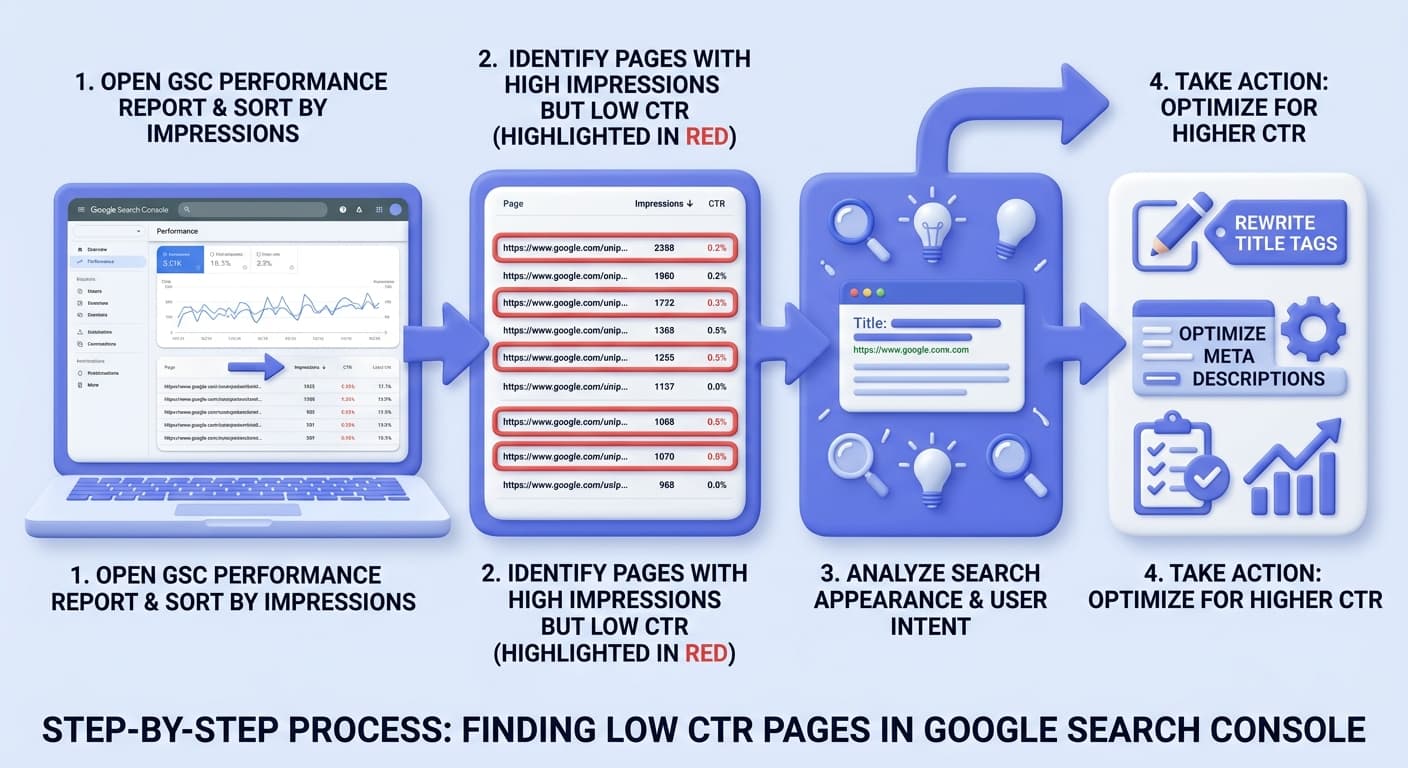
Step 1: Find Your Low-CTR Pages in GSC
The first step is identifying exactly which pages need the most attention. Here's how to do it efficiently:
Open GSC's Performance report and ensure you have "Clicks," "Impressions," "CTR," and "Average Position" all checked.
Click on the "Pages" tab and sort by Impressions (descending).
Look for pages with high impressions but low CTR — these are your biggest opportunities.
Cross-reference with position data. A page with 10,000 impressions at position 3 but only 1% CTR has a serious snippet problem.
Google Search Console provides CTR data for every query and page. Use the Performance report to see average position, impressions, and CTR. Segment by query to identify high-impression, low-CTR opportunities.
Pro tip: If you only have time for one meta improvement this quarter, rewrite descriptions on pages that already have high impressions but low CTR. That's where the ROI is concentrated.
Step 2: Fix Your Title Tags
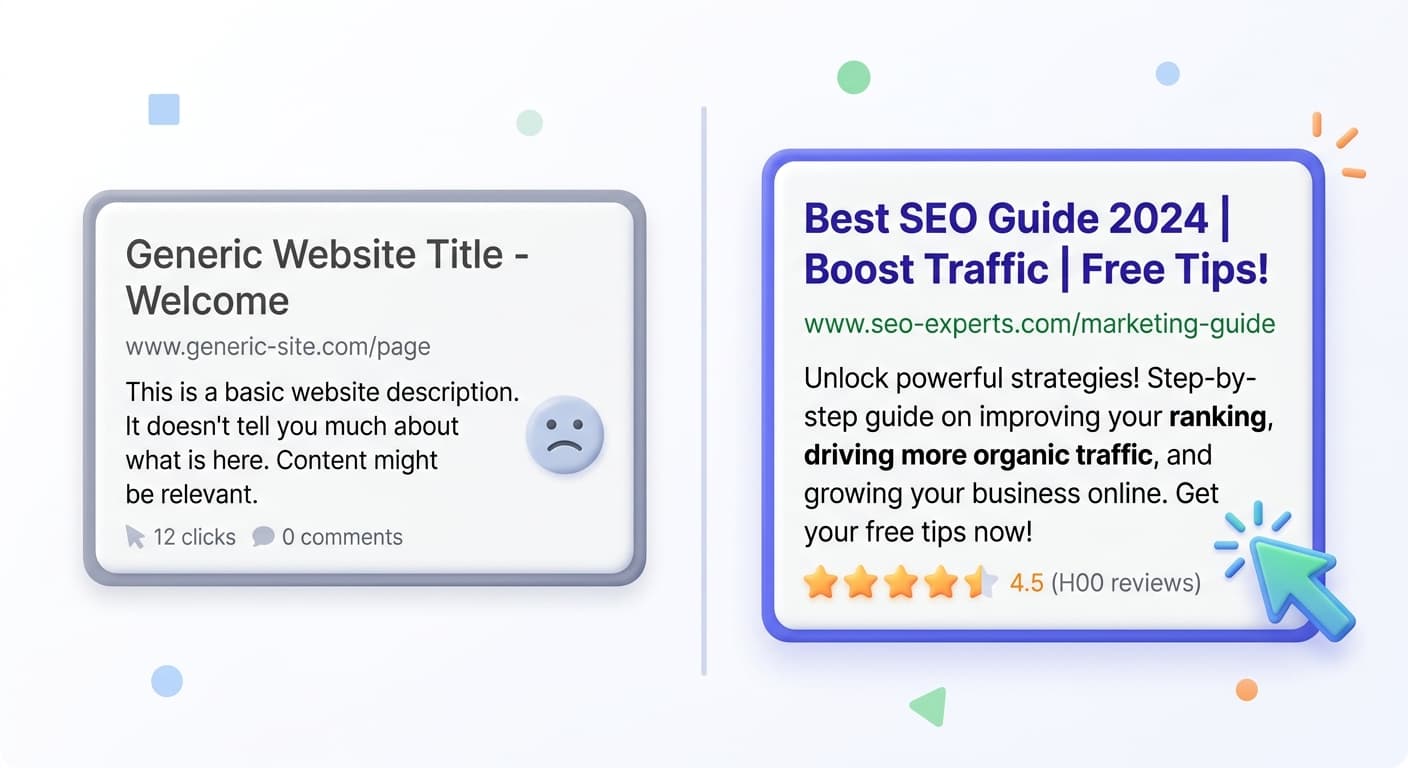
Title tags are the single most controllable element of your SERP snippet, and they're often the root cause of a low CTR.
The Core Rules for CTR-Optimized Title Tags
Match search intent precisely. Low CTR at good positions usually comes down to intent mismatch. If someone searches "best running shoes for flat feet" and your title tag says "Running Shoe Guide: Everything You Need to Know," the searcher will skip your listing even if you rank in position 2. They want a specific answer, and your title signals a broad overview.
Keep titles within 50–60 characters. Aim for 50–60 characters (or about 580 pixels) to ensure your title displays fully on both desktop and mobile devices. Front-load your most important information and keywords at the beginning. If truncation happens, you want the critical message to survive.
Be specific, not clever. Be specific rather than clever. "How to Fix a Leaky Faucet in 15 Minutes" outperforms "Plumbing Tips and Tricks" every time.
Use numbers and year modifiers. For queries where freshness matters — best tools, trends, statistics — adding the current year to your title tag signals that your content is up to date. "(2026 Data)" or "(Updated March 2026)" in your title can meaningfully improve CTR when competing listings show older dates.
Front-load the primary keyword. Your primary keyword should appear as the first element of your title tag whenever the resulting title reads naturally to a human. For most pages, this means the title opens with the exact keyword phrase or a close natural-language variant of it.
Why Google Rewrites Your Titles (And How to Stop It)
Google rewrites title tags constantly. According to Semrush's research, it happens in over 60% of cases. The rewrites usually happen when your title doesn't match the actual content of the page, it's stuffed with keywords rather than written for humans, or it's so short Google doesn't trust it to represent the page accurately.
The fix is straightforward: write your title tag for humans first. When your title accurately represents your page content and is written for a real person scanning search results, Google has far less reason to override it.
You can use QuickSEO's AI Title Tag Generator to quickly produce intent-aligned, character-optimized title options for your low-CTR pages, and preview exactly how they'll look in search results using the SERP Preview tool.
Step 3: Rewrite Your Meta Descriptions as Ad Copy
Treat your meta description like ad copy. You have roughly 155 characters to convince someone your page has the answer they need.
Include the target keyword: Google bolds keywords in the meta description that match the user's search query, which draws the eye and increases clicks. Write a clear value proposition — tell users exactly what they will get by clicking.
What a Good Meta Description Looks Like
Avoid generic filler like "Learn everything about X in this comprehensive guide." Instead:
Try something specific and data-led: "We analyzed 500 pages to find the 7 factors that actually improve content rankings. Here is what the data shows."
Use emotional triggers and power words. Create a sense of urgency or curiosity in your meta content to encourage users to click.
Stay within 140–160 characters. Meta descriptions should stay within 140–160 characters. Desktop users might see your full description, but mobile users get less space. Write concisely, typically in 1–3 sentences.
Avoid keyword cannibalization. Do not use the same target keyword in multiple meta titles or descriptions, as this can dilute the effectiveness of your SEO efforts and negatively impact your CTR.
Important: Search engines override meta descriptions by rewriting more than 62% of them as AI-powered results reshape user behavior. The antidote is alignment: when your page is structured to clearly answer a specific query, and when your meta description mirrors that clear answer, Google has no reason to substitute. The description and the page content tell the same story, and that alignment is Google's green light to show your description as written.
Our AI Meta Description Generator can help you quickly draft compelling, character-counted descriptions for every page on your priority list.
Step 4: Unlock Rich Results with Structured Data
Structured data is one of the highest-leverage CTR fixes available in 2026 — and one of the most underused.
Pages with structured data earn 35% higher CTR from rich results. That's not a marginal improvement; that's the difference between a page that gets 500 clicks and one that gets 675 clicks from the same position.
Structured data is the code you add to your HTML to describe your page content to search engines. Rich snippets are the enhanced visual search results that Google displays as a result of reading that structured data. In short, structured data is the input, and rich snippets are the output.

Schema Types That Move the CTR Needle
Pages with rich snippets get up to 30% more clicks. Start with LocalBusiness, FAQPage, and Review schema. If you publish articles, add Article schema. If you sell products, add Product schema. These five types cover 90% of what most businesses need.
Search Pilot ran a controlled test and found that adding Review schema alone to product pages increased traffic by 20%. Industry quarterly reviews from early 2025 consistently showed significant CTR improvements when rich results were awarded, with product schema delivering as much as 4.2x higher Google Shopping visibility in documented case studies.
The March 2026 Schema Update: What Changed
It's worth noting that Google's March 2026 core update tightened rich result eligibility. Google's March 2026 core update reduced rich result display for several schema types that were widely abused, including FAQ, Review, and How-To on non-primary content pages. Sites that implemented schema aligned to genuine content intent — not as a SERP manipulation tactic — retained and in many cases improved their rich result rates.
The rule of thumb: schema should accurately describe what the page is actually about. Rich snippets aren't guaranteed. Schema markup makes you eligible for rich results. Google's algorithms make the final call.
Use QuickSEO's Structured Data Validator to check your existing markup for errors, and the AI Schema Markup Generator to build valid JSON-LD from scratch.
Step 5: Target Featured Snippets
If you cannot beat the featured snippet, become the featured snippet. Pages that own the snippet position get significantly more clicks than the regular position 1 result for the same query.
To win the featured snippet:
Answer the target question directly in 40–60 words. Use the question as an H2 or H3 heading. Format lists, tables, and definitions clearly. Place the answer near the top of the relevant section.
This approach also increases your chances of being cited in Google's AI Overviews — which is increasingly the real prize. For a deeper dive into AI citation strategy, see our guide on how AI finds and cites sources.
Step 6: Account for AI Overviews and SERP Features
This is the fix most guides skip in 2026, but it may be the most important one.
The core problem: ranking positions are no longer the only "positions" that matter. A #1 blue link can be visually displaced by AI Overviews, featured snippets, local packs, "People Also Ask," video/image blocks, shopping units, and more. That changes user attention, scrolling patterns, and the share of searches that end with no click at all.
AI Overviews have the largest negative impact, reducing position 1 CTR by 50% or more. So if you're ranking #1 but your CTR has cratered, the first thing to check is whether AI Overviews are appearing for your key queries.
If your CTR is consistently below the lower end of expected ranges and you have a good title and meta description, the next thing to check is which SERP features are showing for your top queries. That is usually where the missing clicks went.
What To Do When AI Overviews Are Stealing Your Clicks
The highest-leverage thing you can do right now is win the AI Overview citation. Sites cited inside the AI Overview panel see far better click performance than those that rank organically below it.
Organic CTR falls from roughly 1.41% to 0.64% on queries with AI Overviews — but sites cited in the AI Overview see better CTR than non-cited sites, though still generally pressured compared to classic SERPs.
To maximize your AI Overview citation chances:
Publish authoritative, well-structured content that directly answers target questions
Implement structured data (particularly Article, FAQ, and Organization schema)
Build E-E-A-T signals through author bios, citations, and expert content
Target long-tail queries where AI Overviews appear less frequently
Step 7: Run A/B Tests on Your Snippets
Don't guess — test.
When possible, experiment with different title and description variations to see what resonates with your audience. Small tweaks in wording, tone, or structure can sometimes yield surprising improvements in CTR.
A practical testing cadence:
Export your GSC data for pages with >500 impressions per month at positions 1–15
Identify the bottom 20% by CTR for their position range
Rewrite the titles and descriptions for those pages (aim for 10–15 pages at a time)
Wait 4 weeks, then re-export GSC data and compare
After implementing optimization strategies, improvements in CTR can typically be observed within a few weeks to a couple of months. This timeframe depends on website size, market competition, and search engine algorithm updates. Continuous monitoring and analysis of GSC performance reports will help understand the impact of optimization techniques and make necessary real-time adjustments.
Review your title tags and meta descriptions at least once per quarter, especially for high-traffic pages. Search trends change, your content evolves, and your meta data should keep pace.
A Quick Note on the 2025–2026 GSC Impressions Bug
If you've been scratching your head over CTR numbers that seemed artificially low during the past year, there's a platform-level explanation. Google confirmed that a long-running data logging issue affected impression reporting in Search Console from May 13, 2025 until April 27, 2026, and later marked the issue as resolved.
CTR is clicks divided by impressions, so bloated impressions made CTR look worse than it was for nearly a year. If the real number was 10,000 impressions but GSC logged 15,000, and you earned 500 clicks, GSC would report a 3.3% CTR even though the real CTR was 5%.
If either side of a year-over-year comparison falls within the anomaly window, impression-based analysis may be misleading. Clicks and downstream business metrics are safer comparison points. Going forward (May 2026 onward), your CTR data should be clean and reliable again.
CTR Fixes Checklist: Your 2026 Action Plan
Here's a consolidated checklist of everything covered in this guide:
Snippet Optimization
Identify all pages with >500 impressions and <2% CTR in GSC
Rewrite title tags to match exact search intent (50–60 characters, keyword-first)
Add year modifiers to informational titles where freshness matters
Rewrite meta descriptions as ad copy with a clear value proposition (140–160 chars)
A/B test titles for top 20 impression-generating pages
Technical CTR Boosters
Implement structured data (Article, FAQ, Product, Review, BreadcrumbList)
Validate all schema with Google's Rich Results Test
Check for and fix schema errors in GSC's Enhancements section
SERP Feature Strategy
Identify queries where AI Overviews appear and optimize for citation
Format target-query answers in 40–60 words beneath H2/H3 headings
Check which SERP features are displacing clicks for your top queries
Ongoing Monitoring
Set up monthly GSC CTR review for top 50 pages
Benchmark against position-adjusted CTR norms (not outdated 2020 data)
Track rich result appearance rate in GSC Performance > Search Appearance
🚀 Stop Guessing. Start Tracking.
Impressions and clicks are only half the picture. In 2026, your visibility in ChatGPT, Claude, Gemini, and Google AI Overviews is just as important as your organic CTR — and most brands have no idea where they stand. QuickSEO gives you Google Search Console analytics AND AI visibility tracking in one dashboard. Track your clicks, impressions, AI Score, and which prompts are driving brand mentions across every major AI chatbot. 👉 Get started for free at quickseo.ai — join thousands of marketers already tracking their full search presence.
Conclusion
A high impression count with a low CTR is a traffic problem hiding in plain sight. The fix doesn't require more content, more backlinks, or higher rankings — it requires making your existing search listings more compelling to the human beings who see them.
Start in Google Search Console, identify your highest-impression, lowest-CTR pages, and work through the fixes above: intent-matched title tags, ad-copy meta descriptions, structured data for rich results, featured snippet targeting, and a clear-eyed understanding of how AI Overviews are reshaping click behaviour on your key queries.
What makes CTR optimization so valuable is that it compounds with every other SEO improvement you make. When you improve your rankings through content updates, link building, or technical fixes, a higher CTR means each position gain delivers more traffic than it would have before.
Fix your CTR, and everything else you do in SEO gets more valuable.
Enter your website to track its AI visibility across ChatGPT, Gemini, Claude, and Perplexity — and turn chatbot mentions into traffic.
- Set up in minutes
- Cancel anytime
Try it yourself
Related free tools
Free SEO tools related to the topics covered in this article.
Keep reading
Related posts
More articles on the same topics, prioritized by shared tags and keyword overlap.