Every week, hundreds of millions of people ask ChatGPT, Perplexity, Claude, and Gemini questions that used to go to Google. They ask for product recommendations, software comparisons, and service providers — and the AI gives them a synthesized answer, often without a single link to click. If your brand is in that answer, you win the moment. If you're not, you're invisible.
That's the new reality of search in 2026. And it's why AI search analytics has become one of the most urgent priorities for marketers, SEOs, and brand strategists.
This guide covers everything you need to know: why AI search analytics is different from traditional SEO measurement, which metrics matter most, how to track them, and how to act on what you find.
Why AI Search Analytics Is Now Non-Negotiable
The numbers tell an unambiguous story. AI traffic to U.S. retail sites surged 1,324% between October 2024 and May 2026. Google's AI Mode has grown to 75 million daily active users processing more than a billion queries a month, while ChatGPT pulls in roughly 5.35 billion monthly visits and processes over 2.5 billion prompts per day.
Yet despite that scale, 45% of marketing leaders cannot accurately measure their brand visibility within AI-generated answers, while only 9% have the tools to track all relevant metrics across platforms.
The result is a dangerous blind spot. Only 16% of brands currently track their AI search visibility systematically. The other 84% are making marketing decisions based on incomplete data.
This matters even more when you consider what happens to users who never click through. Zero-click behavior dominates: around 93% of AI search sessions end without a website click, and AI Overviews reduce clicks to the top-ranking page by 58%, making answer visibility more important than traditional rankings.
The traditional SEO dashboard — keyword rankings, click-through rates, organic sessions — was simply never designed to capture this. Your content might shape AI answers across ChatGPT, Perplexity, and Google AI Overviews right now, and your analytics dashboard shows nothing. Traditional metrics like click-through rate and keyword rankings never prepared us for a world where users get answers without visiting a website.
What Is AI Search Analytics?
AI search analytics is the practice of measuring how your brand appears inside AI-generated responses across platforms like ChatGPT, Perplexity, Claude, and Google Gemini.
Grow your organic traffic from chat-bots
Track your AI visibility across ChatGPT, Gemini, Claude, and Perplexity — and turn chat-bot mentions into traffic.
Free to start
No credit card required
Setup in 60 seconds
Keep reading
Related posts
More articles on the same topics, prioritized by shared tags and keyword overlap.
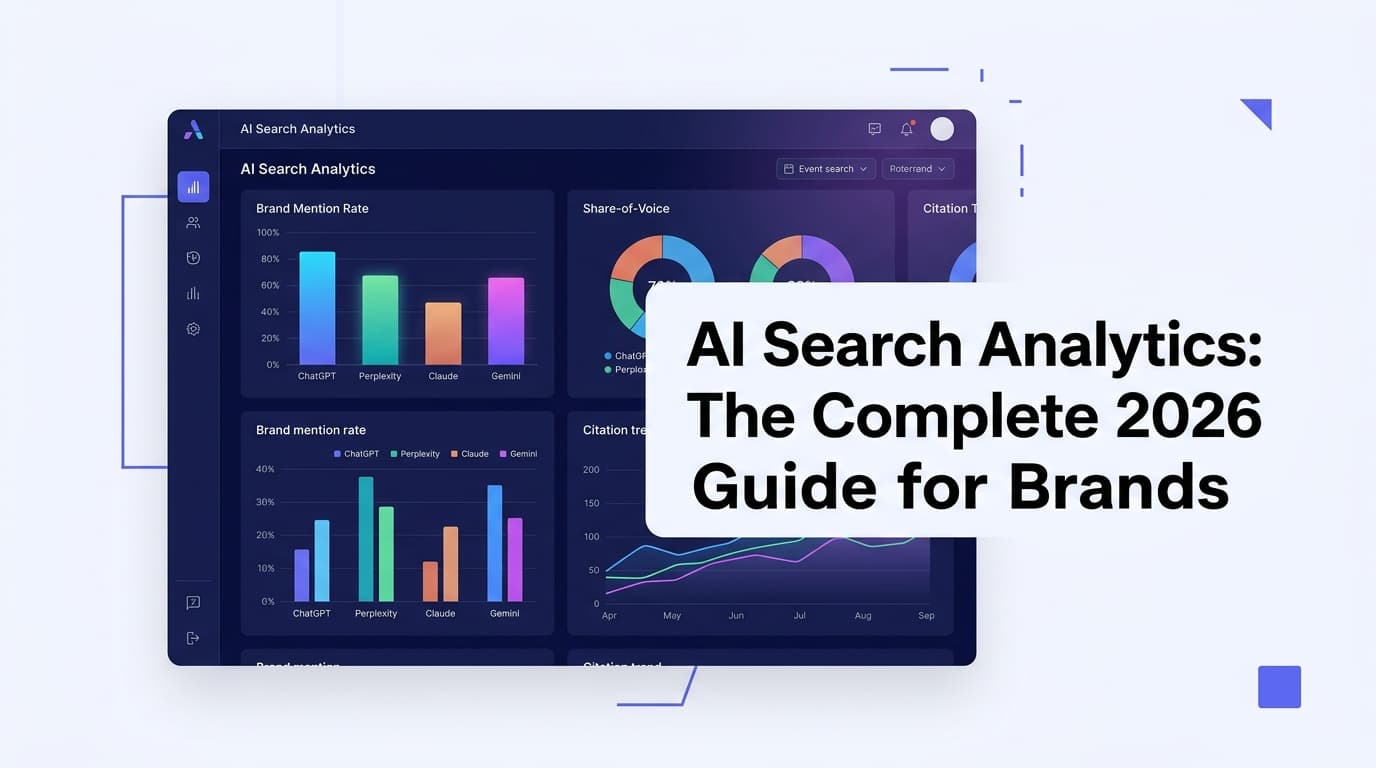
AI Search Analytics: The Complete 2026 Guide for Brands
Unlike traditional SEO tools that measure Google rankings, AI visibility platforms monitor citation frequency, source attribution, sentiment, and competitor share of voice across multiple LLMs.
The question shifts from "Where do we rank for this keyword?" to "Does ChatGPT recommend us, how does Perplexity describe us, and are we cited or ignored versus our competitors?"
This is a fundamentally different measurement discipline because AI search visibility tracking helps brands understand whether they appear in ChatGPT, Gemini, Google AI Overviews, Perplexity, Claude, Copilot, and other AI-generated answer environments — and tracking this is different from traditional SEO rank tracking because AI systems generate answers, summarize sources, cite pages, compare competitors, and may recommend brands without sending users to a standard search results page.
The 5 Core AI Search Analytics Metrics
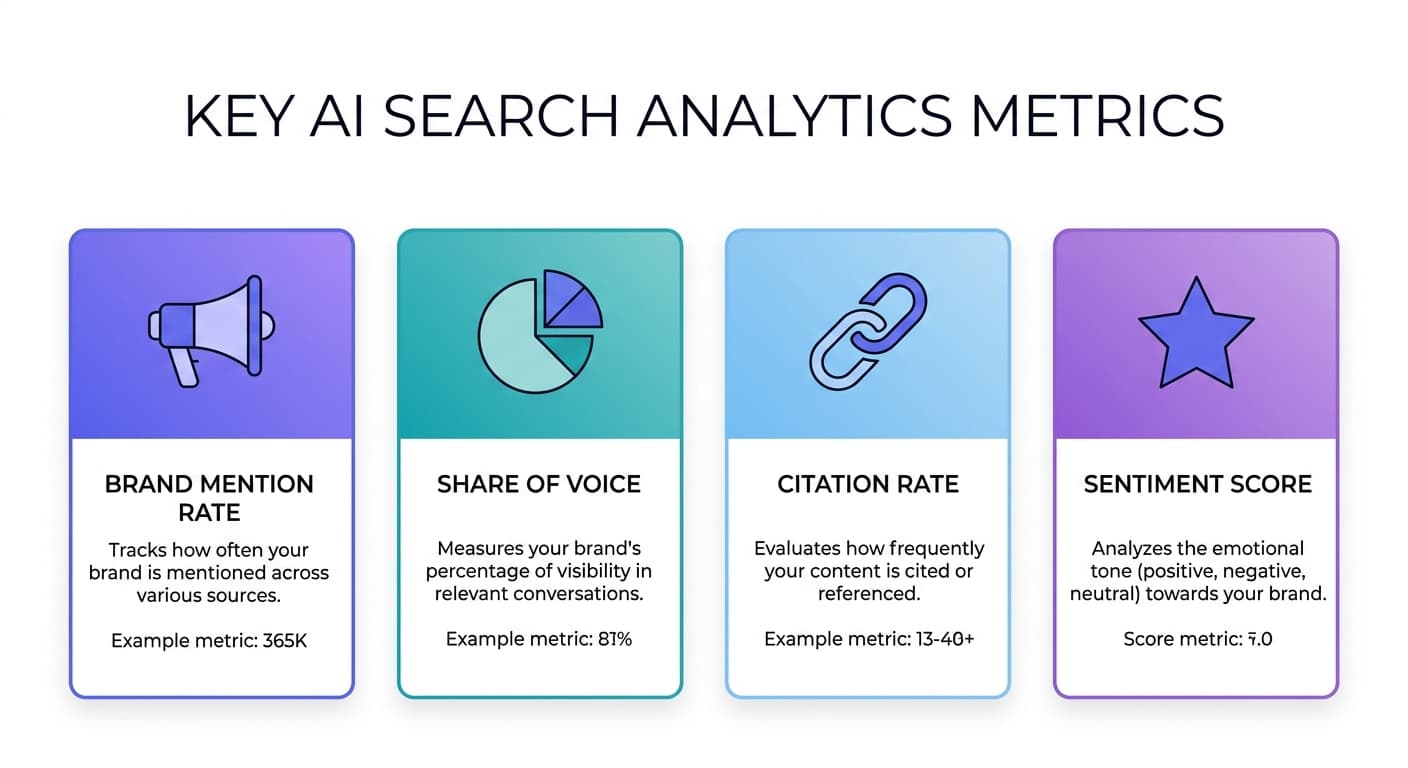
Understanding which metrics to track is half the battle. Here are the five most important signals in AI search analytics:
1. Brand Mention Rate
This is the most fundamental metric: how often does your brand appear in AI-generated responses for your target queries?
AthenaHQ's State of AI Search 2026 report found the average brand mention rate is just 17.2 percent, with leading companies reaching far higher. That gap between average and leader represents the single biggest opportunity in AI search analytics today.
Brand mentions are not the same as citations. Brand mentions capture references to your company even when no link appears. Think of citations as sourced proof and mentions as general brand presence. Track both because AI platforms surface them in different ways.
2. Share of Voice (SoV)
AI Share of Voice is the percentage of AI-generated responses in your category that mention your brand. If 100 relevant AI answers are generated in your space and your brand appears in 28 of them, your AI SoV is 28% — simple to understand, genuinely difficult to improve without a systematic strategy, which is exactly what makes it a useful metric.
As a benchmark: an AI SoV of 10–15% is considered good for an established player. Market leaders aim for 25–40%. The key is to compare your SoV to direct competitors and measure your progression over time.
3. Citation Rate
Understanding the difference between a citation and a mention is essential. A citation includes a clickable URL that links directly to your content, while a mention only references your brand name without attribution. Citations carry more weight because they generate referral traffic and signal to AI models that your content is a trusted source.
Citation Rate is the share of AI answers that link your brand out of the answers that mention it. The formula: Citation Rate = answers that link you ÷ answers that mention you × 100. This is the metric most brands never look at, and the one that exposes the widest gap between perceived and actual AI visibility.
4. Sentiment Analysis
Not all mentions are created equal. Sentiment tracking adds a critical dimension: it measures how AI models characterize your brand — positive, neutral, or negative — not just whether they mention it.
The platform differences here are striking. Sentiment analysis across brand mentions revealed that each AI platform has what amounts to an editorial personality: Perplexity has 76.9% positive sentiment, while the sentiment gap between Perplexity and ChatGPT is 14.8×. Same brand, radically different editorial treatment depending on the platform.
5. Prompt Coverage
This metric measures how many of the buyer-intent queries in your category actually trigger a mention of your brand. A good starting point is testing 50–200 buyer-intent prompts weekly across platforms like ChatGPT, Perplexity, and Google AI Overviews, tracking brand mentions, citation URLs, recommendation ranks, competitor appearances, and content ownership.
You can explore the full picture of these metrics in our guide to AI visibility metrics to understand how each signal feeds into a broader tracking framework.
The Volatility Problem: Why Continuous Tracking Is Essential
One of the most important — and most overlooked — facts about AI search analytics is just how volatile the results are.
AI Overview content changes roughly 70% of the time for the same query, and when the answer updates, almost half of the citations are replaced with new sources. Only about 30% of brands remain visible in back-to-back AI responses for the same query.
This volatility is not a bug — it's a feature of how large language models work. But it has serious implications for measurement strategy.
Tracking data from a five-week period showed brand visibility declining from 1.92% to 1.23% (-35.9%), citation rate declining from 7.35% to 4.82% (-34.4%), and share of voice declining from 0.66% to 0.43% (-34.8%). This proves that AI visibility is not a "set it and forget it" metric. A brand can lose a third of its AI presence in just over a month. Quarterly audits are insufficient; weekly monitoring is the minimum.
AirOps research found that only 30% of brands stay visible from one AI answer to the next, and just 20% remain visible across five consecutive runs. That level of volatility makes one-off checks meaningless and continuous measurement essential.
Platform Differences: Why You Must Track All Four AI Engines
A common mistake is treating all AI platforms as interchangeable. They're not. Platform differences are massive: citation rates, sentiment, and brand mention patterns vary up to 615× across AI platforms, meaning brands need multi-platform tracking.
A Spotlight analysis of over 2.4 million AI responses found that citation and mention rates vary dramatically by platform — Perplexity and Copilot include external links in over 77% of responses, while ChatGPT does so in roughly 31%.
On Gemini, the overlap between mentioned brands and cited domains can be as low as 30%, reinforcing the need for brands to compete on two fronts: earning enough authority and relevance to be mentioned, while also creating credible, structured content that AI platforms can cite.
Because they behave differently and are growing at very different rates — Claude grew 386% year-over-year Jan–Apr 2026 — a brand can be visible in one engine and absent in another; single-engine tracking hides that.
Tools like QuickSEO's AI visibility tracking run automated checks across all four major platforms — ChatGPT, Claude, Gemini, and Perplexity — capturing mention rate, position in answer, sentiment, and cited pages per engine, so you never mistake platform-specific wins for category-wide dominance.
The Content & Technical Signals That Drive AI Citations
Knowing what to measure is one thing. Knowing how to move those numbers is another. Here's what the data says about the signals that drive AI citations.
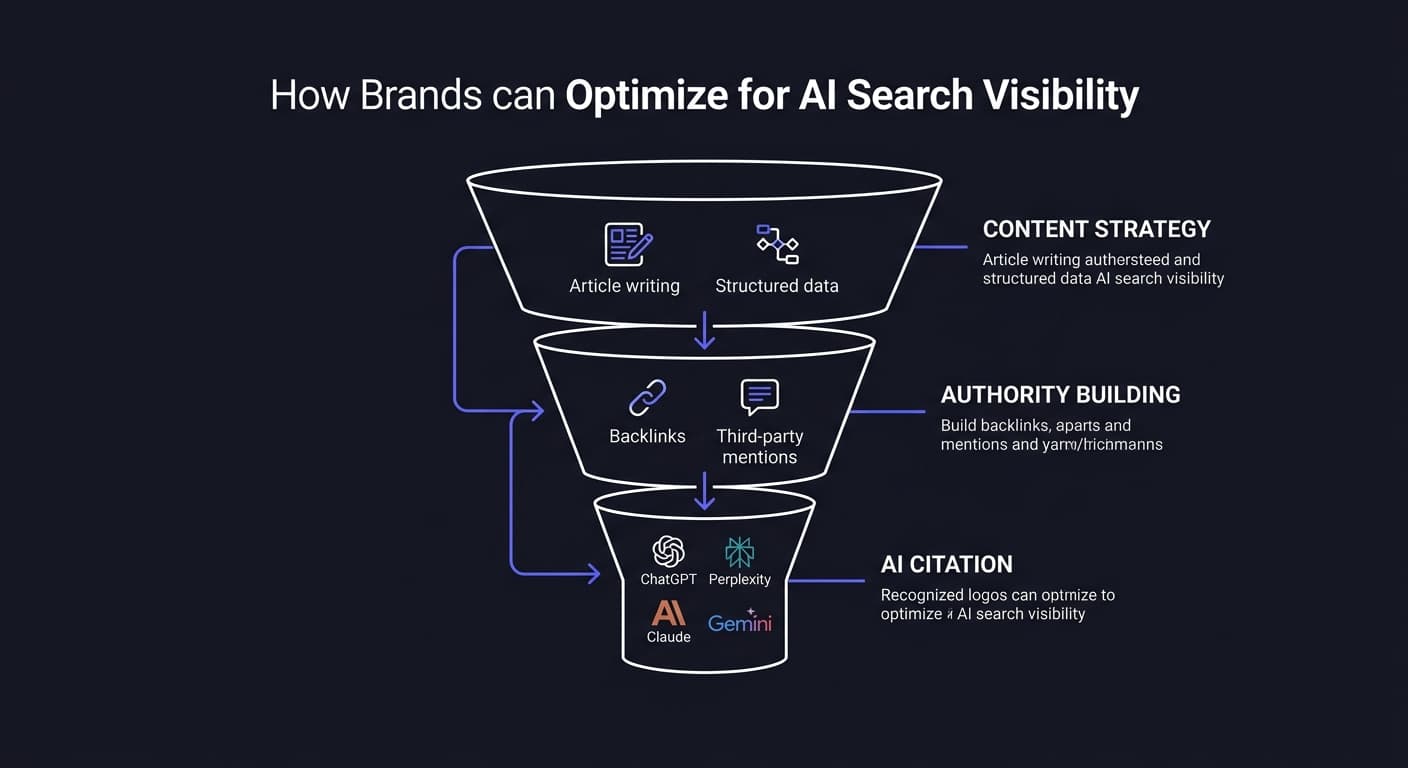
Content Quality and Structure
Citations and mentions are the new authority signals. Content with statistics, citations, and quotations achieves 30–40% higher visibility in AI responses, and pages updated within 2 months earn 28% more citations than older content.
Schema markup adoption rose 35% from 2023 to 2026 across the web. Websites with author schema are 3× more likely to appear in AI answers. Pages updated within 60 days are 1.9× more likely to appear in AI answers. Sites implementing structured data and FAQ blocks saw a 44% increase in AI search citations.
Our AI schema markup generator makes it easy to implement the structured data signals that AI systems use to understand and trust your content.
Third-Party Authority Signals
One of the most counterintuitive findings from AI search research is how much AI platforms lean on sources other than your own website.
McKinsey's AI Discovery Survey found that a brand's own website accounts for only 5 to 10% of the sources AI search platforms reference. The other 90% comes from publishers, user-generated content, affiliate sites, and review platforms. Your website might be perfectly optimized, and AI platforms might still be forming opinions about your brand based almost entirely on what other people say about you elsewhere on the web.
Brand visibility is crucial because AI search engines consult multiple trusted sources and look for consistent brand mentions across third-party websites, social media, and publications — similar to how consumers research products by checking various objective sources before making decisions.
The Business Case for AI Citation Wins
Seer Interactive's study of 25.1 million organic impressions across 42 organizations found that brands cited in AI Overviews earn 35% more organic clicks and 91% more paid clicks compared to those left out entirely. Being inside the AI answer isn't just about the AI answer itself; it creates a halo effect across every other channel.
And on conversion: AI-referred visitors convert 4.4× better than standard organic traffic. A user who arrives at your site after an AI platform cited you as a recommended source has already received a form of pre-qualification. The AI answered their question, mentioned your brand, and they chose to click through — a very different intent signal than someone who clicked a blue link from a ranked list.
How to Build Your AI Search Analytics Stack
Step 1: Define Your Prompt Universe
Start by identifying the 50–200 buyer-intent queries that matter most in your category. These should mirror real user intent: informational queries ("what is the best X for Y"), comparison queries ("X vs Y"), and recommendation queries ("recommend a tool for Z").
Step 2: Set Up Multi-Platform Tracking
At minimum, monitor Google AI Overviews and ChatGPT. Add Perplexity if your audience skews toward research-intensive B2B queries, and Gemini if Google organic rankings are your primary traffic source. Each platform has a distinct citation behavior profile.
Step 3: Track the Right Metrics — Together
CMOs should report AI search performance as a single trended scorecard of four KPIs — Share of Model and Citation Rate as leading indicators, AI-Referral Traffic and Sentiment/Answer-Share as lagging quality indicators — reviewed on the AI ~70-day freshness cadence rather than the ~13-month cadence organic reporting assumes.
Step 4: Fix Your GA4 Attribution
AI referrals are often misclassified in analytics tools. Many sessions from AI tools show up as "Direct" traffic due to referrer stripping, especially during app-to-browser transitions. To fix this, set up a custom channel grouping in GA4 that consolidates sessions from chat.openai.com, perplexity.ai, gemini.google.com, and claude.ai.
Step 5: Close Content Gaps
Use content gap analysis: filter your prompt universe to prompts where competitors win and you don't. Read the AI's answer text. Patterns leap out: maybe the AI prefers comparison-style content, maybe it cites a source type you don't produce.
You can use QuickSEO's keyword gap analyzer to identify the content opportunities your competitors are winning — and then systematically close those gaps with targeted, AI-citation-ready content.
The Integration Imperative: SEO + AI Together
Perhaps the most important strategic finding from recent research is that AI visibility cannot be treated as a standalone initiative.
There is a clear performance gap between integrated and siloed search strategies. Among organizations that fully integrate SEO and AI visibility into a unified workflow, 81% reported increased traffic or leads from AI platforms. Among organizations managing the two areas separately, only 36% reported the same result. The finding suggests that AI visibility is most effective when connected to existing SEO, content, communications, and brand programs.
This is exactly the philosophy behind how we've built quickseo.ai. Rather than treating AI visibility as a bolt-on to your existing SEO stack, QuickSEO brings organic search analytics and AI citation tracking into a single unified workflow — so every piece of content you publish is optimized for both the Google SERP and the AI answer box simultaneously.
What the Data Says About Competitive Concentration
The most striking finding from Q1 2026 research is the accelerating concentration of mentions among top-ranked brands. The top three brands in any given category now capture 68% of all AI-generated mentions, up from 54% in Q3 2025. This represents a 14-percentage-point shift in just six months, suggesting that the "long tail" of brand visibility in AI is contracting rapidly.
This winner-takes-most dynamic means the window for establishing AI authority is closing. Companies using GEO optimization have reported visibility improvements of 30–40% within 60–90 days — but only 25.7% of marketers plan to develop content specifically for AI citations in 2026. Early movers have an outsized advantage.
🚀 Stop Flying Blind in AI Search
QuickSEO finds where you're invisible in Google and AI chatbots, writes on-brand articles built to rank and get cited, and publishes them to your site — every day. While your competitors are guessing, you'll know exactly which prompts you're winning in ChatGPT, Claude, Gemini, and Perplexity — and which gaps are costing you customers. Start growing your AI search visibility at quickseo.ai →No payment required.
Conclusion: Measurement Is the First Step
AI search analytics is not a futuristic discipline — it's a present-day competitive necessity. The brands that are growing fastest in 2026 are the ones that have built a systematic approach to measuring and improving their AI citation footprint.
The core shift is simple, even if the execution is not: stop thinking only about where you rank and start thinking about whether you're in the answer. Those are increasingly two different questions with two different answers.
Start with your prompt universe. Set up cross-platform tracking. Measure Share of Voice, Citation Rate, Mention Rate, and Sentiment separately. Fix your GA4 attribution. Close your content gaps. And do it all again next week — because the AI landscape is volatile enough that weekly monitoring is the minimum viable cadence.
The brands that build this muscle now will have a compounding advantage that only grows as AI search adoption continues its steep upward trajectory.

 Summarize in ChatGPT