Gemini Brand Mentions: The Complete 2026 Guide to Getting Your Brand Cited

 Summarize in ChatGPT
If your brand isn't being mentioned by Google Gemini, you're losing customers you can't even see.
That's not hyperbole. Google AI Mode has reportedly reached 75 million daily active users, and approximately 93% of those sessions end without a single click to any website — meaning if your brand is not mentioned in the AI response itself, you may not exist for that user at all.
The search experience has fundamentally changed. Gemini AI is quietly reshaping how people discover brands because answers now come from generated summaries rather than links. Tracking your brand inside those answers matters because visibility is no longer tied only to rankings, but to whether AI chooses to mention you.
This guide covers everything you need to know about Gemini brand mentions in 2026: what they are, why they matter, how Gemini decides who gets cited, and the exact strategies to earn your spot in AI-generated answers.
Why Gemini Is Now a Brand Discovery Channel You Can't Ignore
Gemini's Explosive Growth in 2026
The numbers tell the story. Google Gemini grew its web market share from 5.4% in January 2025 to 27.4% by June 2026 — more than quintupling its share. Growing from 5.4% to 27.4% in 17 months (+407%) represents the fastest growth of any AI chatbot in that period.
Google said the Gemini app surpassed 750 million monthly active users by February 2026, AI Overviews reached 2 billion monthly users, and AI Mode in Search reached 75 million daily active users.
AI Overviews now appear on 48% of all Google queries as of April 2026, reaching 2 billion monthly users — up from 31% in February 2025. In other words, nearly half of everything typed into Google now produces a Gemini-generated summary before the first blue link.
Gemini Isn't Just a Chatbot — It's Three Surfaces at Once
One of the most important things to understand about Gemini brand visibility is its reach across multiple distinct touchpoints. Gemini powers the standalone Gemini app, AI Overviews, and AI Mode — three of the largest AI surfaces on the planet. When Google embedded Gemini into Search, it stopped being an opt-in experience.
A brand may rank well in Google Search but still be missing from Gemini answers for high-intent prompts. Another brand may not rank first for a keyword but may appear more often in Gemini because its entity data, official website, product pages, documentation, images, videos, third-party references, and Google ecosystem signals are clearer.
This decoupling of traditional rankings from AI visibility is the core challenge — and opportunity — for marketers in 2026.
What Is a Gemini Brand Mention?
Before you can optimize for Gemini brand mentions, you need to understand exactly what they are and how they appear.
A brand mention occurs any time Google Gemini includes your brand name or a specific product in its response as an example, recommendation, comparison point, or cited source. These mentions can appear in different answer formats within the AI-generated answer: bullet lists, paragraphs, comparison tables, or site links that appear under Gemini's response.
There are three types of brand mentions to track:
Direct mention: Gemini includes your exact brand name in the answer text, regardless of whether there's a link. This is the clearest signal of brand visibility and one of the best ways to measure your presence in real time.
Product mention: Gemini names a specific product without necessarily repeating the broader brand context. These often appear in implementation-focused or comparison prompts.
Category mention: Gemini describes your category of solution without naming your brand. You compete in this category, but the model didn't surface your brand. These gaps reveal optimization opportunities where you want to create a stronger presence.
Both linked and unlinked references count as brand mentions, though they carry different weight. A linked mention that includes website links to your documentation or platform can drive referral traffic and signal stronger grounding. An unlinked mention still builds brand visibility and influences how users perceive your category position.
How Gemini Decides Which Brands to Mention
Understanding Gemini's citation logic is the foundation of any effective optimization strategy.
Gemini Draws From Google's Ecosystem
Gemini is built on Google's infrastructure and draws directly from Google's index, Knowledge Graph, and Search Quality Evaluator Guidelines. That means your Google footprint — backlinks, indexing, Google Business Profile, reviews — feeds Gemini visibility in ways it doesn't for other AI engines.
Research shows only 10–25% of AI Overview citations come from pages ranking in the top 10 for the same query. This means strong organic rankings help, but they're not sufficient alone.
Gemini Doesn't Rank Websites — It Cites Sources It Trusts
Gemini doesn't rank websites — it cites sources it trusts. What actually earns Gemini citations in 2026 is: earned media, entity clarity, structured content, and the source architecture most brands are missing.
Gemini looks at more than just who ranks #1. To decide whether to mention or recommend your brand, it tends to favor content and domains with clarity: direct, well-structured answers to user questions.
The Role of Technical SEO
Pages with JavaScript-rendered content have an AI parsing success rate of 23%, while static HTML with schema markup reaches 94%. Getting your technical foundations right is non-negotiable.
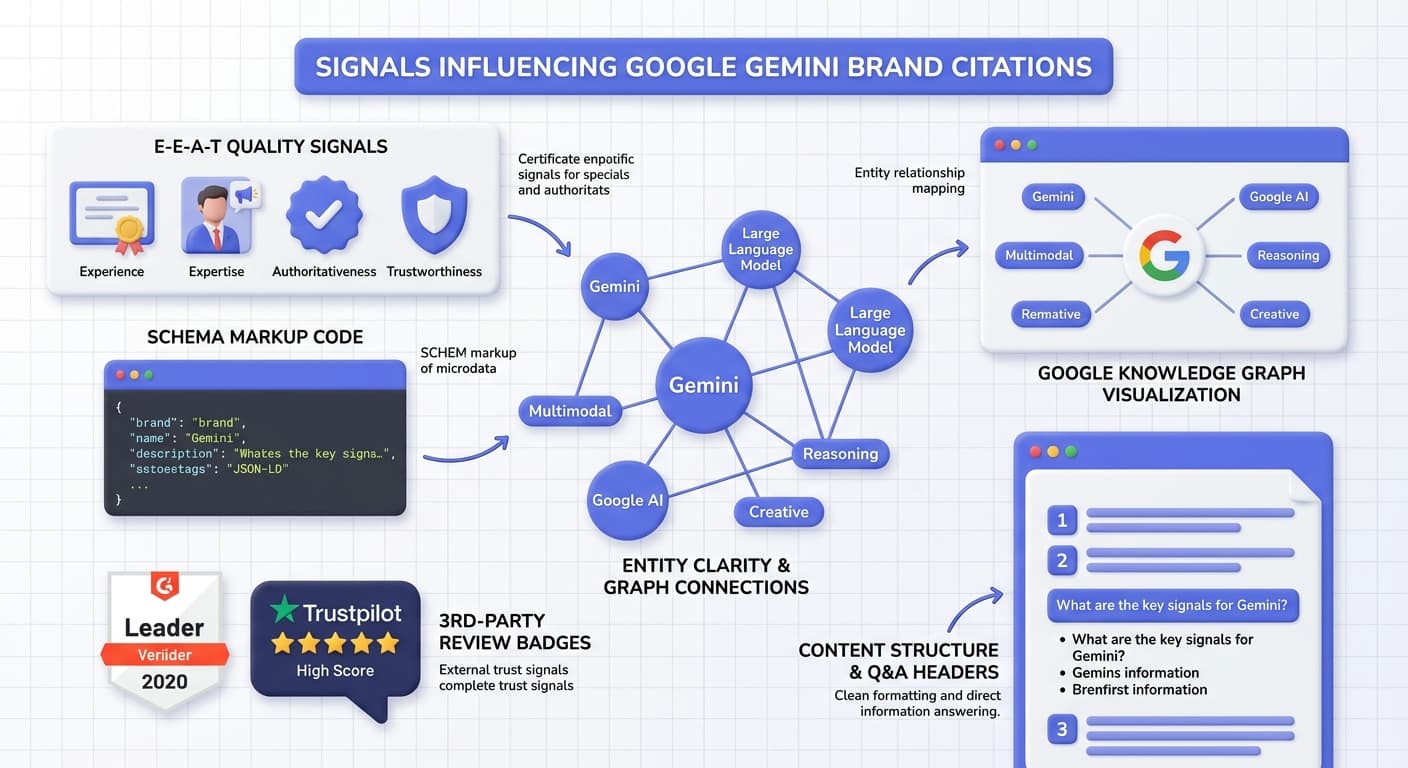
Structured data does three things that matter for Gemini: it tells Gemini's crawlers what your content represents (author, publication date, content type, and entity relationships); this reduces inference errors and increases confidence; and it helps embed brand facts into training pipelines. When a model processes a page with an accurate Article and Organization schema, those facts are more likely to be retained and referenced.
Use QuickSEO's free structured data validator to audit your schema markup and ensure Gemini can correctly interpret your pages.
7 Proven Strategies to Earn Gemini Brand Mentions
1. Build Entity Clarity Across the Web
Gemini resolves entities using Google's Knowledge Graph. If your brand, your founder, and your category exist as distinct, connected entities across multiple independent sources, Gemini can resolve you. If they don't, you're invisible.
When Gemini needs to confirm an entity and quote it with confidence, it triangulates across high-trust directories, knowledge graphs, and reference datasets: Google Business Profile, Apple Business Connect, Bing Places, Crunchbase, LinkedIn, Wikidata, and industry associations.
Action: Claim and verify your profiles, standardize your legal name, categories, location, founders, and URLs. Use the same logo and short description everywhere so AI systems can match embeddings to your entity.
2. Earn Media Placements in Sources Gemini Trusts
Third-party mentions are the external validation that tells Gemini your brand is a credible, real-world entity worth citing. According to TheAnswerEngine.ai, 94% of AI citations come from non-paid sources, with earned media accounting for 82% of those citations. Your own website, no matter how well optimized, cannot substitute for what other sources say about you.
For brands, the highest-impact third-party entity signals come from G2 reviews, Capterra listings, industry directory profiles, partner blogs, and press mentions. Each external mention reinforces your entity in Google's model and increases the probability that Gemini selects your brand when assembling a response about your category.
3. Structure Content for Extraction
Optimizing for Gemini means adding specific layers to your content: explicit Q&A structure, citable 2–3 sentence answers, entity consolidation, and proprietary data.
Use question-based H2s and H3s throughout your content to mirror likely queries Gemini will try to answer. Start your content with a direct, one-sentence answer, then expand with details, examples, or frameworks. Gemini scans for concise, well-structured answers it can quote or paraphrase. If your page clearly answers the exact question a user asks, you increase your odds of being cited.
4. Build Topical Authority Through Content Clusters
Choose a core theme and create a hub page that serves as the pillar or ultimate guide. Build 5–10 supporting articles that explore subtopics, tools, methods, or FAQs. Internally link between pages using natural anchor text. When Gemini sees your domain repeatedly mentioned in different contexts across the same topic, it's more likely to treat you as an expert — and pull your brand into related answers.
Long-form content over 2,900 words can increase citation rates by up to 59% for Gemini according to AI Growth Agent's analysis, reflecting the fan-out mechanism's preference for pages with comprehensive topic coverage.
5. Optimize Your Google Entity Signals
The Google entity signals that most directly influence Gemini citation probability are: a complete and verified Google Business Profile with accurate NAP data and recent reviews, positive review sentiment on Google with a rating above 4.0 and reviews from the past 90 days, consistent brand name and description across Google's indexed mentions of your brand, and author attribution on published content that connects to verifiable professional profiles. These signals tell Gemini's entity verification layer that your brand is a real, trustworthy source before it evaluates content quality.
6. Leverage Original Data and Statistics
Content featuring original statistics sees 30–40% higher visibility in AI responses, according to Averi.ai's 2026 research. Buying guides and comparison posts that include specific, verifiable product specifications, performance data, and comparison figures earn Gemini citations at higher rates than content with vague descriptions and no quantitative claims. The same specificity that helps buyers make informed purchase decisions also makes content more citable by Gemini's extraction process.
7. Maintain E-E-A-T Across All Content
Unlike standalone AI tools, Gemini is tied directly into Google's index, Knowledge Graph, and ranking systems, which means classic fundamentals still matter. Clear information architecture, fast pages, and strong E-E-A-T signals continue to influence which sources get cited and summarized. Gemini also prioritizes content that is precise, current, and verifiable, so visible dates, named authors, and links to primary sources help models trust your pages.
Use QuickSEO's E-E-A-T checker to audit your pages against the exact trust signals that influence Gemini's citation decisions.
How to Track Gemini Brand Mentions
You can't manage what you can't measure. Tracking brand mentions within Gemini isn't exactly straightforward, which is why so many marketing teams are currently struggling with it. You can't just log into a simple dashboard to see your "AI impression share." Generative outputs are highly dynamic, personalized to the user, and can even vary across different sessions.
Here's what a comprehensive Gemini brand mention tracking program should measure:
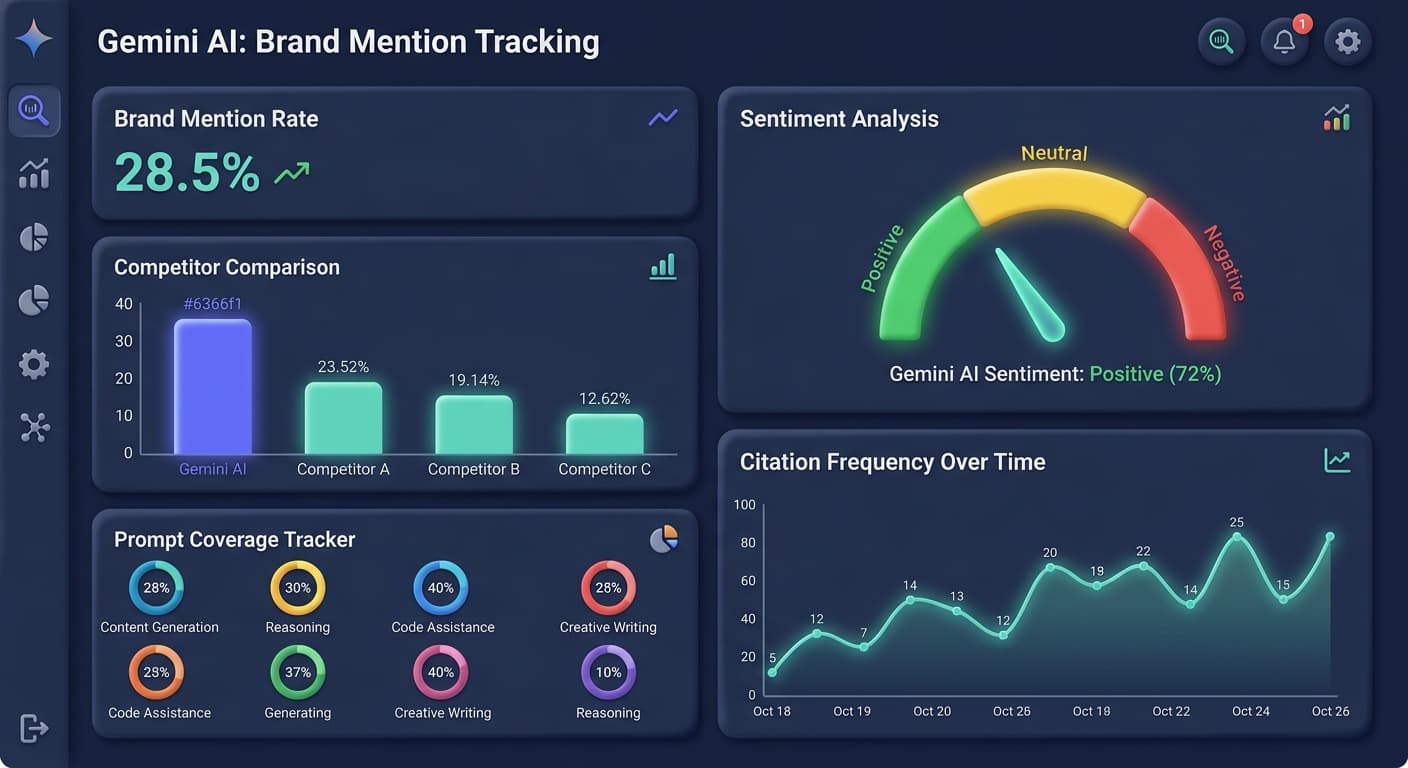
The best tracking workflow should measure more than mentions. Teams should monitor citations, answer position, sentiment, competitor visibility, prompt coverage, source influence, and visibility changes over time.
Key metrics to track include:
Brand mention rate: The percentage of tracked Gemini prompts where your brand appears
Answer position: Whether you're cited first, second, or further down in the response
Sentiment score: Whether Gemini frames your brand positively, neutrally, or negatively
Competitor visibility: Where competitors appear instead of (or alongside) you
Citation sources: Which of your pages Gemini pulls from when citing your brand
Cross-surface coverage: How your visibility differs between Gemini Chat, AI Overviews, and AI Mode
Gemini brand mention tracking is not useful if it only tells you whether your brand appeared once. A serious team needs to understand where the brand appears, where competitors appear, which sources influence Gemini, which topics are missing, what content should be created, and whether optimization work improves visibility over time.
Gemini vs. ChatGPT vs. Claude: Why Platform Divergence Matters
Gemini AI brand mention tracking is a distinct monitoring requirement from ChatGPT or Perplexity monitoring — Gemini's Google ecosystem integration, retrieval architecture using Google's search index, and multi-surface presence create unique citation dynamics. The strategic value of Gemini brand monitoring comes from cross-platform comparison: understanding exactly how Gemini's recommendations differ from other AI platforms and which specific investments improve each platform's recommendations.
For a deeper look at how citation behavior varies across AI platforms, see our guide on AI citation patterns across ChatGPT, Claude, Gemini, and Perplexity.
How Long Does Gemini Optimization Take?
Realistic expectations: Gemini optimization results typically appear 60–120 days after implementation. The key is to focus on building authority and content quality rather than expecting immediate AI citations. The investment in E-E-A-T and content structure benefits both traditional SEO and AI visibility.
Most brands see initial Gemini citation pickup within four to eight weeks of publishing well-structured, schema-optimized content on indexed pages. Third-party mentions on G2 and industry listicles can accelerate this timeline by reinforcing entity signals before your own pages accumulate full authority.
Brands that monitor detect AI citation errors in 14 days on average. Brands that don't detect them in 67 days. This is why continuous, automated tracking is critical — not just a monthly manual check.
The January 2026 Gemini Update: What Changed
Google's January 2026 Gemini update replaced approximately 42% of previously cited domains and generates 32% more source URLs per AI Overview response according to SE Ranking. It uses more aggressive query fan-out, pulling from a wider topic cluster. SaaS brands now need content breadth across a full cluster to get cited in Google Gemini consistently.
Ahrefs data from early 2026 shows only 38% of pages cited in Google AI Overviews rank in the top 10, down from 76% in mid-2025. Structured content, entity signals, and third-party mentions now matter as much as organic position for getting cited in Google Gemini.
This shift levels the playing field. Brands that optimize for the new Gemini 3 requirements now have an equivalent starting position to brands that were previously cited — but the window won't stay open forever.
Gemini vs. Other AI Platforms: Key Differences
Understanding what makes Gemini unique helps you tailor your optimization strategy:
Factor | Gemini | ChatGPT | Perplexity |
|---|---|---|---|
Index connection | Google's live index | Pre-trained + optional browsing | Own real-time search engine |
SEO correlation | High (organic rankings matter) | Medium | Medium |
Entity resolution | Google Knowledge Graph | Training data | Own crawl |
Surfaces | AI Overviews, AI Mode, Gemini Chat | ChatGPT.com | Perplexity.ai |
Citation style | Often summarizes, sometimes links | Often summarizes | Inline citations |
Gemini is connected to Google's index and leans heavily on Google's real-time crawling and ranking systems. AI Overviews and AI Mode mix traditional SEO signals with generative reasoning.
The practices that get you cited in Gemini — Q&A structure, schema markup, operational E-E-A-T, proprietary data, semantic clarity — are the same ones that make you citable in ChatGPT, Perplexity, and Claude. This means a well-executed GEO strategy lifts your visibility across all AI platforms simultaneously.
For a complete breakdown of how the major AI platforms compare for brand visibility, read our analysis of ChatGPT vs. Gemini vs. Claude vs. Perplexity market share in 2026.
The AI Visibility Audit: Where to Start
Before you invest time and budget optimizing for Gemini brand mentions, you need a clear picture of where you stand today. Ask yourself:
Does Gemini know your brand exists? Search your brand name directly in Gemini and observe how it describes you.
Do you appear for category queries? Ask Gemini "best [your category] tools" or "top [your service] platforms."
Where do your competitors appear? Map which prompts trigger competitor mentions but not yours — these are your priority gaps.
What sources does Gemini cite when mentioning your brand? Identify whether it's pulling from your own site, third-party review platforms, or press coverage.
How does your Gemini visibility compare to ChatGPT and Claude? Platform divergence reveals which signals you're missing.
GEO is a long-term strategy — results don't appear overnight. Monthly monitoring helps you track progress and refine strategy: track changes over time in accuracy, frequency of mention, positioning relative to competitors, and sentiment.
🚀 Track Your Gemini Brand Mentions — Without the Guesswork
QuickSEO tracks your brand's presence across Google Search AND AI chatbots like ChatGPT, Claude, and Gemini — all in one place. Set up tracked prompts, monitor your AI Score, see exactly which queries surface your brand (and which surface your competitors), and get actionable insights to improve your Gemini citations. Thousands of marketers are already tracking their AI & SEO performance with QuickSEO. 👉 Get started for free at quickseo.ai — no guesswork, no spreadsheets, no switching between tools.
Conclusion
Gemini brand mentions are no longer a "nice to have" — they're a core visibility metric in 2026. As of June 2026, Gemini holds 27.4% web market share, behind only ChatGPT at 54.7%. Gemini has grown its share more than fivefold in just 17 months. Brands that optimize for Gemini citations today are building a compounding advantage that will only grow harder for competitors to close.
The path forward combines:
Technical foundations — static HTML, schema markup, crawlability
Entity clarity — consistent presence across Google's ecosystem and third-party sources
Content structure — Q&A formatting, extractable answer blocks, topic clusters
Earned media — third-party mentions in the sources Gemini trusts
Continuous tracking — prompt-level monitoring, sentiment analysis, competitor benchmarking
The brands getting cited by Gemini today aren't the ones with the biggest budgets. They're the ones who understood that Gemini cares whether you are a trusted, resolvable entity producing fresh, structured, citable content that independent sources corroborate.
Start with a free AI Visibility Audit at QuickSEO to see exactly where your brand stands in Gemini and the other major AI platforms — and get a clear roadmap to improve it.
Enter your website to track its AI visibility across ChatGPT, Gemini, Claude, and Perplexity — and turn chatbot mentions into traffic.
- Set up in minutes
- Cancel anytime
Try it yourself
Related free tools
Free SEO tools related to the topics covered in this article.
Keep reading
Related posts
More articles on the same topics, prioritized by shared tags and keyword overlap.


