AI Visibility Metrics: The Complete 2026 Guide to Measuring Your Brand in AI Search

 Summarize in ChatGPT
Your brand could be ranking #1 on Google and still be completely invisible to the hundreds of millions of people asking ChatGPT, Claude, and Gemini for recommendations right now. That's not a hypothetical — it's the daily reality for most brands in 2026.
You could be ranking number one on Google for every relevant keyword and still be completely absent from the AI answers your prospects are actually reading. The problem is that traditional SEO metrics simply weren't built to see this.
This is where AI visibility metrics become essential. They represent an emerging measurement framework designed specifically to track brand presence in AI-generated responses: how often you're mentioned, how you're framed, which topics you surface for, and how you stack up against competitors across platforms like ChatGPT, Claude, and Perplexity.
In this guide, we'll break down every AI visibility metric that matters in 2026, how to interpret each one, and how to build a systematic strategy to improve your scores — all from a single dashboard.
Why Traditional SEO Metrics No Longer Tell the Whole Story
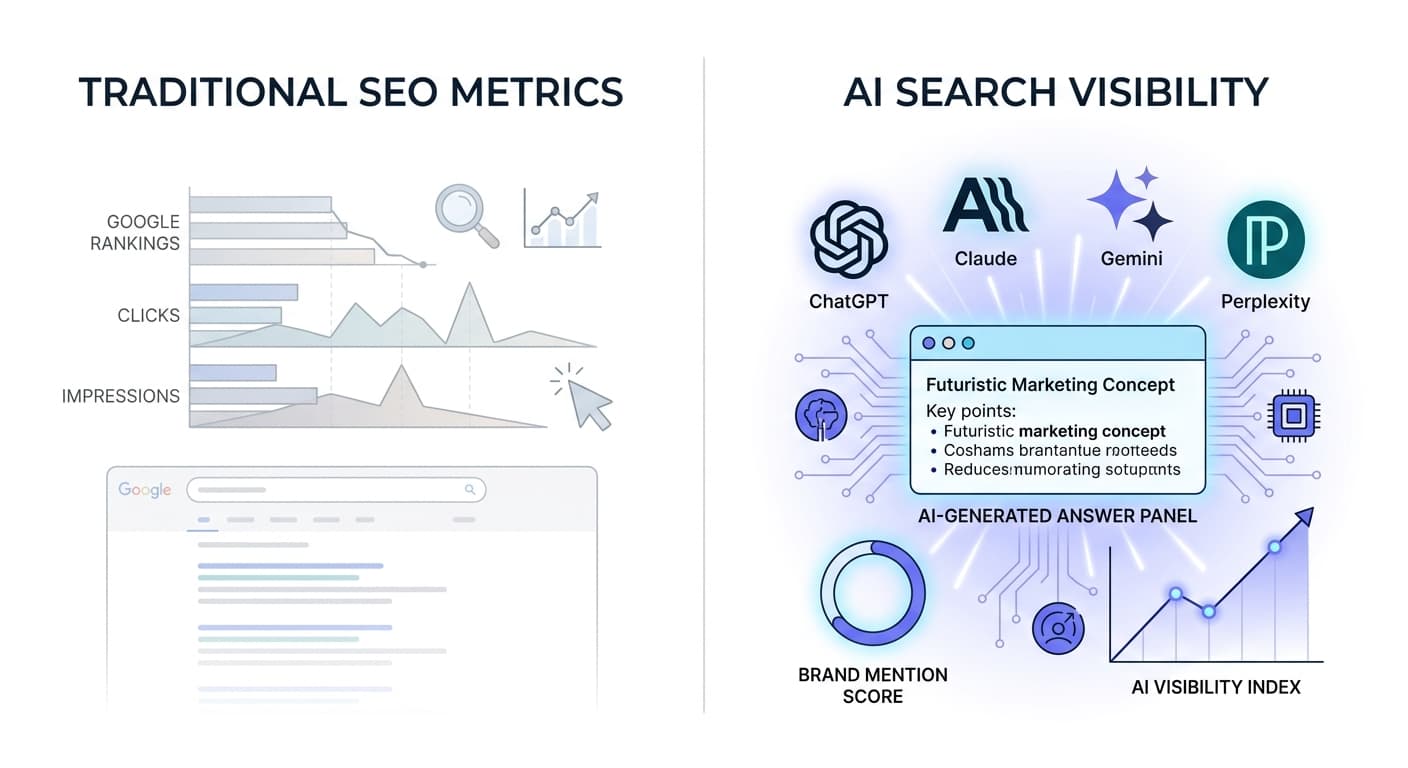
For two decades, digital marketers have measured success by rankings, clicks, and impressions. Those metrics remain valuable — but they only cover part of the picture today.
AI-powered answer engines operate on a fundamentally different model. When a user submits a query to ChatGPT or Claude, the system synthesizes a response from its training data and, in many cases, real-time retrieval. The user gets an answer directly.
There's no results page to rank on. There's no impression to count. There's no link to click. If your brand appears in that answer, it's because the AI decided to include it. If it doesn't, no traditional metric will tell you that you were absent.
The scale of this invisible gap is staggering. The four major AI assistants now reach hundreds of millions of users: ChatGPT with 900 million weekly active users, Gemini with ~400 million monthly active users, Perplexity growing at 184% YoY, and Claude serving millions of weekly users via claude.ai plus enterprise integrations.
Pew Research found that users click traditional search results only 8% of the time when an AI summary appears. With AI Overviews now triggering on 48% of queries, brand visibility inside AI answers has become the most important metric in marketing.
Meanwhile, brands cited in AI Overviews earn 35% more organic clicks and 91% more paid clicks compared to those left out entirely. Being in the AI answer isn't just about the AI answer itself — it creates a halo effect across every channel.
The business consequences are real. AI visibility affects awareness (informational queries), consideration (comparison queries), and conversion (high-intent recommendation queries). Poor AI visibility creates systematic blind spots at every funnel stage. Brands with weak AI visibility lose potential customers before they ever visit a website — making it a top-of-funnel priority with downstream conversion consequences.
The 6 Core AI Visibility Metrics Every Brand Must Track
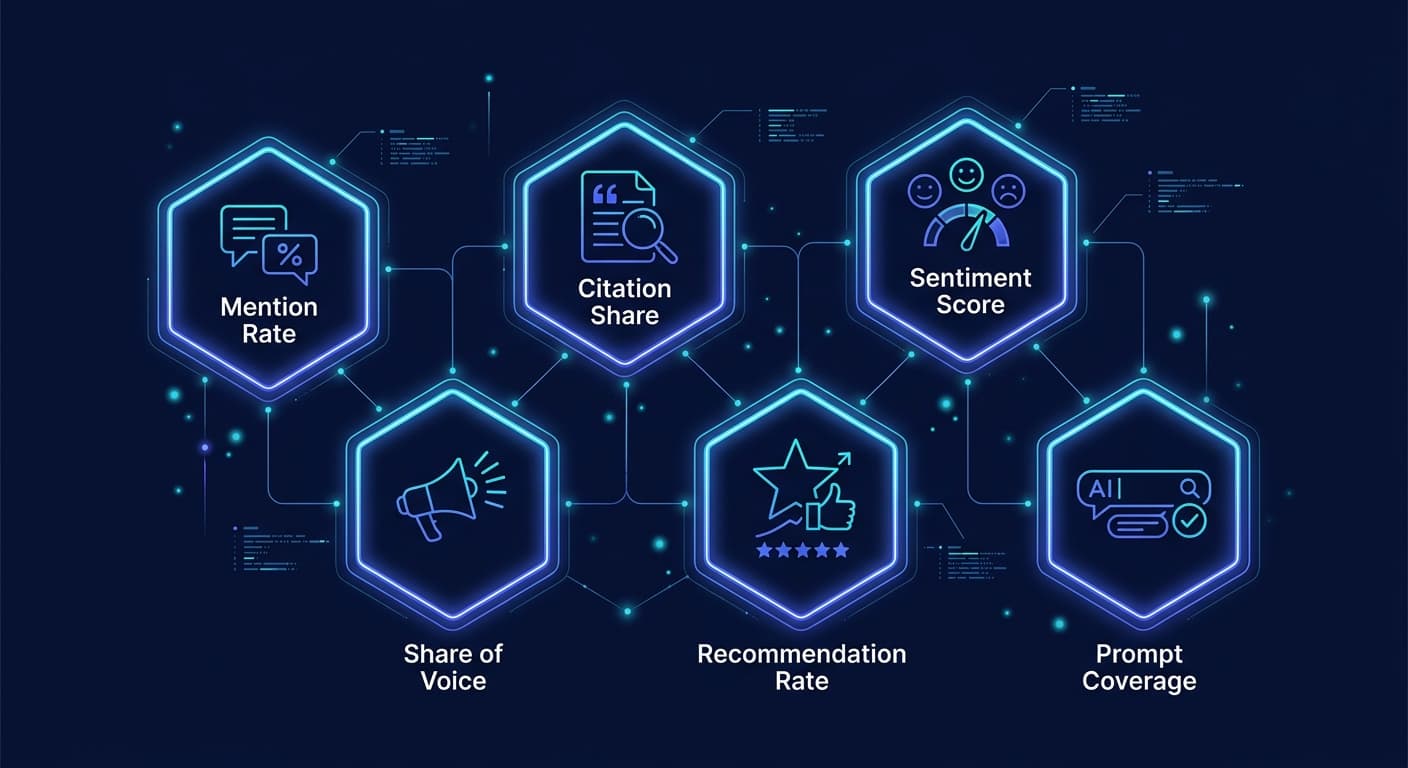
Unlike traditional SEO metrics (impressions, clicks, CTR), AI visibility metrics measure mention frequency, ranking position, sentiment, citation share, and model divergence across AI assistants like ChatGPT, Gemini, Perplexity, and Claude.
Here are the six metrics that matter most — and what each one tells you.
1. Mention Rate (Visibility Rate)
Mention rate is the percentage of tested prompts where your brand appears in the response. If your brand is mentioned in 32 out of 100 prompts, your mention rate is 32%. This is the headline number.
This is the foundation of all AI visibility measurement. At the top of funnel, focus on Visibility Rate and Mention Frequency — the critical question is whether you're being mentioned at all. A citation frequency below 15% typically indicates a structural content or authority problem that needs urgent attention.
2. Citation Share
Citations and mentions are not the same thing. Visibility means your URL appeared in the AI's internal search results. Citations mean the AI actually visited your page and used your content as a source. Mentions mean the AI explicitly named your brand in the response text the user sees.
Citation rate matters because it indicates the AI considers your domain an authoritative source, not just a known name. When your brand appears, tracking whether the answer links to you or just name-drops you is crucial. Citations drive measurable referral traffic; mentions build brand association without clicks. Both matter, and you want to track both separately.
3. Sentiment Score
Sentiment Quality captures how AI systems describe your brand, not just whether they mention it.
Sentiment matters because AI models shape user perception through the language they use. A neutral mention provides awareness but doesn't drive preference. A positive mention actively recommends your brand and influences purchase decisions. A negative mention can damage your reputation before prospects ever visit your website.
Sentiment scores typically range from -1.0 (very negative) to +1.0 (very positive). At the middle of funnel, focus on Sentiment Score and Brand Alignment — the key question is whether AI is accurately describing your value proposition.
4. Share of Voice
The concept that captures this new competitive dynamic is often called AI search share: the proportion of relevant AI-generated answers that include your brand compared to your competitors. Think of it as share of voice, but measured across AI responses rather than search result pages.
Share of voice compares your brand mentions against competitor mentions across the same prompt set. If your category has four key players and you're mentioned 25% of the time while a competitor is mentioned 60%, you know the gap quantitatively. This metric is most valuable for benchmarking and tracking competitive shifts over time.
5. Recommendation Rate
There's a meaningful difference between being mentioned and being recommended. A recommendation occurs when the AI describes your brand as a choice or advised action. Understanding which state your brand appears in shows you whether your brand more effectively influences decision-making.
This metric indicates how often AI assistants treat your brand as a viable or preferred provider rather than simply an entity that exists. For B2B SaaS and AI search companies, Recommendation Rate is often a stronger signal of future pipeline impact than simple mention volume.
6. Prompt Coverage (Topic Coverage)
Identifying prompt categories where visibility is missing is critical. Your brand might dominate "what is AI visibility" prompts but be absent from "best AI visibility tools for enterprises" prompts. These gaps signal exactly where content investment should focus.
Top of funnel: focus on Visibility Rate and Mention Frequency. Middle of funnel: focus on Sentiment Score and Brand Alignment. Bottom of funnel: focus on Rank Position and Citation Share — when users ask for recommendations, do you appear first with credible sources?
Why Platforms Differ — And Why That Matters
ChatGPT, Gemini, Perplexity, Claude, DeepSeek, Grok, and Llama each have distinct training data, inference architectures, and response patterns. Your brand may rank as the top recommendation on one platform and fail to appear at all on another. Platform-level visibility gaps are specific, addressable opportunities that only cross-platform monitoring makes visible.
The same brand can see citation volumes differ by 615x between platforms. Multi-platform tracking is non-negotiable.
Here's what drives each major platform:
ChatGPT: ChatGPT's browsing mode pulls from Bing in real-time. If Bing can't find you, ChatGPT can't cite you. Schema impact is high — JSON-LD helps ChatGPT verify entity facts.
Gemini: Tightly integrated with Google's entity database and Knowledge Graph. Strong Google Business Profile and comprehensive schema markup are key optimization levers.
Perplexity: Perplexity relies heavily on citations. It favors precise definitions, structured answers, and content supported by trustworthy external sources. It often cites websites, UGC, and authoritative resources directly.
Claude: Claude relies heavily on training data, so third-party mentions that were in the training corpus matter more than recent content.
Perplexity and Google AI Overviews prioritize word and sentence count for citations, while ChatGPT leans towards domain rating and readability. Understanding these nuances helps you optimize specifically for each engine rather than applying a one-size-fits-all approach.
How to Measure AI Visibility: Building Your Prompt Testing Framework
Prompt tracking is the most effective AI visibility method because it mirrors exactly how your customers discover brands through AI. Instead of guessing whether your brand "shows up somewhere," prompt tracking tests the specific questions your audience asks — and records the AI's exact response every time.
Here's how to build a solid measurement framework:
Step 1: Build Your Prompt Bank
Define your prompt set by mapping the 20–50 queries your ideal customers ask AI assistants (e.g., "best CRM for startups," "top project management tools for remote teams"). Run prompts across all engines — test each prompt against ChatGPT, Gemini, Perplexity, and Claude simultaneously.
Step 2: Sample Statistically
A single prompt test tells you almost nothing. If you asked ChatGPT "best project management software" once and your brand didn't appear, that's a sample size of one on a highly variable distribution. You measured noise. You need statistical sampling. Search Engine Land's LLM optimization guide recommends a polling-based model borrowed from election forecasting: 250 to 500 high-intent queries daily or weekly to capture the response distribution.
Step 3: Track Trends, Not Snapshots
AI models update regularly. ChatGPT's knowledge base expands with new training data. Claude's capabilities evolve with each version. Perplexity's real-time retrieval surfaces the latest content. Your AI visibility scores from three months ago might not reflect your current standing. Trend tracking metrics measure how your visibility changes over time as AI models update.
Step 4: Establish Competitive Benchmarks
Benchmark against competitors using Share of Voice and Brand Mention Rate for core commercial prompts in your category. Establish where you stand relative to key competitors when AI platforms answer questions about your industry.
You can use QuickSEO's AI visibility scores feature to automate this entire process — tracking mention rate, position-in-answer, sentiment, and cited pages across ChatGPT, Claude, Gemini, and Perplexity in one unified dashboard.
6 Proven Strategies to Improve Your AI Visibility Metrics
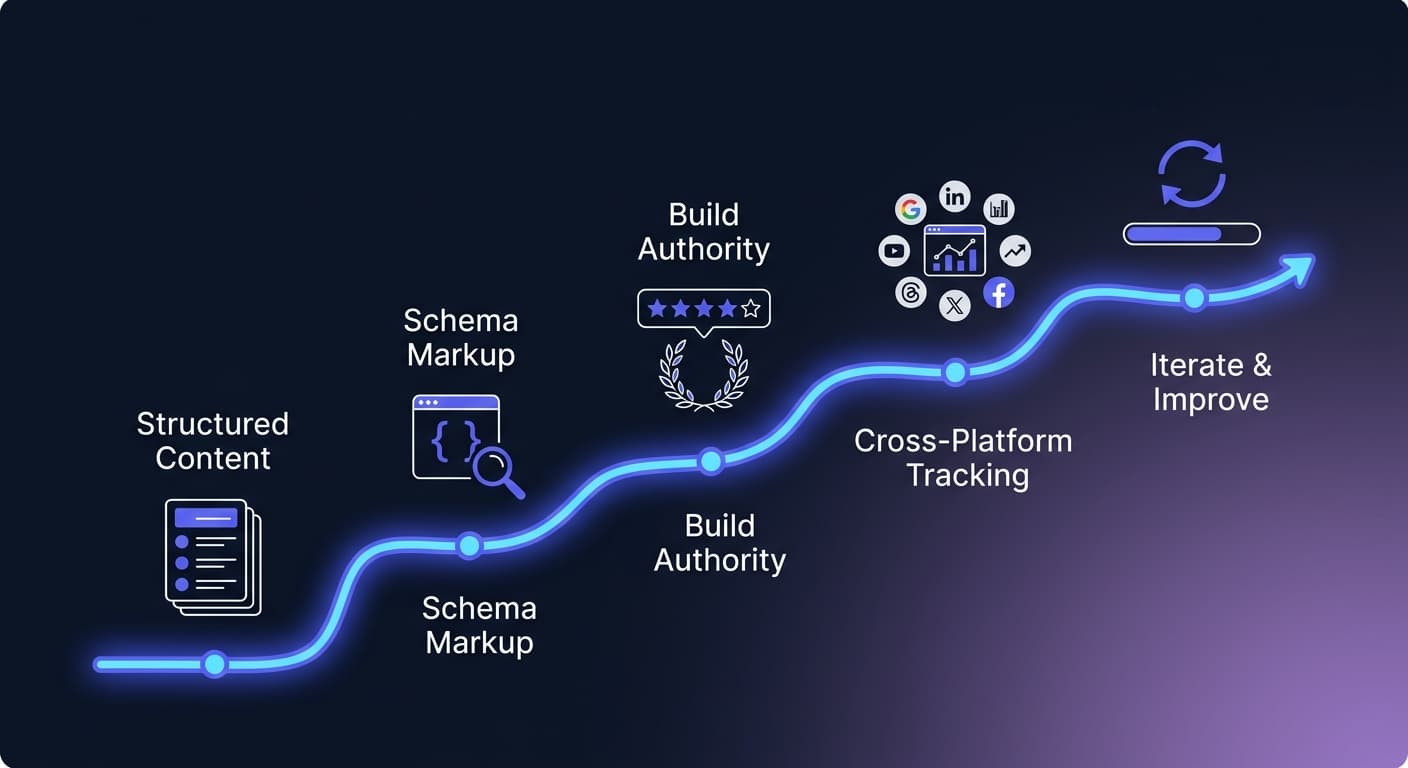
Once you have your baseline metrics, here's how to systematically move the needle.
1. Structure Content for AI Extraction
Improving AI Visibility Score requires deliberate strategy across content, authority, and technical signals. Structure content with clear H2/H3 headings and 40–60 word answer blocks beneath each heading. AI systems pull individual passages — not entire pages. Every section should make sense without surrounding context. Pages with this structure are 2x more likely to earn AI citations than unstructured pages.
Content that performs best for AI search visibility tends to be well-structured, direct, and answer-focused. FAQ sections, numbered lists, clearly labeled headers, and concise explanatory paragraphs all help AI models identify and extract relevant information.
2. Deploy Strategic Schema Markup
FAQ schema, HowTo schema, and Organization schema help AI systems extract and attribute your content cleanly. Schema tells AI what type of content is on the page, who wrote it, and what questions it answers — making your site citable rather than merely crawlable. Triple-stacking FAQPage + Article + HowTo produces 1.8x more citations than Article schema alone.
You can quickly validate and generate structured data using QuickSEO's structured data validator and AI schema markup generator.
3. Build Authority Through Original Research
Original research, data-backed claims, and expert perspectives also increase the likelihood of being cited as a primary source. The fundamentals of good content still matter. But in 2026, the brands that earn AI search visibility are the ones that pair great content with the right structure, the right signals, and a commitment to building genuine authority over time.
AIs cite fresh, authoritative, unique material. Publish original data: benchmarks, surveys, field tests. Being the source that other sources cite is the most powerful compounding signal in AI search.
4. Manage Off-Site Brand Signals
AI engines evaluate your brand based on everything said about you across the web, not just what you publish on your site. This means off-site visibility is a major factor in AI search results.
McKinsey's AI Discovery Survey found that a brand's own website accounts for only 5 to 10% of the sources AI search platforms reference. The other 90% comes from publishers, user-generated content, affiliate sites, and review platforms. This means investing in PR, review generation on platforms like G2 and Trustpilot, and third-party coverage is essential for AI visibility — not just for traditional SEO.
5. Address Sentiment Problems Directly
Negative sentiment indicates reputation issues in how AI models characterize your brand. This often stems from negative reviews, critical coverage, or content that highlights limitations without balancing them with strengths. Addressing sentiment requires publishing positive case studies, customer success stories, and content that demonstrates clear value and results.
If your score shows high mention frequency but neutral or negative sentiment, the fix is not more content — it's better social proof and cross-platform signal management. Add case studies with specific metrics, strengthen review ecosystems on G2 and Trustpilot, and publish original research that AI models can reference as authoritative data. Sentiment improvement requires working on the third-party sources that AI is pulling sentiment signals from.
6. Create a Measurement Feedback Loop
The key is creating a feedback loop: measure your current metrics, identify the biggest gaps, publish content designed to address those gaps, then measure again to see if the content moved the needle. This iterative approach treats AI visibility as an ongoing optimization challenge rather than a one-time project.
Track changes after messaging updates, product launches, or major campaigns. Establish baseline visibility metrics before making changes, then measure whether Recommendation Rate and Mention Rate shift in subsequent testing cycles. This enables causal understanding of which content types or messaging approaches improve AI visibility.
According to research on brands implementing systematic GEO programs, structured factual content, FAQ-rich pages, comparison content, cross-platform authority building, and schema markup can meaningfully improve scores within 60–90 days. Brands implementing systematic GEO programs report visibility improvements of 15–35 percentage points within three months.
AI Visibility Metrics Benchmarks: What "Good" Looks Like in 2026
Understanding your scores is only useful if you have benchmarks to compare against. Here's what the data shows across industries:
Mention Rate: A citation frequency below 15% typically indicates a structural content or authority problem. Competitive categories often see top brands achieving 40–60%+ mention rates.
AI Readiness Score: A good AI Readiness Score is 60 or higher for most categories because it means the page has enough structured data, entity clarity, heading structure, and citation formatting for AI extraction. Foglift's Q2 2026 AEO Readiness study found a 46/100 median across 311 broad-market AEO-scored domains, so 60+ is already above the current broad-market readiness baseline.
Citation Freshness: Pages that have been updated within the past 12 months are 2x more likely to earn citations.
Recommendation Position: First-position citations achieve 2.8× the conversion rate of third-position mentions.
Cross-Platform Consistency: Cross-Platform Consistency measures whether your visibility is robust across all major AI systems or concentrated on just one or two.
Early leaders generate downstream signals — traffic, reviews, brand mentions — that strengthen their AI authority further and become progressively harder for later entrants to overcome. The window to build a compounding advantage is open right now — but it's narrowing fast.
Integrating AI Visibility Into Your Broader SEO Strategy
AI visibility metrics don't replace traditional SEO — they complete it. This isn't a replacement for traditional SEO metrics. It's an additional layer that reflects where a significant and growing portion of user attention is actually going. The brands that recognize this early are the ones building measurement frameworks that capture both dimensions simultaneously.
The smartest approach in 2026 is to track both Google Search performance and AI chatbot visibility in the same workflow. That means correlating your GSC data (clicks, impressions, CTR) with your AI visibility scores (mention rate, sentiment, share of voice) so you can understand how each channel contributes to your overall brand discoverability.
When AI tools mention your brand more often, people tend to search for you by name afterward. Increases in branded search volume often follow improvements in AI visibility. Track these metrics together to see the relationship.
For a deeper look at building a unified measurement system, check out our guide on GSC + AI visibility: one dashboard vs. two tools — it covers exactly how to connect your Google Search Console data with AI visibility tracking without juggling multiple platforms.
🚀 Track Your AI Visibility — Right Now, For Free
Stop flying blind across ChatGPT, Claude, Gemini, and Perplexity. QuickSEO combines Google Search Console analytics with AI visibility tracking across your pick of three of the four major chatbots — in one place, at SMB pricing.
✅ Track brand mention rate, position-in-answer, and sentiment per platform
✅ Monitor AI visibility scores week-over-week
✅ Discover which pages get cited — and which competitors are outranking you in AI answers
✅ See your Google clicks, impressions, and CTR side-by-side with your AI Score Join thousands of marketers already tracking their AI & SEO performance with QuickSEO. 👉 Get started for free at quickseo.ai
Conclusion: AI Visibility Metrics Are No Longer Optional
The brands winning in 2026 are the ones who treat AI visibility as a measurable, trackable, and improvable marketing channel — not an experimental side project.
Success is no longer just about traffic — it's about being the trusted source AI cites in responses. This requires a shift from measuring only clicks to tracking Brand Visibility, Authority, and Conversational Influence.
The six core metrics — mention rate, citation share, sentiment score, share of voice, recommendation rate, and prompt coverage — give you a complete picture of how your brand performs wherever your customers are asking questions.
AI visibility tracking is becoming as essential as SEO tools were in the past decade. Search rankings show visibility in search engines. AI mentions show visibility in conversational discovery, often before users ever visit a website. If you want to know whether your brand exists where modern buying decisions are shaped, tracking AI mentions is no longer optional.
Start measuring. Build your baseline. And systematically close the gap between where your brand is today and where it needs to be in the AI-powered search landscape of tomorrow.
Enter your website to track its AI visibility across ChatGPT, Gemini, Claude, and Perplexity — and turn chatbot mentions into traffic.
- Set up in minutes
- Cancel anytime
Keep reading
Related posts
More articles on the same topics, prioritized by shared tags and keyword overlap.