AI Search Reporting: The Complete 2026 Guide to Metrics, Dashboards & Winning Visibility

 Summarize in ChatGPT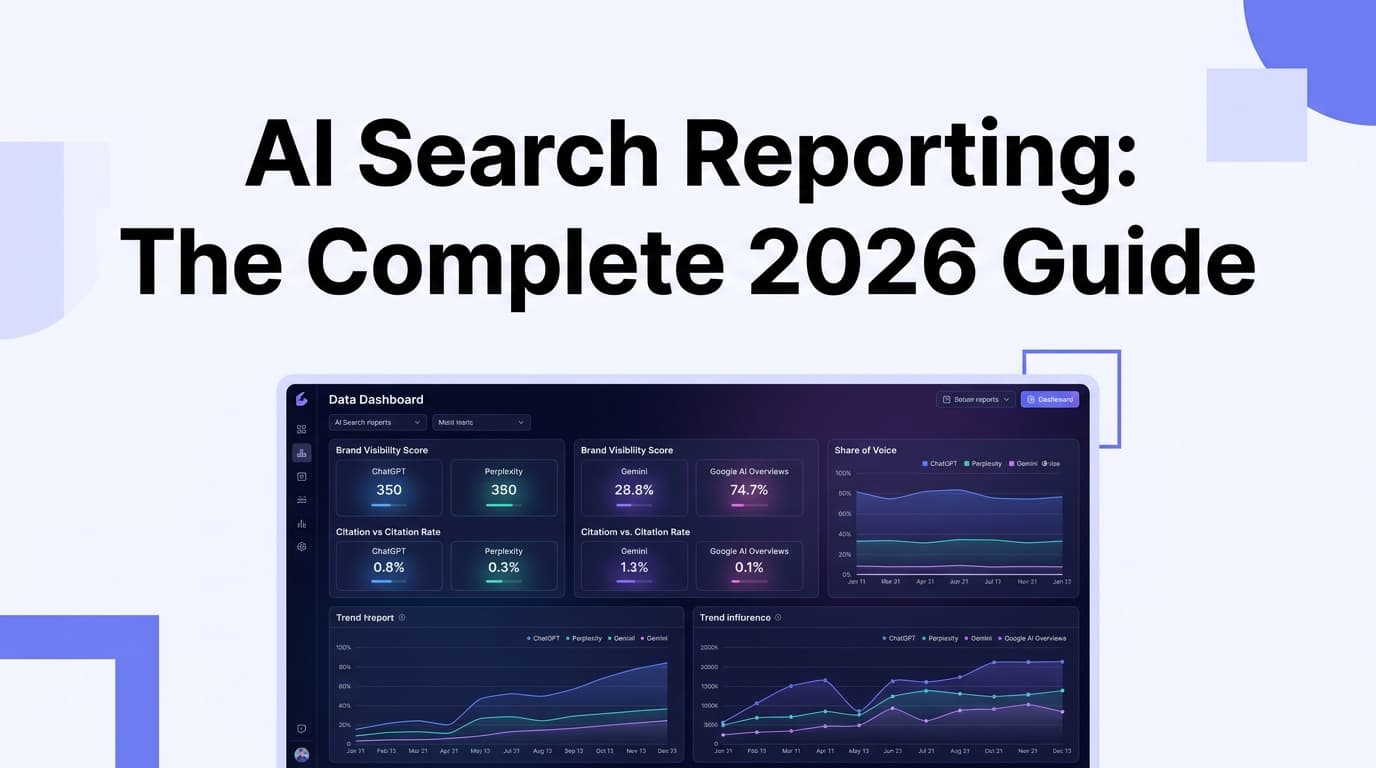

If your reporting still revolves around Google rankings, sessions, and click-through rates, you're measuring the wrong things in 2026.
Search has fundamentally restructured. It didn't gradually evolve — it restructured. Within a single calendar year, the way people find information, compare products, make purchasing decisions, and engage with brands shifted in ways that have been building for years but arrived faster than most marketing teams were prepared for. Today, buyers open ChatGPT before they open Google. They ask Perplexity to compare vendors. They consume AI-generated answers without ever clicking a link.
The problem? Your brand is either showing up in those answers or it is not — and you have no way of knowing which. Google gives you Search Console. Social platforms give you reach metrics. Review sites give you ratings. ChatGPT gives you nothing. No impressions data. No analytics dashboard. No built-in way to see what it says about you or your competitors.
That's the core challenge of AI search reporting in 2026: building a measurement system for a channel that offers zero native analytics. This guide shows you exactly how to do it.
Why Traditional Reporting Falls Short in 2026
The old model — track rankings, watch traffic, measure CTR — was already weakening. Now it's broken.
AI search trends in 2026 confirm that zero-click search is becoming the dominant consumer behavior model. Semrush reports that over 65% of informational queries now resolve without a user visiting a website.
Even more telling: only about 20% of ChatGPT mentions include clickable citation links that show up in GA4. The other 80% — the brand recommendations, comparisons, and descriptions that shape purchasing decisions — are completely invisible to traditional analytics.
The explanation from Similarweb's 2026 report: AI chatbots had evolved into all-in-one solutions where users complete research, comparison, and decision-making entirely inside the conversation. The click out is no longer necessary. And if you're only measuring what happens after the click, you're measuring the shadow of AI's influence, not the influence itself.
Traditional performance dashboards must evolve. Instead of focusing solely on sessions and conversions, leaders should monitor citation frequency, recommendation rank within AI outputs, and sentiment context — metrics that reflect real influence in an answer-driven ecosystem.
The Scale of the Opportunity (and the Risk)
Before building a reporting system, it's worth understanding just how large AI search has become.
ChatGPT Search processes 250–500 million weekly queries, per Similarweb's 2026 AI Search report, making it one of the top five search properties globally by query volume. Combined with Perplexity, Google AI Mode, and Microsoft Copilot, AI-mediated queries represent a structural category that did not exist four years ago and now drives the planning of every serious content and SEO program.
The stakes of being invisible are real: BrightEdge analysed millions of AI search responses in 2025 and found that 44% of all AI prompts return zero brand mentions — not because competitors are better, but because brands haven't optimised for AI citation. Without a monitoring system, you can't know whether you're in that invisible 44% or not.
And the brands acting now are getting a head start: eMarketer data from January 2026 shows 54% of US marketers are already building GEO (generative engine optimisation) strategies. The teams doing this now will have 12 to 18 months of data on anyone who starts when it goes mainstream.
The 6 Core Metrics for AI Search Reporting
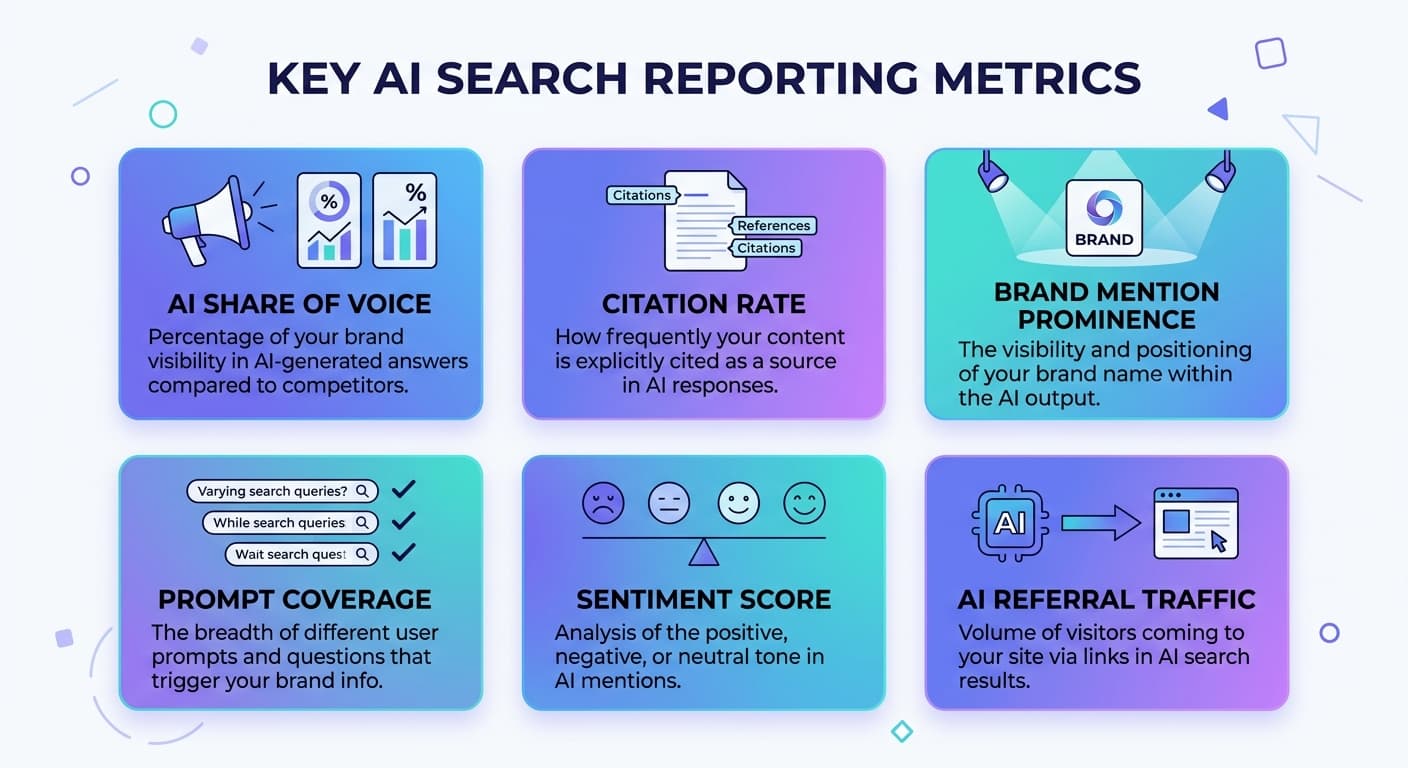
A complete AI search reporting system tracks six distinct signals. Here's what each one measures and why it matters.
1. AI Share of Voice (AISoV)
AI Share of Voice tracks how often your brand appears relative to competitors across prompts, platforms, and query clusters. This is the AI-era version of market visibility, and it belongs on every executive dashboard in 2026.
Share of voice in AI answers is your most strategic headline metric. Citation frequency tells you whether you're showing up. Share of voice tells you how you compare to competitors when the same query is asked.
To calculate it: divide the number of prompts where your brand appears by the total prompts tracked, then compare this ratio against your top competitors.
2. Citation Rate
Citation rate tracks how often AI tools cite your content by URL or name. This is distinct from simple brand mentions — a citation means the AI engine actively sourced your content as proof.
Citation rate tracks how often AI tools cite your content by URL or name. ChatGPT cites its sources 87% of the time, but only 11% of all sites have citations from both Perplexity and ChatGPT — showing that tracking one engine means you lose out on another.
3. Brand Mention Prominence
Brand mentions capture references to your company even when no link appears. Think of citations as sourced proof and mentions as general brand presence. Track both because AI platforms surface them in different ways. Mentions build awareness and shape perception long before a click happens.
When people see your brand consistently mentioned in AI-generated answers, it signals credibility and authority. These mentions influence how users perceive your expertise compared to competitors. The more visible you are in AI responses, the more likely users are to trust and ultimately choose your brand.
4. Prompt Coverage
Prompt coverage is the percentage of tracked prompts where your brand appears. It measures topical reach, conversational breadth, and category relevance across the full spectrum of buyer-stage queries. A brand with high citation share on one narrow query cluster but zero coverage on comparison and solution-seeking prompts has a structural visibility gap.
5. Sentiment Score
Sentiment tracks how AI describes your brand when it does mention you, whether it's positive, neutral, or negative, and whether that framing shifts across platforms.
A sentiment breakdown should be part of every AI report. A citation in a negative context does more harm than no citation. You need to see the split.
6. AI Referral Traffic & Influenced Pipeline
Referral conversion ties AI visibility to business outcomes. It's no longer a vanity metric if you can track and trace your buyer from clicking on your link in an AI engine to their final purchase.
If your branded search volume and direct traffic are both climbing while paid spend stays flat, AI visibility is probably feeding that lift. Look for this "halo effect" in your Search Console and GA4 data.
Building Your AI Search Reporting System: Step by Step
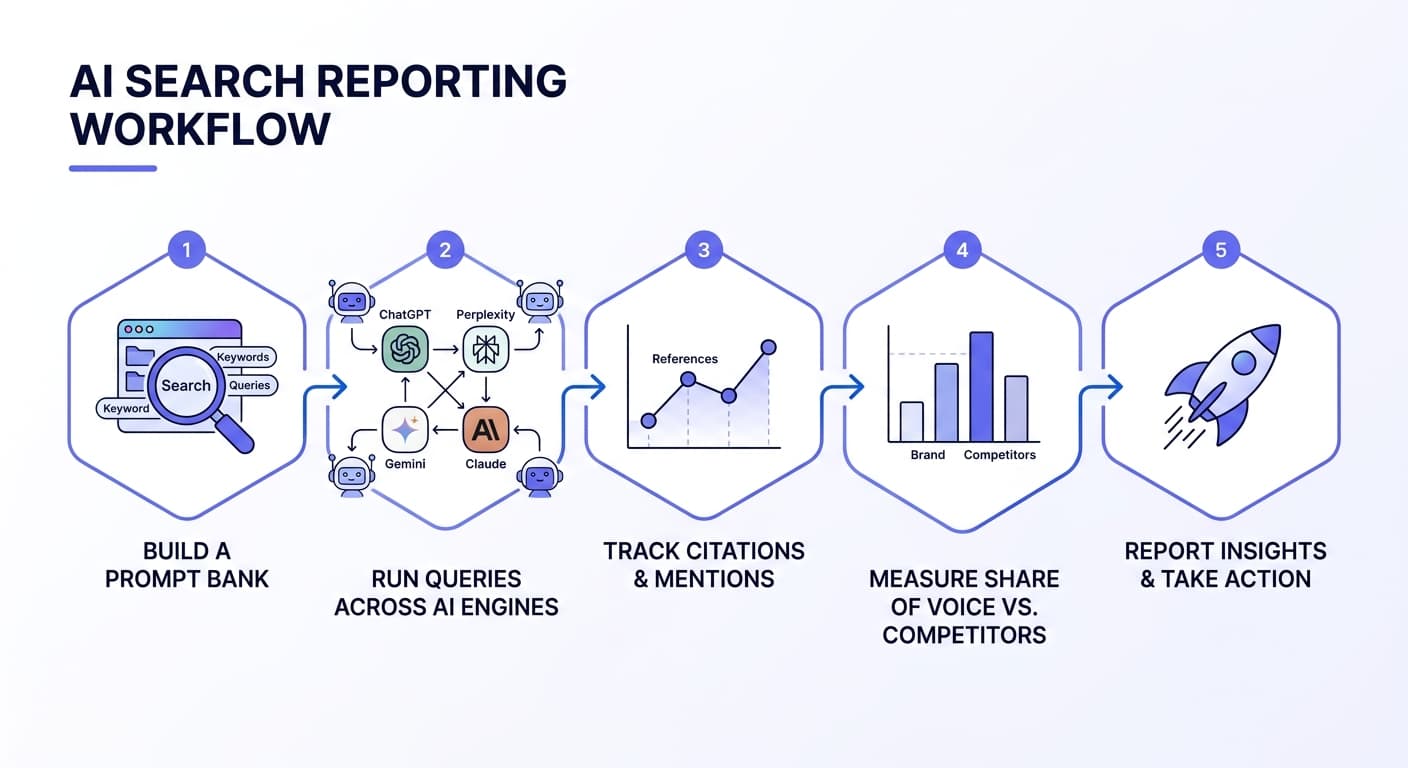
Step 1: Build Your Prompt Bank
Define your prompt universe first. Pick 30 to 100 prompts that represent the questions your buyers ask AI search. Mix branded ("is [Brand] reliable?"), category ("best CRM for small business"), and comparison ("[Brand] vs Competitor") prompts.
Start with your Google Search Console top 50 queries. Add your top sales call questions — the literal words prospects use. Add competitor brand names plus your own. Add category queries like "best [product category] tool for [use case]". This gives you a 40–60 query set representing your competitive landscape in AI search.
Step 2: Run Queries Across All Major Platforms
Track across multiple AI engines. ChatGPT, Perplexity, Gemini, Claude, and Google AI Overviews all behave differently. A brand cited prominently in Perplexity may be invisible in Google AI Mode. Cross-engine measurement is not optional if you want an accurate picture of AI share of voice.
Here's how to prioritize each platform:
ChatGPT — The biggest audience by a wide margin — this is where the most buyer conversations happen, so a recommendation here is worth the most. Track it in both regular and search-enabled modes, because the answers differ.
Perplexity — The best diagnostic engine, full stop. Every answer ships with visible citations, so you can see not just whether you appear but which page earned it and who beat you. It also has the friendliest API for automation.
Google AI Overviews / AI Mode — Massive reach because they sit on top of default search behavior and are deeply integrated with traditional SEO signals.
Gemini & Claude — Growing in enterprise and professional contexts; important for B2B brands.
Step 3: Log Systematically
Run each prompt 3–5 times across ChatGPT and Perplexity. Record whether your brand appears, what position it occupies in the list, what competitors are mentioned, and which sources are cited.
Unlike a search result page ranking, there is no fixed position to hold in AI search — if you run the same buying prompt twice in the same hour you can get different brands, different citations, different framing. API-served models reproduce their own outputs in only 22.1% of tests, so it's most important to track frequency, not rank.
Step 4: Analyze Gaps and Competitor Performance
Use your data for content gap analysis. Filter your prompt universe to prompts where competitors win and you do not. Read the AI's answer text. Patterns leap out: maybe the AI prefers comparison-style content, maybe it cites a source type you do not produce. Each gap is a content brief.
Tools like QuickSEO's keyword gap analyzer can help identify the topics your competitors are covering that you're not — a critical input for AI citation strategy.
Step 5: Build a Reporting Cadence
None of these KPIs are useful if they live in a separate, rarely-opened dashboard. The practical approach is to fold AI visibility metrics into the same reporting cycle as your existing SEO and PPC reporting, reviewed at the same frequency, against the same commercial goals. A sensible structure: track citation frequency, share of voice, and query coverage monthly, since AI answer composition shifts faster than traditional rankings.
What a Board-Ready AI Search Report Looks Like
CMOs report AI search performance as a single trended scorecard, with Share of Model and Citation Rate as leading indicators, and AI-Referral Traffic and Sentiment/Answer-Share as lagging quality indicators. The board needs the trend line and the competitive rank, not per-prompt detail. A board-ready dashboard has four rows and three columns: for each KPI, show current value, prior-period value, and position versus the named competitor set.
Your AI search report should include these five visualizations:
Citation rate over time (line chart) — shows whether your brand is getting more or fewer mentions in AI answers. A flat line means your content strategy isn't keeping up.
Average position per platform (radar chart) — some platforms rank sources by order of mention, so track your average position across ChatGPT, Perplexity, Gemini, and others.
Sentiment breakdown (pie chart: positive / neutral / negative) — a citation in a negative context does more harm than no citation.
Share of voice vs. top 3 competitors (bar chart) — compare how often your brand appears against direct competitors for the same high-value queries.
AI-influenced pipeline — month-over-month trend of branded search lift, direct traffic, and any AI referral traffic captured in GA4.
Common AI Search Reporting Mistakes to Avoid
Even teams that are tracking AI visibility often undermine their own reporting with these errors:
Tracking only one platform. Don't rely on a single platform. ChatGPT gets the most attention, but Perplexity and Gemini may grow faster for your industry. Monitor all relevant engines.
Treating AI visibility as separate from SEO. Don't treat AI visibility as a replacement for SEO — it complements traditional search. Keep tracking organic traffic alongside AI citations.
Chasing rank instead of frequency. Because AI answers vary by run, AI citation tracking over weeks and months reveals the real trend behind volatile snapshots. Frequency and consistency matter more than a single top position.
Ignoring the halo effect. The 2026 AI Brand Visibility Index confirmed that brand visibility is the metric that actually captures AI's commercial weight — and research tracking real user journeys proved that AI recommendations drive measurable site visits, mostly through channels that standard attribution never connects back to AI.
Reporting to leadership without business context. If you have high assisted conversions but low direct conversions, your brand influences buyers even if they don't click. Report this metric to leadership so they see the full funnel, not just last-click traffic.
Connecting AI Visibility to Content Strategy
The best AI search reporting doesn't end with a dashboard — it feeds a content engine. Every gap in your citation coverage is a content opportunity.
Search has shifted from a list of links to a layered answer environment where visibility, citation, and recommendation are distinct forms of influence. Brands winning in this environment publish content that AI engines want to cite: structured, authoritative, factual, and regularly updated.
Structure pages for direct answer extraction using clear definitions, data points, and schema markup. Use tools like QuickSEO's AI schema markup generator to make your content easier for AI crawlers to parse and cite.
Produce proprietary research and executive thought leadership to increase AI citation probability. AI engines strongly prefer original data, expert opinions, and content that is cited elsewhere on the web.
Whatever share of search AI answers end up taking, Google Search Console is still where you see the clicks Google actually sends you. QuickSEO puts Search Console for every website you run on one free dashboard. See all your sites in one place →
Final Thoughts
AI search reporting in 2026 isn't optional for any brand that cares about organic growth. A new field often referred to as "AI Visibility" or "AI Search" has emerged, where brand mentions may become as important as, or in some cases even more relevant than, traditional Google rankings.
The brands that win are the ones building reporting infrastructure today — tracking citations, measuring share of voice, monitoring sentiment, and feeding those insights back into a continuous content strategy. The ones that wait will find themselves playing catch-up in a channel where AI share of voice tells you how present your brand is in the conversations buyers are having with AI before they ever reach a sales team — and if you are not in the AI answer, you are not in the deal.
Start with a prompt bank. Build your baseline. Then turn every gap you find into content that ranks.
QuickSEO shows clicks, impressions, keywords and pages for every website you manage, compared with the period before.
- Unlimited websites on the free plan
- No credit card needed
Keep reading
Related posts
More articles on the same topics, prioritized by shared tags and keyword overlap.