How to Set Up Your AI Dashboard: The Complete 2026 Guide

 Summarize in ChatGPT
If you're still measuring your marketing performance with a dashboard that only tracks Google rankings and organic clicks, you're flying half blind in 2026.
In 2025, dashboards focused heavily on traditional organic traffic and keyword positions. In 2026, the landscape has shifted considerably — search has become far more fragmented, with a growing share of queries now receiving answers directly through Google's AI Overviews, Perplexity, ChatGPT search, and voice assistants. Users often get the information they need without ever clicking through to a website.
Traditional SEO measures clicks and rankings. AI SEO measures citation frequency and share of model, and includes the proportion of AI-generated responses in which your brand appears. The challenge? Most organizations lack reliable tools to measure this. Standard dashboards rely on modeled data or surface-level traffic signals, and do not reveal how often AI systems reference your content during synthesis.
That's exactly the gap this guide is designed to close. Below, we walk you through everything you need to know about setting up a modern AI dashboard — one that tracks your presence across both Google Search and AI chatbots like ChatGPT, Claude, and Gemini — from defining goals and choosing metrics all the way to building a sustainable reporting cadence.
Why Your Old Dashboard Is No Longer Enough
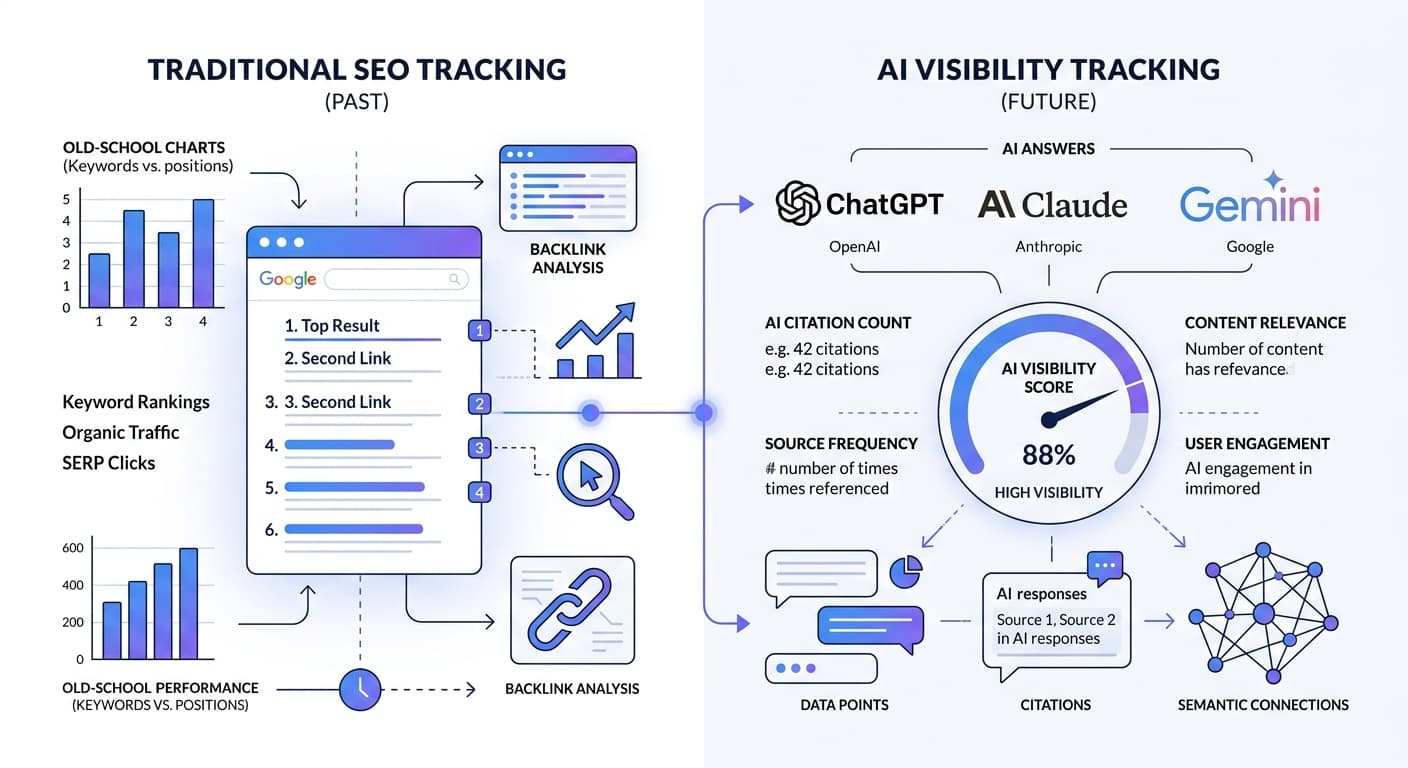
The numbers tell the story plainly. With AI Overviews now appearing in approximately 48% of all Google searches and ChatGPT reaching 883 million monthly users, the gap between what rank trackers show and what users actually see has become a strategic blind spot.
Google AI Mode has reportedly reached 75 million daily active users, and approximately 93% of those sessions end without a single click to any website. If your brand is not mentioned in the AI response itself, you may not exist for that user at all.
AI SEO metrics measure how often and how clearly your brand appears inside AI-generated answers, not just in search rankings. They track visibility in AI summaries, citations, entity recognition, and prompt coverage instead of only clicks and traffic.
AI search visibility refers to how prominently your brand appears when users ask AI models like ChatGPT, Claude, Gemini, or Perplexity for recommendations, comparisons, or information about products and services in your industry. Unlike traditional search engine visibility where you can rank on page 1 or page 10, AI visibility is binary — you either appear in the response or you don't.
This is the new reality your dashboard must reflect. The good news: setting one up from scratch is more straightforward than it sounds if you follow the right framework.
Step 1: Define Your Goals Before You Build Anything
The most common dashboard mistake is jumping straight to tools and metrics without first asking: what decisions should this dashboard help me make?
Before you dive into tools and dashboards, you need to know what success looks like for your business. SEO measurement without clear goals is just data collection — it tells you what happened, but not whether it mattered. Start by connecting your SEO efforts to specific business outcomes.
For an AI-era dashboard, your goals will typically fall into one of three buckets:
Brand discovery — Are AI chatbots recommending your brand when users ask questions in your category?
Content authority — Is your content being cited as a source in AI-generated answers?
Competitive positioning — How does your share of AI voice compare to your top competitors?
The winning teams in 2026 will measure three things continuously: Presence (whether the brand appears in relevant generated answers), Preference (whether the brand is recommended over competitors), and Proof (whether trusted sources support the recommendation).
Mapping your goals to these three pillars gives you a clear brief for which metrics to build into your dashboard.
Step 2: Connect Your Core Data Sources
Once your goals are defined, you need to wire up the data. A complete AI SEO dashboard in 2026 pulls from at least two distinct data layers:
Traditional Search Data
Google Search Console — clicks, impressions, average position, CTR by page and query
Google Analytics 4 — organic sessions, conversions, engagement rate, landing page performance
The most effective dashboards combine data from Google Analytics, Search Console, and rank tracking tools for a complete performance overview.
AI Visibility Data
This is the layer most dashboards are still missing. AI visibility monitoring software tracks how your brand shows up when someone asks ChatGPT, Claude, Perplexity, or Google Gemini a question. Traditional SEO tracking won't help you here. Google Analytics can't tell you what ChatGPT said about your company or whether Perplexity recommended you to someone comparing solutions in your category.
AI visibility tools work by running queries across multiple AI platforms, then analyzing the responses for brand mentions, citation patterns, and factual accuracy.
The key is to not treat these as two separate reporting workflows. Having Google Search data in one tab and AI visibility data in another defeats the whole purpose. You need them unified — which is exactly what QuickSEO's AI visibility dashboard is built to deliver.
Step 3: Build Your Prompt Set
The heart of any AI visibility setup is your tracked prompt set — the list of questions and queries you want to monitor across ChatGPT, Claude, Gemini, and other AI platforms. Think of these as the AI equivalent of your keyword tracking list.
Build a list of prompts that reflect how people actually ask for recommendations (e.g., "best accounting software for agencies," "how to fix X issue," "alternatives to Y"). Then check those prompts regularly across major AI platforms and log presence, position, and sentiment.
A well-structured prompt set should include:
Category prompts — broad questions like "what's the best [product category]?" where your brand could appear
Comparison prompts — "X vs Y" style queries where you're being stacked against competitors
Problem-solution prompts — questions users ask when they have a problem your product solves
Brand-specific prompts — direct queries about your brand to check for accuracy and sentiment
Your platform coverage should track the AI platforms that matter: ChatGPT, Perplexity, Gemini, Google AI Overviews, Google AI Mode, Claude, Copilot, and Grok. Citation and source tracking is essential: it should show where AI answers are pulling information from, not only whether a brand was mentioned.
QuickSEO's Tracked Prompts feature lets you set up and monitor exactly this kind of prompt set across all major AI engines simultaneously — no manual copy-paste required.
Step 4: Choose the Right Metrics to Track
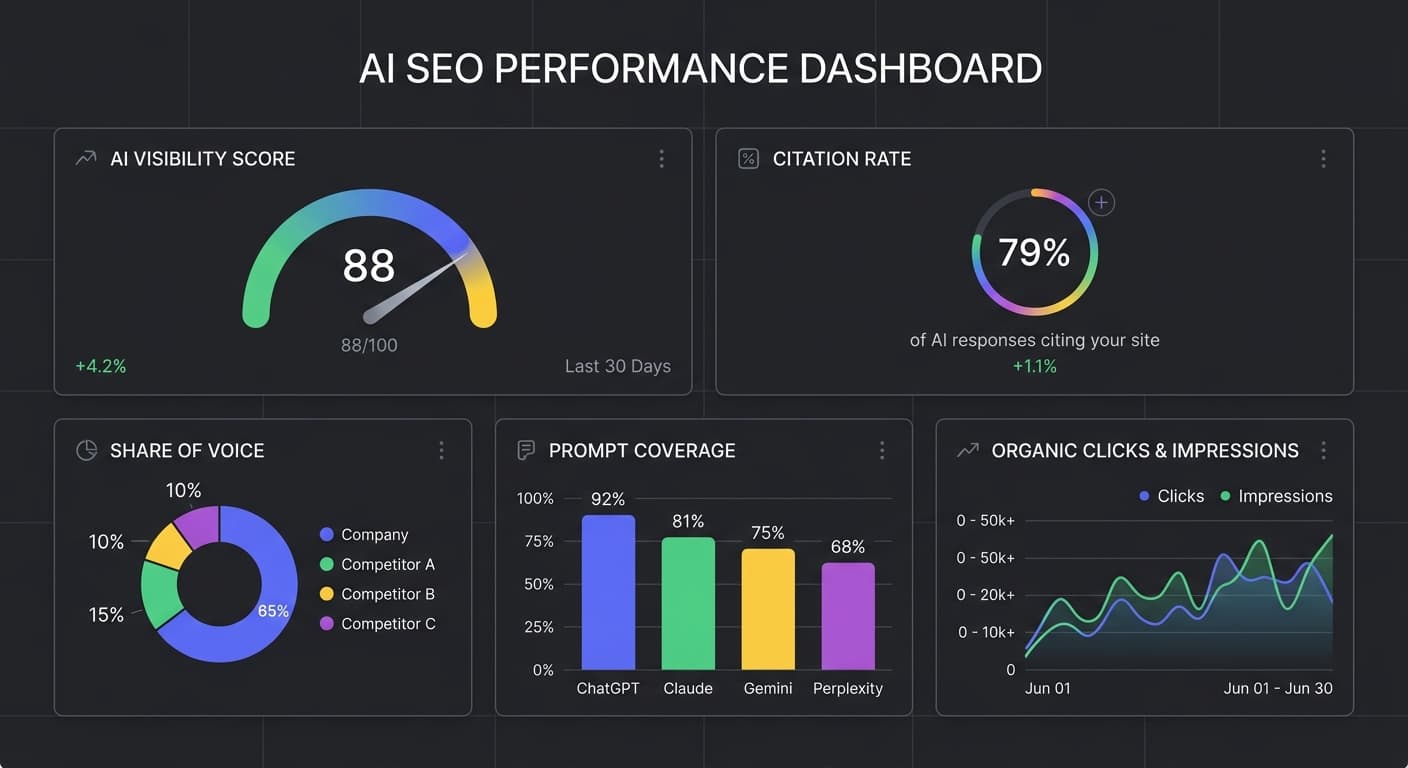
Most businesses struggle with choosing which metrics to prioritize. Tracking too many numbers makes it hard to act on any of them. Start with five to seven core metrics and expand from there.
Here's the metric framework we recommend for a complete AI SEO dashboard:
Traditional SEO Metrics
Metric | What It Tells You |
|---|---|
Organic Clicks | How much traffic Google is sending |
Impressions | How often your pages appear in SERPs |
Average Position | Your ranking trend for target keywords |
Click-Through Rate (CTR) | How compelling your titles/descriptions are |
Core Web Vitals | Technical health signals |
AI Visibility Metrics
Metric | What It Tells You |
|---|---|
AI Visibility Score | Overall presence across AI engines |
Citation Rate | How often your content is cited as a source |
Share of Voice (AI) | Your mentions vs. competitors in AI responses |
Prompt Coverage | Which tracked prompts you appear in |
Sentiment | Whether AI mentions frame your brand positively |
Structure your dashboard across funnel stages: top-funnel metrics include AI SOV and question coverage rate; mid-funnel tracks citation rates and prominence scores; bottom-funnel focuses on brand search lift and AI-assisted conversions.
You must track both traditional signals (impressions, clicks, CTR, backlinks) and AI-source growth signals (generation likelihood, provenance matches, extractive snippet presence) to understand changes in search visibility.
Step 5: Set Up Competitor Tracking
Your AI dashboard is only half complete without a view of how competitors are performing in AI search. Share of AI voice measures how often your brand appears compared to competitors when people ask questions in your category.
Discovering exactly which prompts and queries trigger mentions of your brand across AI engines — understanding user intent, identifying high-performing content topics, and spotting patterns in how AI models reference you — lets you turn prompt data into actionable optimization strategies.
More importantly, you want to know which prompts are triggering your competitors but not you. Those are your highest-priority content gaps.
These insights clarify which narratives your brand already owns and which need reinforcement.
Use QuickSEO's Competitor Tracking and Share of Voice features to automatically benchmark your AI presence against up to several competitors simultaneously.
Step 6: Configure Your Reporting Cadence
A great dashboard is only useful if you actually look at it. Check your dashboard weekly to catch sudden changes in traffic or rankings. Review it monthly to assess overall trends and quarterly to evaluate strategic performance.
Monthly is the floor for trend monitoring. Weekly is the standard cadence for competitive industries and for any team actively investing in AI SEO content. Daily is overkill outside of news or fast-moving topics — citation patterns inside AI engines don't update fast enough to justify the API spend, and you'll mistake noise for signal.
Here's a simple reporting schedule to start with:
Weekly: Scan for significant AI visibility changes, new competitor movements, and any drops in organic traffic
Monthly: Full review of AI Score trend, citation rate, Share of Voice vs. competitors, and top/bottom performing pages
Quarterly: Strategic review — are your content investments moving the needle on both Google rankings and AI citations?
Every SEO dashboard should include these foundational elements: KPI scorecards showing current values and period-over-period change for your top metrics; trend line charts for organic traffic, conversions, and keyword visibility; comparison tables for current vs. previous period; a top performers list of pages driving the most traffic; opportunity flags for pages that could improve; and issue alerts for drops that need immediate attention.
Step 7: Optimize Based on What You Find
Setting up the dashboard is just the beginning. Dashboards should drive decisions, not just display data. Every metric should connect to specific optimizations or strategic choices.
Here's how to act on the most common signals your AI dashboard will surface:
Low AI Visibility Score
Your content isn't being cited. Focus on creating more authoritative, well-structured content with clear factual statements, proper schema markup, and strong internal linking. Check your E-E-A-T signals — AI engines prioritize trustworthy, expert-backed sources.
High Impressions, Low Citations
You're being seen but not cited. This usually means your content answers the query but isn't structured in a way that's easy for AI to extract. Use clear headers, bullet points, and concise summary statements that AI can pull directly.
Competitor Outpacing You on Specific Prompts
Audit what content they have that you don't. If your content repeatedly links your brand to specific topics, your entity becomes stronger in that niche. Without entity clarity, AI may summarize your ideas but not mention your brand. Strong semantic structure increases the chance of being cited, not just summarized.
AI Mentions with Negative Sentiment
Address factual inaccuracies on your own site, update your structured data, and amplify positive third-party coverage (reviews, press mentions, industry citations) that AI engines can pull from.
The QuickSEO Dashboard Setup Checklist
Here's a practical checklist to get your AI dashboard live and running:
Connect Google Search Console to your dashboard
Connect Google Analytics 4
Define your top 20–50 tracked prompts across categories, comparisons, and problem-solution queries
Add your top 3–5 competitors for Share of Voice tracking
Set your AI Visibility Score baseline
Configure weekly email alerts for significant changes
Set up monthly report cadence for stakeholder review
Run your first AI Visibility Audit to identify quick wins
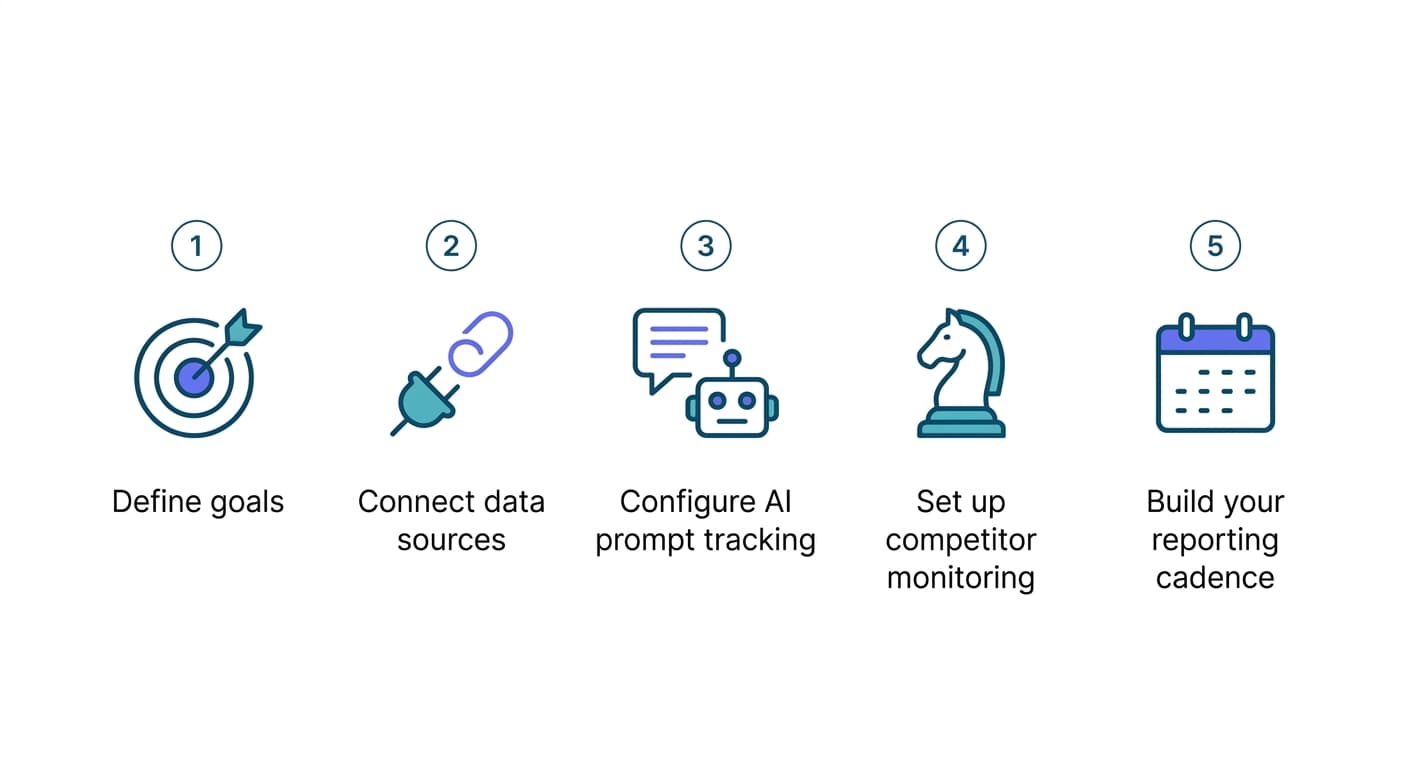
QuickSEO Dashboard: Google Search + AI Visibility in One Place
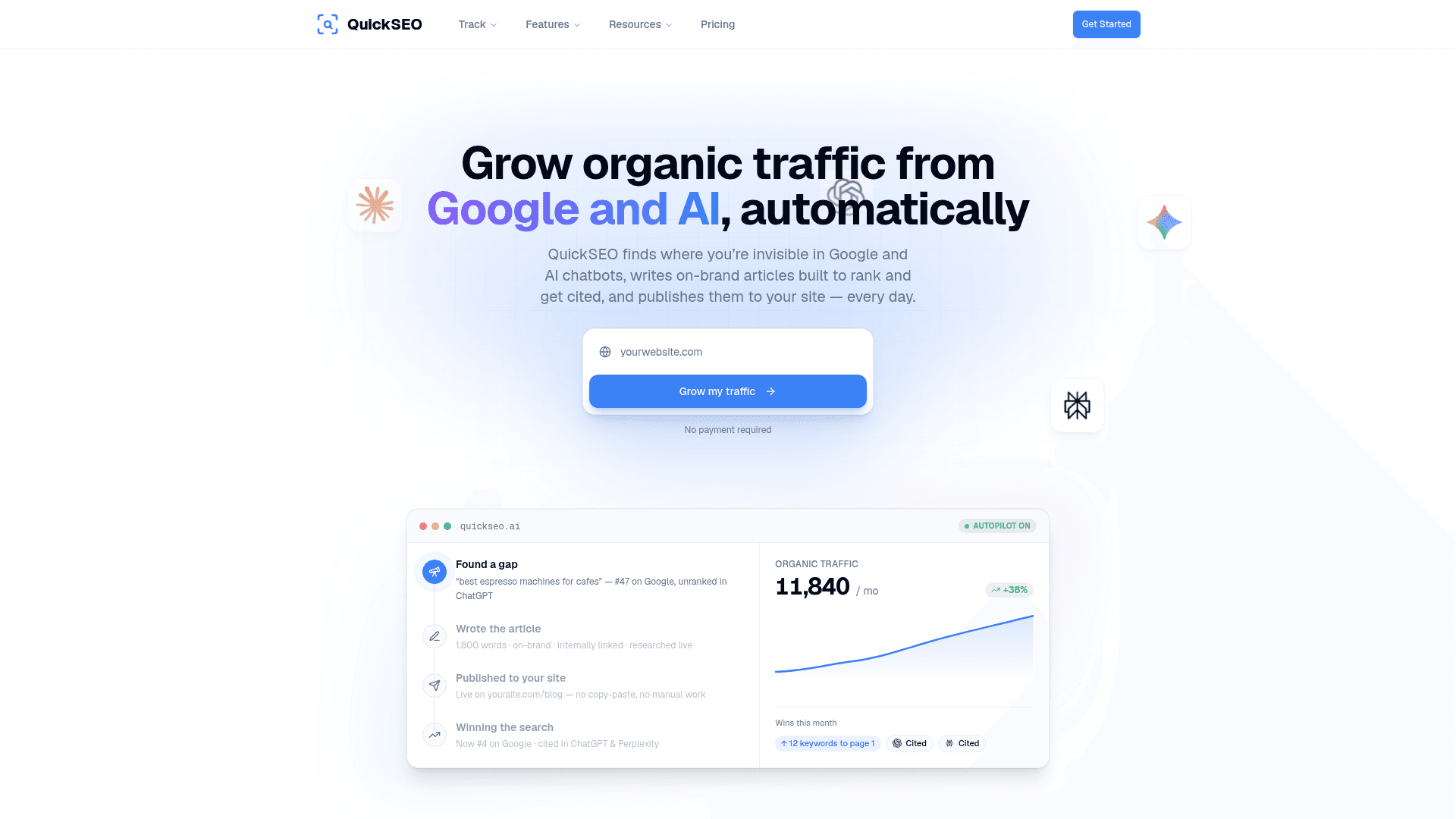
The QuickSEO platform is built for exactly this use case: tracking your performance across Google Search and AI chatbots without juggling multiple tools.
In a single dashboard, you get:
Search Analytics — Clicks, Impressions, and CTR pulled directly from Google Search Console
AI Visibility Scores — Real-time scores tracking how often your brand appears in ChatGPT, Claude, and Gemini responses
Tracked Prompts — Per-platform breakdown of which AI engines are citing you and at what position
Competitor Tracking — Side-by-side Share of Voice comparisons vs. your competitors
Cited Pages — Exactly which pages are earning AI citations and for which prompts
This is the setup that gives marketers a single source of truth — no more switching between Google Search Console, a rank tracker, a separate AI monitoring tool, and a spreadsheet.
Ready to Track Your AI + SEO Performance in One Dashboard?
Join thousands of marketers already using QuickSEO to track their brand's visibility across Google Search AND AI chatbots like ChatGPT, Claude, and Gemini — all in one place. Monitor your AI Score, track prompts, benchmark competitors, and stop guessing. Get started for free at quickseo.ai →
Conclusion
The shift from traditional SEO dashboards to AI-era dashboards isn't optional in 2026 — it's a strategic necessity. Search is undergoing a structural transformation. With the rise of AI overviews, generative search engines, and large language models, discovery is no longer driven primarily by ranked links, but rather by synthesized answers. By 2026, visibility will depend less on page position and more on whether a brand is cited within AI-generated responses.
The good news is that setting up a robust AI dashboard doesn't require rebuilding your entire analytics stack. It requires adding the right layer on top of what you already have: prompt tracking, AI visibility scores, citation monitoring, and Share of Voice data — all connected to your existing Google Search data in a single view.
Start with the seven steps in this guide, use the checklist to get your first setup live, and revisit your AI visibility strategy every time your metrics signal a new gap. The brands winning in AI search are not necessarily the biggest ones — they're the ones who can see the full picture fastest and act on it.
For more on how AI visibility works and how to improve your citations across platforms, check out our guides on how ChatGPT cites sources and getting your brand cited by Gemini.
Enter your website to track its AI visibility across ChatGPT, Gemini, Claude, and Perplexity — and turn chatbot mentions into traffic.
- Set up in minutes
- Cancel anytime
Keep reading
Related posts
More articles on the same topics, prioritized by shared tags and keyword overlap.