Do Backlinks Still Matter for AI Search? The 2026 Mechanism Breakdown

 Summarize in ChatGPT
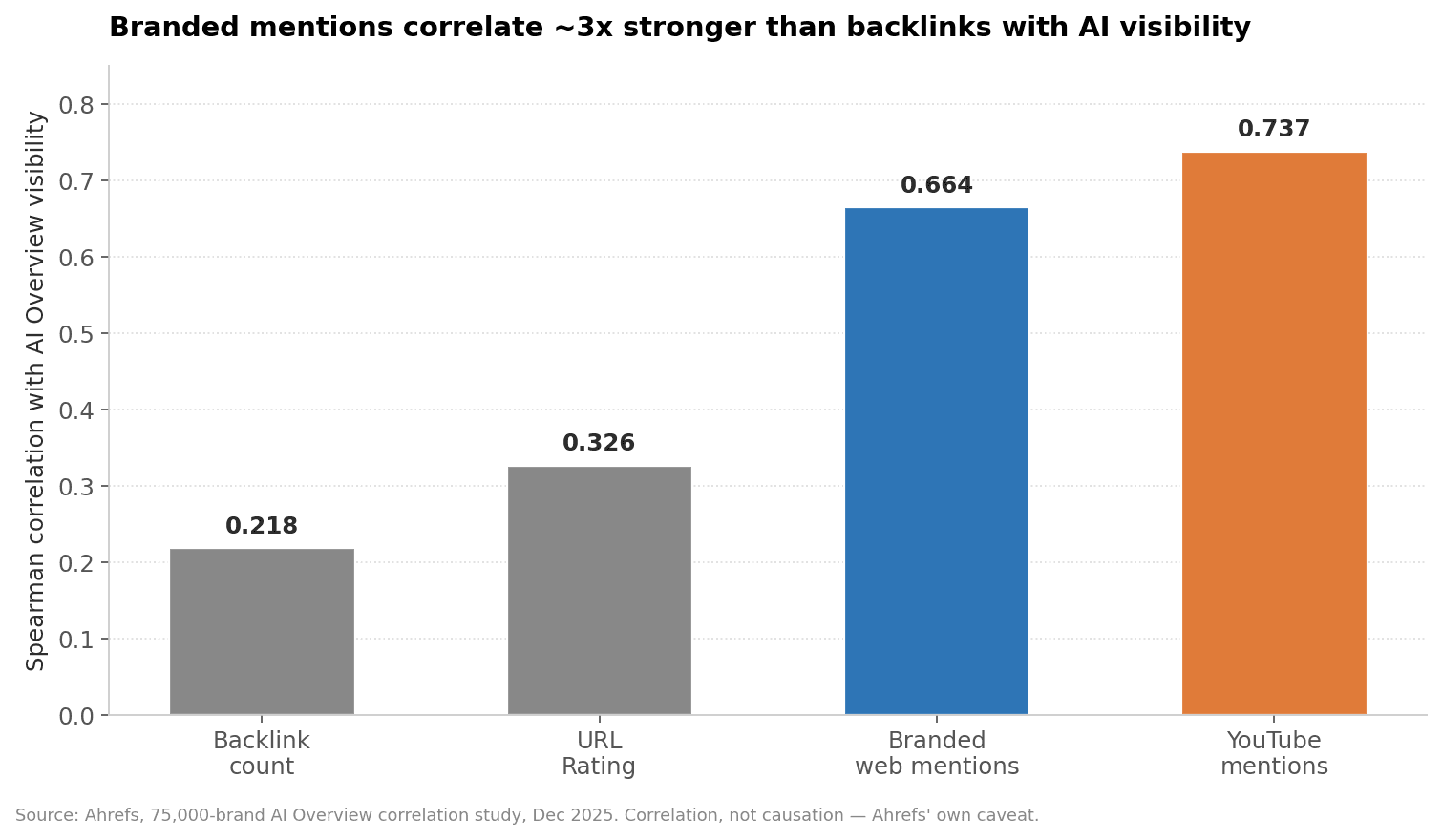
Ahrefs spent late 2025 correlating link and mention data for 75,000 brands against how often each one shows up in Google AI Overviews. The number that came out the other end: branded web mentions correlate with AI Overview visibility at 0.664. Backlink count correlates at 0.218. Mentions — plain-text references to a brand, no <a href> required — beat the classic ranking signal by roughly 3x.
That number has been making the rounds, and it's easy to read it as "backlinks are dead." That's the wrong takeaway, and it flattens a more useful question: not whether backlinks matter, but why the same signal now does two different jobs, one shrinking, one nearly absent. Google's own spokespeople have been saying links matter less since 2022. Two consecutive Google spam updates in 2026 explicitly skipped link spam as a target. And no AI lab — OpenAI, Google, Anthropic — names backlinks as something their answer engines weigh when deciding what to cite. Untangling why requires looking at the actual mechanism each surface uses to decide what to show, not just the correlation coefficients.
How Google Search and AI Answer Engines Actually Decide What to Show
There are two genuinely different mechanisms at work here, and most "backlinks vs. AI search" takes collapse them into one.
Real-time retrieval (RAG). ChatGPT search, Perplexity, Google AI Overviews and AI Mode, and Microsoft Copilot all run a live web search before generating an answer, then ground the response in what that search returns. Because it's a live search, the system inherits whatever ranking signals its underlying index already uses — and for most of these systems, that index is a search engine where backlinks have always mattered to some degree. ChatGPT search runs against Bing's index and API; Copilot runs on Bing directly; Google AI Overviews and AI Mode draw from "the same ranking systems" as core Google Search, per Google's own Search Central documentation, which requires a page be indexed and snippet-eligible in normal Search before it can appear in an AI answer at all. Claude's web-search tool leans on Brave Search as a backend. Perplexity has migrated toward its own crawler and index over time, re-ranking with its own relevance model before generating a response. We've broken down how ChatGPT specifically picks sources across its four retrieval paths if you want the mechanics in more depth.
Parametric, training-time recognition. Separately, what a model already "knows" about a brand — without doing a live search at all — comes from how often and how favorably that brand was discussed across its training data. This is a mention/co-occurrence signal: the model learned that your brand name tends to appear near certain topics, in certain sentiment, in certain company. It has nothing to do with the hyperlink graph. A brand can be mentioned constantly across forums, review sites, podcasts and press without ever earning a single backlink, and still build strong parametric recognition.
Here's the tell: none of the labs running these systems name backlinks as a ranking input for either mechanism. OpenAI's documentation describes ChatGPT search ranking via "reliability, relevance" with no mention of link count. Anthropic describes Claude's source selection via relevance, extractability, and domain-authority preference — not links. The one partial exception is Microsoft, whose own Bing team wrote in October 2025 that "crawlability, metadata, internal linking, and backlinks remain essential for ensuring your content is discoverable" — but immediately frames that as "just the starting point," with actual inclusion in AI answers driven by content structure and extractability, not link count.
AI surface | Underlying retrieval | Does the operator name backlinks as a citation signal? |
|---|---|---|
ChatGPT search / Copilot | Bing index + API | No — Microsoft names backlinks only as baseline discoverability, not a ranking lever |
Google AI Overviews / AI Mode | Google's own ranking systems | No — Google's public AI-features docs specify indexing/snippet eligibility, not link signals |
Perplexity | Own crawler + index, custom re-ranking | No public statement naming backlinks |
Claude (web search tool) | Brave Search backend | No — Anthropic cites relevance, extractability, domain authority |
What the Data Says: Backlinks vs. Google Rankings in 2026
For classic organic rankings, the honest answer is: still real, still declining, still worth doing carefully. Ahrefs' own tracked correlation between Domain Rating and organic position has fallen from roughly 0.27 in 2019 to 0.22–0.24 in 2024–2025 — a real signal, visibly weaker than it used to be.
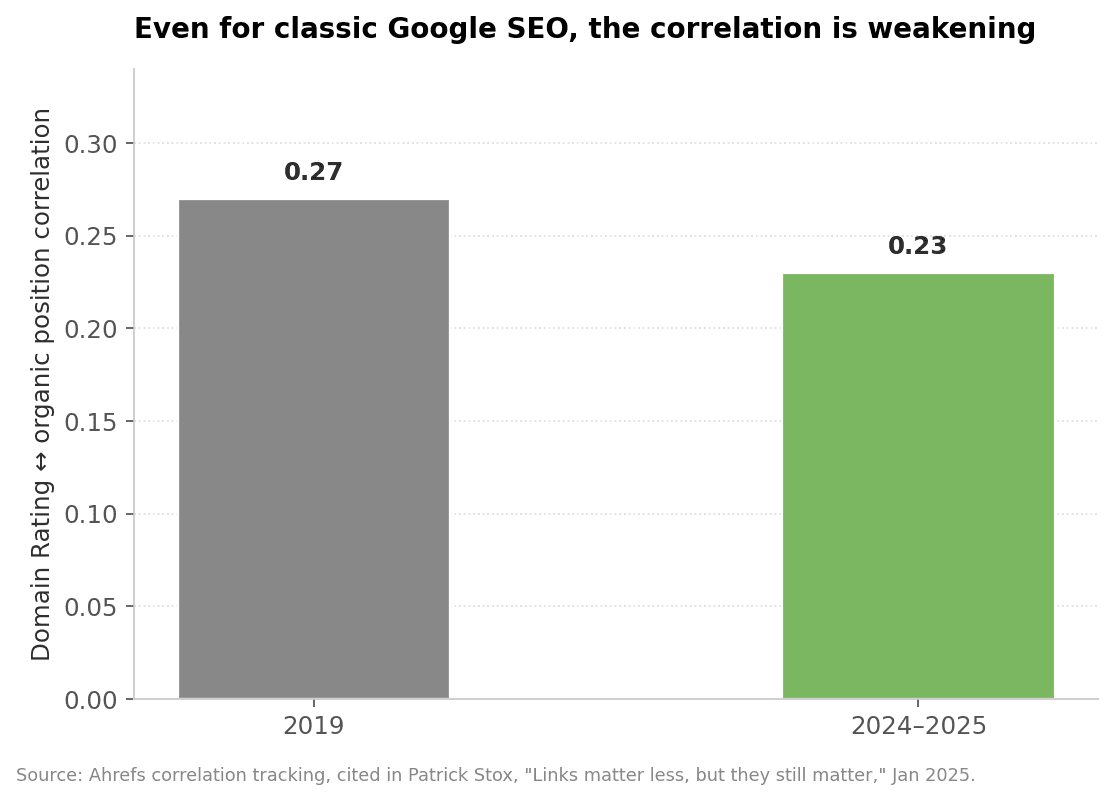
Google's own people have been telegraphing this decline since before the AI-search era even started. Gary Illyes told a PubCon audience in 2023 that links aren't "in the top three" ranking factors, illustrating the point with a page that ranked #1 for "Porsche" with zero internal or external links. John Mueller predicted back in 2022 that "over time, the weight on the links at some point will drop off a little bit as we can figure out a little bit better how the content fits in." Neither has walked that back. Google's Danny Sullivan summarized the current era in one line at a 2025 keynote: "Good SEO is good GEO, or AEO, AIO, LLM SEO, or LMNOPO" — deliberately refusing to give links special new-era treatment, folding them into generic content-quality advice instead.
None of this means links stopped mattering causally. Ahrefs' Patrick Stox ran a live experiment — disavowing all links to a set of test pages for a month — and found rankings dropped when the links were removed. His conclusion, worth taking at face value: "I still believe that links should be a part of your SEO strategy, but they shouldn't be your whole strategy." The 2024 Content Warehouse API leak complicated the "links don't matter" reading further, exposing internal Google features resembling a site-authority score, which contradicted years of public denials that anything like domain authority existed inside Google's ranking systems. Google downplays links publicly and appears to still weight link quality internally — both things the record supports simultaneously.
What the Data Says: Backlinks vs. AI Citation in 2026
For AI citation, the picture is different in degree, not just direction. Ahrefs' December 2025 study — 75,000 brands, filtered to Domain Rating above 40 and meaningful keyword volume, correlated via Spearman's rank — found branded web mentions at 0.664 and YouTube mentions at 0.737, against backlink count at 0.218 and URL Rating at 0.326. The study's own authors are careful to flag these as "moderate to very weak" correlations and explicitly warn against reading causation into them: brands that earn more mentions also tend to have more of everything else — better product, bigger PR budget, more search demand. But even accounting for that caveat, the gap between mentions and links is wide enough, and the sample large enough, that it's the strongest single piece of evidence available on this question right now.
It isn't the only piece. Muck Rack's "What Is AI Reading?" study, now in its third edition as of May 2026, analyzed more than 25 million links cited across ChatGPT, Gemini, and Claude and found earned media accounts for 82–89% of citations — a share that has held steady across three editions since mid-2025, not a one-off snapshot. Paid or advertorial content accounted for just 0.3% of citations in the same dataset. That consistency over three separate measurements is what makes this the second load-bearing data point in this piece: one correlational study could be a fluke of its sample; three consecutive editions of a longitudinal citation audit landing on roughly the same number is a pattern.
The academic literature got here earlier and from a different angle. The original GEO — Generative Engine Optimization — paper (Aggarwal et al., published at ACM SIGKDD 2024, first posted to arXiv in November 2023) built a 10,000-query benchmark and tested nine content-level optimization levers against a live-validated pipeline, cross-checked against real answers from Perplexity.ai. None of the levers that actually moved visibility involved backlinks: adding quotations lifted visibility 41%, adding statistics 31%, citing sources in-text 28–30%, fluency and readability optimization 15–30%. Keyword stuffing did nothing or actively hurt. The paper's framing is the theoretical backbone for everything above it: generative engines condition on page content, not the link graph pointing at that content — which is also why backlink-heavy incumbents don't automatically dominate AI citation the way they dominate classic search rankings.
A May 2026 meta-analysis from Zyppy, synthesizing 54 separate experiments, patents, and case studies across ChatGPT, Gemini, and Perplexity and scoring 23 distinct factors, puts backlinks near the bottom of that list — characterized not as a driver of citation likelihood but as a "threshold condition," something a site needs to clear a baseline trust bar, after which additional backlinks stop buying additional citations.
Signal | Correlation with AI Overview visibility (Spearman) |
|---|---|
YouTube mentions | 0.737 |
Branded web mentions | 0.664 |
URL Rating | 0.326 |
Backlink count | 0.218 |
Source: Ahrefs, 75,000-brand study, December 2025. Correlation, not causation.
What Changed Specifically in 2026
Most of what's above is a trend that's been building since 2023. A few things are genuinely new to this year and worth flagging on their own, because they change what "optimizing for links" actually buys you going forward.
Google ran spam updates in March and June 2026, and both explicitly excluded link spam from their target list. That's not Google deprioritizing link manipulation — it's Google moving link-scheme detection into a continuous, real-time SpamBrain process rather than a periodic sweep, meaning manipulative link patterns now get devalued within minutes of detection rather than waiting months for the next update to catch them. The cost of trying anyway has gone up to match: average cost per quality link is now roughly $509, with 47% of buyers paying $500 or more per link in the first quarter of 2026 alone. Buying links hasn't disappeared — it's priced and risked like a liability now, not a shortcut.
On the AI-search side, Google expanded its "Preferred Sources" feature into AI Mode globally on May 27, 2026 — letting users pin favorite sites, which then carry a visible badge inside AI answers and reportedly earn roughly double the click-through rate. The number of pinned sources grew from around 90,000 at its December 2025 launch to more than 345,000 by late May — a user-curated citation signal that has nothing to do with the link graph at all, competing directly for the same citation real estate that used to be won by domain authority. The same rollout added "Highly Cited" labels and a "Perspectives" carousel surfacing forum and discussion content, both new discovery surfaces layered on top of, not derived from, classic backlink authority.
One more data point worth flagging, if only because it's a little self-serving: Google's own citation share inside AI Mode jumped 8.4x between mid-April and the end of June 2026, driven almost entirely by the system citing its own Business Profiles and Product Knowledge Panels. Increasingly, Google's AI answers point back at Google — a dynamic no amount of backlink building on your own site changes.
Where the Experts Actually Disagree
Nobody credible in this space calls backlinks worthless, and nobody disputes that backlinks predict AI citation more weakly than they predict classic rankings. Where real, sourced disagreement shows up is over urgency — how much of the next marginal hour of SEO work should still go toward link building for classic Google rankings.
Ahrefs' own Patrick Stox, backed by his disavow experiment showing rankings drop when links are removed, argues links should stay part of the strategy, just not the whole strategy. Rand Fishkin, formerly of Moz and now running SparkToro, takes the sharper position: "Links are just not where it's at; AI tools don't really give two craps about them either," later summarized even more bluntly on a 2026 clip: "Mentions matter more than backlinks. If you're still link building, I have great news, you can stop." Backlinko itself — the brand most associated with classic link-building content for a decade — has quietly repositioned its own advice around multi-channel brand building and getting cited in LLMs rather than link acquisition as the centerpiece.
Google's own spokespeople split the difference but lean rhetorically toward Fishkin's side: Illyes says links aren't top-three, Mueller says the weight keeps dropping, while Google Search continues to crawl and index via links as infrastructure regardless of what gets emphasized publicly. Ahrefs embodies the tension inside one company — a January 2025 post from its own analyst defends link building as part of a classic-SEO strategy, while its December 2025 study shows links barely correlating with AI visibility at all. Both are true. They're answering different questions.
What This Means for Where You Actually Spend Effort
The mechanism split has a direct, practical consequence: link-building effort and AI-mention effort are now two different line items, and treating them as one metric hides which one is actually working. If the goal is classic Google rankings, Stox's experiment is the closest thing to causal evidence in this whole space — quality backlinks, earned deliberately rather than bought, still move the needle, just less than they did five years ago. If the goal is AI citation specifically, the evidence points somewhere else: earned media, original data, digital PR, and the kind of coverage that produces a plain-text mention whether or not it links back. We've laid out the full 2026 numbers on link-building cost, outreach response rates, and penalty risk separately if that's the piece you need next — this one is about why the two efforts diverge, not a replacement for the tactics.
The practical failure mode is treating "SEO" as one number when it's now genuinely two, tracked by two different mechanisms, moved by two different kinds of work. A site can have a strong backlink profile and weak AI visibility, or the reverse, and neither dashboard will tell you that on its own if it only tracks one side. QuickSEO tracks both — Google Search performance and AI visibility across ChatGPT, Gemini, Claude, and Perplexity — in one dashboard specifically so a change in one doesn't quietly go unnoticed by only watching the other. See how it looks on your own site.
Enter your website to track its AI visibility across ChatGPT, Gemini, Claude, and Perplexity — and turn chatbot mentions into traffic.
- Set up in minutes
- Cancel anytime
Try it yourself
Related free tools
Free SEO tools related to the topics covered in this article.
Keep reading
Related posts
More articles on the same topics, prioritized by shared tags and keyword overlap.