GEO Statistics 2026: 60+ Data Points Inside the $7.3B Generative Engine Optimization Market

 Summarize in ChatGPT
Generative engine optimization went from a phrase nobody used in 2023 to a $7.3 billion forecasted market by 2031, with 98% of enterprise CMOs actively investing in it and 94% planning to spend more next year. Three years. A new discipline, a new vendor category, a new line item on the marketing budget. And yet only about 14% of marketers actually track whether they're being cited by ChatGPT, Claude, Gemini, or Perplexity.
That gap — between investment and measurement — is the story of GEO in 2026. Below is the data, grouped into the seven shifts every marketer should be quoting this year. Sixty-plus stats, with sources linked inline so you can reuse them.
1. A new $7.3B market, built in three years
Valuates Reports / QYResearch publishes what has become the canonical GEO market forecast: $886M in 2024 growing to $7.318B by 2031 at a 34% CAGR (Valuates / PR Newswire release). Other firms model the opportunity with wider or narrower scopes — Market Intelo projects $33.7B by 2034 at 50.5% CAGR, Maximus Labs models a $110B total AI search opportunity by 2032, and the more conservative Mobility Foresights forecast lands at $4.1B by 2031 (Maximus Labs GEO market analysis).
Forecast source | Base year | Target year | CAGR |
|---|---|---|---|
Valuates / QYResearch (canonical) | 2024 — $886M | 2031 — $7.318B | 34.0% |
Market Intelo (wider scope) | 2025 — $848M | 2034 — $33.7B | 50.5% |
Mobility Foresights (conservative) | 2024 — $720M | 2031 — $4.1B | 27.5% |
Maximus Labs (full AI search opp.) | 2024 | 2032 — $110B | ~50%+ |
Four GEO market forecasts compared. The Valuates / QYResearch baseline is the one most other publications cite; higher numbers fold in AI search platforms and infrastructure on top of optimization services.
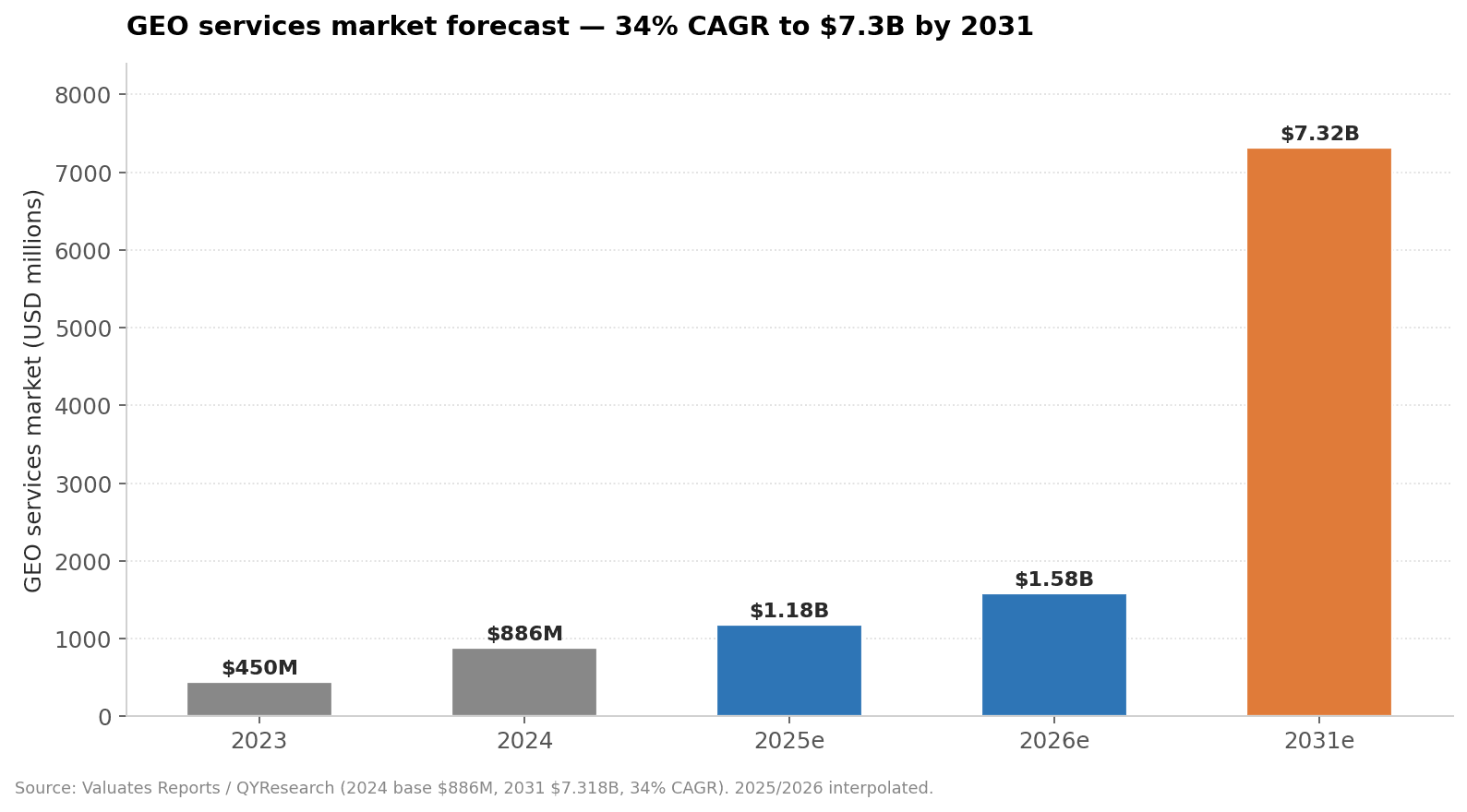
GEO services market forecast — 34% CAGR from $886M (2024) to $7.318B (2031). Source: Valuates Reports / QYResearch.
The segment mix already looks like a real industry: platforms account for 62.7% of spend, services 37.3%; large enterprises 55.2% of buyers, SMBs 44.8%. North America holds 44.8% market share, Europe 28–30%, APAC 18–22% and growing at 25% CAGR. The biggest spending verticals are marketing/advertising (34.7%), B2B SaaS (15–20%), and tech/AI vendors (12–15%) (Maximus Labs synthesis).
Sitting behind all of this is the broader AI funding wave. In Q1 2026, AI captured $242B — 80% of global venture capital (Crunchbase News Q1 2026 venture data). February 2026 was the largest funding month in history at $189B globally (OpenAI $110B, Anthropic $30B, Waymo $16B). On the AI-search pure-play side, Perplexity has raised $1.5B at a $20B valuation and is running at roughly $200M ARR; OpenAI is targeting a $1T IPO in Q4 2026. The discipline of generative engine optimization sits on top of an unprecedented capital base.
If you want the conceptual primer behind these numbers, our complete 2026 guide to generative engine optimization walks through what GEO actually is, how it differs from SEO, and why the discipline emerged when it did.
2. 98% of enterprise CMOs are investing — and 94% are increasing it
Conductor's 2026 State of AEO/GEO CMO Investment Report surveyed 250+ enterprise CMOs, VPs, and senior directors at 500+ employee organizations. The headline numbers are stark:
98% of enterprise CMOs invest in AEO/GEO in 2026.
94% plan to increase AEO/GEO budget over 2025.
AEO/GEO ranked the #1 strategic marketing priority for 2026.
Enterprises allocated an average of 12% of digital marketing budgets to AEO/GEO in 2025; high-maturity orgs are pushing 15%+ in 2026.
55% of marketers now have a dedicated AEO/GEO budget line.
97% of enterprises report positive AEO impact in 2025.
51% use a fully integrated AEO platform; high-maturity orgs are 6x more likely to do so than mid-maturity peers.
LLM-sourced visitors convert at 2x the rate of other channels in 1/3 the sessions (Conductor).
Gartner's 2026 CMO Spend Survey confirms the direction: CMOs now allocate 15.3% of marketing budgets to AI — but only 30% say they're ready to actually scale AI capabilities. The willingness-to-spend curve is running well ahead of the operational readiness curve.
Lindsay Boyajian Hagan, VP Marketing at Conductor: "94% of CMOs are planning to increase investment in 2026. This speaks to a fundamental shift in how enterprise brands approach discoverability." (BusinessWire press release).
3. The audience GEO is reaching — and how fast it's growing
All of that budget is chasing an audience that's still inflating. As of early 2026, ChatGPT reports 900M weekly active users — up from 800M in October 2025 and 700M mid-year — plus 50M paying subscribers (Search Engine Land — ChatGPT 900M WAU). The Gemini app has surpassed 750M monthly active users, and Gemini-powered Google AI Overviews reach roughly 2 billion monthly users (TechCrunch — Gemini app 750M MAU).
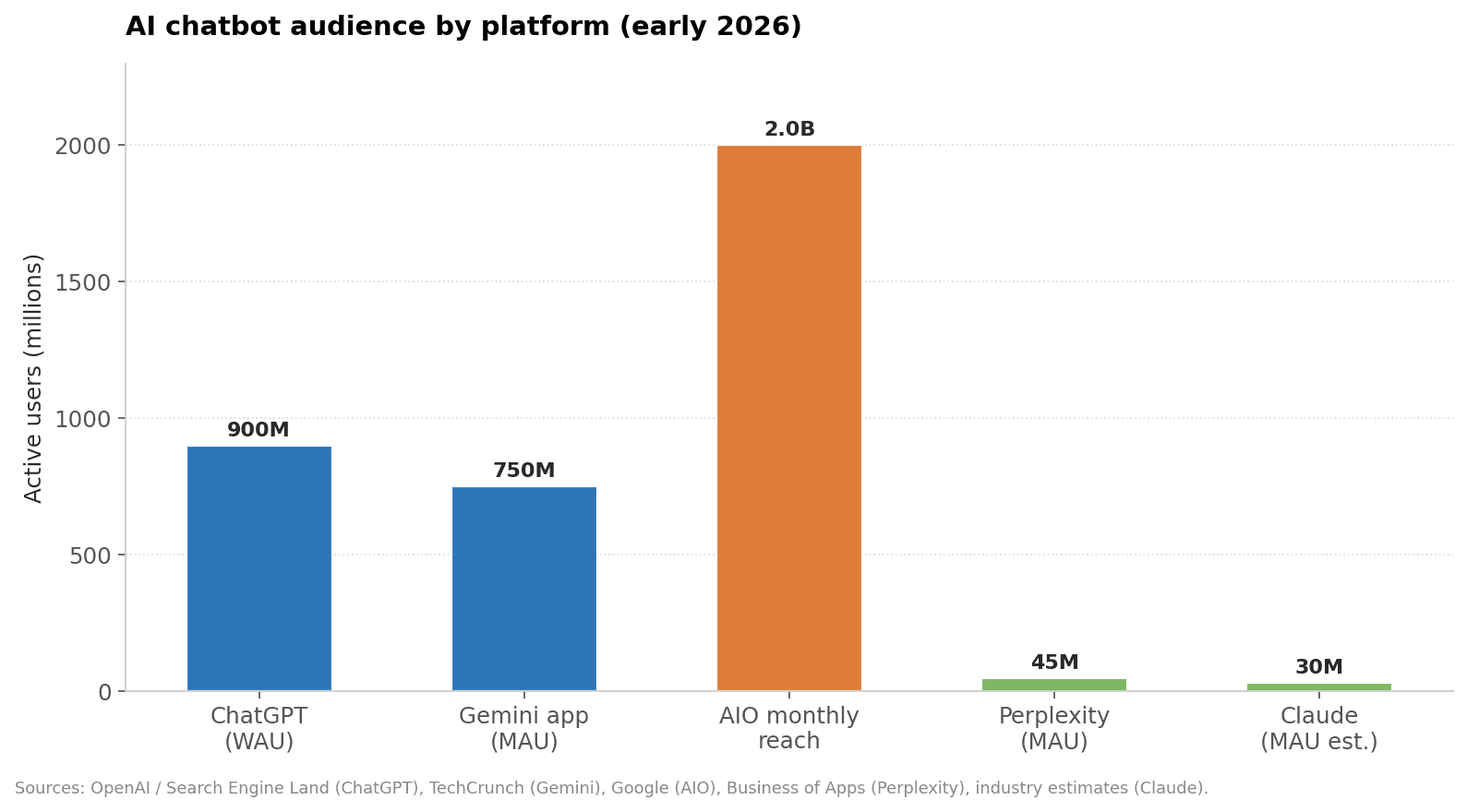
AI chatbot audience sizes (early 2026). Sources: OpenAI / Search Engine Land, TechCrunch, Google, Business of Apps.
Perplexity ended 2025 at ~45M monthly active users running roughly 780M monthly queries — more than 3x its 2024 volume (Business of Apps — Perplexity stats 2026). Google AI Overviews coverage has reached 48% of US searches (BrightEdge, Feb 2026, +58% YoY), with Advanced Web Ranking measuring 60.32% across tracked queries (Search Engine Journal — BrightEdge AIO data).
The growth rate of AI-source traffic to publisher sites is the eye-popping number. Ahrefs measured 9.7x year-over-year growth in AI traffic across 81,947 sites through June 2025, while average organic search traffic on those same sites fell 21% over the same window (Ahrefs — AI traffic has increased 9.7x).
AI platform visits grew +28.6% YoY (Jan 2025 → Jan 2026), per Similarweb.
AI referrals to the top 1,000 websites hit 1.13B in June 2025 alone — up 357% YoY (TechCrunch on Similarweb data).
Platform-level YoY referral growth (Sep–Nov 2025): Gemini +388%, ChatGPT +52%. ChatGPT still carries 87.4% of all non-Google AI referral traffic.
ChatGPT's query volume equals roughly 12% of Google's, but Google still sends 190–210x more website traffic than the top three AI platforms combined (Ahrefs — ChatGPT 12% of Google).
Zero-click search rate climbed from 56% (May 2024) to 69% (May 2025), per Similarweb.
On the demographic side, ChatGPT skews young and increasingly female: 42% of users are under 25, the 25–34 cohort is 29.67% of the base, and the female-named user share rose from 37% in January 2024 to 52% by July 2025. 92% of US undergrads reported using AI in 2025 (up from 66% in 2024); 79% of developers and 71% of marketers use ChatGPT professionally (TDMP — Who is using ChatGPT 2025). On the enterprise side, Gemini Enterprise hit 8M+ paid seats across 2,800 companies, with paid MAUs up 40% QoQ in Q1 2026.
4. 83% of AI Overview citations come from outside Google's top 10
If you're optimizing for AI visibility the same way you optimize for Google rank position, you're optimizing for the wrong universe. BrightEdge's year-one AIO analysis shows that only ~17% of AI Overview citations come from pages that also rank in Google's organic top 10 — meaning roughly 83% are pulled from outside the top 10 (BrightEdge — AIO at the one-year mark).
Study | AIO citations from non-top-10 pages | Notes |
|---|---|---|
BrightEdge | ~83% outside top 10 | Sample skews enterprise queries |
Surfer SEO | 67.82% outside top 10 | 10,000-keyword sample |
Ahrefs (updated 2025) | 62% outside top 10 | Down from 76% earlier in 2025 |
Three studies, three different numbers — but all agree the majority of AIO citations come from pages outside Google's organic top 10.
Surfer SEO's 10,000-keyword analysis puts the figure at 67.82% outside the top 10 (Surfer SEO — AIO citation sources), and Ahrefs' updated 2025 number is 62% (Ahrefs — 38% of AIO citations from top 10) — a meaningful shift from 76% earlier in 2025, suggesting Google is gradually re-anchoring AIO sources toward its organic ranking signal, but slowly.
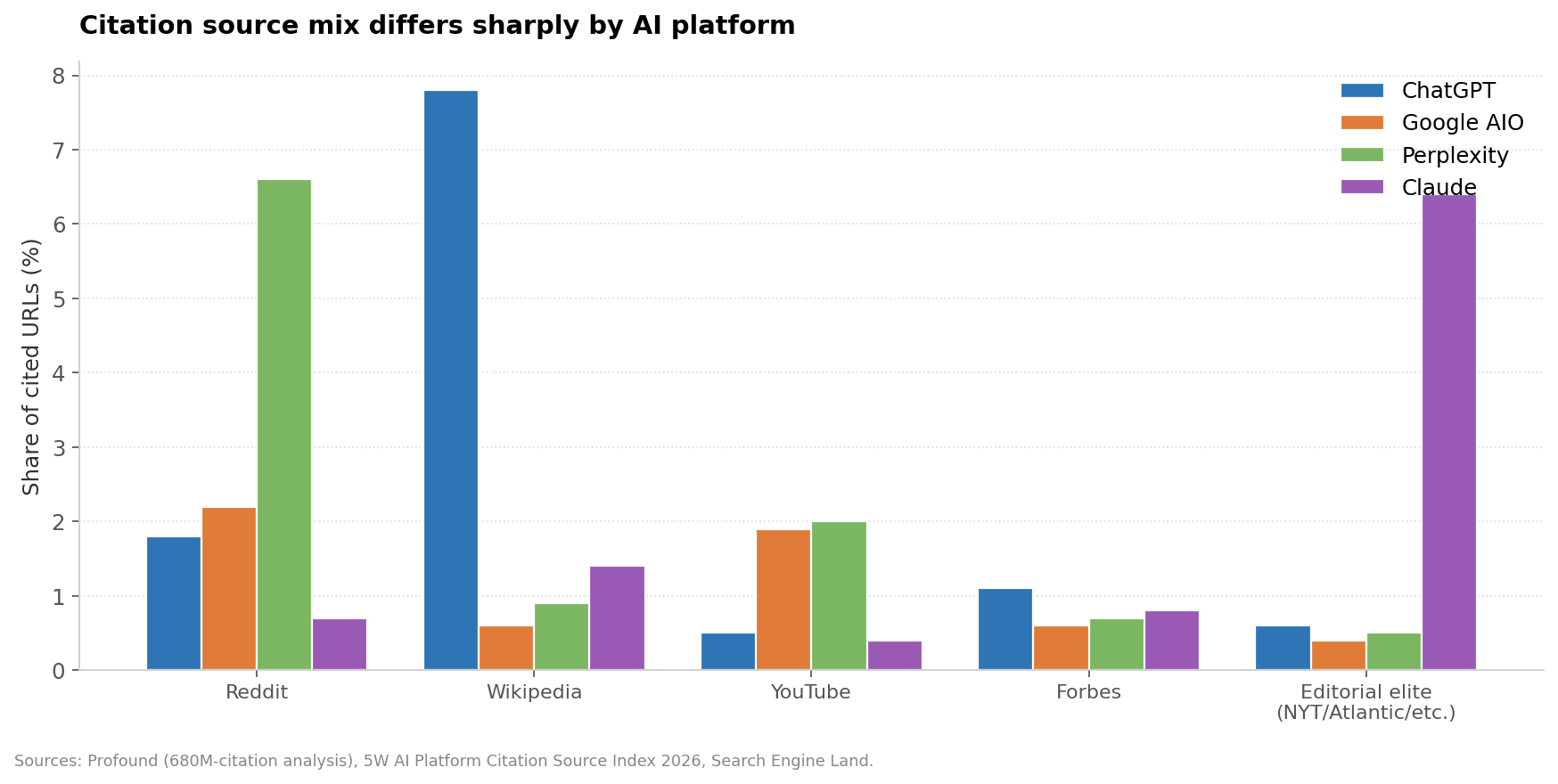
Citation source mix differs sharply by AI platform. Sources: Profound (680M citation analysis), 5W AI Platform Citation Source Index 2026.
And the source mix itself is wildly platform-specific. Profound's analysis of 680 million citations shows ChatGPT leaning on Wikipedia (7.8%), Reddit (1.8%), and Forbes (1.1%); Google AIO leans on Reddit (2.2%), YouTube (1.9%), and Wikipedia; Perplexity rewards Reddit (6.6%), YouTube, NIH/PubMed, and B2B authority sites like G2 and LinkedIn (Profound — AI platform citation patterns). Claude, meanwhile, leans editorial-elite — NYT, The Atlantic, The New Yorker, The Economist — and pulls older sources: only 36% of Claude's journalism citations come from the past 12 months, vs. 56% for ChatGPT (5W AI Platform Citation Source Index 2026).
A few other patterns worth quoting at parties:
Reddit is the #1 source across every major AI engine — roughly 40% combined share in cross-platform aggregates.
Top-15 domains capture ~68% of consolidated AI citation share, a much higher concentration than PageRank ever produced.
Only 11% of cited domains appear across multiple AI platforms — meaning the same brand needs different content strategies per engine.
Citation hallucination is rare: only 0.86% of Gemini-cited URLs return a 404 (Ahrefs).
Average AI Overview length is 254 words / 1,766 characters; the visual footprint is now >1,200 pixels tall — bigger than a standard above-the-fold viewport (BrightEdge, SE Ranking).
AIO triggers shifted from 91.30% informational queries in January 2025 to 57.13% by October — commercial AIOs went 8%→18%, transactional 2%→14%, and navigational from <1% to >10%.
If you want the engine-by-engine breakdown of platform-specific citation patterns with the source-type tables, the dedicated post pulls the per-engine playbook out of the same Profound and 5W data.
5. The Princeton GEO paper: quotes and statistics beat keywords by 4–5x
The Aggarwal et al. paper (arXiv 2311.09735, presented at KDD '24) is the closest thing GEO has to a foundational empirical reference. The authors built a black-box optimization framework, ran 10,000 queries across multiple generative engines, and tested nine content-level techniques against an unmodified baseline. The headline finding most people quote — "GEO can boost visibility up to 40%" — is the aggregate ceiling. The per-technique numbers are more useful:
Technique | Visibility lift | Category |
|---|---|---|
Quotation addition | +41% | Trust signal — winner |
Statistics addition | +33% | Trust signal |
Fluency optimization | +29% | Readability |
Cite sources | +28% | Trust signal |
Technical terms | +18% | Depth signal |
Easy-to-understand language | +14% | Readability |
Authoritative tone | +12% | Tone |
Unique words | +6% | Marginal |
Keyword stuffing | −9% | Actively hurts |
Position-Adjusted Word Count lift vs. baseline, by technique. Source: Aggarwal et al., GEO: Generative Engine Optimization (KDD '24 / arXiv 2311.09735), 10,000-query study.
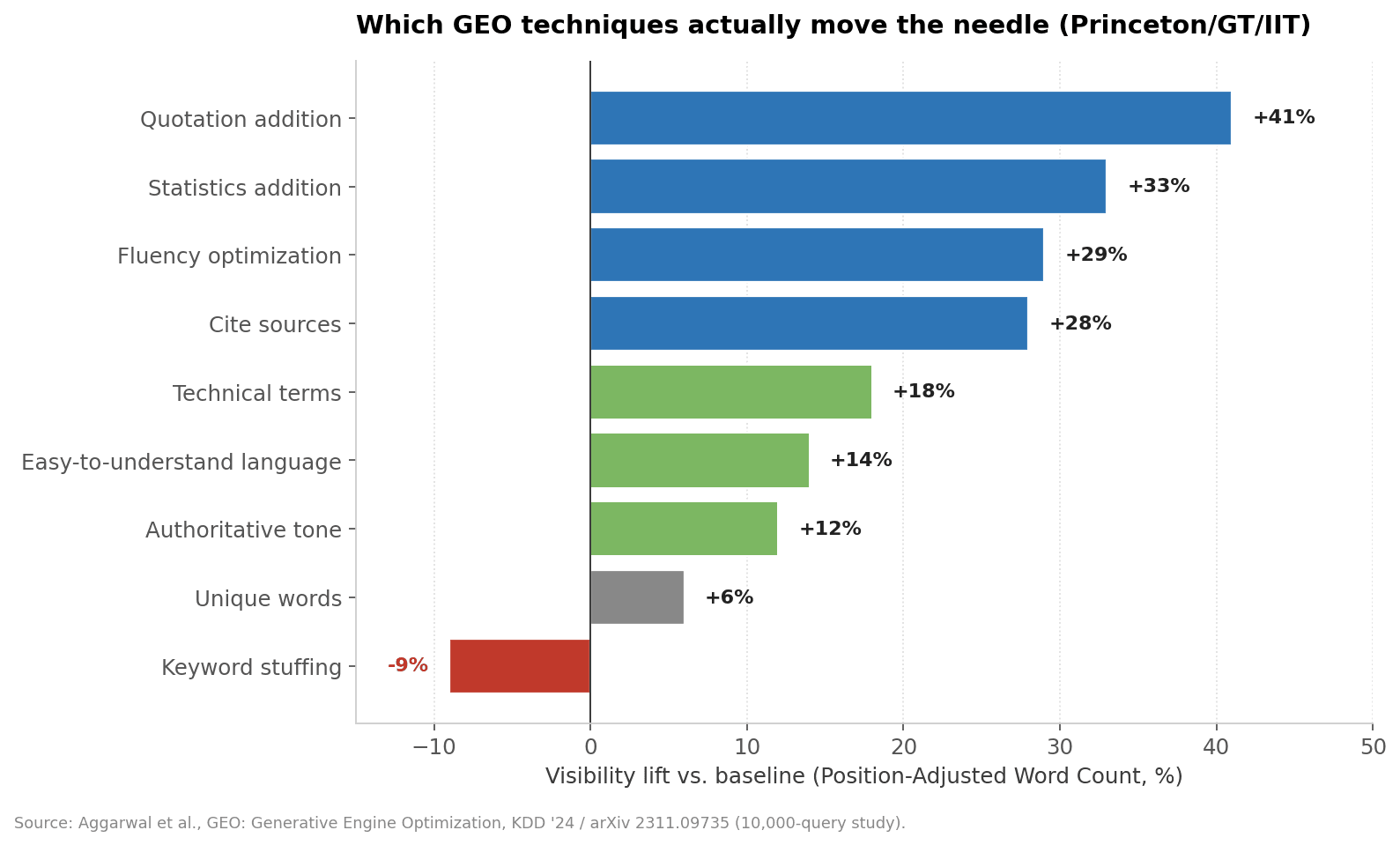
Trust signals beat traditional SEO levers. Keyword stuffing is the only technique that actively hurts AI visibility.
Three things stand out. First, trust signals dominate — quotation addition (+41%), statistics addition (+33%), and source citation (+28%) are the three biggest content levers, all of which make a passage more verifiable. Second, classic SEO levers underperform: "unique words" delivers +6%, "authoritative tone" +12%, and keyword stuffing actively hurts (−9%). Third, fluency and readability optimization (+29% / +14%) outperform technical-term density — generative engines reward content that's easy to summarize, not content that's dense with jargon.
Translated to a 2026 GEO playbook: add direct quotes from authoritative sources, embed concrete statistics with hyperlinked citations, and stop counting keyword density. The Princeton authors' framework reproduces these results across BingChat, Perplexity, and YouChat — the technique lifts generalize across engines.
6. AI visitors convert 4.4x better than organic — with one big asterisk
Semrush ran the most-cited conversion study of 2025, analyzing 500+ high-value marketing and SEO topics: the average AI search visitor was 4.4x as valuable as the average organic search visitor by conversion rate (Semrush — AI search SEO traffic study). Seer Interactive's customer case showed an even sharper gap on a single B2B SaaS account: 15.9% conversion from ChatGPT-referred traffic vs. 1.76% from Google organic, with 2.3 pages per session vs. 1.2 (Seer Interactive — how ChatGPT traffic converts).
Adobe Analytics' industry data fills in the vertical-by-vertical picture (Feb 2025):
Retail: bounce rate −23%, time on site +41%, pageviews +12%, conversion gap narrowed from −43% (Jul 2024) to −9% (Feb 2025) and flipped to +42% better than non-AI by March 2026.
Travel: revenue per visit +80%, bounce rate −45%.
Banking: app start rate +23%, time per visit +45%.
Holiday 2025 retail AI traffic grew +693% YoY.
By AI platform, the revenue-per-visit gap is wide — Claude $4.56, Perplexity $3.12, ChatGPT $2.34 — even though ChatGPT carries the lion's share of volume (MediaCopilot on Profound + TripleDart data).
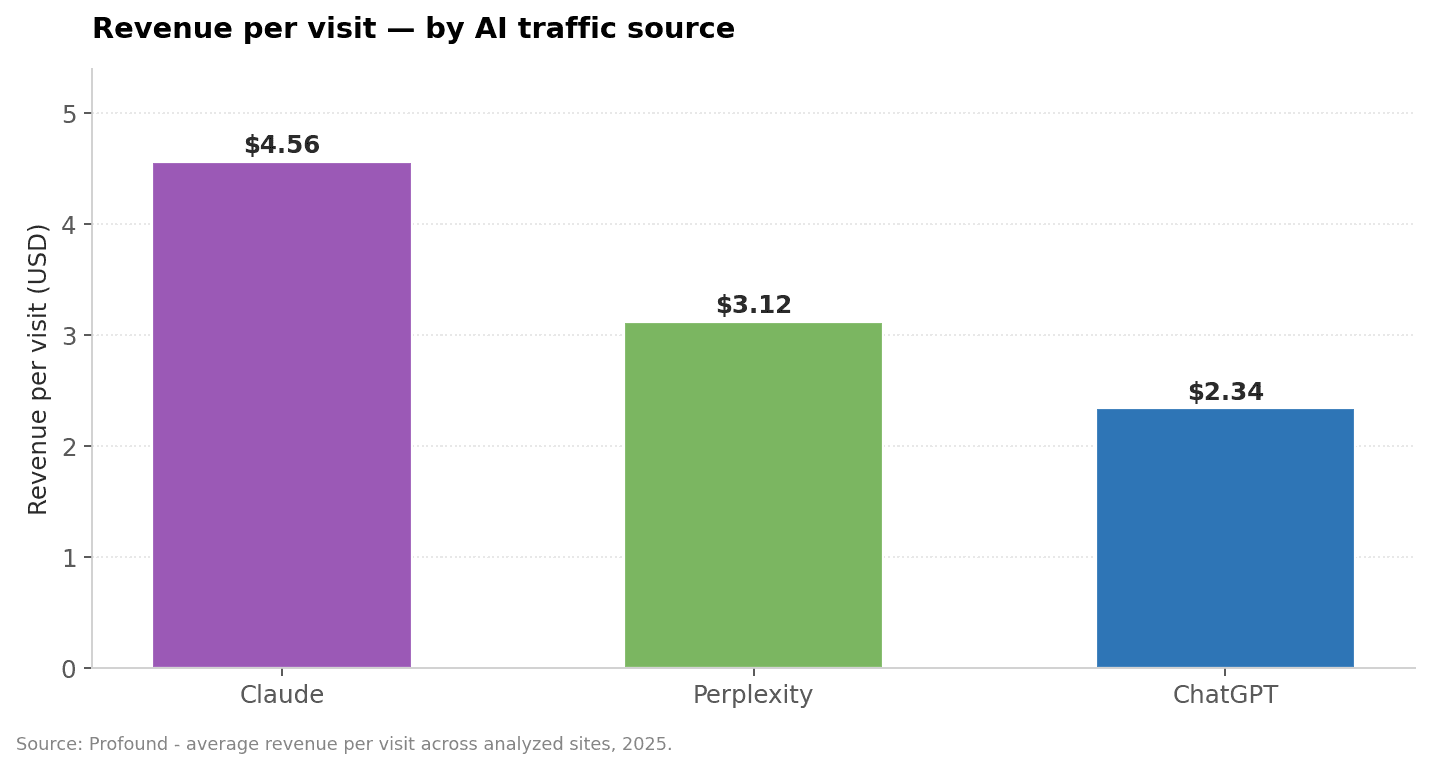
Revenue per visit by AI source. Volume is concentrated on ChatGPT but value-per-visit is highest from Claude. Source: Profound.
In B2B SaaS specifically, TripleDart's 400+ site benchmark found AI referrals converting above 50% vs. 20–30% organic — and AI-sourced customers produce +158% more referrals and have −73% cancellation rates than organic-acquired customers (TripleDart B2B benchmark).
The asterisk: AI traffic conversion benchmarks vary sharply by vertical, and not all of them flatter AI. An academic study published in Marketing Science (973 e-commerce sites, $20B in revenue) found oLLM traffic converting 13% lower than organic and 86% lower than affiliate, with AOV down $24.70 (Marketing Science — ChatGPT referrals to e-commerce). The 4.4x figure holds for informational/consideration queries and B2B SaaS; for pure transactional e-commerce, AI traffic is catching up but is not yet a clean win. The honest read: AI traffic is high-intent and deeply engaged, but conversion-rate superiority depends heavily on what business you're in.
Our deeper breakdown of AI traffic conversion benchmarks by vertical walks through the Adobe, Semrush, and Marketing Science data side-by-side.
7. AI Overviews compress the classic Google CTR curve
The flip side of AI search adoption is a tighter squeeze on traditional Google clicks. Seer Interactive's 3,119-query, 25.1M-impression dataset measured a 61% drop in organic CTR when an AIO appears (1.76% → 0.61%) and a 68% drop in paid CTR (Seer — AIO impact on Google CTR Sept 2025). Ahrefs measured top-position clicks falling 58% with AIO present (Ahrefs — AIO reduce clicks by 58%); Authoritas saw position-1 CTR drops of up to 79% in the worst case.
Zero-click search rate climbed from 56% (May 2024) to 69% (May 2025), per Similarweb.
But there's an upside if your brand is the one inside the AIO: +35% organic clicks and +91% paid clicks when the brand appears as a citation (Seer).
Average AIO answer length: 254 words / 1,766 chars / >1,200px tall — visually larger than a standard viewport's worth of organic results.
The strategic implication is the one every senior SEO has been quietly internalizing: in a category where AIOs appear, ranking #1 without being cited is worth less than ranking #4 while being cited. Citation share is the new click share.
8. The measurement gap: 94% are investing, ~14% are tracking
Despite the budget surge, the GEO measurement layer is the most underdeveloped part of the modern SEO stack. Two recent 2026 surveys put hard numbers on the gap:
Only 14% of marketers currently track AI citations, despite 43% naming AI search optimization as a core 2026 strategy.
Only 23% of marketers have invested in any GEO measurement tooling (NP Digital data via The Digital Bloom).
47% of brands still lack a deliberate GEO strategy (Marketing LTB).
68% of marketers say they are "embracing the AI search shift"; 32% remain in observation mode (BrightEdge AI search shift survey).
On the tactic side, the data is even more lopsided. NP Digital's 200-practitioner survey found GEO traffic is being driven overwhelmingly by listicle plays:
Self-published listicles: 68% adoption.
Guest-posted listicles: 11%.
Digital PR: 6%.
On-page SEO repurposed for GEO: 4%.
Other (Reddit, YouTube, original research): 11%.
Hiring signals confirm the shift even where measurement lags: Generative Engine Optimization Specialist and GEO Lead job titles are now live at Google, J. Jill, Eliassen Group, and APILayer, plus 11+ freelance experts listed on Toptal as of May 2026 (Toptal — freelance GEO experts). 86% of enterprise SEO teams have integrated AI tools into their workflow, 74.2% of new webpages now include AI-generated content, and 91% of US ad agencies are using or exploring generative AI (Search Engine Journal — State of AEO/GEO partner content).
Close the measurement gap
The 2026 GEO story is unusual in marketing: the demand-side, the budget-side, and the published research are all moving in the same direction, but most brands still can't answer a question as basic as "which prompts is ChatGPT recommending us for, and which is it recommending our competitors for?"
QuickSEO tracks your brand mentions, citations, and competitor share across ChatGPT, Claude, Gemini, and Perplexity, alongside your Google Search data — so you can see whether the AI half of your search funnel is moving in the right direction. Run a free AI visibility check on your domain and see what each chatbot is currently saying when buyers in your category ask.
The bottom line
Sixty-plus data points, three clear conclusions. (1) The market is real — $7.3B by 2031 with 98% of enterprise CMOs already investing. (2) The techniques are knowable — quotes, statistics, and citations win; keyword stuffing loses. (3) The blind spot is measurement — fewer than 1 in 7 marketers track AI citations, and that gap is the single biggest unclaimed advantage in 2026 marketing.
Enter your website to track its AI visibility across ChatGPT, Gemini, Claude, and Perplexity — and turn chatbot mentions into traffic.
- Set up in minutes
- Cancel anytime
Try it yourself
Related free tools
Free SEO tools related to the topics covered in this article.
Keep reading
Related posts
More articles on the same topics, prioritized by shared tags and keyword overlap.