Why GSC + AI Visibility in One Dashboard Beats Two Tools (Founder Notes)

 Summarize in ChatGPT
Update, October 2026: QuickSEO no longer tracks AI visibility; it is now a free Google Search Console dashboard for all your websites. This post describes QuickSEO as it was in June 2026.
I built QuickSEO solo, and the entire product rested on one bet: that Google Search Console data and AI visibility data belong on the same screen, on the same date range, owned by the same person looking at the same dashboard. Not two tools. Not two tabs. One view.
That's an opinionated bet, and I want to defend it honestly — with the data that convinced me, the four things you can only see when the two datasets share a timeline, and a real section on when I think two separate tools are the smarter call. Most of the advice out there tells you to start tracking AI now and keep doing your SEO. Almost nobody tells you to look at them together. This is the argument for why you should.
The two-tool tax: what tracking GSC and AI visibility separately actually costs
Start with the stack you already have. The average B2B marketing team runs 12–20 martech tools, mid-market teams 20–40, and enterprises often blow past 100. Two-thirds of marketers use 16 or more tools, frequently for overlapping jobs, which is how you end up with duplicate datasets and three different numbers for the same thing.
Here's the part that should bother you: Gartner's 2025 Marketing Technology Survey found marketers use only 49% of their stack, and companies lose an estimated $21M a year on unused SaaS licenses. Adding a second, siloed dashboard — one for Search Console, one for AI — is the exact pattern that produces that 49%.
The real tax isn't the second subscription. It's subtler. It's two date pickers that never quite line up, so you're comparing last-28-days of GSC clicks against this-week's AI scan. It's two export formats nobody reconciles. It's the context-switch every time you want to ask "did that page move in both places?" — and the fact that, structurally, nobody owns the join. This is the same reason people argue you need to track both Google and AI search at once: the channels are related, and the relationship is where the insight lives. Split across two tools, the relationship is the one thing you never see.
Why AI visibility is worth a column at all
Before defending the unified view, I should defend tracking AI at all — because if AI search is a fad, none of this matters.
It isn't. 64.82% of Google searches now end without a click, up from about 50% in 2019. Searches that trigger an AI Overview hit an 83% zero-click rate versus roughly 60% for queries without one. Pew Research found only about 1% of users click a link inside an AI Overview. Google's newer AI Mode is even more extreme — Semrush measured a 93% zero-click rate, and AI Mode crossed 100M+ monthly actives by Q1 2026.
The money is following the behavior. The generative engine optimization (GEO) services market was valued around $1.01B in 2025 and is projected at ~$1.48B in 2026, growing at a 45.5% CAGR toward $17B by 2034.
So a growing share of brand discovery now happens inside answer engines that Search Console simply cannot see. If your only dashboard is GSC, you are blind to that surface. That's the easy half of the argument. The interesting half is why AI deserves a column next to GSC rather than a dashboard of its own.
The volume-vs-value gap that makes a single view non-negotiable
Here's the tension that, more than anything, convinced me a separate AI dashboard is the wrong shape.
In raw volume, AI traffic is a rounding error. AI platforms drive about 0.15% of all internet traffic versus roughly 48.5% from organic search — Google still sends on the order of 300x more referral traffic than every AI engine combined. If you stared only at an AI dashboard, you'd be obsessing over a sliver.
But two other facts pull hard in the opposite direction. First, growth: AI referral sessions grew 527% in five months in 2025 across 400+ sites. Second, and more important, value per visit. Across 94 ecommerce brands and 9.46 million sessions, ChatGPT referral traffic converted at 1.81% versus 1.39% for non-branded organic — 31% higher — and the advantage held in 10 of 12 months even though ChatGPT visitors had lower average order values. Other datasets put the multiple even higher, at 4–6x.
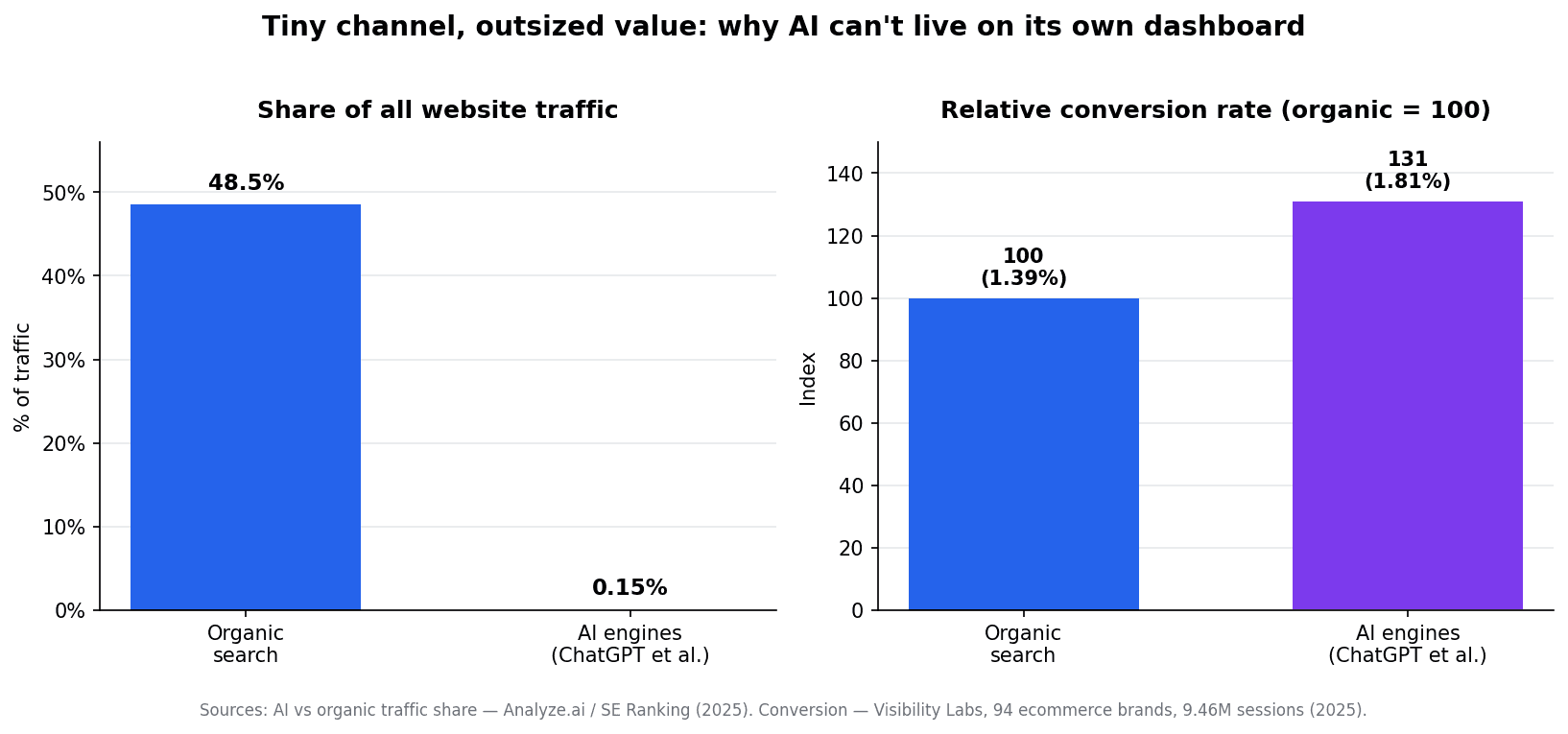
Look at those two panels together, because that's the whole point. A channel that is 0.15% of your volume but converts 31% higher is impossible to judge on its own dashboard. On a standalone AI view it looks either trivially small (by volume) or wildly impressive (by conversion), and both readings are wrong in isolation. The only way to weigh the trade correctly is to put AI citations beside the 48.5% of organic clicks they're competing with for your attention and your content budget. The comparison is the analysis. Separate it into two tools and you'll either over-invest in a sliver or ignore your fastest-growing, highest-converting channel.
The four things you only see when GSC clicks and AI citations share a date range
This is the core of the thesis. Date-alignment isn't a UI nicety — it's what unlocks insights that are literally invisible otherwise. Four of them:
1. The branded-mention → AI-citation flywheel. Ahrefs studied 75,000 brands and found branded web mentions correlate 0.664 with AI Overview visibility — far stronger than backlinks at 0.218. Brands in the top quartile of web mentions earned more than 10x the AI Overview citations of the next quartile. When a PR push lands you a wave of mentions, you want to watch your branded-search impressions in GSC and your AI citation count move on the same timeline. That's one story, told by two datasets.
2. Rank and citation are coupled. Roughly 75% of AI citations come from pages ranking in Google's top 10, and 76.1% of URLs cited in AI Overviews also rank top 10. So when a page climbs in GSC, the honest question is: did its AI citations follow? You can only answer that if both metrics sit on one chart. This is the practical core of a hybrid SEO and AI strategy — the two surfaces feed each other, so you manage them as one system.
3. Freshness windows you can actually watch. 76.4% of ChatGPT citations come from content updated within the last 30 days. When you refresh a page, a unified view lets you watch the GSC impressions tick up and the AI citations reappear, on the same dates, so you can tell whether the update actually worked.
4. The cannibalization read. When a query goes zero-click inside an AI Overview, your GSC clicks for it can drop while the AI citation is the only place you're still "winning" the answer. Side by side, that's a clear signal to defend the citation. In two separate tools, it just looks like unexplained GSC decay.
One honest caveat, because it matters: Ahrefs is explicit that correlation is not causation. A unified dashboard's job is to surface these relationships so you can act on them — not to promise that nudging one number mechanically lifts the other. The view gives you the hypothesis; your experiments confirm it.
How QuickSEO actually joins the two
The architecture is deliberately boring, which is the point. QuickSEO connects to your Google Search Console over OAuth and pulls clicks, impressions, CTR, and average position — the data you already trust. Separately, it runs your prompts on a weekly schedule across ChatGPT, Claude, Gemini, and Perplexity, logging whether your brand is mentioned, in what position, the sentiment of the mention, which sources got cited, and which competitors showed up instead of you.
The trick is that both streams land in one date-aligned store, and a single date picker drives both panels. Change the range once and your GSC clicks and your AI visibility score move together. No exporting, no reconciling, no mental math across two tabs.

I'm not going to oversell it. The AI scans are weekly, not real-time. The value isn't in any single number — it's that the GSC number and the AI number finally share an x-axis. If you've been hunting for a ChatGPT rank tracker that connects to Google Search Console, that GSC-native join is precisely the gap I built this to fill.
What the other AI-visibility tools do — and where the gap still is
I respect the other tools in this category, and I want to be fair about them. The honest summary is that they are excellent at AI visibility, and that how much of your Search Console picture they bring in varies from tool to tool.
Tool | What it tracks | GSC traffic in the same dashboard? | Best for |
|---|---|---|---|
QuickSEO | GSC clicks/impressions/rank/CTR + AI mentions, position, sentiment, citations, competitors | Yes — date-aligned in one view | SMBs and agencies who want SEO and AI in one place |
Profound | Deep analytics on how AI engines build answers and pick sources | Yes — GSC integration | Enterprises reverse-engineering AI answer construction |
Peec AI | Brand mentions + citations across ChatGPT, Perplexity, AI Overviews, daily | No native integration | Mid-market teams wanting daily AI monitoring |
Otterly | Entry-level AI search monitoring | No (AI-only) | Solo/small teams starting AI tracking cheaply |
Profound is the category leader for a reason — it raised $155M at a ~$1B valuation and goes deeper on AI answer mechanics than I do. Peec is the fast-growing challenger; Otterly is the accessible on-ramp.
I have to correct myself on one thing here. When I first wrote this, my line was that none of them touched Google Search Console at all. That's no longer true. Profound now lists a Search Console integration that pulls impressions, clicks, and average position by keyword and page into its platform. Peec still has no native one — the only GSC route there is a community-built connector a customer wires up themselves.
So the honest version of my claim is narrower than it used to be. Profound reads your search data; what it doesn't appear to do is rank-track — keyword position tracking as a first-class product of its own, sitting on the same screen as the AI numbers. That second half is the part I built. They built AI microscopes; I built a two-channel cockpit.
When two separate tools are actually the right call
I promised an honest section, so here it is: a combined dashboard is not always the right answer.
The best-of-breed argument is real. Specialized point tools generally offer more functional depth, iterate faster on their one thing, and let you swap a single component without ripping out your whole stack. All-in-one suites have a documented downside too — only about 22% of suite users use 60% or more of the features, and consolidation creates lock-in, since switching means replacing several functions at once.
So when are two tools genuinely the smarter call?
You need maximum depth in one channel. If you're an enterprise team whose whole job is reverse-engineering how AI assembles answers, a specialist like Profound will out-resolve any generalist on that axis.
You already have a BI layer doing the join. If GSC and your AI data both flow into a warehouse and someone owns the SQL that aligns them, a unified app is redundant.
GSC just isn't your channel. If organic search is a minor part of your mix, there's nothing to align — track AI on its own and move on.
The rule I keep coming back to: a combined dashboard wins specifically when the join between the two datasets is the value. If you're going to look at GSC clicks and AI citations on the same timeline and ask how one moves the other, you want them in one place. If you'll genuinely never put them on the same x-axis, two specialized tools are a defensible — even better — choice.
The bottom line
That's the bet, stated plainly. Tracking AI visibility is now non-optional — the volume is small but growing 500%+ and converting 31% higher, and the inputs to AI visibility are the same branded mentions and organic rankings GSC already measures. Because those two surfaces feed each other, the most useful thing you can do is stop looking at them apart. The dashboard isn't the product. The join is the product.
QuickSEO is a free Google Search Console dashboard for all your websites. Connect Search Console, pick the properties you want, and see clicks, impressions, CTR and average position for every site on one screen, each compared with the previous period, with the keywords and pages behind the numbers. Connect Search Console for free →
QuickSEO shows clicks, impressions, keywords and pages for every website you manage, compared with the period before.
- Unlimited websites on the free plan
- No credit card needed
Try it yourself
Related free tools
Free SEO tools related to the topics covered in this article.
Keep reading
Related posts
More articles on the same topics, prioritized by shared tags and keyword overlap.