AI Visibility Benchmarks 2026: Is Your Brand Showing Up in AI Answers?

 Summarize in ChatGPT
Every week, hundreds of millions of people ask ChatGPT, Claude, Gemini, and Perplexity which brand to buy from, which tool to use, or which service to trust. The AI picks one or two brands to recommend — and everyone else is invisible.
The critical question for marketers in 2026 isn't whether AI search matters. It's: where does your brand stand relative to the benchmark? Without context, a visibility score of 40/100 could mean you're leading your industry or falling dangerously behind it. That's precisely why AI visibility benchmarks have become one of the most important reference points in modern marketing.
In this guide, we break down the latest 2026 industry benchmarks, explain the key metrics that define AI visibility, and show you exactly what it takes to improve your score.
Why AI Visibility Benchmarks Matter Right Now
Industry data confirms AI-driven search has surged from under 10% of interactions in 2023 to roughly 30% by early 2026. That's not a slow-burn trend — it's a structural shift in how buyers discover brands.
Pew Research found that users click traditional search results only 8% of the time when an AI summary appears. With AI Overviews now triggering on 48% of queries, brand visibility inside AI answers has become the most important metric in marketing.
53% of brands are invisible in AI answers. That's the uncomfortable baseline reality. And the brands that don't know their benchmarks are almost certainly in that majority — losing consideration before prospects ever visit their site.
A brand ranking first on Google might not appear at all when someone asks Claude for recommendations in the same category. A brand can rank #1 on Google and be invisible to AI systems. This is the fundamental disconnect that benchmarks help you navigate.
Benchmarks give you three things: context (is your score good or bad relative to peers?), direction (where should you invest to improve?), and accountability (are your GEO efforts actually moving the needle?).
2026 AI Visibility Benchmarks by Industry
The most comprehensive benchmark dataset published to date comes from a Q1 2026 analysis of 4,217 brands across ChatGPT, Perplexity, Claude, and Google AI Overviews, scored on citation frequency, recommendation rank, sentiment, and contextual relevance.
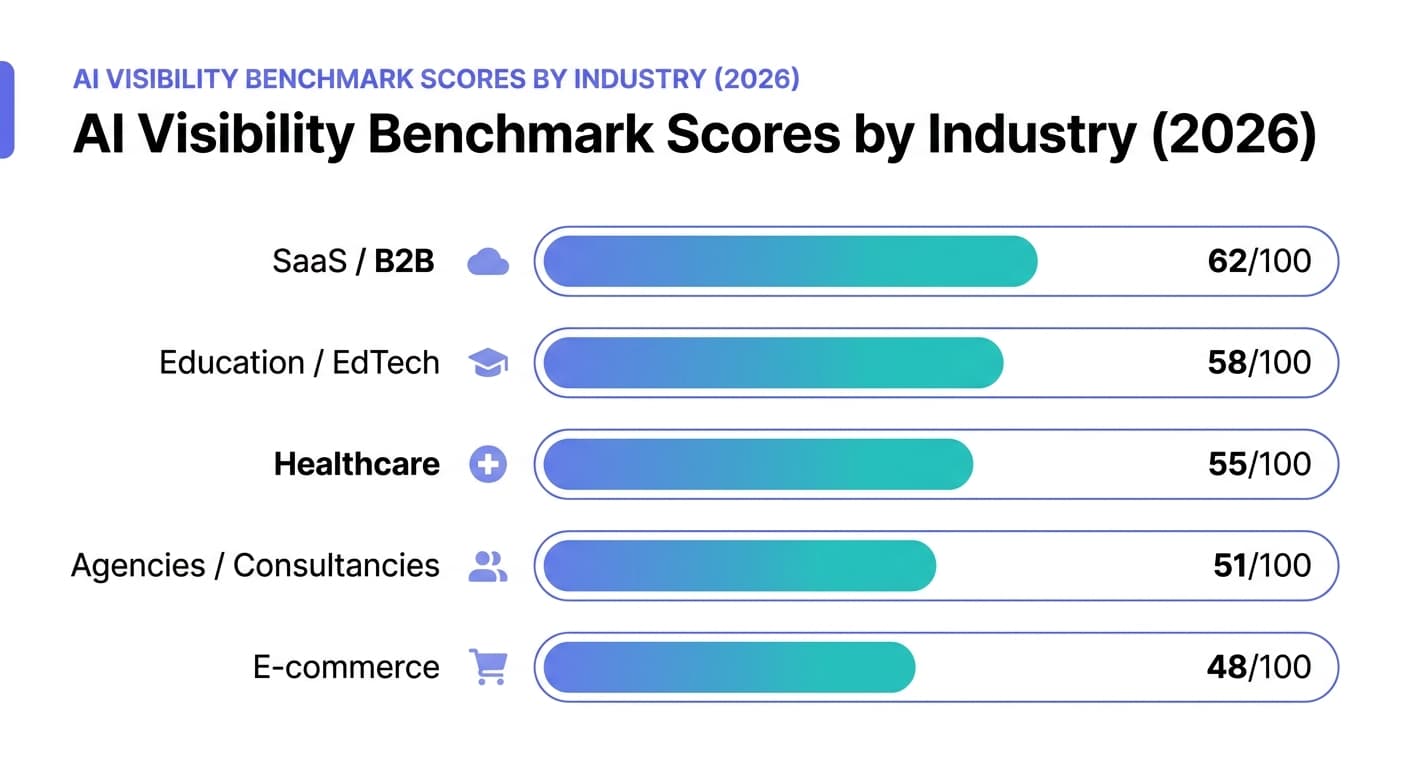
SaaS/B2B leads with an average AI visibility score of 62/100, followed by Education/EdTech at 58/100 and Healthcare at 55/100. Agencies/Consultancies average 51/100, and e-commerce trails at 48/100 due to thin product-page content.
Here's what separates top performers in each vertical:
SaaS/B2B (62/100): SaaS brands lead because their content-heavy marketing and strong domain authority translate well to AI visibility. Companies investing in content optimization for AI see the clearest ROI here.
Education/EdTech (58/100): Top performers leverage Course and Program schema markup, instructor bios with credential-rich structured data, syllabi published as crawlable HTML (not locked behind logins), and student outcome statistics.
Healthcare (55/100): The challenge is that a "good" score in one industry may be below average in another. A healthcare brand scoring 55/100 is right at the median, while a SaaS brand with the same score is underperforming.
E-commerce (48/100): E-commerce lags largely because of thin product-page content that AI systems cannot easily extract or attribute.
The Measurement Gap Is Alarming
Semrush found that 45% of marketing leaders cannot accurately measure their brand visibility within AI-generated answers, while only 9% have the tools to track all relevant metrics across platforms.
That means the majority of brands are flying blind. They don't know whether they're winning or losing in the conversations that are shaping buyer decisions right now.
Platform Concentration Varies Wildly
The Semrush 2026 AI Visibility Index, which analyzed 126 million U.S. AI search prompts, revealed dramatic differences in how concentrated AI visibility is across categories.
In News and Media, the three most visible brands accounted for 82.9% of total category visibility, while in Consumer Electronics, the top three represented 76.9%. By comparison, visibility was more distributed in Finance, where the top three brands accounted for 41.4%, and Industrial, where they represented 42.2%. These less concentrated categories may offer greater opportunities for brands to gain visibility over time.
Only 36 brands maintained top-100 visibility across all four platforms during every month of the study. The "Universal 36" include YouTube, Google, Reddit, Amazon, Facebook, Apple, Walmart, Disney, and Nintendo.
The 4 Key AI Visibility Metrics You Must Track
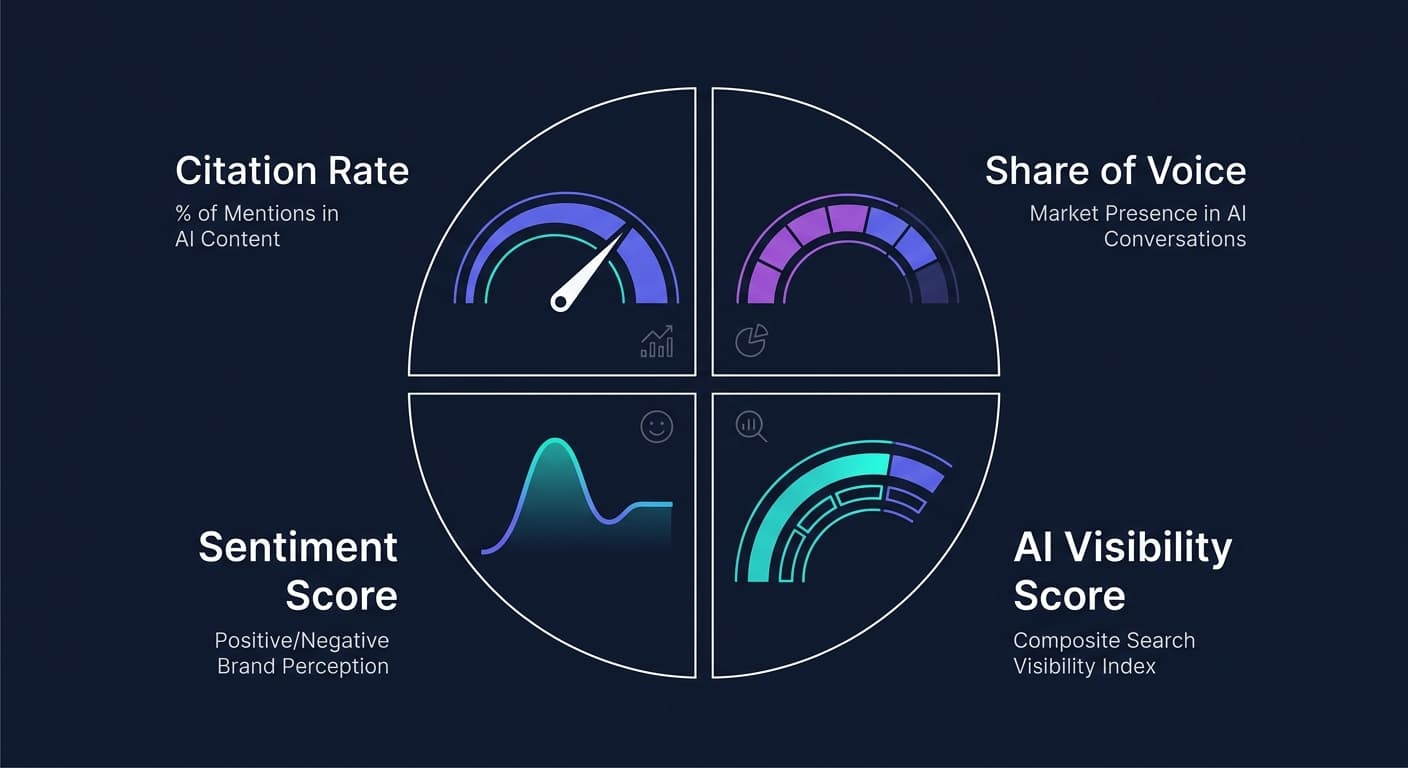
Understanding benchmarks requires understanding what's actually being measured. Here are the four metrics that define AI visibility performance in 2026:
1. AI Visibility Score (0–100)
The visibility score measures how often your brand appears in AI answers across a defined set of prompts. It shows whether you are present where AI-driven discovery actually happens. Most platforms express this as a 0–100 score. A score of 30–50 is competitive in most moderate-competition categories. Above 50 is strong — category leaders rarely exceed 70 because AI systems naturally diversify citations.
2. Share of Voice (SOV)
Share of Voice measures how often your brand appears in AI answers relative to competitors. While visibility shows if you are present, SOV shows whether you are winning attention.
Even category leaders rarely clear 60%, because AI systems deliberately diversify the sources they cite. Always read the number per platform, since a healthy 35% on ChatGPT can hide a 5% on Perplexity that is quietly costing you referral traffic.
3. Citation Rate by Platform
Perplexity and Gemini cite brands at roughly twice ChatGPT's rate; Claude is the most selective citer of all. This means your citation strategy must be tailored per platform, not applied uniformly.
Your brand may rank as the top recommendation on one platform and fail to appear at all on another. Platform-level visibility gaps are specific, addressable opportunities that only cross-platform monitoring makes visible.
4. Sentiment
In benchmarking, sentiment helps distinguish helpful visibility from exposure that may actually hurt consideration. Being mentioned is not enough — you need AI systems to describe your brand positively and in the right context. Brands commonly have strong informational visibility but weak high-intent recommendation coverage — where commercial value is highest.
What the Citation Data Is Telling Us
A major index synthesizing more than 680 million individual citations across ChatGPT, Google AI Overviews, Perplexity, Gemini, and Claude found that Reddit is the #1 source across every major AI engine, cited at roughly 40% frequency across LLMs.
Wikipedia dominates ChatGPT, accounting for 26% to 48% of ChatGPT's top-10 citation share. The top 15 domains capture 68% of all consolidated AI citation share — a concentration far more extreme than Google PageRank ever produced.
For individual brand pages, machine-readability is the key variable: of 2,225 pages analyzed, 36% were thin or non-extractable, 77% carried no visible date, and only 21.2% showed author signals. AI systems cite pages they can extract, date, and attribute — and the most-cited format is the brand's own site.
Trust-sensitive categories are the most invisible: finance brands are cited in just 2.1% of checks, and 86% of legal and professional-services brands were never cited at all. Meanwhile, 70% of marketing agencies are invisible to the AI platforms they advise clients about.
The Citation Lag Is Shorter Than You Think
Research tracking roughly 900 newly published marketing pages found a median of 6.81 days to first citation by ChatGPT or Claude. 90% of cited pages earned their first citation within 37 days; a page still uncited past that point likely has a technical issue such as a robots.txt block.
Platform-by-Platform: How Each AI Engine Behaves
Each AI platform has a distinct citation behavior, which means benchmarks need to be read at the platform level, not just in aggregate.
The four AI platforms that matter most for brand visibility are ChatGPT (powered by Bing), Gemini (powered by Google's Knowledge Graph), Perplexity (live web crawling), and Claude (training data consensus). Each has different data sources, optimization levers, and biases.
ChatGPT: ChatGPT Search cites recent, authoritative pages with strong topical relevance — top organic results, well-structured listicles, benchmark reports, and official documentation. ChatGPT commands 92.4% of all trackable LLM referral traffic.
Claude: Claude relies heavily on training data, so third-party mentions that were in the training corpus matter more than recent content. If your audience includes technical buyers, developers, or professional services, Claude visibility is becoming a real factor, and the window for early positioning is now.
Gemini: Gemini's behavior in 2026 is closer to a mixed retrieval-and-reasoning system that occasionally surfaces sources, often produces general statements without them. Wikipedia and entity-graph presence matter more for Gemini than for ChatGPT Search.
Perplexity: Citation-formatted content (statistics with sources, definition lists, structured comparisons) performs well. Perplexity's source list is often deeper than the answer itself — the long-tail of citations is where the audience that goes deeper finds you.
How to Improve Your AI Visibility Score
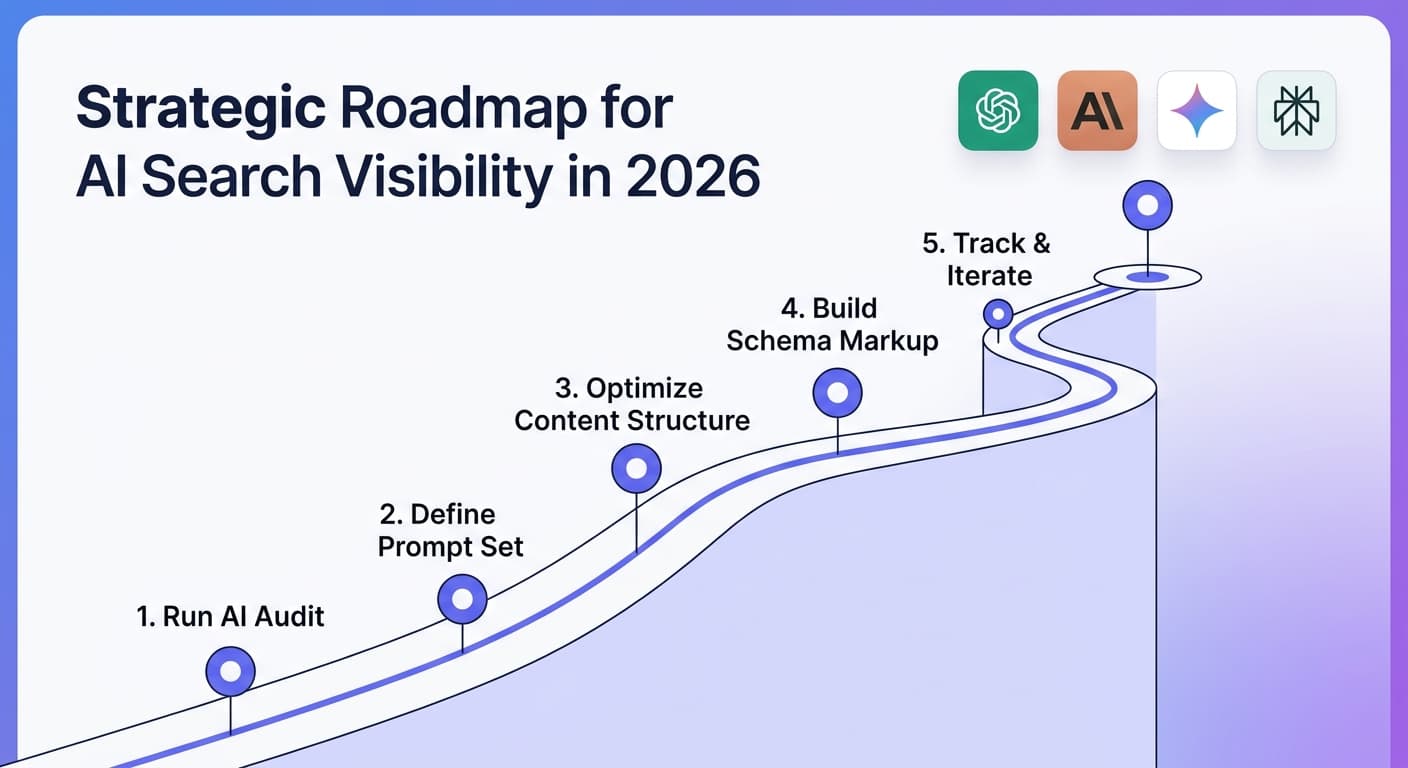
Knowing your benchmark is step one. Here's how to systematically improve your position.
Step 1: Run a Baseline AI Visibility Audit
You cannot improve what you have not measured. Before you optimize a single piece of content or build a single link, you need to understand where your brand currently stands in the AI search landscape.
Establish your baseline across ChatGPT, Claude, Gemini, and Perplexity — then set up a cadence of weekly or monthly re-testing.
Step 2: Define Your Target Prompt Set
Define your prompt set — Map the 20–50 queries your ideal customers ask AI assistants (e.g., "best CRM for startups," "top project management tools for remote teams"). Run prompts across all engines — test each prompt against ChatGPT, Gemini, Perplexity, and Claude simultaneously.
Step 3: Fix Technical Crawlability First
Most major AI crawlers do not run JavaScript. GPTBot, OAI-SearchBot, ClaudeBot, PerplexityBot, and Meta's crawler fetch raw HTML and stop. Google's Gemini is the exception because it runs on Googlebot infrastructure. A page can rank in Google and appear in AI Overviews, yet still look blank to ChatGPT, Claude, and Perplexity.
Use our Robots.txt Validator to make sure you aren't inadvertently blocking AI crawlers, and our Structured Data Validator to ensure your schema markup is clean and parseable.
Step 4: Invest in Structured Data and Schema
Brands with comprehensive JSON-LD markup score 23 points higher on average than those without, regardless of industry. External research found that sites with structured data see up to 30% higher visibility in AI overviews.
FAQ schema, HowTo schema, and Organization schema help AI systems extract and attribute your content cleanly. Schema tells AI what type of content is on the page, who wrote it, and what questions it answers — making your site citable rather than merely crawlable. Triple-stacking FAQPage + Article + HowTo produces 1.8x more citations than Article schema alone.
Step 5: Publish Citation-Worthy Content
Brands producing 12 or more new or optimized pieces of digital content per month achieve up to 200x faster visibility gains in AI platforms than those producing just four.
But volume alone isn't the play. AI systems reward authority, and authority in 2026 means being the source of data that other people cite. Commission surveys, publish benchmarks, conduct original research, and put specific numbers into the world that AI systems can reference. Content that generates its own data is inherently more citable than content that summarizes someone else's.
Statistics pages, benchmark reports, comparison pages, glossary pages, and third-party listicles are over-cited relative to generic blog content.
Step 6: Build Entity Authority Across Third-Party Platforms
Build entity authority through: consistent brand messaging across all digital properties, third-party citations on LinkedIn, G2, and Reddit, and knowledge graph optimization (Wikipedia or Wikidata entries where eligible). Entity authority is the slowest component to build and the hardest to displace once established.
Step 7: Track Position Within Answers, Not Just Presence
Where in the AI answer your brand appears matters enormously — first mention, mid-paragraph, or buried footnote. LLMs tend to rank the first entity mentioned as the default recommendation. A brand mentioned first in 60% of responses is far more valuable than one buried in footnotes in 90% of responses.
The Downstream Impact: AI Citations Drive Branded Search
One of the most important — and underappreciated — findings of 2026 is the downstream effect of AI citations.
Brands that win an AI Overview or LLM citation see a measurable 23% lift in branded search volume over the following 30 days — even when direct AI-engine click-through to their site is negligible. Users see the brand named inside the AI answer, store it in working memory, and search for it directly when they're ready to act.
Brands cited consistently across multiple weeks see a 41% cumulative branded search lift over 90 days. Direct click-through from AI engines is minimal (typically 0.4–0.8% of brand visibility events), but the downstream branded-search effect is the real ROI.
This reframes how you should measure success. Citation rate is replacing click-through rate as the primary KPI for AI search work. Track branded query impressions in Google Search Console as your primary AI-search KPI — and tag citation-detected dates to run lift analysis against your baseline.
AI Visibility + Traditional SEO: A Two-Dashboard Reality
Research from GEO firm Brandlight suggests that the overlap between top Google links and AI-cited sources has dropped from 70% to below 20%. This gap is growing as AI systems develop their own preferences for which sources to cite.
This is not an argument for abandoning SEO. It's an argument for adding a second measurement layer on top of it. AI visibility and SEO are complementary — not competing. The best brands optimize for both.
A modern search strategy requires monitoring two distinct dashboards: one for your website's performance (rankings and traffic) in traditional search, and one for your brand's mentions across AI search. You need both to see the full picture.
Setting Realistic AI Visibility Goals for 2026
Here are the benchmark targets to aim for based on the latest data:
AI Visibility Score | What It Means |
|---|---|
Below 20 | Significant structural gaps in content, authority, or technical accessibility |
20–35 | Early-stage visibility — present in some category conversations |
35–50 | Competitive in most moderate-competition categories |
50–62 | Strong — roughly industry-average for SaaS/B2B leaders |
62+ | Category leader — among the top performers in your vertical |
Scores can shift meaningfully within days when significant content, authority, or competitor events occur. A competitor earning major press coverage may improve their share of voice at your expense within a week. This is why weekly tracking matters more than monthly spot checks.
Only 14% of brands currently have an AI visibility strategy. That's a massive opportunity window — but it's closing as more teams wake up to the shift.
Conclusion
AI visibility benchmarks are no longer a "nice to have" — they're the new baseline for competitive marketing intelligence. Knowing that your SaaS brand's median visibility score should sit around 62/100, or that 86% of legal brands are invisible in AI answers, gives you the context to allocate resources, set realistic goals, and prove progress.
The brands winning in 2026 are the ones who started measuring six months ago. They built baselines, identified platform-specific gaps, and systematically improved their presence across every AI engine. The window is still open — but it's narrowing fast.
Whatever share of search AI answers end up taking, Google Search Console is still where you see the clicks Google actually sends you. QuickSEO puts Search Console for every website you run on one free dashboard. See all your sites in one place →
QuickSEO shows clicks, impressions, keywords and pages for every website you manage, compared with the period before.
- Unlimited websites on the free plan
- No credit card needed
Try it yourself
Related free tools
Free SEO tools related to the topics covered in this article.
Keep reading
Related posts
More articles on the same topics, prioritized by shared tags and keyword overlap.