AI Citation Sources: How ChatGPT, Claude & Gemini Choose What to Cite in 2026

 Summarize in ChatGPT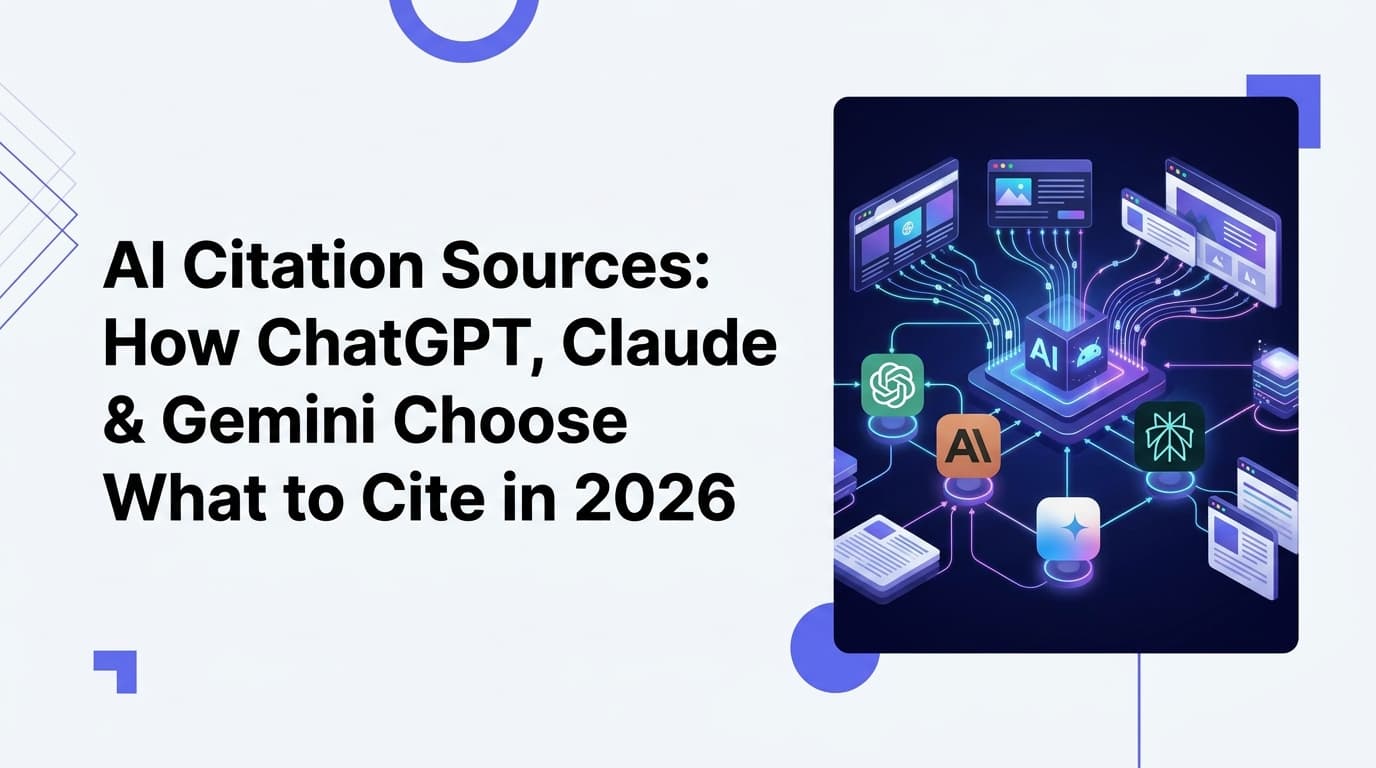
When someone asks ChatGPT "What's the best project management software?" or Gemini "Which brand has the best return policy?", a handful of sources get cited — and everyone else is invisible. That's the reality of AI search in 2026, and it's reshaping how brands think about organic visibility.
When AI models choose which brands to mention, they're essentially deciding who gets visibility in the next generation of search. Understanding how AI citation sources are selected is no longer a niche technical curiosity — it's the foundation of a new marketing discipline called Generative Engine Optimization (GEO).
In this guide, we break down exactly how ChatGPT, Claude, Gemini, and Perplexity decide what to cite, what the data reveals about citation concentration, and the actionable strategies your brand needs to earn a seat at the table.
Why AI Citations Matter More Than Ever
The stakes are higher than most marketers realize.
In 2026, getting a citation inside an AI-generated answer is the new "position zero." Google AI Overviews now appear in roughly 50% of all searches. ChatGPT handles over 200 million weekly active users, and Perplexity has become the default research tool for analysts, journalists, and technical buyers.
When these platforms answer a question, they cite a small handful of sources — and everyone else is invisible.
The conversion data makes the stakes even more concrete:
AI search traffic converts at 14.2% compared to Google organic's 2.8% — making an AI citation worth roughly five times as much as a traditional organic click.
Pages cited in AI Overviews earn 35% more organic clicks than non-cited competitors on the same results page.
Visitors arriving from Perplexity convert at roughly 11 times the rate of traditional organic search traffic.
And yet, more than 50% of brands still have no GEO strategy.
The Hidden Logic: How AI Selects Citation Sources
AI chatbots don't randomly select information sources. Instead, they employ sophisticated algorithms that evaluate multiple factors to determine which content deserves inclusion in their responses.
The most important thing to understand is that there are two mechanically distinct pathways through which AI systems retrieve content:
AI answer engines choose sources through two mechanically distinct pathways — training-corpus recall (6–12 month update cycle) and live RAG retrieval (24–72 hours) — and most brands optimize for one without knowing which governs their citations.
AI platforms use Retrieval-Augmented Generation (RAG) to select sources, and RAG follows predictable rules that differ dramatically from Google's ranking factors. Unlike traditional search engines that rank pages by backlinks and keyword density, RAG systems evaluate content based on semantic clarity, structural retrievability, and third-party validation.
The Citation Concentration Problem
Here's a data point that should alarm every SEO professional: the AI Platform Citation Source Index 2026 synthesizes more than 680 million individual citations across ChatGPT, Google AI Overviews, Perplexity, Gemini, and Claude, drawn from six of the largest published citation studies conducted between August 2024 and April 2026.
The finding? The top 15 domains capture 68% of all consolidated AI citation share — a concentration far more extreme than Google PageRank ever produced.
And critically: research from Ahrefs analyzing 15,000 queries found that only 12% of URLs cited by AI tools overlap with Google's top 10 results. The remaining 88% of AI citations pull from sources that don't rank anywhere on page one.
That's the paradigm shift. You can dominate Google's first page and still be completely absent when a prospect asks ChatGPT for a recommendation.
Platform-by-Platform: What Each AI Prefers to Cite
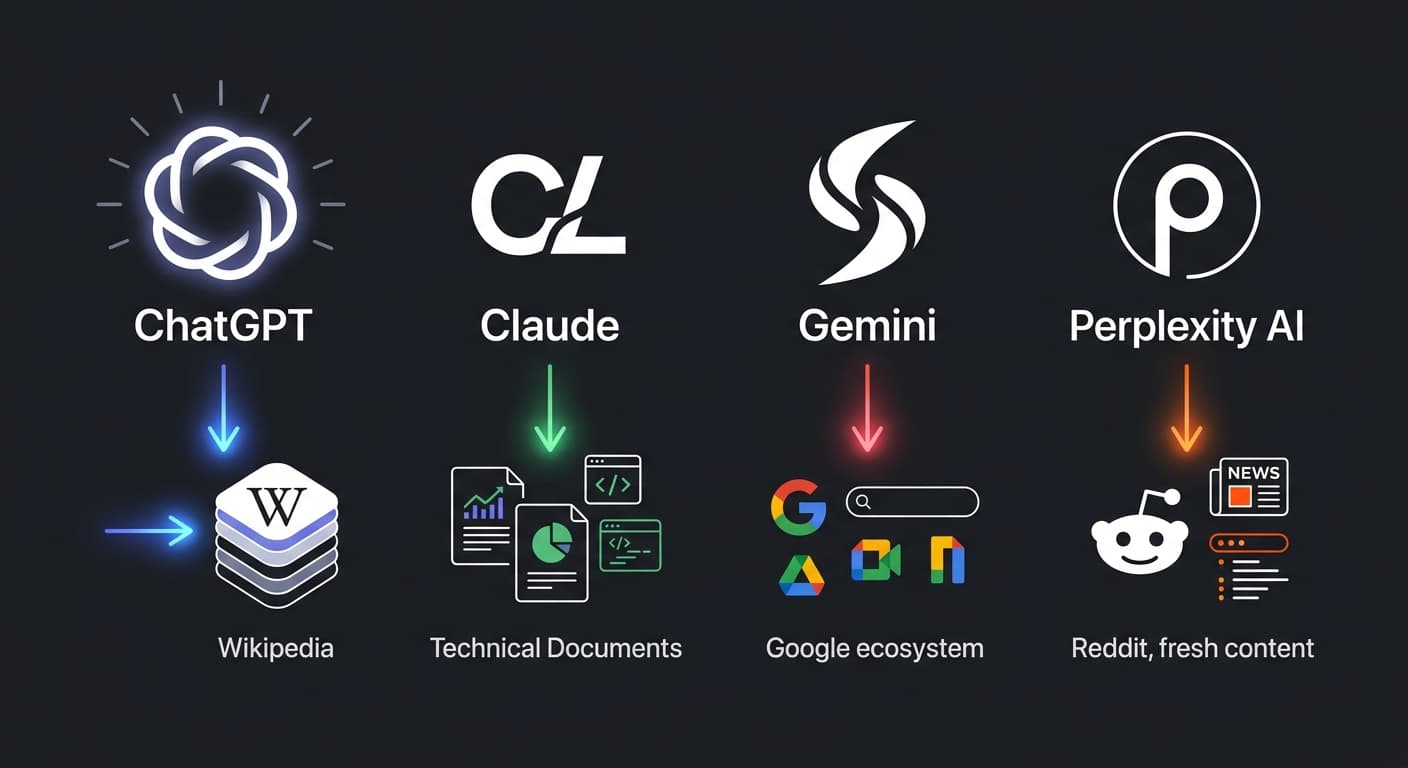
The problem compounds because AI platforms don't share a single retrieval architecture. ChatGPT uses Bing's real-time index, Claude relies on training data with a January 2025 cutoff, and Perplexity crawls the web continuously. Each platform has distinct citation patterns, source biases, and transparency standards.
Here's what the research reveals about each platform:
ChatGPT
ChatGPT favors Wikipedia-style depth and Bing index presence. Wikipedia dominates ChatGPT, accounting for 26% to 48% of ChatGPT's top-10 citation share — near-foundational training material.
Submit to Bing via IndexNow. 87% of SearchGPT citations match Bing's top 45 results.
Perplexity cites a mean of 16.35 sources per answer, compared to 12.06 for Google AI Overview and 6.88 for ChatGPT. However, ChatGPT's absorption rate is 4.2x higher per citation, meaning it extracts far more from each source it does cite.
Claude
Claude rewards source-backed reasoning. Claude tends to synthesize information rather than quote directly. It favors well-structured, logical content. To win Claude citations, you need technical depth, credible outbound links, and content built around verifiable claims.
Gemini
Gemini cites brand-owned domains with strong schema. Gemini is the fastest-growing AI search platform. It integrates deeply with Google's existing search infrastructure, and strong Google SEO performance tends to translate into Gemini visibility.
Perplexity
Perplexity prioritizes freshness and Reddit. Perplexity AI selects sources with transparent citation, showing users exactly which sources informed each part of the response. Perplexity performs real-time web retrieval for every query, meaning new content can appear in Perplexity citations within hours of being indexed.
The 8 Key Factors AI Uses to Choose Citation Sources
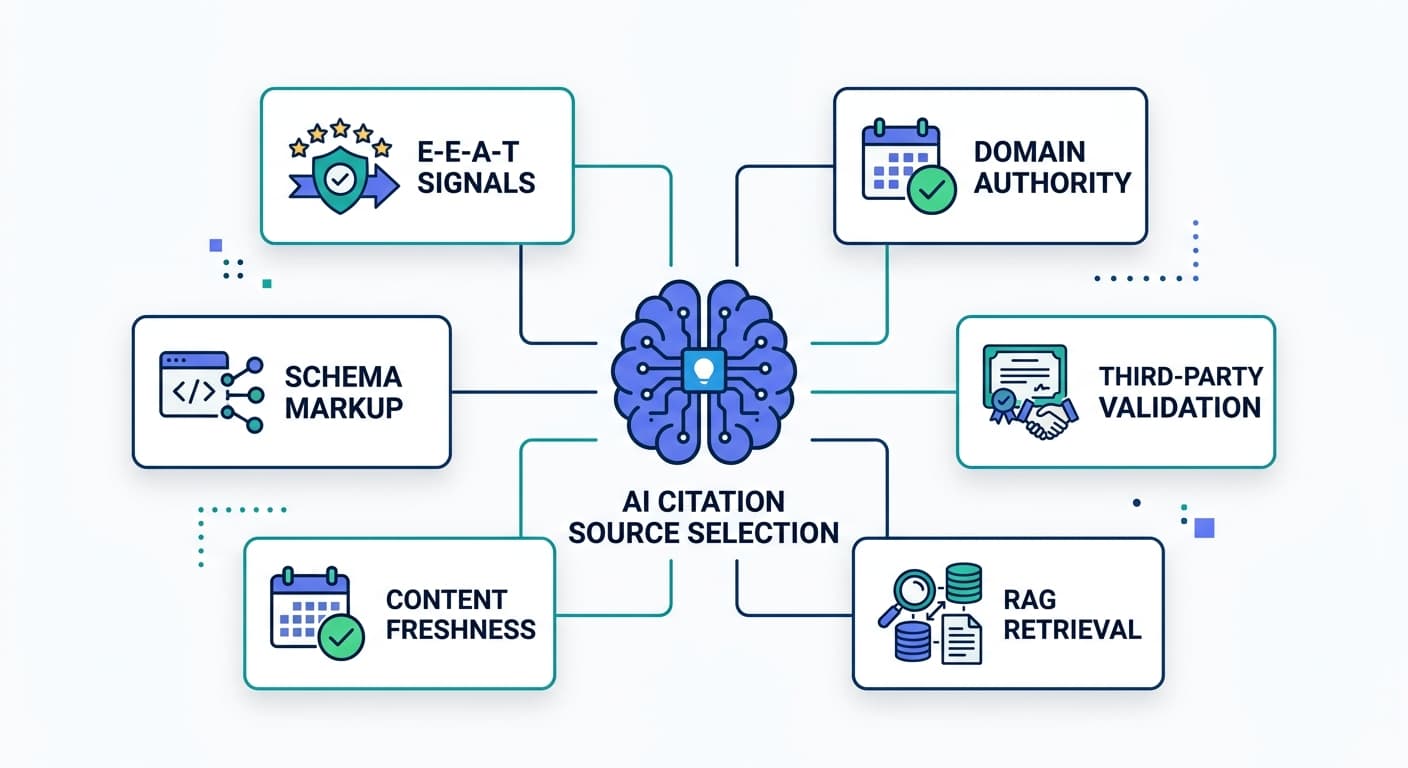
The core AI search ranking factors in 2026 include E-E-A-T signals, entity recognition, content structure, schema markup, citation authority, and content freshness — each weighted differently across ChatGPT, Gemini, Claude, and Perplexity.
Let's break down each one:
1. E-E-A-T Signals
E-E-A-T (Experience, Expertise, Authoritativeness, Trustworthiness) strongly influences AI chatbot citations. AI systems evaluate author credentials, demonstrated expertise, brand recognition, and consistency across the web. Content that establishes clear expertise and is published on trusted platforms gets cited more frequently.
2. Schema Markup & Structured Data
Citation algorithms scan schema to verify E-E-A-T signals before choosing sources. Pages with proper FAQ schema, structured author credentials, and explicit expertise markers consistently outperform equivalent pages without schema.
Structured data markup shows a 73% improvement in AI Overview selection rates. Use our free AI Schema Markup Generator to get started quickly.
3. Content Freshness
Maintaining content freshness through regular updates, adding new examples, incorporating recent developments, and updating statistics keeps content relevant for AI citation. Stale content from years ago might still exist in training data but won't get prioritized by RAG systems.
According to BrightEdge research, pages updated within 60 days are 1.9x more likely to appear in AI answers.
4. Third-Party Validation
85% of brand AI mentions come from third-party pages, and models like ChatGPT and Claude draw 93%+ of citations from earned media.
You can influence AI chatbot source selection by publishing authoritative content, building quality backlinks, using structured data and schema markup, maintaining content freshness, and ensuring strong topical relevance. Consistent brand mentions across trusted websites also strengthen your chances of being cited.
5. Domain Authority & Backlink Quality
Over 61% of chatbot-attributed links go to sites with 100+ referring domains. While traditional link-building still matters, the quality and context of those links is what AI systems are actually evaluating.
6. Original Data & Unique Insights
Content that contains information not easily found elsewhere is highly attractive for AI citation. Inclusion of original data or "owned" insights was the second-strongest differentiator for cited pages.
Generative Engine Optimization rewards specificity over vague claims—"conversion rates improved 47% after implementing personalization" beats "personalization works well" every time.
7. Content Structure & Extractability
Roughly 44% of AI citations are pulled from the first 30% of the text. AI models scan for clear, extractable answers. They rely on obvious cues that point to what each section contains and how it addresses specific queries.
8. Answer Capsules
Answer capsules are the single strongest predictor of citations: 72.4% of cited content includes a standalone answer immediately after the H2. Place a direct, concise answer of 120–150 characters directly under each H2 heading.
The Reddit & Wikipedia Effect
Two platforms consistently dominate AI citations across every major engine — and neither is a brand-owned website.
Reddit is the #1 source across every major AI engine, cited at roughly 40% frequency across LLMs. ChatGPT favors Wikipedia (47.9% of top citations), while Perplexity prioritizes Reddit (46.7%).
What does this mean for brands? Your own blog is rarely the first thing quoted, which means GEO is partly an off-site job.
Practical implications:
Build a Wikipedia presence where appropriate for your brand or category
Participate honestly in Reddit and Hacker News threads where your category comes up — not drive-by self-promotion, but real contributions that mention you when relevant
Earn citations from established industry publications and get listed on relevant comparison and review sites (G2 is the most cited software review platform across ChatGPT, Perplexity, and Google AI Overviews)
What AI Citation Sources Are NOT
It's equally important to know what does not reliably win AI citations:
Traditional Google rankings: One industry analysis reported only a 10% to 15% overlap between traditional Google results and AI citations. Ranking #1 on Google does not guarantee AI visibility.
Keyword stuffing: Tests on Perplexity.ai showed keyword stuffing underperformed baseline content (with no optimization applied) by 10%. Because AI models are trained on natural language, they detect and penalize clumsy phrasing caused by forced keywords.
Marketing jargon: If your best answers are vague or wrapped in heavy marketing jargon, AI systems will bypass them for clearer sources.
Blocking AI crawlers: If your robots.txt blocks any AI crawler, you are invisible to that platform regardless of content quality. Check your crawler accessibility before any other optimization work begins.
How to Optimize Your Content for AI Citations: A Practical Framework
Based on the latest GEO research, here's a prioritized action plan for earning more AI citations in 2026:
Step 1: Fix Technical Accessibility First
Before worrying about content, ensure AI crawlers can actually reach your pages. Use a tool like QuickSEO's Robots.txt Validator to check that you're not accidentally blocking the bots that power AI citations. Run a Structured Data Validator check to confirm your schema is error-free.
Step 2: Structure Content for Extraction
Apply the inverted pyramid. Lead each key section with a direct, concise answer before expanding.
Open each section with a direct answer of about 40 to 80 words. State the fact, then support it underneath. Phrase your H2s as questions people actually type.
Use tables for any comparison. Models lift tables almost verbatim, which is why comparison content gets cited so heavily.
Keep paragraphs short — two to three sentences maximum. Long blocks of text are harder for AI to parse and less likely to be extracted as a citation.
Step 3: Add Original Data & First-Party Research
Highlight proprietary data and original research. Case studies, unique datasets, and first-hand findings give you an edge because competitors can't duplicate them. Even modest original research noticeably boosts citation potential.
Step 4: Build Third-Party Authority
Getting your brand cited by ChatGPT, Gemini, Claude, Perplexity, and Grok requires consistent third-party validation across Reddit, G2, LinkedIn, and earned media.
Step 5: Keep Content Fresh
Large language models and AI search tools prefer recent sources for topics that change often. Pricing, legal rules, and product details need to be up to date. Old content loses citations to newer, updated competitors. Establish a 3–6 month review cycle for your priority pages.
Step 6: Platform-Specific Tuning
Strengthen structured comparisons for ChatGPT, prioritize E-E-A-T and schema for Gemini, ensure transparent methodology for Claude, and focus on crawlable, fresh content for Google AI.
Measuring Your AI Citation Performance
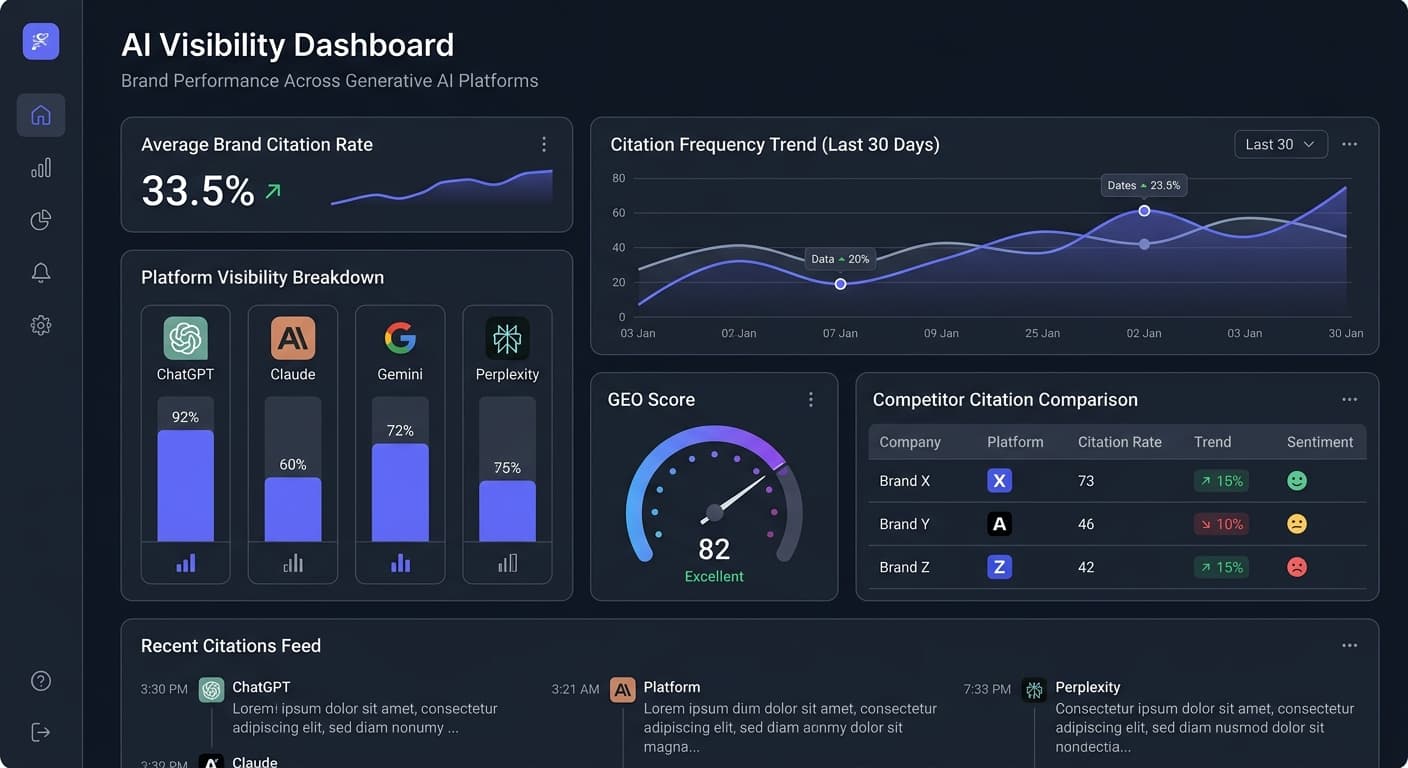
Traditional analytics platforms like GA4 or Google Search Console cannot track AI citation signals. They only see what happens after a click. This creates a "measurement blind spot." You might be the most mentioned brand in ChatGPT, but your standard dashboards would show zero activity.
The new metrics you need to track are:
Citation frequency — How often does your brand get mentioned when relevant prompts are fired across each AI platform?
Share of voice — Your citation frequency compared to competitors for the same query set. If five vendors operate in your category and AI answers typically recommend three to five options, your share of voice is the percentage of times you're included.
Sentiment accuracy — Are the AI descriptions of your brand positive, accurate, and aligned with your messaging?
AI-referred pipeline — Track revenue opportunities where the first touch involved an AI citation. This requires updated attribution modeling that captures AI referral sources.
For a deeper look at how the top AI engines differ in their citation behavior, check out our analysis of AI citation patterns across ChatGPT, Claude, Gemini, and Perplexity.
The SEO + GEO Connection
Here's the reassuring truth: you don't need to throw out your existing SEO strategy.
GEO builds on SEO fundamentals. Traditional SEO optimizes for rankings and clicks. GEO optimizes for mentions, citations, and recommendations inside AI-generated answers. They work together. Strong SEO creates the foundation — technical accessibility, quality content, credibility signals — that AI systems rely on when deciding which brands to reference.
Generative Engine Optimization isn't some mysterious new craft you need to learn overnight. It's simply SEO stepping into its next phase, powered by the same pillars you already know by heart: E-E-A-T, user-first content, and a technically sound site.
The key difference: AI search ranking factors prioritize how well an AI engine can extract, verify, and cite your content in a generated prose answer. That's a fundamentally different goal than climbing the traditional SERP, and it requires a hybrid approach.
For a comprehensive look at how to win in both environments simultaneously, see our guide on hybrid SEO and AI strategy for 2026.
🚀 Track Your AI Citations Before Your Competitors Do
Are you invisible in ChatGPT, Claude, and Gemini while your competitors get cited daily? QuickSEO tracks your brand's AI visibility and Google Search performance in one place — no guesswork, no switching tabs. Track your AI Score across ChatGPT, Claude, Gemini, and Perplexity. Monitor the exact prompts where you appear (or don't). Compare your share of voice against competitors in real time. Start tracking your AI citations for free →
Final Takeaways
The shift to AI-powered search is creating a new tier of brand visibility that operates completely independently of traditional Google rankings. Research shows that only 10% of what ChatGPT cites for a given query appears in Google's top 10 organic results. That means 90% of AI citations come from sources outside Google's top rankings. You can dominate Google's first page and still be completely absent when a prospect asks ChatGPT for vendor recommendations.
The brands winning the AI citation game in 2026 share a common playbook: they structure content for machine extraction, build real third-party authority across Reddit, G2, and industry publications, keep their information fresh, and use proper schema markup to help AI systems understand and trust their content.
Most importantly, they measure their AI visibility systematically — not just their Google rankings.
GEO is an ongoing discipline. Showing up consistently, across surfaces, over time, is how you build trust with AI systems. The window for early movers is still open — but it won't be for long.
Enter your website to track its AI visibility across ChatGPT, Gemini, Claude, and Perplexity — and turn chatbot mentions into traffic.
- Set up in minutes
- Cancel anytime
Try it yourself
Related free tools
Free SEO tools related to the topics covered in this article.
Keep reading
Related posts
More articles on the same topics, prioritized by shared tags and keyword overlap.