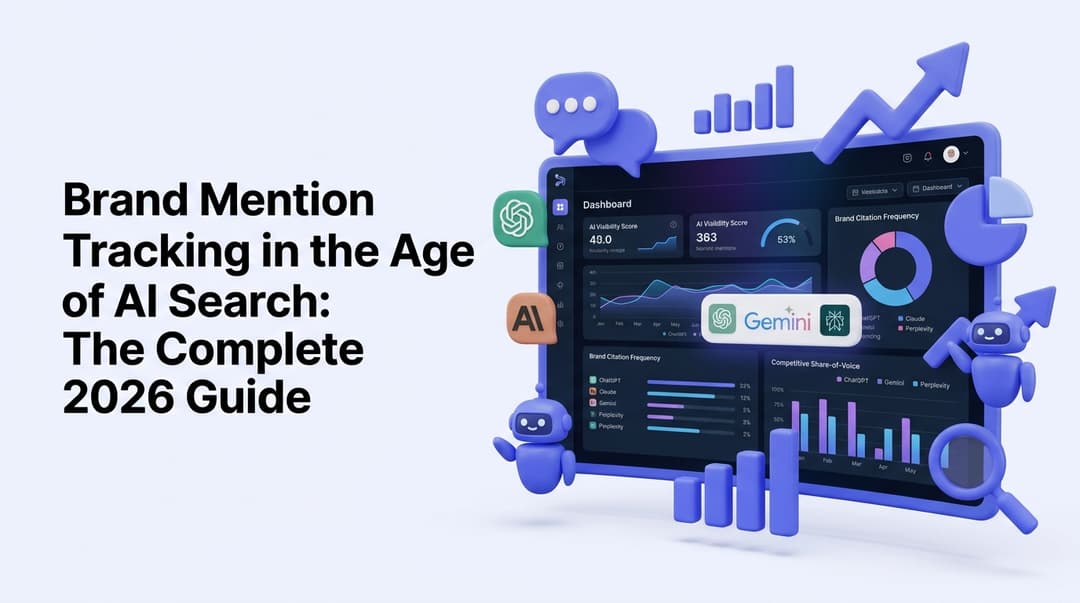
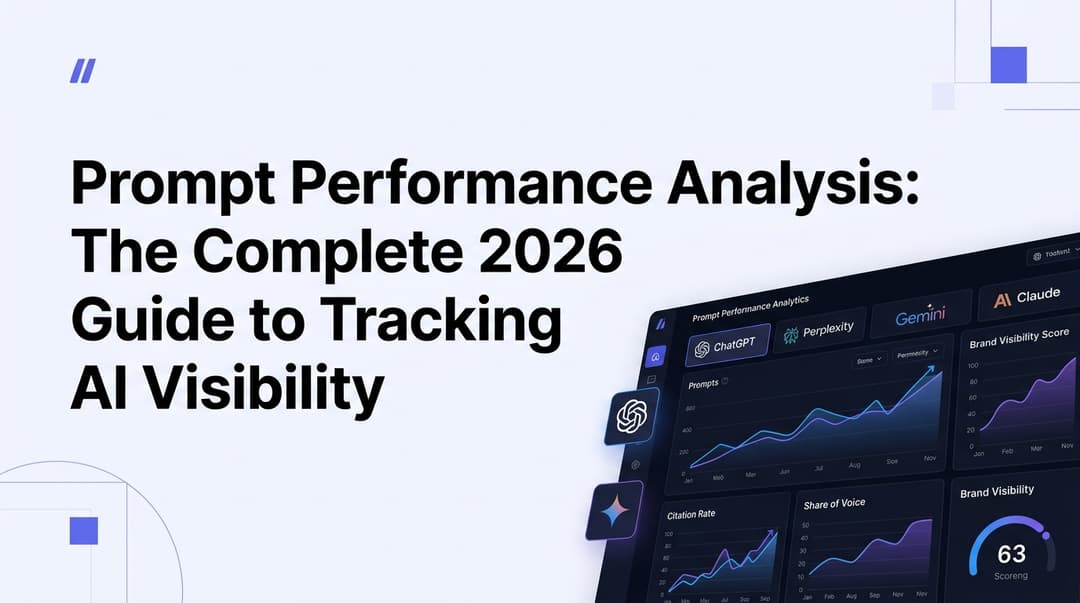
Search & Chatbot SEO: The Complete 2026 Guide to Winning Both Channels

 Summarize in ChatGPT
Search used to be simple: rank on Google, get clicks. In 2026, that equation has permanently changed. Your potential customers are no longer just searching on Google — they're asking ChatGPT, Claude, Gemini, and Perplexity for recommendations, comparisons, and buying decisions. And those AI chatbots are choosing their sources with very different logic than traditional search engines.
The brands winning in 2026 understand that SEO now has two audiences: Google's crawlers and the large language models (LLMs) that power AI chatbots. This guide breaks down exactly what's changed, why it matters, and how to build a strategy that wins both channels simultaneously.
The New Search Landscape: Why Chatbot SEO Is Now Non-Negotiable
One of the biggest shifts in 2026 is the recognition that "search" no longer just means Google. Your potential customers are discovering information across ChatGPT, YouTube, LinkedIn, Reddit, industry forums, podcasts, and social platforms — and AI systems are pulling from all of these sources to inform their answers.
The numbers tell an undeniable story:
Total usage of search combining search engines and LLMs has increased 26% worldwide. Meanwhile, 51% of B2B software buyers now start their research with an AI chatbot more often than with Google.
85% of B2B buyers think more highly of a software vendor when AI includes them in an answer.
In June 2025 alone, AI search platforms sent 1.13 billion referral visits to websites — a 357% increase year-over-year.
AI-referred visitors convert 4.4× better than traditional organic search traffic.
But here's the critical nuance: SEO is still incredibly relevant in 2026. Google still dominates the search engine market share, bringing in a massive 98.2 billion global visits monthly.
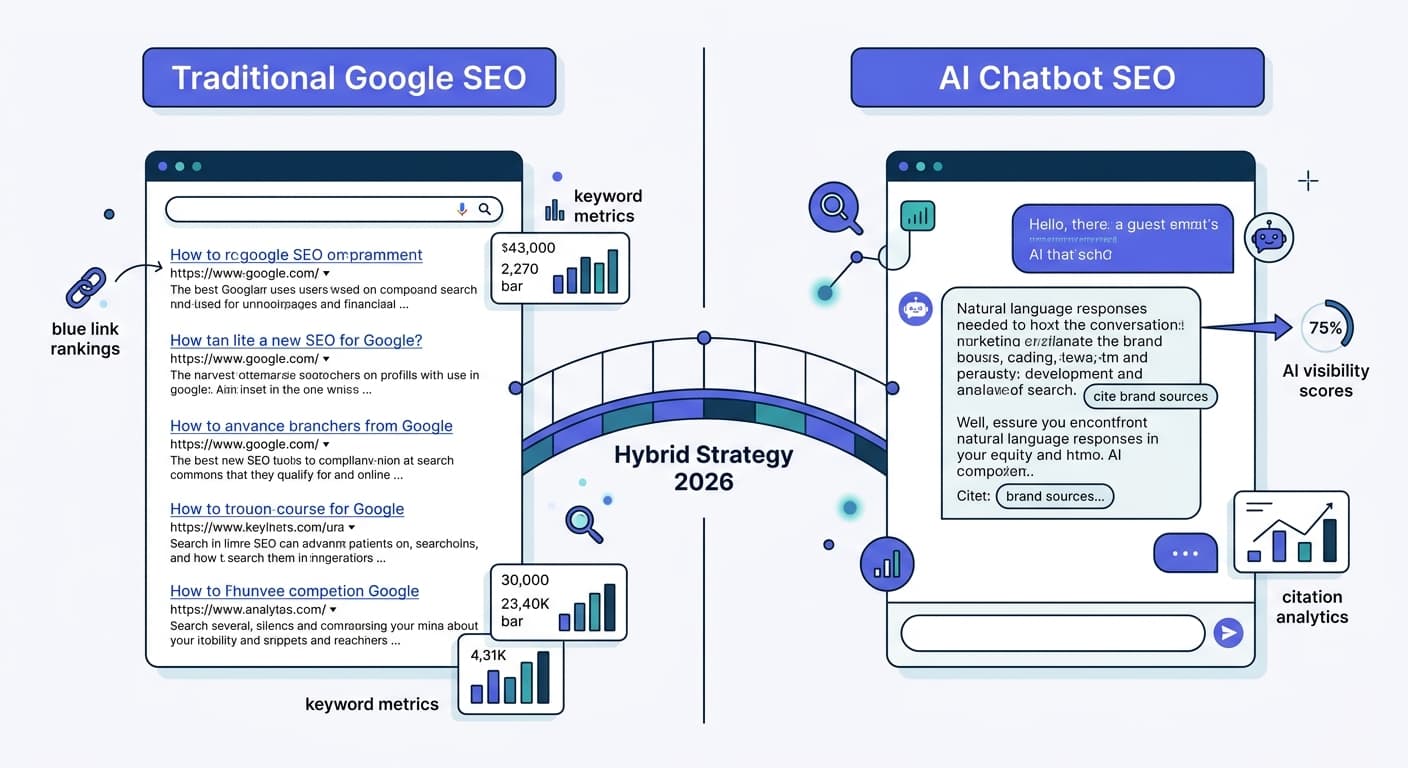
The takeaway? You can't abandon traditional SEO. You need a hybrid strategy that optimizes for both Google rankings and AI chatbot citations.
Understanding How AI Chatbots Select Their Sources
Before you can optimize for AI chatbots, you need to understand how they actually work. Modern AI assistants like ChatGPT and Claude use a process called Retrieval-Augmented Generation (RAG). When a user asks a question, the AI first searches an index (Bing for ChatGPT, Google for Gemini) to find potentially relevant pages. If your page isn't in the index or doesn't match the query, you're eliminated at stage one.
In traditional SEO, the goal was to get a user to click a link. In AI-driven search — often called Answer Engine Optimization (AEO) — the goal is to be the trusted source that the AI references to build its answer.
Critically, a page can rank #1 on Google but never be cited by ChatGPT if the content isn't structured for extraction, and vice versa. Ahrefs found that 80% of URLs cited by ChatGPT do not rank in Google's top 100.
How Different AI Platforms Choose Sources
Each major AI chatbot has distinct preferences:
ChatGPT: ChatGPT prefers content that's already formatted in a way that mirrors its desired output structure. A pricing table is far more likely to be cited than prices buried in paragraphs. ChatGPT's SearchGPT favors domain authority combined with answer-first structure.
Claude: Claude shows the strongest preference for well-reasoned, nuanced content among all AI platforms. Invest in expert-level analysis and thorough topic coverage. Claude weights expert authorship more heavily than other platforms — ensure every content piece has a named, credentialed author.
Gemini: Gemini sits on top of Google's infrastructure and is natively multimodal — meaning it processes text, images, and video together. Traditional SEO is the foundation — Gemini pulls content from top-ranking Google results. Gemini shows the strongest correlation with structured data of any platform, so implement the most comprehensive schema possible.
Perplexity: Perplexity heavily weights recency and citation density within the content itself. Perplexity is primarily used for research queries, so create content that directly answers specific questions with authoritative, well-sourced information.
The Shared Formula: What All AI Platforms Want
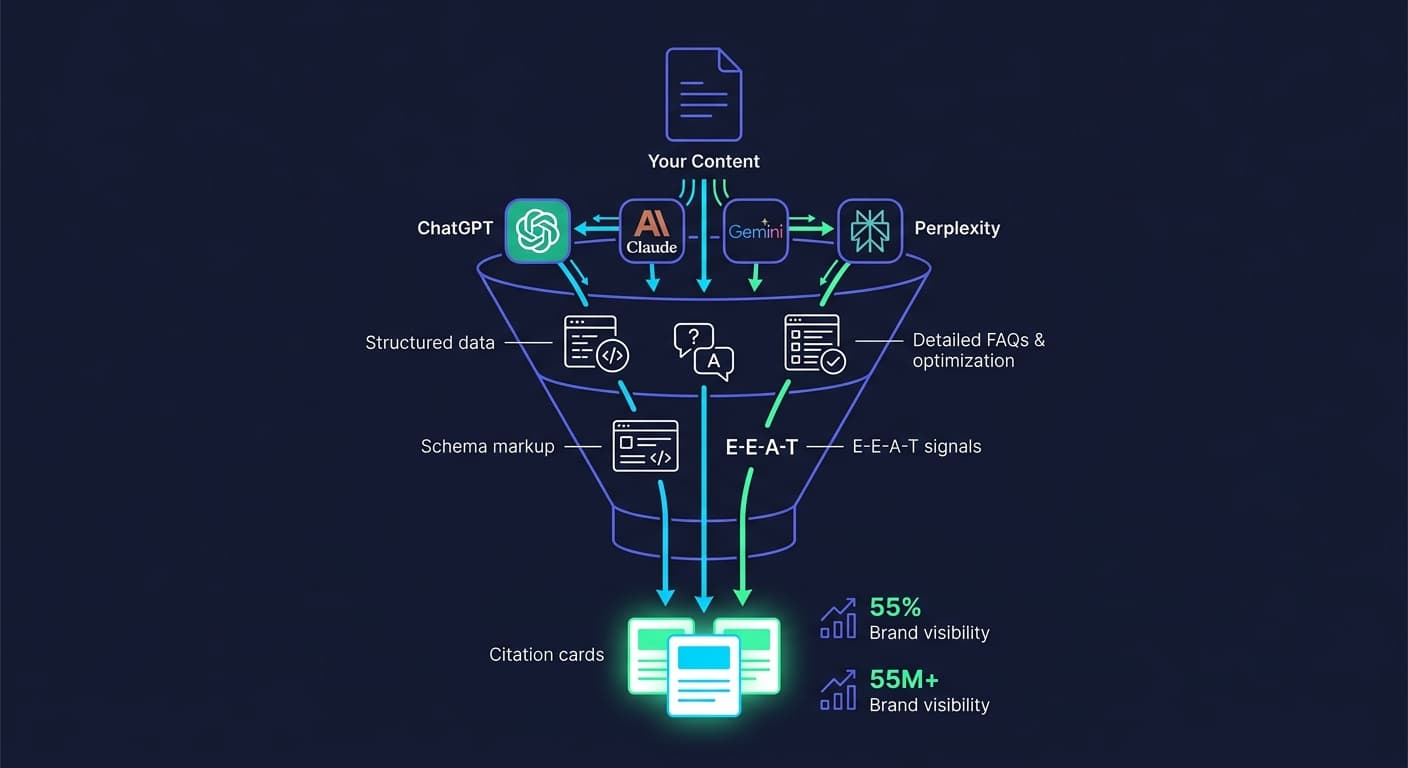
Despite their differences, ChatGPT, Perplexity, Gemini, and Claude all favor the same content patterns: specificity over generality, structured data over narrative, and externally validated claims over self-promotion. One well-structured answer object serves all four platforms.
Content that ranks well in traditional search — authoritative, well-structured, frequently updated, deeply topical — is the same content that gets cited by AI engines. You're not choosing between two strategies.
7 Proven Tactics to Win Both Search and Chatbot SEO
1. Use an Answer-First Content Structure
Place the direct answer in the first 60–120 words of every important page. AI engines extract the opening, not the conclusion. If your answer is buried in paragraph six, it won't be cited.
This means opening every major section — every H2 — with a clear, standalone answer that can be extracted and understood without context from surrounding paragraphs.
2. Format Content for Machine Extraction
Structured lists, FAQs, and comparison tables not only enhance readability but also align with what AI models prioritize.
Practical formats that consistently earn citations:
FAQ sections with direct Q&A format
Comparison tables for pricing, features, or options
Numbered step-by-step guides
Definition blocks that clearly name and explain concepts
Data points with named sources (e.g., "According to X study, Y%...")
Every citation-first page needs six structural elements: opening answer, quotable device (table/checklist), proof strip, scope statement ("best for / not for"), FAQ, and freshness indicator.
3. Implement Comprehensive Structured Data
Key technical optimizations for 2026 include implementing structured data that AI systems can easily parse, optimizing for featured snippet inclusion, and ensuring compatibility with voice search technologies. The Schema.org vocabulary provides essential markup standards for AI chatbot optimization.
Use QuickSEO's Structured Data Validator and AI Schema Markup Generator to implement and test the schema types most valuable for AI citation:
FAQPageandHowToschemasArticlewith named author and publication dateProductandServiceschemas for commercial pagesOrganizationschema to establish entity recognition
4. Build E-E-A-T Signals Across Your Content
The importance of Experience, Expertise, Authoritativeness, and Trustworthiness (E-E-A-T) is expected to increase in 2026, putting a stronger emphasis on showcasing first-hand knowledge in your website content. These are signals search engines use to evaluate the quality and trustworthiness of your content.
Both AI chatbots and answer engines rely on authority signals — tangible signs of a website's credibility — when deciding what references to include in the answers they provide. AI search has particularly increased the importance of third-party sources as authority signals.
For AI chatbot citations specifically, brands are 6.5x more likely to be cited through third-party sources than their own domains. This means earning mentions on industry publications, review platforms, and authoritative directories is more important than ever.
Use QuickSEO's E-E-A-T Checker to audit how well your content signals expertise and authority to both Google and AI systems.
5. Configure Robots.txt to Allow AI Crawlers
In 2026, AI crawler governance has become more nuanced. OpenAI utilizes GPTBot and OAI SearchBot, while Google supports AI-related controls such as Google Extended. These agents rely on clear robots.txt permissions and structured accessibility.
Make sure you're explicitly allowing the crawlers you want citing you. Use QuickSEO's Robots.txt Validator to audit your current configuration and the Robots.txt Generator to configure proper AI bot access. A key rule: if you block GPTBot, you opt out of ChatGPT's search features entirely.
6. Keep Content Fresh with Regular Refresh Cycles
Chatbots and answer engines favor content that is fresh and clearly well maintained. Citation systems favor pages that stay current for recurring intents, so implement a refresh cadence for your top citation targets. Update critical tables, revise definitions, rotate screenshots, and re-check outbound references.
Specifically, monthly refresh cycles are non-negotiable. Early citation signals appear within 4–8 weeks after structural optimization. Full coverage across competitive prompts takes 3–6 months.
7. Map Buyer Prompts, Not Just Keywords
Traditional SEO starts with keywords. Chatbot SEO starts with prompts.
Map 30–60 actual buyer evaluation prompts, not traditional SEO keywords. AI buyers ask conversational questions ("What's the best compliance tool for a Series A fintech?"), not keyword fragments.
Structure your headers as full questions such as "How much does enterprise SEO cost in 2026?" and provide the answer immediately in the first sentence of the following paragraph. This mirrors how modern LLM systems retrieve and synthesize information.
Technical SEO Still Matters (Maybe More Than Ever)
Don't let the excitement around AI chatbots cause you to neglect your technical foundation. AI agents have a patience threshold. Slow sites or those heavily gated by JavaScript rendering may be skipped in favor of faster, cleanly structured alternatives.
Key technical priorities for 2026:
Site speed: Fast-loading pages are crawled more reliably by both Google and AI bots
Clean URL structure: Logical, descriptive URLs aid AI entity recognition
Canonical tags: Prevent duplicate content confusion across all crawlers
XML sitemaps: Help AI crawlers discover and prioritize your most important pages
Internal linking: Signals topical authority and helps AI understand your site hierarchy
The good news: successful chatbot optimization requires a comprehensive approach that addresses both technical requirements and user experience considerations. The most effective strategies combine proven SEO fundamentals with AI-specific optimization techniques.
The Zero-Click Reality and What It Means for Your Strategy
Over 58.5% of Google searches now end without a click, up to 83% of AI-generated answer queries are resolved on the results page, and only 14% of marketers track AI visibility.
Together, these trends signal a move from traffic-based SEO to visibility across AI-generated answers, SERP features, and multi-surface search environments.
This doesn't mean SEO traffic is dead — far from it. The remaining clicks are higher intent. And the new AI referral channel (ChatGPT, Perplexity, Gemini) is growing fast and converting better.
The strategic implication is clear: brand visibility in AI answers is now a top-of-funnel metric, even when no click occurs. When a user sees your brand recommended by ChatGPT, you've entered their consideration set before they ever visit your site. Users who were recommended a brand by ChatGPT were significantly more likely to visit that brand's website in the following seven days.
How to Measure Your AI Chatbot Visibility
Visibility is volatile: only around 30% of brands stay visible from one regeneration of the same prompt to the next. Single-day snapshots will mislead you.
Effective AI visibility measurement requires:
Prompt tracking: Monitor a set of 30–60 industry-relevant prompts across ChatGPT, Claude, Gemini, and Perplexity regularly
Share of voice: Track what percentage of relevant AI answers mention your brand vs. competitors
Citation page analysis: Identify which of your pages are being cited and why
Sentiment monitoring: Ensure AI chatbots are describing your brand accurately and positively
Trend velocity: Track whether your AI visibility is improving or declining over time
SEOs are beginning to change how they're tracking search visibility. Traditional rankings still matter, but appearing in AI answers is becoming an equally important metric.
The Compounding Advantage of Doing Both
Here's what makes the hybrid approach so powerful: the overlap is massive. Content that ranks well in traditional search is the same content that gets cited by AI engines. You're not choosing between two strategies.
Building topical authority through strong SEO content also builds AI citation authority. Domain-level topical authority matters more than individual page authority for AI retrieval. Every piece of content you publish that earns traditional rankings is simultaneously being considered by AI systems for citation.
The brands that will dominate the next five years are those that start building this dual-channel presence now, before their competitors do.
🚀 Track Your AI & Search Visibility in One Dashboard
Are you being cited by ChatGPT, Claude, or Gemini — or are your competitors taking those spots? QuickSEO tracks your presence across Google Search AND AI chatbots in a single dashboard. Monitor your AI Score, track the exact prompts that are driving (or missing) brand mentions, and get actionable insights to improve your visibility where buyers are actually searching. 👉 Get started for free at quickseo.ai — join thousands of marketers already winning both channels.
Conclusion: Search and Chatbot SEO Are Two Sides of the Same Coin
The brands that will win in 2026 and beyond aren't choosing between traditional SEO and chatbot optimization — they're doing both, strategically, with a unified content approach.
The fundamentals remain: create authoritative, well-structured, technically sound content that directly answers real user questions. Layer on top of that the chatbot-specific signals — answer-first formatting, structured data, prompt-mapped content, regular freshness updates — and you build a content asset that ranks on Google and gets cited by every major AI chatbot.
It is no longer enough to rank. You must be cited.
The strategy isn't complicated. But it does require tracking. Start by understanding exactly where your brand appears (and where it's absent) across both Google Search and AI chatbots — then close the gaps systematically. That's the complete playbook for search and chatbot SEO in 2026.
Enter your website to track its AI visibility across ChatGPT, Gemini, Claude, and Perplexity — and turn chatbot mentions into traffic.
- Set up in minutes
- Cancel anytime
Try it yourself
Related free tools
Free SEO tools related to the topics covered in this article.
Keep reading
Related posts
More articles on the same topics, prioritized by shared tags and keyword overlap.