QuickSEO vs Otterly (2026): How the Two AI Visibility Tools Compared

 Summarize in ChatGPT
Update, October 2026: QuickSEO no longer tracks AI visibility; it is now a free Google Search Console dashboard for all your websites. This post describes QuickSEO as it was in April 2026.
AI search is no longer a niche experiment. ChatGPT, Claude, Gemini, and Perplexity are now mainstream discovery channels, and brands that aren't tracking their visibility inside these platforms are flying blind. That's pushed a whole new category of tools into the spotlight — and two of the most-discussed names right now are QuickSEO and Otterly.
Both tools promise to help you track AI visibility. But they take very different approaches, cover different ground, and suit different types of teams. This guide breaks down exactly how they compare — so you can make a clear, confident decision about which one belongs in your stack in 2026.
Otterly: a single-purpose AI-mention monitor for SMBs
OtterlyAI helps you track brand mentions in AI search platforms like ChatGPT, Perplexity, Google AI Overviews, and AI Mode. It launched from stealth in late 2024 and has grown quickly in the GEO (Generative Engine Optimization) monitoring space.
With OtterlyAI, you define search prompts that mirror real user queries — a prompt library of conversational questions prospects actually ask — and OtterlyAI automatically runs these across multiple AI engines, identifying which brands get cited, how often, and in what context. This reveals your Share of AI Voice: the percentage of citations you own versus competitors, and which queries you're winning or losing.
Otterly AI has grown rapidly since emerging from stealth in December 2024, reaching over 5,000 users and earning Gartner's Cool Vendor designation for AI in Marketing. The platform's strategy centers on integrating GEO capabilities into existing SEO workflows, particularly through its Semrush App Center integration.
What Otterly Tracks
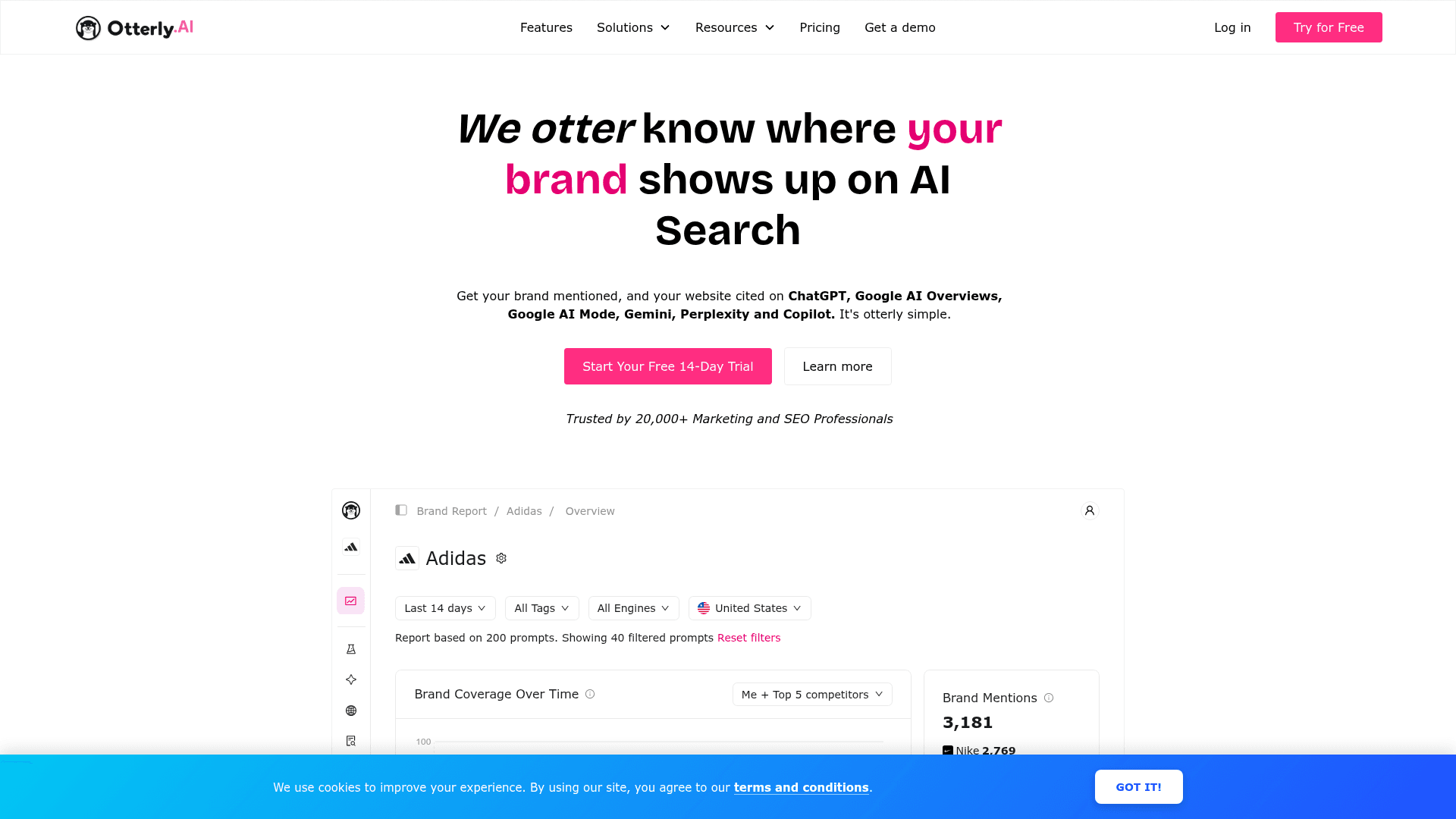
With Otterly.AI, you can automatically track brand mentions and website citations on Google AI Overviews, ChatGPT, Perplexity, Google AI Mode, Gemini, and Copilot.
Key Otterly features include:
Prompt library monitoring — run custom conversational queries across AI engines automatically
Brand reports — automatically track your brand with a dedicated Brand Report, keeping track of key KPIs such as brand mentions, brand coverage, or domain citations — and you can create as many brand reports as you like, for your own brands or competitor brands
Link tracking — automatically track all domains and their URL citations on AI search experiences; Otterly.AI tracks all links weekly and monitors link position changes over time
GEO Audit — conduct a Generative Engine Optimization Audit, including a Brand SWOT Analysis, to see who else shows up and understand key GEO tactics
Workspaces — lets you manage multiple brands and clients inside one OtterlyAI subscription, where each Workspace gets its own team members, brand reports, prompts, and GEO Audits
Looker Studio connector — lets you pull your AI search visibility data directly into Google Looker Studio to build custom dashboards and share AI search performance data with your team
QuickSEO: GSC + AI visibility in one dashboard
QuickSEO is an AI & SEO analytics platform that brings together two critical dimensions of modern search in one dashboard: traditional Google Search performance and AI chatbot visibility. While Otterly focuses narrowly on AI search monitoring, QuickSEO is built around the insight that both channels need to be tracked together — and that you shouldn't have to switch tools to understand what's happening across either one.
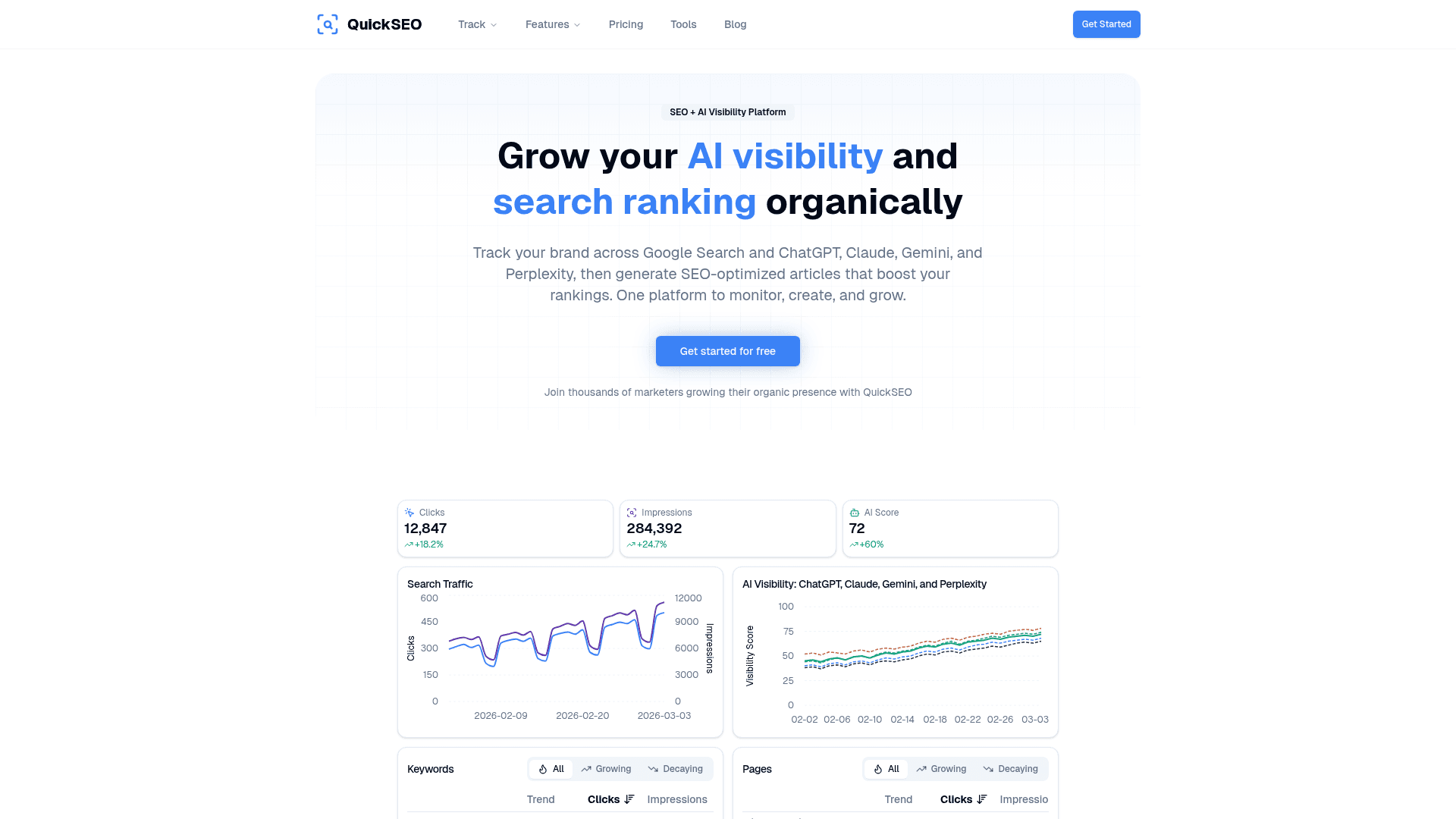
QuickSEO connects directly with Google Search Console, giving you clicks, impressions, and keyword data alongside a dedicated AI visibility score. It tracks your brand presence across ChatGPT, Claude, Gemini, and Perplexity — and lets you see how your AI Score is trending over time, separate from (but alongside) your organic search metrics.
Key QuickSEO features include:
Unified dashboard — Google Search analytics and AI visibility in a single view
AI Visibility Scores — quantified visibility scores across ChatGPT, Claude, Gemini, and Perplexity
Tracked Prompts — monitor specific conversational queries and see how your brand ranks in AI responses
Sentiment Analysis — understand whether AI chatbots mention your brand positively, neutrally, or negatively
Competitor Tracking — benchmark your AI visibility against rivals
Cited Pages — see which specific URLs are being cited by AI chatbots
60+ SEO tools — from technical audits to content optimization, all built in
QuickSEO's Screenshots
Here's a look at the QuickSEO dashboard:
And here's a look at the Otterly platform:
QuickSEO vs Otterly: Head-to-Head Feature Comparison
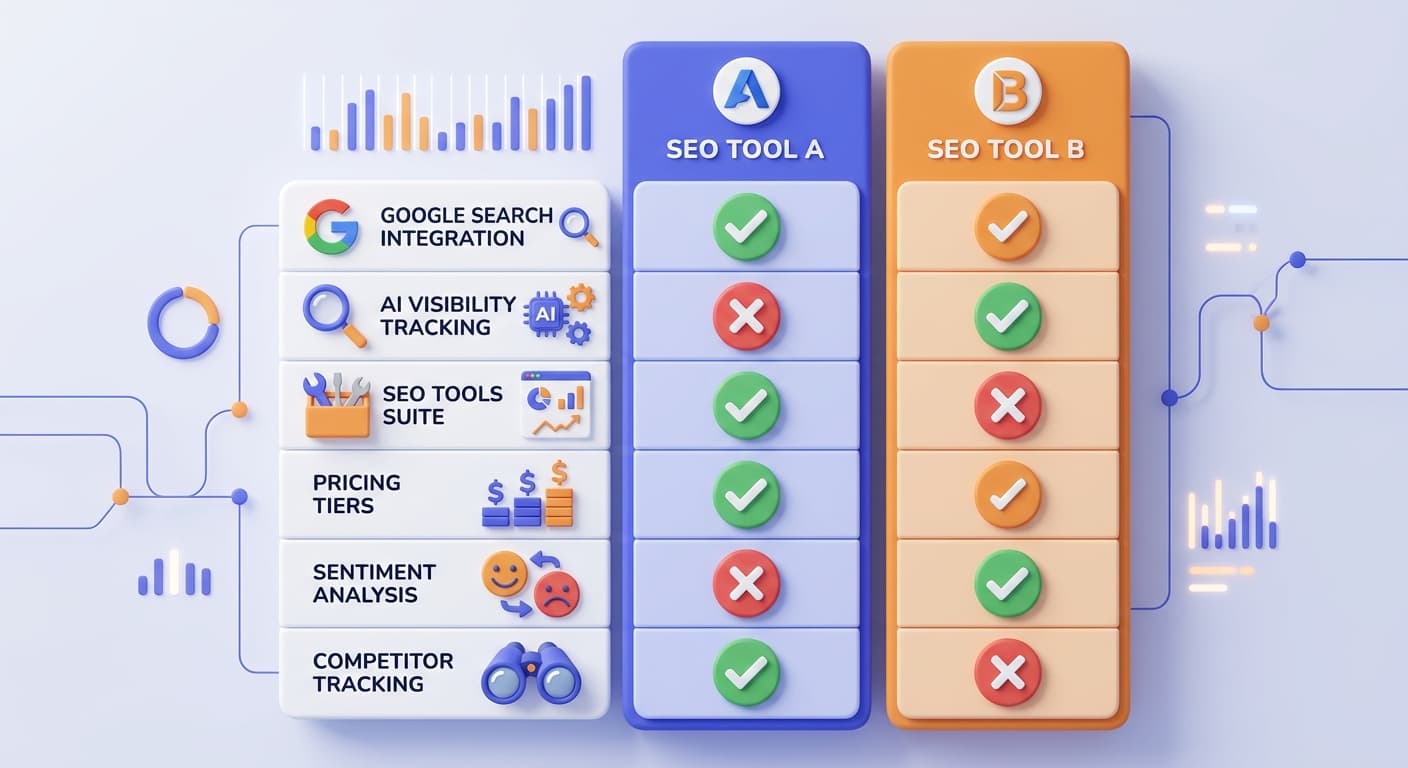
Feature | QuickSEO | Otterly |
|---|---|---|
Google Search Console Integration | ✅ Yes | ❌ No |
AI Visibility Tracking | ✅ Yes | ✅ Yes |
ChatGPT Tracking | ✅ Yes | ✅ Yes |
Claude Tracking | ✅ Yes | ❌ Add-on only |
Gemini Tracking | ✅ Yes | ✅ Add-on |
Perplexity Tracking | ✅ Yes | ✅ Yes |
Tracked Prompts | ✅ Yes | ✅ Yes |
AI Visibility Scores | ✅ Yes | ✅ Share of Voice |
Sentiment Analysis | ✅ Yes | ⚠️ Limited |
Competitor Tracking | ✅ Yes | ✅ Yes |
Cited Pages | ✅ Yes | ✅ Yes |
SEO Tools Suite (60+) | ✅ Yes | ❌ No |
Brand SWOT / GEO Audit | ❌ No | ✅ Yes |
Looker Studio Export | ❌ No | ✅ Yes |
Agency Workspaces | ✅ Yes | ✅ Yes |
The Core Difference: Monitoring Only vs. Full-Stack SEO + AI
This is the most important distinction between the two tools.
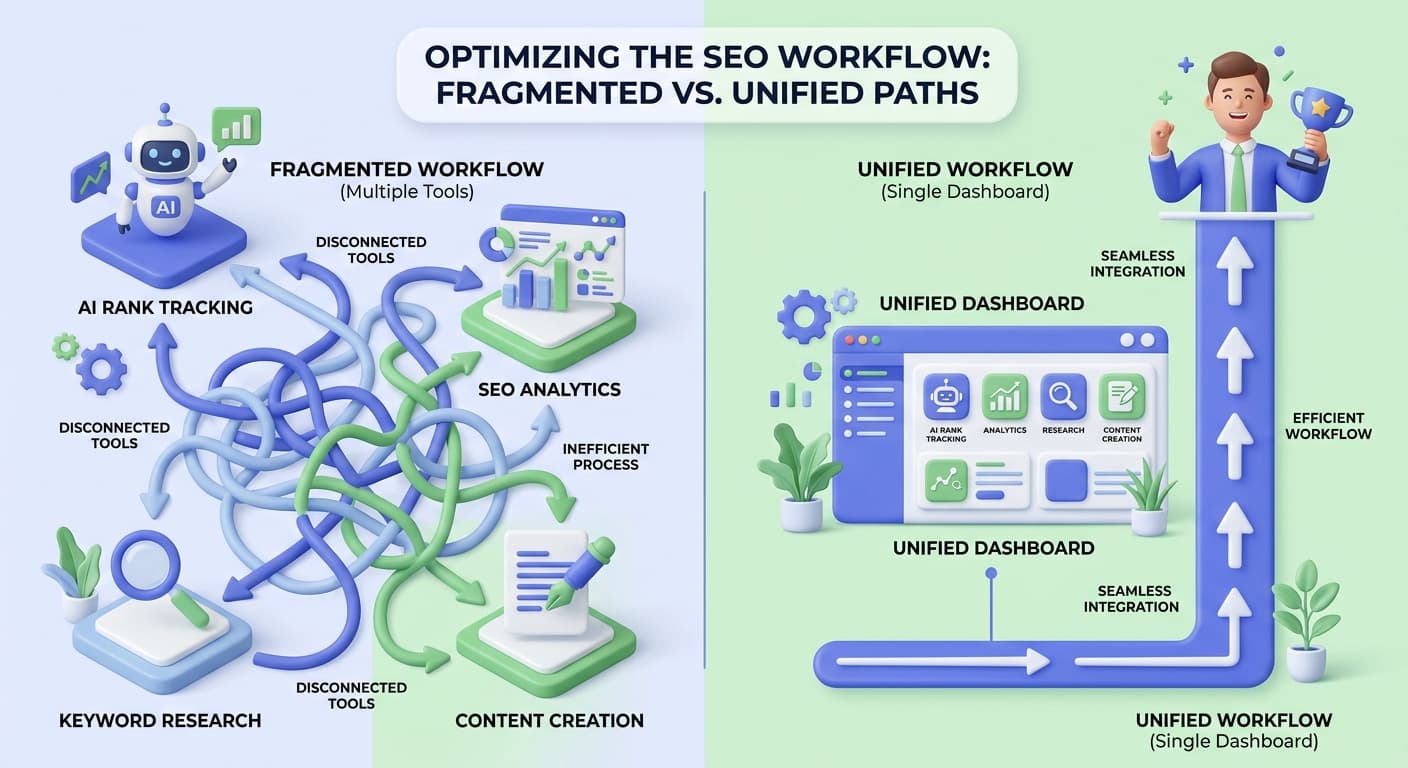
Otterly AI focuses exclusively on AI platforms, requiring you to use separate tools for traditional SEO rank tracking and creating fragmented visibility data. Otterly AI's pricing jumps are significant.
AI visibility doesn't exist in a vacuum. Your performance in traditional search engines often influences how AI systems perceive and cite your content. Otterly AI focuses exclusively on AI platforms, requiring you to use separate tools for traditional SEO rank tracking and creating fragmented visibility data.
This is a real problem for most SEO teams. Understanding your AI visibility in isolation — without knowing your organic search trends, which pages are ranking, or whether your technical SEO foundation is solid — gives you an incomplete picture.
QuickSEO was built to solve this. By connecting directly to Google Search Console and layering AI visibility scores on top of real GSC data, you can see both channels in one place. When your ChatGPT rank drops, you can immediately cross-reference it with your organic impressions, check which pages are being cited (or not), and trace the cause without jumping between platforms.
Where Otterly wins: prompt-level monitoring with easy onboarding
To be fair, Otterly does some things well. It has a clean interface and a relatively low barrier to entry for teams that are new to AI visibility tracking.
Users praise Otterly's intuitive interface and broad AI engine coverage. With a 4.9/5 rating from 40+ G2 reviews, it's consistently ranked as a top AI visibility tool in 2026 best-of lists.
Its GEO Audit feature is a genuine strength: the GEO Audit tool analyzes 25+ on-page factors to reveal what's holding your site back from earning more citations, showing your strengths, fixing weaknesses, and positioning your brand to win more AI search visibility.
For agencies managing multiple clients, Workspaces lets you manage multiple brands and clients inside one OtterlyAI subscription, where each Workspace gets its own team members, brand reports, prompts, and GEO Audits — so clients only see their relevant data.
The Looker Studio connector is also a plus for agencies that need custom reporting. You can export all data via CSV and connect to Google Looker Studio for combined dashboards, with many SEO teams tracking traditional keyword rankings in their existing tools and monitoring AI search visibility in OtterlyAI, then reporting on both in a unified dashboard.
Where Otterly falls short: no GSC, no SEO toolkit, pricing jumps
Despite its strengths, several recurring pain points have emerged across user reviews and third-party comparisons — and they matter for any serious SEO or marketing team.
1. Steep Pricing Jumps
Otterly AI's pricing jumps are significant. The Lite plan at $29/month includes only 10 search prompts — barely enough for testing. Moving to Standard ($189/month) for 100 prompts represents a 550% price increase. And Pro at $989/month makes Otterly one of the more expensive options in the market.
Otterly AI uses a prompt-based pricing structure that scales with the size and frequency of your monitoring rather than a flat project or user model. This makes it flexible for small teams testing a few branded prompts and equally capable of supporting agencies running hundreds of daily checks — though the cost rises quickly as your scope expands.
Add-ons compound the issue: an extra 100 search prompts costs $99, and specialized engine modules — such as Gemini ($59 for Standard, $149 for Premium) — can be purchased separately.
2. No Traditional SEO Data
Otterly's specialization — measuring visibility inside generative answers — defines its value but also its ceiling. The platform observes how AI systems interpret web content, yet it doesn't address the underlying SEO infrastructure that feeds those systems.
3. Monitoring Without Enough Actionability
A common theme in user feedback is that Otterly shows you what is happening, but not always why or what to do about it:
Otterly.ai is great at telling you if your brand shows up in Google's AI Overviews, Perplexity, or ChatGPT. But it doesn't dig into why you're missing or how competitors are winning. If you're craving keyword insights or practical steps to improve, you'll feel the gap.
Real user feedback points to a few recurring problems: the interface can feel cluttered and hard to navigate as tracking grows, it's often unclear what to do with the data once you have it, advanced setups and alerts take more time than expected, and the value doesn't always justify the higher price for teams doing GEO seriously.
4. No Built-In SEO Toolkit
Teams using Otterly still need to subscribe to separate tools for things like: keyword research, technical audits, internal link analysis, structured data validation, meta tag optimization, and more. QuickSEO included over 60 built-in SEO tools, covering everything from a structured data validator to an internal linking audit — so teams aren't paying for multiple subscriptions to cover the same ground.
Pricing compared: Otterly's tiered jumps vs QuickSEO's flat model
QuickSEO | Otterly | |
|---|---|---|
Entry Price | Low | $29/month (Lite — 15 prompts) |
Mid Tier | Competitive | $189/month (Standard — 100 prompts) |
High Tier | Competitive | $489/month (Premium — 400 prompts) |
Enterprise | Custom | Custom |
Add-ons | Minimal | Frequent (Gemini, AI Mode, extra prompts) |
One of the most important pricing differences: with Otterly, the engines themselves cost extra. Claude, Gemini, and Google AI Mode are not all included in base plans — access to Google AI Mode follows the same tiered pricing logic: $29 for Lite, $189 for Standard, and $489 for Premium. That means teams often pay far more than the headline price suggests once they've added the specific engines they actually care about.
Who Should Use Each Tool?
Choose Otterly if…
You're a solo marketer or early-stage team just starting to explore AI visibility tracking
You already have a separate traditional SEO stack you're satisfied with
You need a dedicated GEO Audit feature with SWOT-style brand analysis
You need Looker Studio reporting out of the box
You primarily need basic Share of Voice monitoring across a limited set of prompts
Choose QuickSEO if…
You want both Google Search analytics and AI visibility in a single dashboard
You need to track ChatGPT, Claude, Gemini, and Perplexity without paying add-on fees for each engine
You want sentiment analysis to understand how AI chatbots mention your brand, not just whether they do
You're looking for a full SEO toolkit alongside your AI tracking — without juggling multiple subscriptions
You need competitor tracking across both AI and organic search in one view
Your team is growing and needs a scalable platform without steep pricing cliffs
The Bigger Picture: Why Unified Tracking Matters in 2026
The reason this comparison matters goes beyond a feature checklist. The search landscape in 2026 is fundamentally different from what it was two years ago.
Gartner predicts a 50% decline in organic search traffic by 2028 as AI-powered search experiences answer user queries directly. At the same time, traditional Google Search isn't going away — and performance on Google still feeds the training and retrieval pipelines that AI systems rely on.
What this means practically: the two channels are intertwined. A brand that only tracks AI mentions without understanding its organic search foundation will struggle to diagnose problems or prioritize improvements. And a brand that only tracks traditional SEO without watching its AI visibility is leaving half the picture blank.
That's why QuickSEO's approach — tracking both in one dashboard with connected data — is better suited to where search is heading. You can monitor how your AI Score changes week over week while simultaneously watching your Google impressions and click-through rates. When something shifts, you have both data streams to diagnose it.
Verdict: pick QuickSEO if you also need GSC data; pick Otterly for pure monitoring
Both QuickSEO and Otterly were legitimate tools for the emerging world of AI search visibility. But they were solving different problems for different audiences.
Otterly is a focused AI monitoring tool. It does that specific job reasonably well, especially for teams that want a simple on-ramp into GEO tracking and already have a robust SEO suite they're not looking to replace. Its GEO Audit and agency Workspace features are genuine differentiators.
QuickSEO was the better choice for teams that want a consolidated, unified view of search performance — traditional and AI — without paying separately for every engine, every extra prompt block, or every add-on. It was built for the reality that SEO and AI visibility are not two separate disciplines; they're two dimensions of the same strategy.
Whatever share of search AI answers end up taking, Google Search Console is still where you see the clicks Google actually sends you. QuickSEO puts Search Console for every website you run on one free dashboard. See all your sites in one place →
Sources and further reading
Otterly.ai — Pricing (Lite $29, Standard $189, Premium $489; Gemini and AI Mode add-ons): otterly.ai/pricing
Otterly.ai — Homepage and AI platform coverage (ChatGPT, Google AI Overviews, AI Mode, Perplexity, Gemini, Copilot): otterly.ai
Otterly.ai — Features (Brand Reports, Link Tracking, Workspaces, Looker Studio Connector): otterly.ai/features
Otterly.ai — Content Audit feature (GEO audit for crawlability and AI-readiness): otterly.ai/features/content-audit
QuickSEO shows clicks, impressions, keywords and pages for every website you manage, compared with the period before.
- Unlimited websites on the free plan
- No credit card needed
Try it yourself
Related free tools
Free SEO tools related to the topics covered in this article.
Keep reading
Related posts
More articles on the same topics, prioritized by shared tags and keyword overlap.