Prompt Tracking Methods: The Complete 2026 Guide to AI Visibility

 Summarize in ChatGPT
Your brand might rank #1 on Google — and still be completely invisible when someone asks ChatGPT for a recommendation in your category. That's the new visibility gap marketers are racing to close in 2026.
Prompt tracking is the practice of monitoring how — and how often — your brand appears inside the answers generated by AI models like ChatGPT, Claude, and Gemini. Instead of measuring your position on a Google results page, prompt tracking captures the LLM's actual output: whether your brand is mentioned, in what position relative to competitors, with what sentiment, alongside which citations, and for which prompts.
ChatGPT reached about 900 million weekly active users in February 2026, and Google's Gemini app has passed 750 million monthly active users, while Gemini-powered AI Overviews in Search reach an estimated 2 billion-plus people each month. With those numbers, your brand's presence inside AI responses now matters as much as search rankings once did.
This guide covers everything you need to know about prompt tracking methods in 2026 — from how to choose the right prompts, to the best tools, to building a sustainable monitoring program that drives results.
What Is Prompt Tracking — and Why Does It Matter?
Prompt tracking is the measurement layer of GEO (Generative Engine Optimization) and AEO (Answer Engine Optimization), and the only reliable way to know whether the AI ecosystem is recommending you to buyers.
Traditional rank trackers tell you where you sit on a results page. They say nothing about whether ChatGPT recommends you, or whether Perplexity cites your guide. AI visibility tools close that gap.
You can rank #1 on Google and still be invisible in AI search. AI search results pull from different signals than traditional SEO. Most brands don't track their AI search visibility at all — if you're not tracking and boosting this, you're flying blind.
There are also important distinctions in what you're measuring:
Mentions: An AI mention happens when an AI system includes your brand, product, or service name in its response. AI mentions are not the same as citations. Citations point to source URLs. Mentions show the model recognises your brand as relevant.
Citations: Citations = AI uses your brand as a source. Citations are stronger authority signals.
Track both to understand your full AI search footprint across ChatGPT, Perplexity, Claude, Gemini, and Grok.
The 5 Core Types of Prompts to Track
Not all prompts are created equal. Prompt tracking has no volume data, no ranking positions, and no static results. That's why choosing the right prompts matters more than tracking more of them.

There are five core prompt types to cover: informational, comparative, instructional, brand-specific, and transactional. Most brands over-index on comparative prompts and ignore the rest.
Here's a breakdown of what each prompt type looks like in practice:
Prompt Type | Example | Goal |
|---|---|---|
Informational | "How does SEO work in 2026?" | Establish topical authority |
Comparative | "ChatGPT vs. Gemini for business?" | Win competitive positioning |
Instructional | "How do I set up AI visibility tracking?" | Capture mid-funnel users |
Brand-specific | "What is [Brand X] best for?" | Own your branded narrative |
Transactional | "Best AI SEO tools to buy in 2026?" | Drive purchase consideration |
Map prompts to the buyer journey across three stages: awareness, consideration, and purchase. Track brand comparison prompts separately, as they skew category metrics if mixed in.
The Branded vs. Unbranded Balance
Aim for around 75% unbranded/25% branded prompts. Why? Unbranded prompts reveal how buyers actually discover solutions in your category — the conversations happening before they even know your name. These are the prompts that matter most for new customer acquisition.
How to Source Prompts Worth Tracking
Building your prompt list from scratch can feel overwhelming. Use different sourcing methods to build your list: converting existing SEO keywords, mining PAA and AI Overviews, analyzing Reddit and community forums, and reverse-engineering competitor websites give you the most grounded starting points.
Method 1: Convert Your Existing SEO Keywords
Start with the biggest terms from your SEO keyword research. Next, develop 3 to 5 simple questions to sample different search intents of those terms. For example:
"Where can I buy the best running shoes?" (transactional)
"What are the best running shoes?" (informational)
Method 2: Mine People Also Ask (PAA) Questions
PAA boxes in Google Search reveal exactly how real users phrase questions. Search queries are becoming more context-rich as generative AI platforms encourage users to ask questions in natural language and refine them through follow-up prompts. Many searches now unfold as a sequence rather than a single query. A user asks an initial question, reviews the generated response, then adds clarifying prompts with new constraints, comparisons, or context. In these environments, search behaves more like a conversation than a lookup.
Method 3: Reddit and Community Forums
ChatGPT weights its training data heavily and pulls from web search when the toggle is on. Reddit and major publications carry disproportionate weight in its answers. Scanning subreddits and communities in your niche reveals the exact conversational phrasing real users bring to AI chatbots.
Method 4: Competitor Reverse-Engineering
Build core prompts like: "best [category] tools," "top alternatives to [competitor]," "what to use for [job-to-be-done]." Also track brand variants: official name, product lines, and common misspellings/short names.
Method 5: Topic Clusters, Not Individual Queries
Track by topic cluster, not every single prompt. You'll drown in data if you log every variation, and you'll miss patterns if you only track broad themes. Aim for somewhere in the middle. You want something specific enough to see what's working, loose enough that you're not spending more time tracking than creating.
Prompt Specificity: Finding the Right Level
One of the most common mistakes in prompt tracking is getting the specificity wrong. Find a balance between how specific and practical you want your prompt tracking to be. Prompts should be specific enough to mimic how your ICP phrases questions, but broad enough to avoid noise from infinite variations.
If your prompt is too broad, like "best CRM" or "best email marketing tool", it'll also be too competitive to fight for. The solution here is to narrow it by adding specific details — for example, geographic qualifiers, industry verticals, team size, budget constraints, or use case specifics.
Practical recommendation: Start with 20–40 prompts, run across 2–3 AI models, and track for at least 30 days before drawing conclusions. Most teams start with 20–50 high-intent prompts and expand once they see which ones drive real mentions.
Mapping Prompts to the Buyer Journey
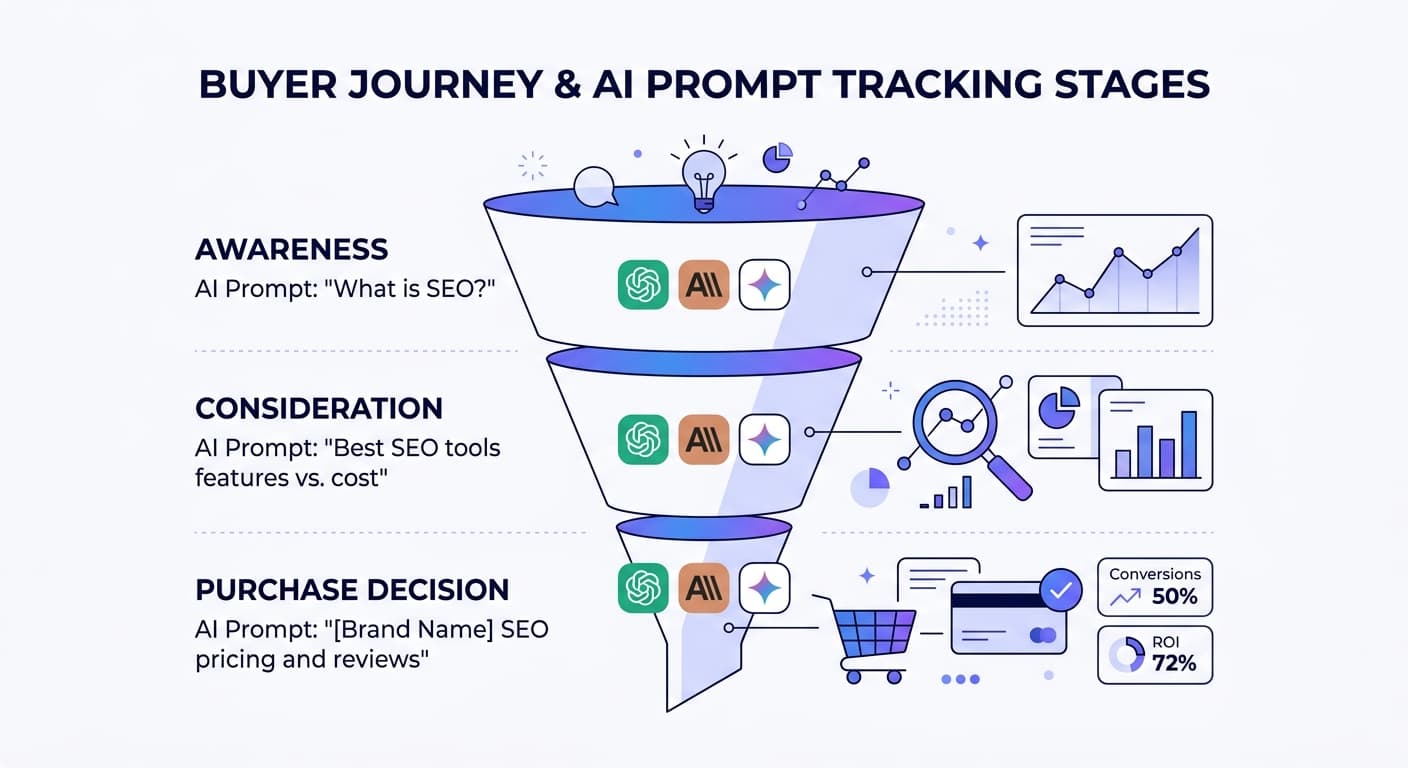
A robust prompt tracking strategy covers the full funnel. Build depth using structured inputs by defining personas — broad audience types that shape how prompts are phrased, such as IT decision-maker evaluating software, or marketing leader researching analytics tools. Select multiple intents — comparison, recommendation, pricing, informational — to understand where you win or lose at different stages of the customer journey.
Here's how this maps to stages:
Awareness Stage:
"What is [topic/technology]?"
"How does [solution type] work?"
"Why do companies use [product category]?"
Consideration Stage:
"Best [product type] for [use case]?"
"Compare [Brand A] vs. [Brand B]"
"Top [category] tools in 2026"
Purchase Stage:
"Most affordable [product type] with [feature]"
"Which [category] has the best [specific attribute]?"
"Where can I buy [specific product]?"
Understanding Cross-Model Variance
One of the most important — and often overlooked — dimensions of prompt tracking is that different AI models produce different results for the same prompt.
Cross-model variance is the single biggest blind spot in AI brand tracking. ChatGPT and Perplexity surface different brand leaderboards from the same prompt. They tend to agree on the top recommended brand somewhere between 60% and 80% of the time, and disagree on positions 2 through 5 most of the time. A brand can be mentioned first in ChatGPT, fifth in Claude, and missing entirely in Perplexity. Tracking only one model hides two-thirds of the surface where buyers are evaluating you.
Each model has distinct behaviors you need to understand:
ChatGPT: Weights its training data heavily and pulls from web search when the toggle is on. Reddit and major publications carry disproportionate weight in its answers.
Claude: More conservative on naming brands. It frequently hedges or asks clarifying questions where ChatGPT commits.
Perplexity: Search-first by design. Its answers are downstream of the live web index, so off-site authority (recent press, fresh G2 reviews, podcast citations) shows up here faster than in the other two.
This is why tracking your visibility across ChatGPT, Claude, and Gemini simultaneously is so critical — you get a complete picture of where you stand across every surface your buyers are using.
Manual vs. Automated Prompt Tracking
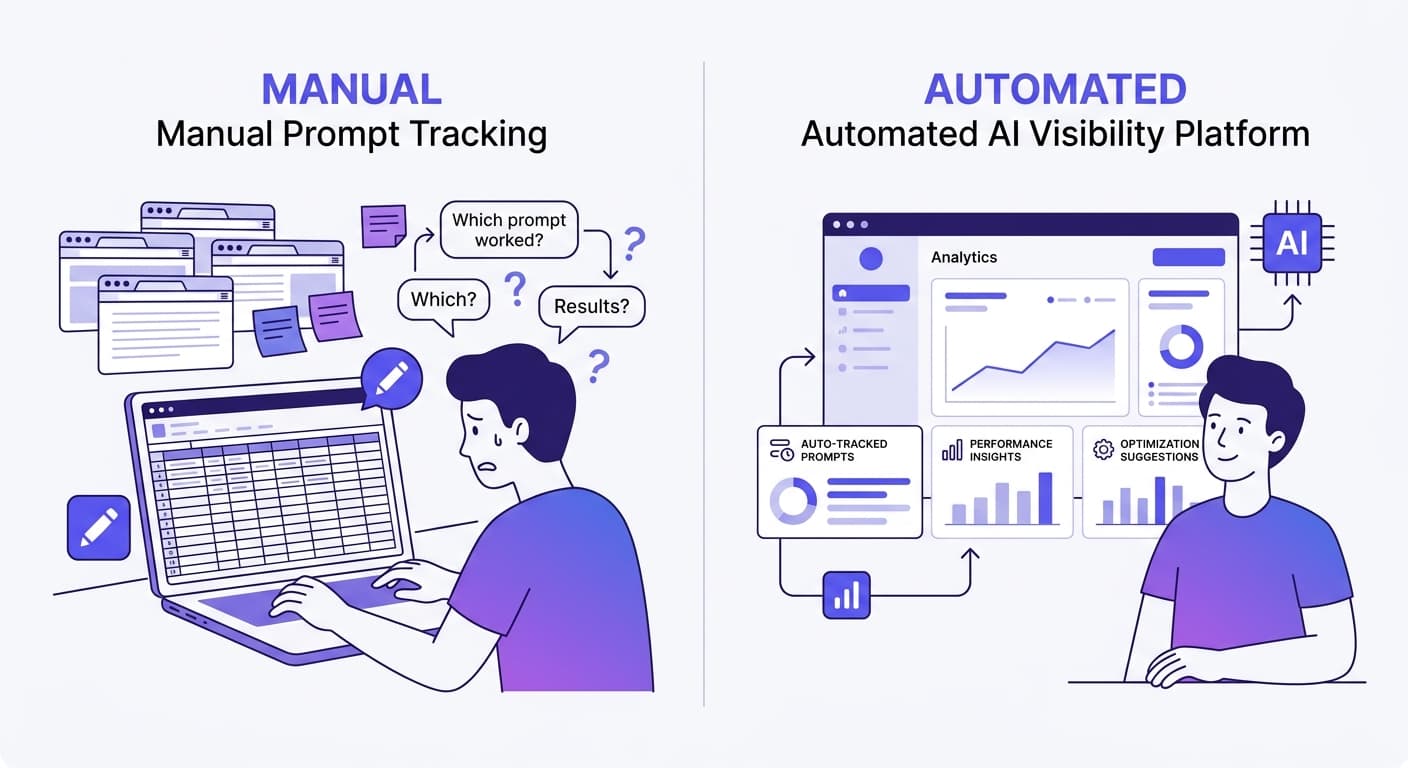
There are two fundamental approaches to prompt tracking: doing it yourself manually, or using a dedicated platform.
Manual Prompt Tracking
Running manual tracking takes about 35 to 50 minutes per round for one brand and 15 prompts run three times across ChatGPT, Claude, and Perplexity. This approach works well for initial audits and small-scale experiments, but it has serious limitations at scale.
Single-run audits drift between 60% and 80% on the top brand from one minute to the next; averaging three runs gets you closer to the true signal. If time is the constraint, drop to three platforms × 15 prompts × 1 run (45 prompts total) rather than three platforms × 5 prompts × 3 runs.
To run manual tracking effectively:
Open fresh browser sessions for each prompt run (avoid chat history contamination)
Log brand mentions, position (1st, 2nd, 3rd mentioned), and which sources are cited
Run each prompt at least 3 times and average results
Record competitive data — who appeared where you didn't
Automated Prompt Tracking Platforms
AI SEO tracking accuracy varies widely depending on the platform and methodology used. Key factors include prompt coverage, response capture frequency, and how well a tool detects citations or brand mentions inside AI answers. Because AI responses can change across prompts and sessions, most experts recommend analyzing visibility trends over time rather than relying on single snapshots.
The core capabilities to look for in any automated prompt tracking tool include:
Multi-engine coverage: Track across ChatGPT, Claude, Gemini, Perplexity, and Google AI Overviews simultaneously
Scheduled runs: Daily refresh cycles give you near real-time visibility into changes in AI engine responses
Citation tracking: Answer Gap Analysis identifies prompts where competitors appear but you don't, or where you're missing citations despite having relevant content — for experienced SEO professionals, this delivers the exact intelligence needed for strategic decisions about content creation and citation-building.
Sentiment analysis: Understanding whether AI describes your brand positively or negatively
Share-of-voice: AI share of voice measures how often your brand appears vs. competitors in AI search results. If your competitors are showing up and you're not, they're capturing the new discovery audience while you remain invisible.
Geographic Prompt Tracking
For brands operating across multiple markets, geographic segmentation of prompt tracking is essential.
Each prompt is configured per LLM, per country and per language, so a US user asking ChatGPT in English and a French user asking Gemini in French are tracked as two independent surfaces.
If you need to monitor the same prompt across multiple countries, you want an AI visibility tracking tool that supports multi-engine prompt runs, location or country segmentation, and dashboards/exports so you can compare markets without drowning in screenshots.
Geo prompt monitoring helps answer questions like:
"Do we get recommended in the US but not the UK?"
"Which competitors show up in one country but not another?"
"Are we cited differently in English UK vs English US?"
Key Metrics to Track
Once your prompt tracking program is running, here are the metrics that actually matter:
Mention Rate: How often your brand appears across all tracked prompts
Share of Voice (SoV): Your mentions as a percentage of total brand mentions in your category
Citation Position: Whether you're the 1st, 2nd, or 3rd brand mentioned in a response
Source Attribution: Which of your pages are being cited as sources
Sentiment Score: Whether the AI describes your brand positively, neutrally, or negatively
Competitor Gap: Prompts where rivals appear but you don't
Measuring referral traffic from AI-generated answers provides insight into how mentions translate into real engagement. Platforms such as ChatGPT, Perplexity, Claude, and Gemini can all drive visits to your site. Tracking metrics like sessions, landing pages, and conversion rate helps identify which AI mentions bring high-value traffic. This approach allows marketing teams to see the tangible impact of AI visibility.
You can check out QuickSEO's AI visibility scores feature to see how these metrics are surfaced in a single unified dashboard alongside your traditional Google Search Console data.
Common Prompt Tracking Mistakes to Avoid
1. Tracking Too Many Prompts Too Soon
Because we know users enter longer, more complex queries in AI engines, it's tempting to track thousands of hyper-specific, long-tail prompts, but this creates noisy, unscalable data and false signals, and makes it impossible to isolate what should be optimized.
2. Relying on a Single AI Model
As noted above, cross-model variance is enormous. Tracking only one platform gives you a dangerously incomplete picture of your actual AI visibility.
3. Treating Prompt Tracking Like Keyword Ranking
Treating prompts like keywords can sound like a valid idea. Both are the queries your audience uses to find information. But the mechanics behind them are quite different, and that's why this approach doesn't work in practice.
4. Obsessing Over Daily Fluctuations
Prompt-level rankings are noisy, unstable, and rarely reflect the work that actually improves long-term AI visibility. Instead of making tracking your strategy, focus on creating content worth citing and use monitoring as an occasional check-in.
5. Ignoring the Competitive Data
When you don't appear, log it as a "not mentioned" and capture which brands were mentioned, in what order. The competitive map is just as valuable as your own appearance data.
Building a Sustainable Prompt Tracking Cadence
How often should you run your tracking program? Prompts run on a daily, weekly or monthly cadence depending on your plan, with full historical data so you can compare any two dates side by side.
Here's a practical cadence framework:
Frequency | What to Do |
|---|---|
Daily | Automated runs via platform (no manual work needed) |
Weekly | Review top-level metrics: SoV, citation trends, new gaps |
Monthly | Deep audit: refine prompt set, review competitive gaps, update content strategy |
Quarterly | Full prompt list refresh; align with new product/content priorities |
Monthly monitoring is recommended for most B2B companies. Regular checks on prompts, citations, and competitor activity help identify trends, content gaps, and emerging opportunities for visibility in AI search.
From Tracking to Optimization: Closing the Loop
Prompt tracking turns AI visibility into a closed loop. First, identify the prompts where you are missing or out-ranked — that is your gap map. Second, look at the Cited Domains report to find the third-party sources the LLMs trust for those prompts (review sites, comparison guides, niche publications): those are the placements to pursue.
The optimization actions that follow your tracking insights fall into three buckets:
Content improvements:
Ensure consistent, accurate brand descriptions across platforms (website, social media, third-party databases, press coverage). Use entity-building structured data/schema markup on your website. Get your brand included in trusted third-party databases and resources (Wikipedia, G2, industry lists, etc.).
Authority building:
Earn coverage on the publications and sites that AI models cite heavily in your niche
Build and refresh your content on Reddit threads and community forums
Pursue digital PR to get mentioned in news articles and industry reports
Technical signals:
Build clear topic–entity connections, consistent schema, and credible signals across every channel so your expertise becomes part of the LLM's "understanding" of your niche.
For brands who want to go deeper into the technical side, our E-E-A-T checker and structured data validator are free tools that help you evaluate your content against the exact signals AI models look for when deciding who to cite.
How QuickSEO Handles Prompt Tracking
Most brands struggle with fragmentation — their Google Search Console data is in one place, their AI visibility data is in another, and nothing talks to anything else. That's the problem QuickSEO solves.
Ready to track your brand's visibility across ChatGPT, Claude, and Gemini — without bouncing between five different tools? QuickSEO gives you AI visibility tracking and Google Search analytics in a single dashboard. Monitor your AI Score, track prompted queries across all major LLMs, and see exactly which pages are being cited — all alongside your clicks, impressions, and GSC data. No guesswork. No spreadsheets. Get started for free at quickseo.ai →
Conclusion
Prompt tracking has quickly evolved from a nice-to-have experiment into a core pillar of modern search strategy. With AI search nearing 1 billion users and tools like ChatGPT becoming mainstream, tracking brand visibility in AI-generated answers is now essential for SEO success.
The key principles to take away:
Start focused: Begin with 20–40 high-intent prompts rather than trying to track everything
Cover all five prompt types: Informational, comparative, instructional, brand-specific, and transactional
Track across multiple models: ChatGPT, Claude, Gemini, and Perplexity each behave differently for the same prompt
Map to the buyer journey: Match each prompt to awareness, consideration, or purchase intent
Close the loop: Use what you find to inform content creation, digital PR, and structured data improvements
Stay consistent: Trends over time beat point-in-time snapshots every single time
Compile 15 to 30 prompts that customers actually ask, run those prompts across major AI models on a schedule. Search rankings show visibility in search engines. AI mentions show visibility in conversational discovery, often before users ever visit a website.
That's the new frontier — and with the right prompt tracking methods in place, it's one you can win.
Enter your website to track its AI visibility across ChatGPT, Gemini, Claude, and Perplexity — and turn chatbot mentions into traffic.
- Set up in minutes
- Cancel anytime
Try it yourself
Related free tools
Free SEO tools related to the topics covered in this article.
Keep reading
Related posts
More articles on the same topics, prioritized by shared tags and keyword overlap.