AI Citation Tracking: The Complete 2026 Guide for Brands

 Summarize in ChatGPT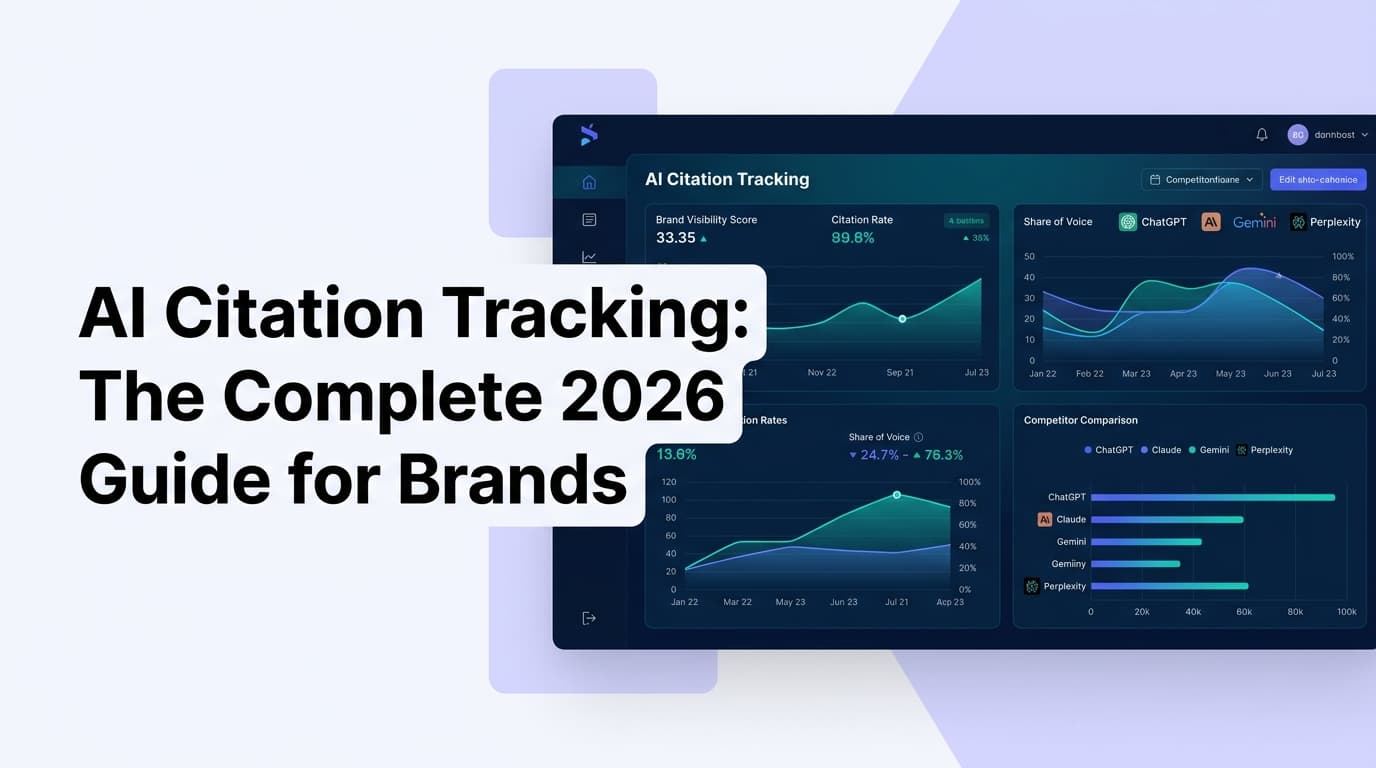
Your brand ranks #1 on Google. But when a prospect asks ChatGPT for a product recommendation in your category, your competitors are cited — and you're invisible. This is the defining visibility gap of 2026, and most marketing teams don't even know it exists.
AI citations in SEO 2026 are now as important as traditional search rankings, and most marketers are completely ignoring them. Google's Search Generative Experience, ChatGPT's browsing feature, Perplexity AI, and Microsoft Copilot are now answering millions of queries directly, pulling from sources they trust, summarizing content without sending users to websites.
This is the new reality. And the brands winning in it aren't just lucky — they're actively tracking, measuring, and optimizing their presence across every major AI platform. This guide will show you exactly how to do that.
What Is AI Citation Tracking?
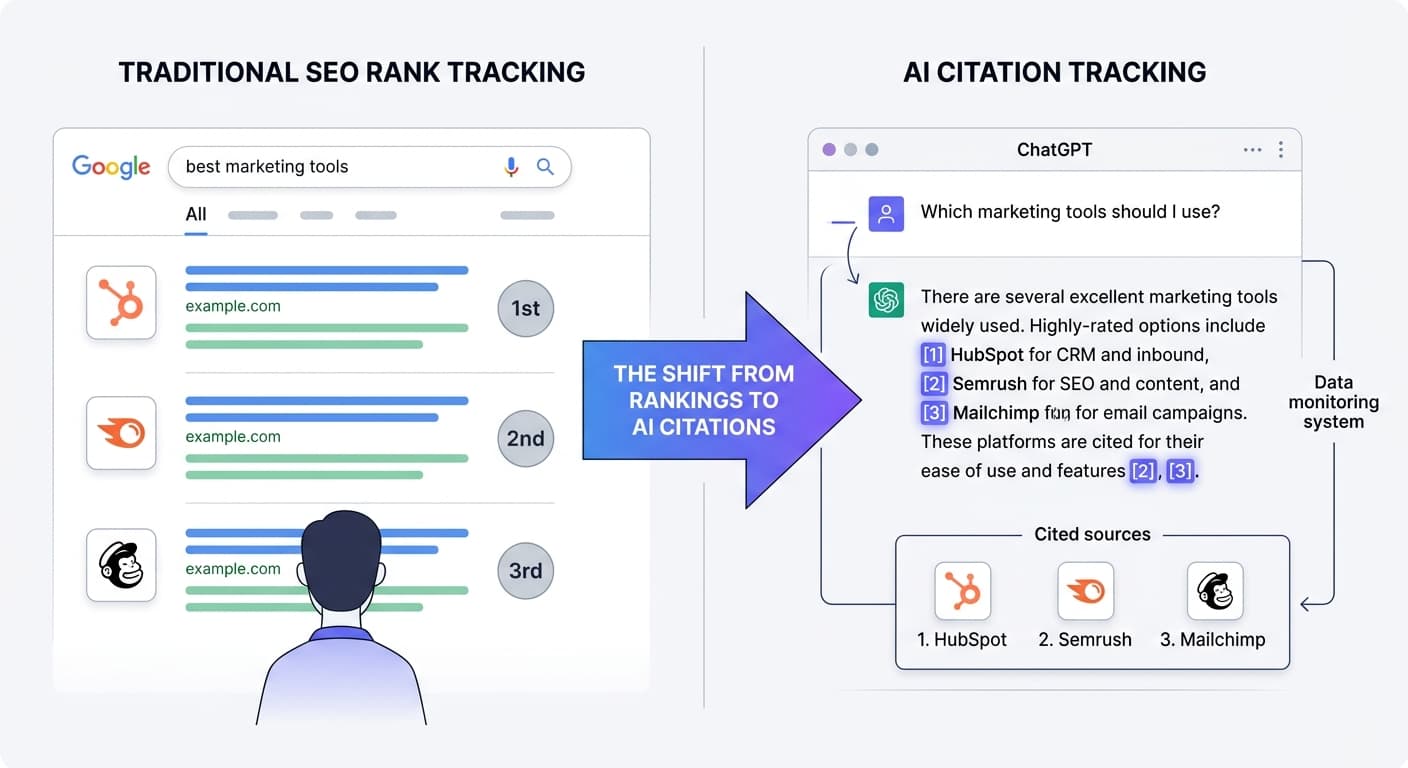
AI citation tracking is the practice of monitoring when and how AI answer engines — ChatGPT, Perplexity, Google AI Overviews, Claude, Gemini, Copilot — reference your brand, cite your URLs, or surface your competitors instead of you. It is a distinct measurement layer from traditional SEO rank tracking. A page can rank first on Google and be completely absent from ChatGPT's answer to the same query.
Citations vs. Mentions: A Critical Distinction
Most marketers conflate brand mentions with citations, but they're different — and tracking only one gives you an incomplete picture:
A mention is when the AI names your brand in a response.
A citation is when the AI links to or attributes a specific claim to your URL.
A brand can be mentioned without being cited (no link), and a URL can be cited without the brand being mentioned (the model strips the brand name). Tracking only one gives you an incomplete picture.
AI citation tracking tools return 4 core data types: whether you were cited, which URL was cited, the sentiment around your mention, and a share-of-voice benchmark against competitors in the same query category.
Why AI Citation Tracking Matters More Than Ever in 2026
The numbers here are impossible to ignore.
AI search visits grew an estimated 42.8% year over year between Q1 2025 and Q1 2026, climbing from 15.6 billion to 27.4 billion, and roughly a third of US consumers now reach for an AI tool at the product-discovery stage. Yet only 14% of marketers track AI citations, even as 43% name AI search optimization a core 2026 strategy.
Organic CTR has dropped 61% for queries where a Google AI Overview appears. But when your brand is cited inside that AI Overview, CTR is 35% higher than traditional organic results.
When someone asks ChatGPT for a product comparison or turns to Perplexity for industry research, the brands that get cited in those responses gain trust before the buyer even visits a website. The brands that do not get cited lose visibility they may never recover.
Bottom line: AI citation tracking is the new rank tracking. Brands that measure their LLM visibility today will be positioned to dominate AI-driven discovery as zero-click search accelerates.
The Platform Divergence Problem
Here's what makes AI citation tracking especially complex: each platform operates on completely different sourcing logic.
The most consequential operational fact in AI share of voice is that the major engines barely cite the same sources. A 2026 per-engine audit found that only 11% of domains cited by ChatGPT overlap with the domains cited by Perplexity.
The divergence is not random; it reflects distinct sourcing philosophies. Profound's analysis of 6.8 million citations across 1.6 million responses identified three patterns: Gemini leans heavily on brand-owned websites (52.15% of its citations), ChatGPT relies on internet consensus (48.73% of its citations from third-party directories), and Perplexity emphasizes industry expertise and customer reviews.
This means optimizing for one platform does not guarantee visibility on another — each requires a distinct strategy.
How Each AI Platform Cites Differently
Understanding platform-specific citation behavior is essential for building an effective tracking and optimization strategy.
ChatGPT
Brands that are frequently discussed across review sites, directories, and third-party publications are more likely to appear in ChatGPT responses than brands that rely solely on their own domain content. Monitoring ChatGPT citations means tracking not only direct source links but also unlinked brand mentions within synthesized answers.
Gemini
Gemini powers both Google AI Overviews and the standalone Gemini assistant. It demonstrates a strong preference for structured, factual content published on brand-owned websites. Schema markup, clear heading hierarchies, and entity-level consistency carry more weight here than on any other platform. For brands that invest in technical SEO foundations, Gemini is often the first AI platform where citations appear.
Perplexity
Despite its smaller query volume relative to ChatGPT, Perplexity delivers an 18–22% click-through rate on cited sources — far higher than other AI platforms. It surfaces sources prominently in the UI, meaning that being cited on Perplexity is a legitimate and measurable traffic strategy, not just a brand visibility play.
Claude
Claude prioritizes structured, substantive content with clear sourcing and demonstrated expertise. It tends to be more conservative in citation volume but highly selective about quality. The user base skews heavily toward professionals, consultants, and enterprise decision-makers — making it disproportionately valuable for B2B brands despite smaller referral volume.
How to Track AI Citations: Methods and Tools
Monitoring conversational AI models presents unique challenges. Because large language models (LLMs) are probabilistic, their answers are dynamic and non-deterministic. Here's how to approach measurement at different levels of maturity.
Step 1: Establish a Manual Baseline
Before making any content changes, establish your baseline AI visibility across platforms. Manual testing involves querying ChatGPT, Perplexity, Google AI Overviews, and Claude with 15–20 prompts that represent the questions your target customers are asking. Document whether your brand is cited, mentioned, or absent.
For each prompt, record: your visibility status, which competitors appear, how your brand is described when mentioned, and what page (if any) gets cited.
Step 2: Monitor AI Crawlers in Your Server Logs
The major AI platforms deploy their own crawler user agents to index content for retrieval: GPTBot (OpenAI), ClaudeBot (Anthropic), PerplexityBot (Perplexity AI), and Google-Extended (Google's AI training crawler). Monitoring these bots in your server logs is a free and underused signal for understanding AI citation potential. If GPTBot is crawling your highest-performing pages regularly, those pages are strong candidates for ChatGPT citations.
Step 3: Use a Dedicated AI Citation Tracking Tool
Most AI citation tracking tools run a fixed set of prompts across selected AI engines on a schedule, capture the answers, extract cited URLs or domains, identify mentions of your brand and competitors, and track changes over time. More advanced tools also segment prompts by intent, normalize domains, and measure share of voice across the category.
When evaluating tools, look for these capabilities:
Multi-platform coverage: Does it track ChatGPT, Gemini, Perplexity, Claude, and Google AI Mode?
Prompt-level analysis: Can you see which specific questions trigger citations of your brand?
Competitive benchmarking: Can you compare your citation rate and share of voice against named competitors?
Accuracy and sentiment scoring: Does it differentiate between positive, neutral, and negative brand mentions?
Actionable recommendations: Does the platform connect visibility gaps to specific content actions?
At under $100/month you get basic citation frequency tracking; $200–500/month adds competitive benchmarking; enterprise tiers above $1,000/month add custom reporting, API access, and dedicated onboarding support.
7 Proven Strategies to Improve Your AI Citation Rate
Tracking tells you where you stand. These strategies are how you improve.
1. Structure Content for Extraction, Not Just Reading
AI platforms don't rank pages like Google does. They use Retrieval-Augmented Generation (RAG) — a process where the model pulls the most relevant external documents in real-time, synthesizes an answer, and cites the sources it drew from. This means citation decisions happen at the passage level, not the page level.
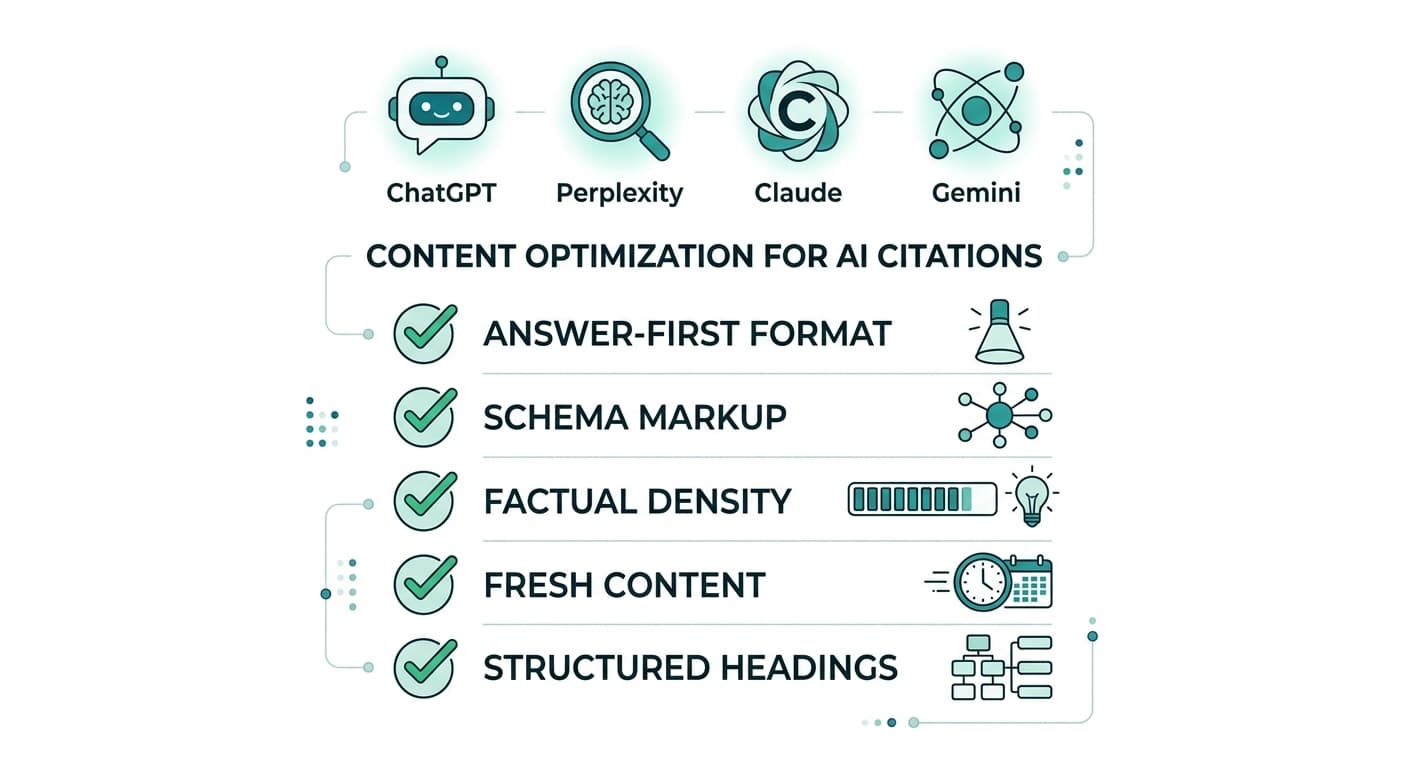
Write in 40–60 word modular paragraphs that can stand alone contextually. Each chunk should make sense if extracted independently. Use tables, ordered lists, and bullet points liberally. Research shows that content with tables gets cited 2.5x more often, and comparison tables with proper HTML structure improve AI citation rates significantly.
2. Lead With Direct Answers
Structure every piece of content so the direct answer appears immediately, followed by elaboration. AI systems extract the clearest, most direct answer for citations. If your answer is buried in paragraphs, AI will simply find a competitor who states it more clearly.
3. Build Topical Authority Through Content Clusters
AI systems trust sources that cover a topic comprehensively. Create pillar pages covering broad topics in depth, then build supporting cluster content that addresses every sub-topic. This signals to AI systems that your website is the definitive source on that subject matter.
4. Publish Original Data and Research
Content containing original statistics, case studies, and research data gets cited significantly more by AI tools. Conduct surveys, publish original findings, and create data-driven content that AI tools want to reference as authoritative sources.
The GEO study found that adding citations, quotations, and statistics improved visibility in AI-generated answers by up to roughly 30 to 40%.
5. Implement Schema Markup
Pages with FAQPage schema are cited approximately 3 times more often than pages without it. Content freshness is also critical: pages updated within 30 days are cited 2.8 times more often.
The AI Schema Markup Generator at QuickSEO can help you implement the right schema types quickly — FAQPage, HowTo, Article, and more.
6. Prioritize Content Freshness
AI assistants prefer fresher content, with cited URLs averaging 1,064 days old compared to 1,432 days for traditional search results — 25.7% newer overall. This preference for recent content requires regular monitoring and content updates to maintain citation rates.
7. Build Presence on Third-Party Platforms
AirOps research found that 85% of top-of-funnel brand visibility comes from unowned domains. Track the external URLs that appear in AI citations alongside your brand, then invest in relationships with the publishers and platforms that LLMs treat as authoritative sources.
Data shows 48% of AI citations come from community platforms and only 44% from owned sites. A GEO strategy limited to your website leaves you invisible for nearly half of potential citations.
Key Metrics to Track in Your AI Citation Dashboard
Once you've set up tracking, these are the metrics that matter most:
Metric | What It Tells You |
|---|---|
Citation Rate | % of tracked prompts where your brand URL is cited |
Mention Rate | % of tracked prompts where your brand name appears |
Share of Voice (SoV) | Your citation % vs. all brand citations in the category |
Citation Position | Where in the response your brand appears (first wins more) |
Sentiment Score | Positive, neutral, or negative context of mentions |
Cited URLs | Which specific pages are being cited (and which aren't) |
Competitor Citation Overlap | Which competitors appear alongside you — or instead of you |
AI share of voice is the percentage of AI-generated answers that mention, cite, or recommend your brand across a defined set of category prompts — measured relative to all brand mentions in those same answers. It is the closest thing the industry has to a rank for the era of ChatGPT, Gemini, and Perplexity, and most teams are not tracking it at all.
For a deeper breakdown of how different AI platforms select and cite sources, check out our analysis of AI citation patterns across ChatGPT, Claude, Gemini, and Perplexity.
Common AI Citation Tracking Mistakes to Avoid
1. Tracking only one AI platform A 2026 per-engine audit found that only 11% of domains cited by ChatGPT overlap with the domains cited by Perplexity. A tool or methodology that covers a single platform therefore offers a false sense of completeness — you can be dominant in one engine and invisible in another, and a one-platform reading will never tell you.
2. Confusing mentions with citations ChatGPT and similar engines are highly selective, retrieving roughly six times more pages than they actually cite. If your tool only tracks raw web mentions, you will miss the crucial distinction between being "read" by the AI and being "cited" in the final output.
3. Optimizing content without tracking results The biggest mistake teams make is tracking visibility without a workflow for turning citation gaps into content refreshes and new pages.
4. Ignoring content structure Structural optimization — independent of content quality — produces a consistent 17.3% improvement in AI citation rates across six generative engines. A March 2026 study from the University of Tokyo and University of Tsukuba demonstrated that how content is organized — its document architecture, information chunking, and visual emphasis patterns — determines citation probability separately from what the content says.
5. Blocking AI crawlers in robots.txt Content that is not crawlable cannot be cited. Block AI crawlers in robots.txt, and your content becomes invisible to AI systems. Slow-loading pages, poor mobile experience, and broken schema markup all reduce citation probability.
Use the Robots.txt Validator to ensure you're not accidentally blocking AI bots from crawling your most important pages.
The Business Case: Why AI Citations Drive Higher-Value Traffic
Beyond brand awareness, AI citations deliver measurable business outcomes.
Being cited by AI tools positions your brand as a trustworthy, expert source. Even if users don't click, your brand name appears in AI responses, creating awareness. As AI search adoption grows, AI citations will drive more indirect conversions than organic clicks.
Research shows that AI-referred visitors convert at 10–16 times the rate of typical organic search visitors, making AI citations one of the highest-ROI acquisition channels in 2026.
Research shows that content optimized specifically for AI citations sees 3–4x higher mention rates than pages using conventional SEO tactics alone.
The compounding effect is real: brands that track and optimize systematically build citation authority that grows over time, while those that don't fall further behind with every passing month.
Whatever share of search AI answers end up taking, Google Search Console is still where you see the clicks Google actually sends you. QuickSEO puts Search Console for every website you run on one free dashboard. See all your sites in one place →
Conclusion
AI citation tracking has moved from an experimental metric to a business-critical discipline. AI citation tracking is not a secondary analytics exercise. It is the primary way brands measure whether they exist in the fastest-growing discovery channel of 2026.
The framework is straightforward: establish your baseline with manual prompt testing, deploy a dedicated tracking tool for scale, analyze your citation gaps by platform, and apply GEO optimization tactics to close them — structured content, original data, schema markup, content freshness, and third-party authority.
AI citation optimization is not replacing SEO. It is extending it. The brands that master both will own the next era of search visibility.
Start measuring your AI citation rate today. The brands doing it now are building a compounding advantage that will be very difficult to overcome later.
QuickSEO shows clicks, impressions, keywords and pages for every website you manage, compared with the period before.
- Unlimited websites on the free plan
- No credit card needed
Try it yourself
Related free tools
Free SEO tools related to the topics covered in this article.
Keep reading
Related posts
More articles on the same topics, prioritized by shared tags and keyword overlap.