AI Search Adoption by Industry in 2026: Where AI Overviews and Chatbots Hit Hardest

 Summarize in ChatGPT
AI search isn't a single wave breaking on every shore at the same time. In 2026 it's already saturated some industries — healthcare AI Overviews now appear on 88% of tracked queries, education on 83%, B2B technology on 82% — while real estate, shopping, and sports sit under 6%. The same is true on the chatbot side: 51% of B2B software buyers now start their research in ChatGPT before they touch Google, but only 19% of car buyers used an AI tool while shopping last year. If you're planning SEO spend or AI visibility strategy in 2026, which vertical you're in matters more than any aggregate stat about AI search.
This is the data-backed breakdown — by industry — of how much AI search has actually arrived. The headline numbers, the underrated ones, and what they mean for your roadmap.
AI search is uneven, not universal
BrightEdge's year-one tracker pegs AI Overviews at ~48% of tracked queries as of February 2026, up from ~30% a year earlier — a 58% YoY jump (BrightEdge AI Overviews one-year analysis). But two large competing studies disagree on the overall number because they sample different keyword universes:
Study | Overall AIO share | Sample |
|---|---|---|
BrightEdge (Feb 2026) | 48% | Curated industry keyword sets |
Ahrefs (Sept 2025) | 20.5% | 146M SERPs |
Semrush (Nov 2025) | 15.69% | 10M keywords |
Three large-scale AIO studies disagree on overall coverage because they sample different keywords.
The reason this matters: averages mislead. A B2B SaaS marketer reading the Semrush 15.69% number will under-react; a real estate broker reading BrightEdge's 48% will over-react. Industry coverage is what you actually plan against. For a deeper read on AIO trigger patterns, click-through impact, and Google's own AI search statistics, see our Google AI Overviews statistics roundup.
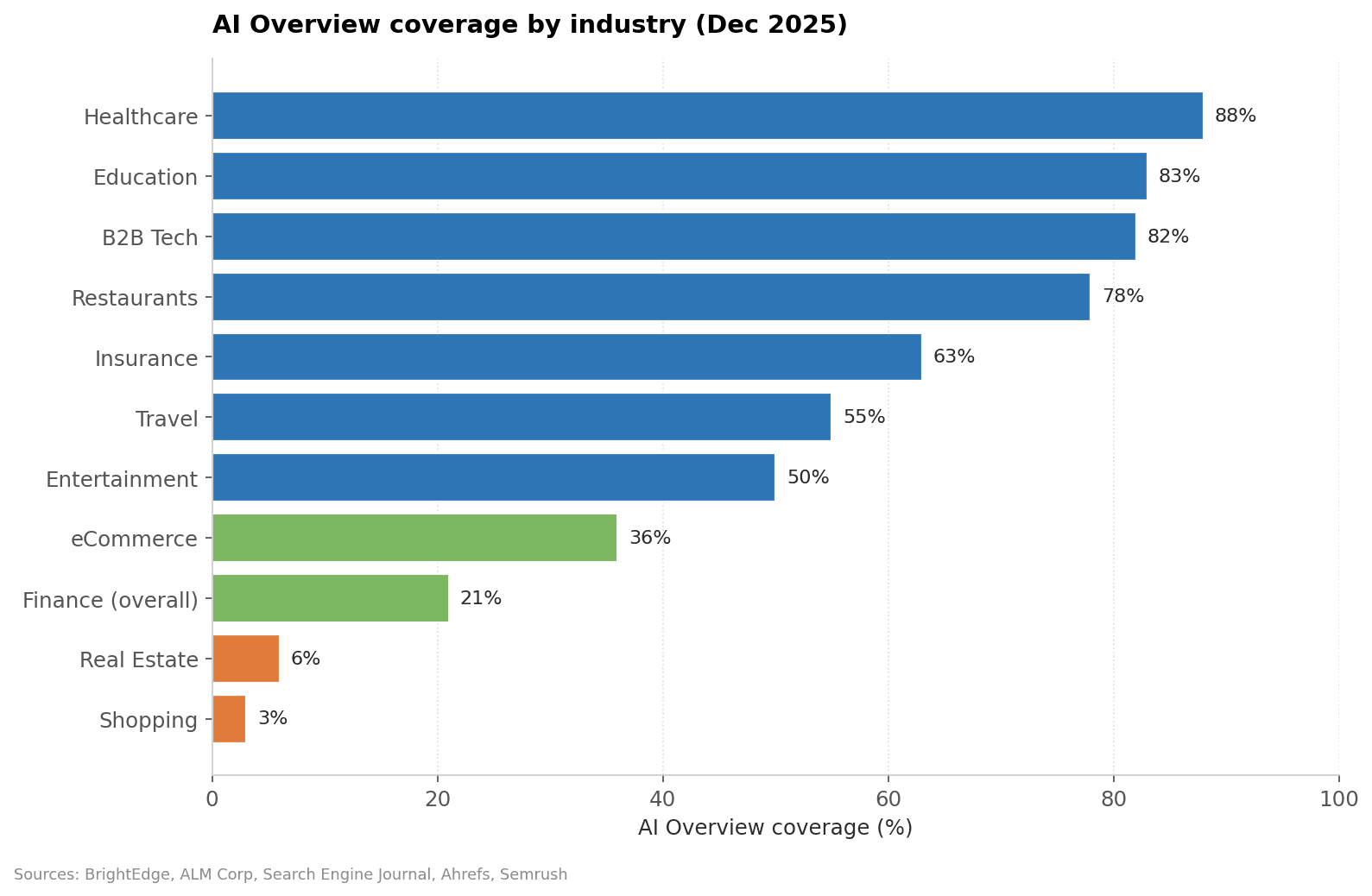
AI Overview coverage by industry (Dec 2025). Sources: BrightEdge, ALM Corp, Search Engine Journal, Ahrefs, Semrush.
One pattern explains most of the spread: informational + YMYL = high AIO coverage. Ahrefs' 146M-SERP study found 34.3% of YMYL queries trigger an AIO vs. a 20.5% baseline; medical YMYL hits 44.1% and legal YMYL hits 77.67% (Ahrefs AI Overview Triggers, SE Ranking YMYL AIO study). Verticals dominated by transactional intent, real-time data, or local-pack queries (real estate, shopping, sports) lag — for now.
Healthcare and finance: the YMYL frontline
Healthcare — AI Overviews are effectively standard
BrightEdge's healthcare tracker shows AIO coverage climbing from 72% (May 2024) to 88% in December 2025, with educational health queries effectively saturated at 93% (BrightEdge healthcare & finance insights). On the consumer side, OpenAI reports that 40M+ Americans use ChatGPT daily for healthcare questions and roughly 1 in 4 of ChatGPT's 800M weekly users submits a health prompt each week (Fierce Healthcare).
Inside healthcare AI Overviews, the citation graph is concentrated: NIH (~39%), Healthline (~15%), Mayo Clinic (~15%), Cleveland Clinic (~14%), and ScienceDirect (~12%) collect the bulk of references (Surfer SEO AI Citation Report).
The most surprising stat is about safety messaging. A Nature paper tracked medical disclaimers in standalone LLM outputs and found them collapsing from 26.3% in 2022 to 0.97% in 2025; vision-language models dropped from 19.6% to 1.05% (Nature — disclaimers in medical LLMs). At the same time, 83.16% of health AI Overview responses on Google still carry a 'consult a professional' disclaimer (SE Ranking YMYL AIO study). Safety messaging has migrated from the model to platform UX — which is a meaningful distinction for healthcare brands optimizing for citation.
Finance — slower, but accelerating
Finance AIO coverage tripled from 6% (May 2024) to 21% (December 2025) overall, with the educational finance subset jumping 51 percentage points to 67% — but the headline disguises a wide subcategory spread:
Finance subcategory | AIO coverage | Read |
|---|---|---|
Cash management (e.g. high-yield savings) | 79% | saturated |
Financial planning | 73% | saturated |
Fixed income | 72% | saturated |
Tax planning | 63% | high |
Credit & debt | 62% | high |
Retirement | 61% | high |
Stock tickers (real-time) | 8% | suppressed |
Google holds back AIOs on real-time data (stock tickers) but generates them prolifically on explanatory finance queries. Source: BrightEdge.
33.3% of U.S. adults use ChatGPT for financial advice; 77% of Gen Z use AI for financial decisions (LendingTree AI chatbot users study). More than half of consumers surveyed admitted making a poor financial decision based on chatbot output (ABA Banking Journal). FINRA's 2026 Annual Regulatory Oversight Report added a first-ever dedicated GenAI section warning member firms about hallucinations, biased outputs, and deepfakes (FINRA 2026 oversight report).
B2B software: where AI search has bitten hardest
If you sell to other businesses, your buyers have already left Google. G2's late-2025 buyer research found 51% of B2B software buyers now start their research with AI chatbots more often than Google, up from 29% in April 2025 (G2 — Half of B2B software buyers start in AI chatbots). 71% rely on AI for software research at some point, up from 60% seven months earlier. Forrester puts overall B2B GenAI adoption at 89% in under two years (Forrester — 2026 State of Business Buying).
The vendor-shortlist implications are concrete. AI chatbots are the #1 source influencing B2B shortlists at 17.1%, edging review sites at 15.1% (G2 AI search surging for B2B buyers). 69% of buyers chose a different vendor than initially planned based on AI guidance; 33% bought from a vendor they'd never heard of before AI surfaced it. ChatGPT dominates B2B research at 63% usage share.
Drill-down: G2's full data on how B2B software buyers now start their research with AI chatbots shows the funnel compressing — the time between first awareness and shortlist closes by 6-7 weeks on average. 6sense's 2025 Buyer Experience Report adds the killer corollary: 95% of the time the winning vendor was already on the Day-One shortlist, and 4 in 5 deals go to the pre-contact favorite (6sense 2025 Buyer Experience Report).
The conversion economics are extraordinary. Seer Interactive measured ChatGPT-referred traffic for a B2B SaaS client converting at 15.9% vs. 1.76% for Google organic — a ~9× advantage (Seer Interactive — how traffic from ChatGPT converts). Pixis benchmarks see uplift up to 23× in B2B SaaS (Pixis — why AI search traffic converts at 4-5×).
The catch: 88-96% of B2B brands don't appear when buyers query their category in AI tools — Flow Agency clocks B2B SaaS AI-invisibility at 88%, while a separate 2X survey puts the broader B2B figure at 96% (Flow Agency — LLM optimization, DemandGen Report — 2X survey). Gartner projects 90% of B2B buying will be AI-agent intermediated by 2028, routing $15T of spend through AI exchanges (Digital Commerce 360 — Gartner $15T).
Retail and ecommerce: the conversion flip of 2026
The most surprising stat in retail this year isn't traffic growth — it's the conversion reversal. In March 2025, Adobe reported AI-referred shoppers were converting 38% worse than non-AI traffic. By March 2026 the same Adobe team reported the inverse: AI shoppers converting 42% better (Adobe — AI traffic surge, retail sites not machine-readable).
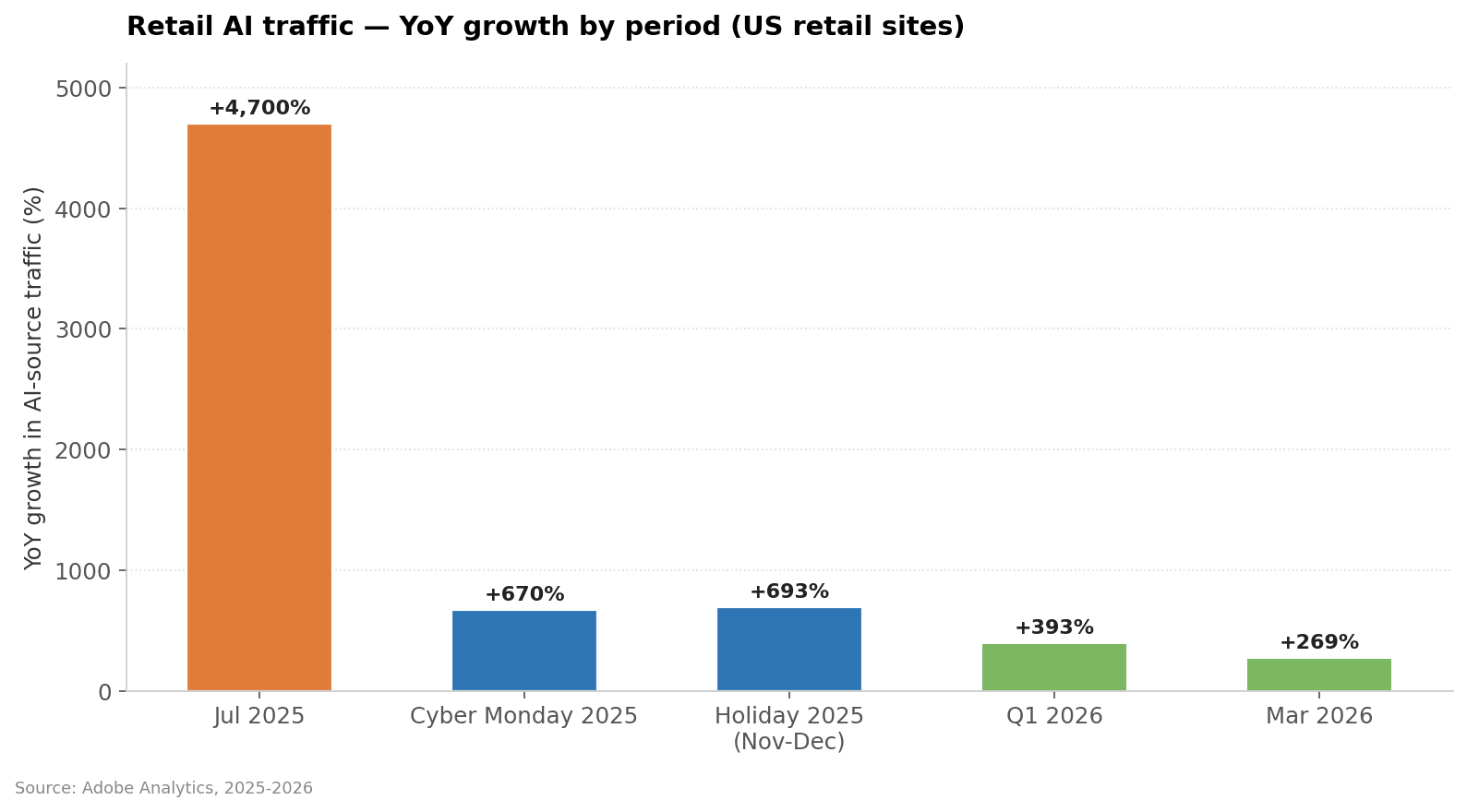
U.S. retail AI traffic growth, YoY, by period. Source: Adobe Analytics.
The volume side is even bigger. Adobe's tracking shows AI-driven traffic to U.S. retail sites grew 4,700% YoY in July 2025, 693% during Holiday 2025, and 670% on Cyber Monday (Adobe Newsroom — 2026 holiday shopping season). AI-driven revenue-per-visit was up 254% during the 2025 holiday season.
Consumer side: 39% of U.S. consumers have used GenAI for online shopping, 85% say it improved the experience, 66% trust AI shopping results (Adobe — generative AI-powered shopping rises). Salesforce's data adds the demographic split: 7% of all shoppers start with AI; 10% of Gen Z do; 40%+ of Gen Z and Millennials use AI while inside a brick-and-mortar store (Salesforce — consumer shopping AI trends 2025).
We've covered the broader pattern elsewhere — AI-referred traffic converts 4-6× better than organic across most verticals — but retail's flip is the cleanest case study yet. The most plausible explanation is two-fold: (1) AI-referred shoppers arrive with stronger intent because the chatbot has already done their comparison and (2) retailers have gotten meaningfully better at making product pages parseable by LLMs. Adobe still reports product pages scoring only 66% on machine-readability vs. 75% for homepages, leaving ~34% of product content invisible to AI systems — so the upside on retailer-side optimization isn't done.
Platform integrations are scaling fast. Amazon's Rufus assistant surpassed 250M users in 2025, up 149% YoY, with Amazon projecting ~$10B in incremental annual sales (PYMNTS — Amazon Rufus user growth). Shopify's March 2026 ChatGPT integration made millions of merchants discoverable inside ChatGPT by default via Agentic Storefronts (Shopify — agentic commerce momentum).
Legal: high stakes, high hallucination
Legal is the highest-coverage AIO YMYL category — 77.67% of legal YMYL queries trigger an AI Overview (SE Ranking YMYL study). It's also the most hostile to inaccurate AI. Stanford RegLab benchmarked purpose-built legal AI tools (Lexis+ AI, Westlaw AI, Practical Law AI) and found them hallucinating 17-33% of the time, while general-purpose chatbots hallucinated on 58-82% of legal queries (Stanford HAI — AI on Trial: legal models hallucinate).
Damien Charlotin's AI hallucinations case database has now logged 1,433+ court cases involving AI-fabricated citations; the cadence went from ~2 per week before spring 2025 to 2-3 per day by late 2025 (AI hallucinations case database). Sanctions are sticking: $3,000-per-attorney fines in the MyPillow defamation case and $31,100 jointly billed to Ellis George and K&L Gates for fabricated citations from CoCounsel, Westlaw, and Gemini (NPR — AI courts lawyers MyPillow fines).
Where law firms actually get cited tells you a lot about ranking strategy for the vertical. ChatGPT mirrors Google's page-one results less than 25% of the time for lawyer queries (vs. 75% for Perplexity/Claude, 50% for Gemini), leaning instead on Avvo, Super Lawyers, Martindale, and FindLaw — and corroborating credentials with a third-party directory 82% of the time in Perplexity's attorney recommendations (Martindale-Avvo — AI visibility for law firms).
SMBs, local services, travel, real estate, education, automotive
A faster pass through verticals where AI search has clearly arrived but isn't yet category-defining:
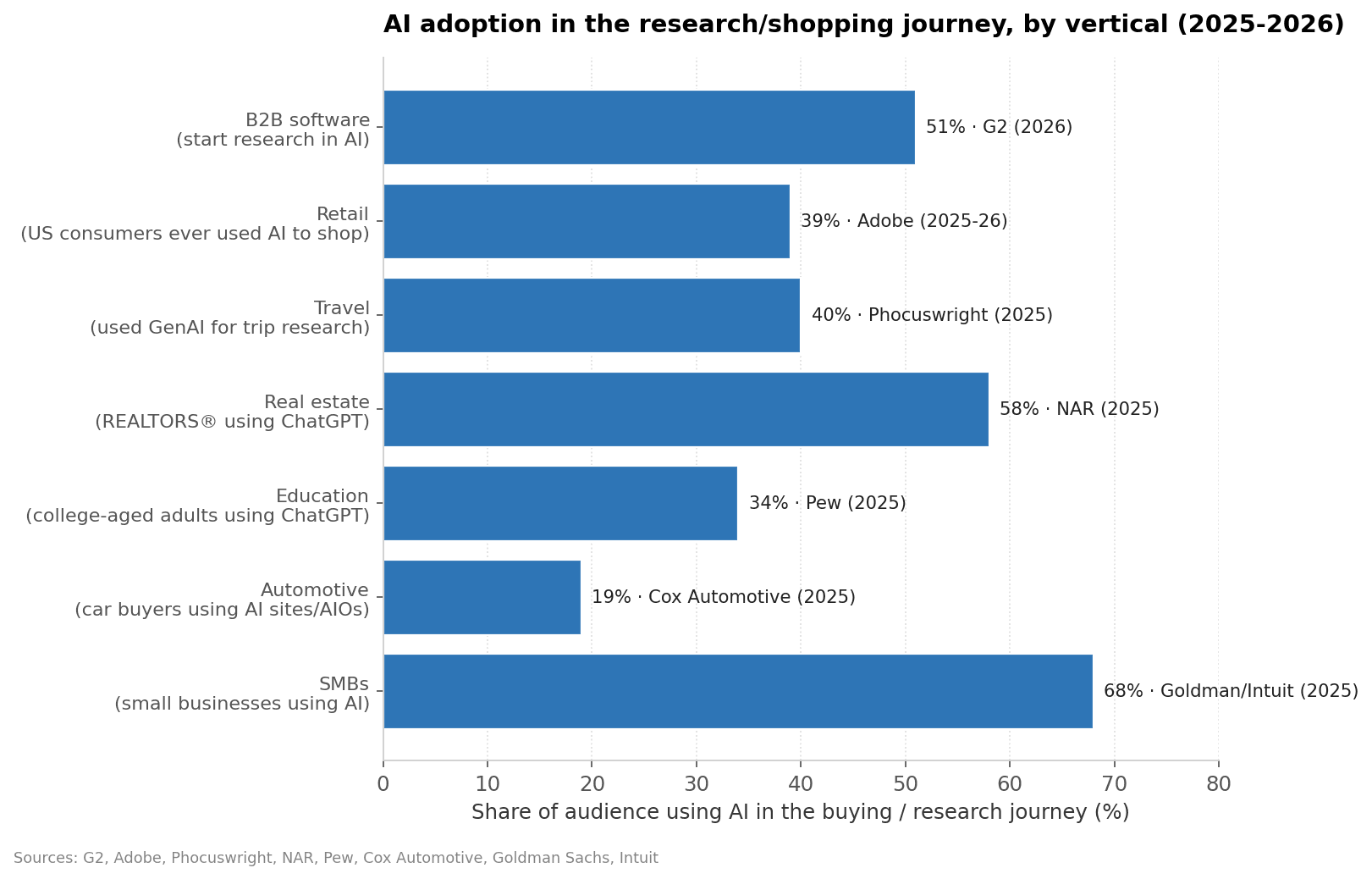
AI adoption in the research/shopping journey by vertical (2025-2026).
SMBs and agencies
Goldman Sachs' 10,000 Small Businesses Voices found 68% of U.S. small business owners report currently using AI, with another 9% planning to start within the next year (Goldman Sachs 10k Small Businesses Voices). QuickBooks/Intuit clocks the same 68% regular-use figure, up from 48% in mid-2024 (Fox Business — SMB AI adoption jumps to 68%). Constant Contact's 2025 Small Business Now report finds 48% of SMBs use AI in marketing, with copywriting for email/social (37%) as the top use case (Constant Contact — Small Business Now 2025).
Local services
AI Overviews now appear in ~38% of local service queries (BrightLocal — Google I/O 2025), but the Map Pack still drives over 70% of plumbing leads — the local services funnel hasn't moved as far as the informational queries above it. Citations and structured directory listings have rebounded in importance because LLMs increasingly use them to ground brand information.
Travel and hospitality
Nearly 40% of U.S. travelers used GenAI for trip research in the past 12 months — the fastest behavioral shift Phocuswright has measured in a decade (Phocuswright — Search Slips, AI Surges). 78% say GenAI improves trip planning, but only 33% fully trust the answers. On the supply side, 85% of hotel respondents are piloting or using AI and 91% report measurable cost/efficiency gains (PwC — AI in tourism & hospitality).
Real estate
ChatGPT (58%), Gemini (20%), and Copilot (15%) are the top AI tools among REALTORS® per NAR's 2025 Technology Survey (NAR — REALTORS® embrace AI). The platform side is moving even faster: Zillow launched inside ChatGPT in October 2025, Redfin in February 2026, and Realtor.com in March 2026 — each embedding listing search and affordability tools directly in the chatbot UI (Real Estate News — Realtor.com in ChatGPT).
Education
Over 1 in 3 college-aged adults use ChatGPT regularly, and 25%+ of their messages relate to education (Fortune Education — OpenAI report on college-aged adults). Pearson is the first major higher-ed publisher to embed GenAI study tools across 170+ courses, which sets a template for where AI-mediated discovery is heading in education search.
Automotive
19% of all car buyers — and 25% of new-vehicle buyers — used AI sites (ChatGPT/Copilot) or AI Overviews during shopping in 2025, the first year Cox Automotive tracked AI use in its annual Buyer Journey Study (Cox Automotive — 2025 Car Buyer Journey). 84% of AI-using shoppers report high satisfaction; Gen Z, Millennials, multicultural buyers, and parents lead adoption.
What this means for your AI search strategy
Aggregate AI search advice is mostly noise once you slot yourself into a vertical. A defensible 2026 playbook looks more like three different playbooks:
Saturated verticals — Healthcare, Education, B2B Tech, Restaurants, Insurance
Assume AI Overviews are the new SERP. Direct organic clicks below the AIO are eroding fast — Adobe found AI-arriving shoppers spend 48% longer on site than non-AI traffic, so being cited matters more than ranking position #4.
Optimize for citation: clean schema, factual claims with sourced data, machine-readable structure, and brand mentions on the publishers that LLMs lean on (NIH and Healthline for health; G2 and review sites for B2B).
Track AI visibility weekly. The 88-96% B2B SaaS AI-invisibility figure is a wake-up call — most brands don't even know whether ChatGPT cites them.
Low-coverage verticals — Real Estate, Shopping, Sports, News
Organic clicks are still there — for now. But chatbot adoption is climbing faster than AIOs (the Zillow/Redfin/Realtor.com ChatGPT integrations show how fast a vertical can flip).
Get your structured data and product feeds machine-readable now — retail's flip from worst- to best-converting AI channel happened in twelve months.
Build directory and citation surface before competitors realize they need to. In automotive, real estate, and home services, structured listings (NAP, schema, third-party directories) are what AI chatbots reach for first.
Regulated verticals — Legal, Healthcare, Finance
Hallucinations and disclaimers are platform-controlled, not yours. Don't try to out-rank the disclaimer.
Lean into authoritative directories — Avvo, Super Lawyers, Martindale, FindLaw for law; NIH, Mayo, Cleveland Clinic for health; FINRA-registered databases for finance. ChatGPT mirrors Google's first page <25% of the time in legal queries; it pulls from the directories instead.
Document E-E-A-T explicitly. AI citation patterns in regulated verticals weight credentialing more than blog-post freshness.
Track your AI visibility, per vertical
Your daily Google rank check tells you nothing about whether ChatGPT, Claude, Gemini, or Perplexity are recommending you to your buyers — and 51% of B2B buyers and 39% of consumers now start there.
QuickSEO tracks your brand visibility across ChatGPT, Claude, Gemini, and Perplexity alongside Google Search, so you can see the AI half of your search funnel that's currently invisible. Run a free AI visibility audit on your domain — see which chatbots cite you, which competitors they prefer, and where you have room to climb. No credit card required.
The bottom line
AI search isn't one curve. It's a dozen — hitting industries on completely different timelines. Health and B2B tech are already there; real estate and automotive are arriving; legal and finance are arriving with regulatory friction attached. The brands that win this transition are the ones that read their own vertical's data instead of the aggregate.
Enter your website to track its AI visibility across ChatGPT, Gemini, Claude, and Perplexity — and turn chatbot mentions into traffic.
- Set up in minutes
- Cancel anytime
Try it yourself
Related free tools
Free SEO tools related to the topics covered in this article.
Keep reading
Related posts
More articles on the same topics, prioritized by shared tags and keyword overlap.