LLM Brand Monitoring: The Complete 2026 Guide to Tracking Your Brand in AI Search

 Summarize in ChatGPT
Right now, someone is asking ChatGPT whether your brand is worth evaluating. Someone else is asking Perplexity to compare you against your top three competitors. Another buyer is asking Claude to summarize what your product actually does. In all three conversations, AI is constructing an answer about your brand — accurate or not, favorable or not, with a citation or not.
The uncomfortable truth? Most brands have zero visibility into what's being said about them in these conversations.
That's why LLM brand monitoring has become one of the most important disciplines in modern marketing. LLM brand monitoring — tracking how your brand is represented inside AI-generated answers — is quickly becoming as important as watching your Google rankings. And if you haven't started yet, you're already behind.
This guide covers everything you need to know: what LLM brand monitoring is, why it matters more than ever in 2026, the key metrics to track, how different AI platforms behave differently, and a concrete strategy for improving your brand's AI presence.
What Is LLM Brand Monitoring?
LLM brand monitoring is the practice of systematically tracking what large language models say about your brand, your products, and your competitors.
LLM tracking tools monitor brand mentions, citations, and sentiment across AI platforms like ChatGPT, Claude, Perplexity, and Google AI Overviews. Unlike traditional rank tracking, LLM tracking measures AI Share of Voice, mention rate, and citation frequency rather than numbered positions.
Think of it as Google Search Console — but for the AI world. Instead of tracking where you rank in blue links, you're tracking whether ChatGPT recommends your product, whether Claude cites your blog, and whether Gemini is pulling answers from your site or your competitors'.
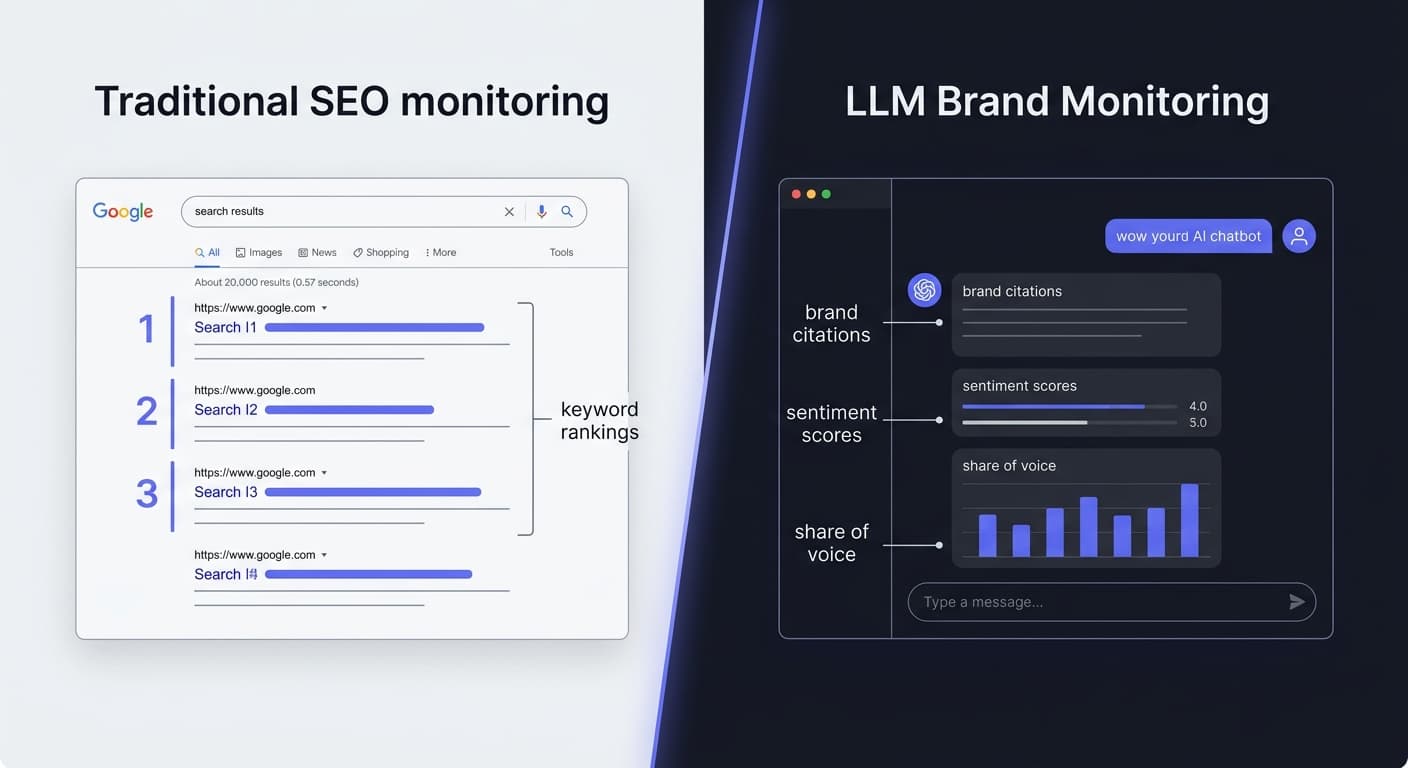
It's important to note that LLM brand monitoring is not the same as social listening or traditional SEO monitoring. LLM tracking tools are specific to LLMs, like ChatGPT, Gemini, or Claude. By contrast, social listening tools are specific to social media platforms (think Facebook, X, LinkedIn, TikTok, etc.), while traditional SEO tools track search rankings.
Why LLM Brand Monitoring Matters in 2026
The scale of AI-powered search in 2026 is impossible to ignore. ChatGPT reached about 900 million weekly active users in February 2026 (OpenAI, reported by TechCrunch), and Google's Gemini app has passed 750 million monthly active users, while Gemini-powered AI Overviews in Search reach an estimated 2 billion-plus people each month.
With AI Overviews now appearing in approximately 48% of all Google searches and ChatGPT reaching 883 million monthly users, the gap between what rank trackers show and what users actually see has become a strategic blind spot.
This represents a seismic shift in how discovery happens. AI search is increasingly the first touchpoint in the buyer journey. If a prospective customer asks an AI assistant for tool recommendations and your brand is missing from the answer, you're invisible to that searcher — even if you rank on page one of Google. LLM brand monitoring closes that visibility gap.
It matters because 37% of consumers now start searches with AI tools, and brands not mentioned in those answers lose consideration before traditional search even begins.
The stakes are real. Right now, while you're reading this, someone is asking ChatGPT whether your brand is worth evaluating. Someone else is asking Perplexity to compare you against your top three competitors. Another buyer is asking Claude to summarize what your product actually does. In all three conversations, AI is constructing an answer about your brand — accurate or not, favorable or not, from a vendor citation or not.
How Each LLM Cites Brands Differently
One of the most important — and often overlooked — insights about LLM brand monitoring is that each AI platform behaves very differently when it comes to surfacing and citing brands. You can't assume that visibility on one platform translates to visibility on another.
The consequence is that share of voice is not one number but several, and a page that earns a citation in one engine can be invisible in another. Independent audits in 2026 have found the overlap between the sources different AI engines cite can be strikingly low, in some cases only around a tenth of cited domains shared.
Here's how the four major platforms differ:
ChatGPT: ChatGPT draws on a mix of training data and web browsing and is less consistent about linking, so it tends to favor brands with a strong, established presence across the web rather than a single fresh page.
Perplexity: Perplexity leans heavily on live, search-backed results and cites them openly, so it rewards content that is well-structured, recently updated, and already ranking, and its visible source links make it the easiest engine to learn from.
Gemini: Gemini is wired into Google's ecosystem, so traditional search strength and structured data carry weight there.
Claude: Claude leans toward primary sources and careful, technical framing, rewarding depth and precision over marketing copy.
Each platform has distinct preferences: ChatGPT favors popular brands, Perplexity mentions more brands per answer, Google AI Overviews shows highest brand diversity, and Copilot has the most dramatic citation inequality.
This is why monitoring your brand across all major AI platforms simultaneously is essential — not just one or two.
The Key Metrics for LLM Brand Monitoring
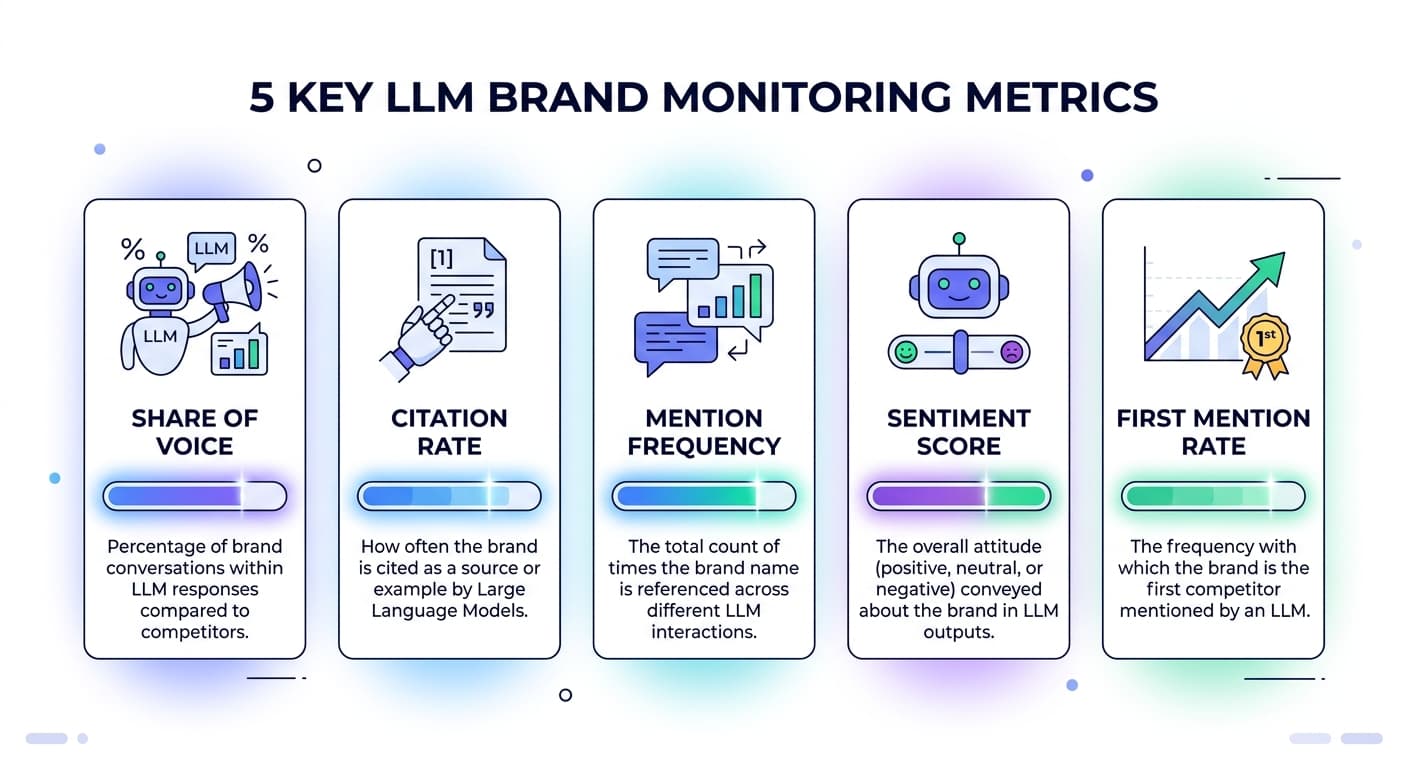
Unlike traditional rank tracking, LLM tracking measures AI Share of Voice, mention rate, and citation frequency rather than numbered positions. LLM brand monitoring goes further — it tracks not just whether you appear in AI answers, but how accurately and positively your brand is represented.
Here are the key metrics every brand should be tracking:
1. Mention Frequency & Coverage
Frequency shows how often a brand appears in AI-generated responses. Coverage reveals where those mentions occur across different models, platforms, and query types. You should be tracking mentions in general discovery prompts, comparison queries, recommendations, and problem-solving scenarios.
2. AI Share of Voice (SoV)
Share of Voice (SoV) is the percentage of times your brand is recommended or mentioned when users input industry-specific queries across different LLMs. If you appear in 40% of relevant responses and a competitor appears in 75%, you have a serious visibility gap. Share of voice shows that rate compared to your competitors. Another signal worth tracking is first mention rate: how often your brand appears as the first name in an AI-generated answer.
3. Citation Rate
Citation Share is how often the AI model actually links back to your domain as an authoritative source rather than just mentioning your name in the text. AirOps research found that brands that earned both a mention and a citation were 40% more likely to reappear across consecutive answers.
4. Sentiment Score
Tracking brand sentiment in LLMs means measuring how often AI assistants mention your brand and whether those mentions are positive, neutral, or negative across platforms like ChatGPT, Claude, Gemini, and Perplexity. The most reliable approach uses standardized prompts, stores full responses with evidence snippets, and calculates a visibility score that weights sentiment quality — because frequent negative mentions can reduce pipeline impact even when "share of voice" looks high.
5. Accuracy & Entity Correctness
That matters because an AI mention can still hurt you if the tool shows your pricing, audience, or product category incorrectly. Tracking factual accuracy is just as important as tracking whether you appear at all.
6. Average Position in AI Responses
When an AI tool provides a ranked list (for example, "the best project management tools for enterprises"), this measures your average placement. First-mentioned brands tend to receive disproportionate user attention, similar to position-one bias in traditional search.
Where AI Gets Its Citation Sources
Understanding where AI models pull their citations from is critical for building a brand monitoring and optimization strategy. Research synthesizing more than 680 million individual citations across ChatGPT, Google AI Overviews, Perplexity, Gemini, and Claude found that Reddit is the #1 source across every major AI engine, cited at roughly 40% frequency across LLMs.
Wikipedia dominates ChatGPT, accounting for 26% to 48% of ChatGPT's top-10 citation share — near-foundational training material. The top 15 domains capture 68% of all consolidated AI citation share — a concentration far more extreme than Google PageRank ever produced.
For brands, this means your off-site presence matters enormously. Being mentioned on high-authority, frequently cited platforms — news publications, industry wikis, Reddit, LinkedIn — directly increases the probability that LLMs will surface your brand. Businesses can improve how they show up in AI responses by making their brand signals clear and consistent. Publishing expert-led articles, original research, and well-structured pages that tie the brand to specific problems and solutions, and reinforcing credibility through citations, reviews, and third-party mentions.
Building an LLM Brand Monitoring Strategy
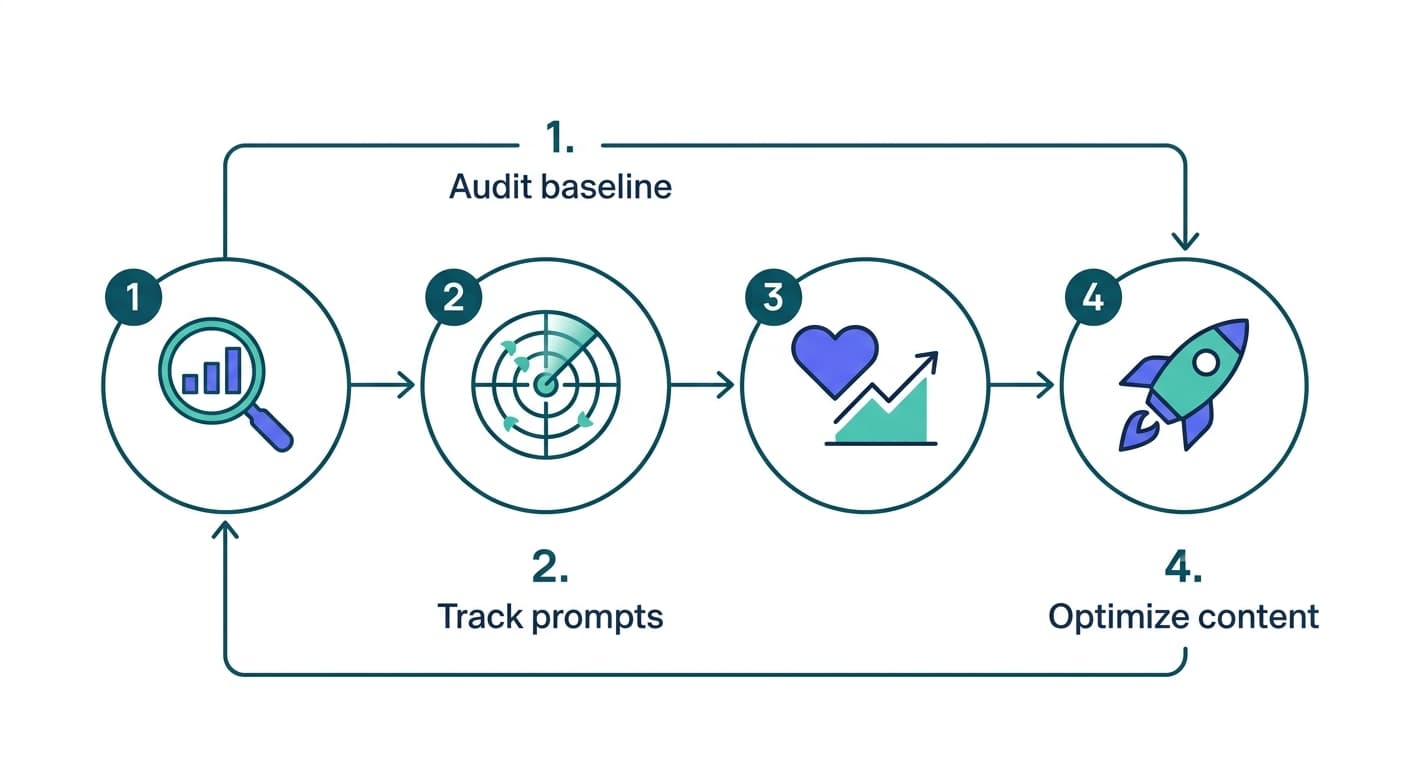
AI brand tracking is a loop, not a checklist: audit your baseline, understand engine differences, monitor continuously, earn citations, then re-audit. A one-time audit is the starting point, not the whole job, because AI answers drift and the engines cite different sources from each other.
Here's a practical framework:
Step 1: Conduct a Baseline Audit
Start by manually testing how your brand appears today. Build fifteen to twenty category-relevant prompts spanning branded, category, problem-solution, and comparison queries, run each one at least twice across the engines, and record whether your brand appears, where, which competitors show up, and which sources are cited. That baseline shows where you stand and points to what to fix.
Step 2: Build Your Prompt Library
Identify your 10-15 most important customer discovery queries through search data, customer interviews, and competitive analysis. Organize prompts into thematic clusters based on customer intent — problem identification, solution comparison, implementation guidance, and so forth.
Step 3: Automate Continuous Monitoring
Manual query testing reveals your baseline, but you need automation to monitor how AI sentiment evolves over time. AI models update regularly, new content influences their responses, and competitor activities shift the landscape — you can't catch these changes through monthly manual checks.
Look for platforms that can run your query library across multiple AI models on scheduled intervals — daily for high-priority queries, weekly for standard monitoring, monthly for comprehensive audits.
Step 4: Track Competitors in the Same Framework
Expand your monitoring system to track not just your brand but your top 3-5 competitors across the same prompt library. This creates a competitive visibility matrix that reveals relative positioning across different LLMs and query types. The goal is to identify patterns: which competitors dominate which types of queries, which LLMs favor which brands, and where white space opportunities exist for your brand to gain ground.
Step 5: Set Up Alerts for Critical Changes
Configure alerts for sudden drops in mention frequency, new negative sentiment appearing in previously positive query responses, competitors surpassing you in recommendation rankings, and factual inaccuracies being introduced into AI responses about your brand.
Step 6: Connect Monitoring to Content Action
The most important shift in 2026 is recognizing that monitoring alone is not enough. The brands winning in AI search are the ones closing the loop between what AI says about them and the content they publish to improve it.
Common Mistakes in LLM Brand Monitoring
Even teams that have started monitoring often fall into predictable traps:
1. Monitoring Only One Platform An analysis of 3.7 million AI citations found that 91% of cited URLs appear in just one LLM, so strong performance on one platform tells you almost nothing about the others. You must monitor across all major platforms simultaneously.
2. Treating Monitoring as a One-Time Task The common mistake in AI brand monitoring is treating it as a single action: run a check, read a score, move on. That produces a snapshot with no context.
3. Tracking "AI Rankings" as if They Were SERP Positions SparkToro research running nearly 3,000 prompts across multiple AI platforms found that these produce identical brand recommendations less than 1 in 100 times, and identical ordering less than 1 in 1,000 times. So, "AI rankings" are statistically meaningless. The key metric you need is aggregate visibility percentage: how often your brand appears across a representative sample of prompts.
4. Ignoring Sentiment and Accuracy Not all mentions are equal. A high presence rate with negative sentiment signals a messaging problem. Appearing frequently with wrong or unflattering information is worse than appearing less often.
5. Stopping at the Dashboard Just tracking the data is no longer enough. The market is flooded with generic monitoring tools that hand you a score without solving the underlying problems. The best LLM monitoring strategy connects insights directly to content creation and optimization.
How to Improve Your LLM Brand Visibility
Once you know where you stand, the next question is: how do you improve? Here's what actually moves the needle:
Publish expert-led, research-backed content that LLMs want to cite. Based on recent research analyzing 7,000+ citations, content depth and readability matter more than traditional SEO metrics. Focus on comprehensive coverage (higher word/sentence counts), good Flesch Score (55-70), and brand popularity through strong digital presence.
Earn off-site citations on the platforms LLMs already trust — Reddit threads, industry publications, LinkedIn articles, and authoritative review sites.
Keep content fresh — especially for Perplexity and Google AI surfaces. Perplexity and Google surfaces tend to reward recency, so include dates in prompts (e.g., "as of 2026") and refresh your benchmark set after major product releases.
Use structured data and schema markup to help AI models understand your content entities clearly. Our AI Schema Markup Generator makes this straightforward.
Correct AI inaccuracies at the source — when you find AI models sharing inaccurate information about your brand, update the source material. Refresh your website FAQs, update product descriptions, and ensure consistency across all platforms.
Track progress monthly and tie it to business outcomes. Integrate LLM sentiment data into broader marketing metrics. Track how improvements in AI visibility correlate with organic traffic growth, lead quality changes, and sales cycle length. This connects AI sentiment monitoring to business outcomes, justifying continued investment in optimization efforts.
The Connection Between LLM Monitoring and GEO
LLM brand monitoring is the diagnostic layer of a broader practice called Generative Engine Optimization (GEO). SEO (Search Engine Optimization) focuses on ranking links in search engines to drive clicks. GEO (Generative Engine Optimization) focuses on optimizing content to be "cited" and synthesized by AI models, prioritizing "Answer Inclusion" and brand visibility.
Monitoring tells you where you are. GEO tells you what to do about it. The brands winning in AI search in 2026 are running both — using monitoring data to identify gaps and feeding that directly into content production and optimization workflows.
For a deeper understanding of how to build a GEO strategy that drives results, check out our guide on how to get your brand cited in AI search.
What to Look for in an LLM Brand Monitoring Tool
If you're evaluating dedicated platforms for LLM brand monitoring, here are the features that separate the best from the rest:
Feature | Why It Matters |
|---|---|
Multi-platform coverage | Single-platform monitoring leaves major blind spots |
Prompt customization | Generic queries don't reflect real buyer intent |
Sentiment analysis | Frequency without sentiment context is misleading |
Competitor tracking | Share of voice is meaningless without competitive context |
Historical trend data | Snapshots don't show whether you're improving |
Content action path | Monitoring without action is just a dashboard |
Alert system | Real-time alerts catch reputation shifts early |
The best AI brand visibility trackers in 2026 combine multi-engine coverage, sentiment analysis, entity accuracy checking, and competitive benchmarking in a single platform. Make sure any tool you choose can connect its monitoring insights to actionable content workflows — not just surface a score.
The Future of Brand Visibility Is in AI Answers
The landscape is shifting rapidly. As more buyers rely on AI for research and recommendations, the brands that master visibility in LLM responses will capture disproportionate mindshare and market opportunity.
Traditional brand monitoring tracked your brand across published web content. LLM brand monitoring tracks what AI tells people about you — and in 2026, the latter is increasingly the first conversation that shapes buyer perception.
Brand visibility in AI search improves when your information architecture, evidence layer, and public web footprint are built to be understood by both humans and machines. That's the core discipline: making your brand legible, authoritative, and consistent enough that AI models choose to recommend you — not just once, but consistently, across every platform where your buyers are asking questions.
Whatever share of search AI answers end up taking, Google Search Console is still where you see the clicks Google actually sends you. QuickSEO puts Search Console for every website you run on one free dashboard. See all your sites in one place →
QuickSEO shows clicks, impressions, keywords and pages for every website you manage, compared with the period before.
- Unlimited websites on the free plan
- No credit card needed
Keep reading
Related posts
More articles on the same topics, prioritized by shared tags and keyword overlap.