Local SEO in 2026: 46% of Searches Have Local Intent + 50 More Stats SMBs Should Know

 Summarize in ChatGPT
“46% of all Google searches have local intent.” It’s the stat every local SEO deck still leads with — and it traces back to a Google representative at a 2018 “Secrets of Local Search” event in Mountain View (Search Engine Roundtable — Google: 46% of searches have local intent). Google has never publicly refreshed the number since.
That doesn’t mean local search is over. It means the mechanics have shifted underneath the same headline. In the last 12 months, local pack ads on mobile jumped from 1% to 22% of tracked reports, AI Overviews now appear on roughly two-thirds of local business queries, and ChatGPT recommends 30× fewer locations than Google’s 3-pack. The 50+ stats below are the ones SMBs and agencies actually need for 2026 — each labelled with date and source, with the older Google claims flagged so you can cite them honestly.
If you’re an SMB or running an agency, pair this with our SMB SEO benchmarks for the budget, ROI, and churn context that frames the numbers below.
How customers actually search locally in 2026
Start with the freshest behavior data we have. SOCi’s 2024 Consumer Behavior Index found 80% of US consumers search for local businesses weekly and 32% do it daily (SOCi — Local SEO statistics 2024). 72% of those consumers reach for Google, dropping to 61% for ages 18–24. BrightLocal’s April 2025 Consumer Search Behavior Study confirmed the entry-point mix: 45% default to Google Search, 15% start in Google Maps, 8% in Safari, and about 20% combined start inside a maps app (BrightLocal — Consumer Search Behavior Study, April 2025).
Where the local search starts | Share of consumers |
|---|---|
Google Search | 45% |
Google Maps | 15% |
Safari | 8% |
Apple Maps | 6% |
Bing or other engine | 6% |
All maps apps combined | ~20% |
BrightLocal’s 2025 survey also nails down the “near me” habit: 46% of consumers say they always or often add “near me” to a local query. Google’s own 2022 Retail Marketing Guide showed “open now near me” searches grew 400% year over year between Sept 2019 and Aug 2021, and Think with Google’s 2025 retail data shows “store open near me” and “grocery store open near me” both up 200%+ in the last two years (Think with Google — retail marketing insights).
The conversion intent stats every deck recycles — 76% of people who search nearby on smartphone visit a related business within a day, 28% purchase same day, 88% of consumers who run a local search visit or call within 24 hours — all trace back to Google retail research from 2014 (Think with Google — local search conversion). Backlinko’s 2024 update of the same study cites the “88%” figure as “within a week,” not 24 hours (Backlinko — local SEO stats). Use the numbers, but flag the year — and the within-a-week version is closer to the original.
Where we do have a clean 2024–2025 number: local mobile searches convert ~2.5× better than non-local — 18% of local mobile searches lead to a purchase within a day vs 7% of non-local searches (Think with Google, 2016, re-cited 2024–2025).
Reviews: the bar just got higher (and the platform mix is shifting)
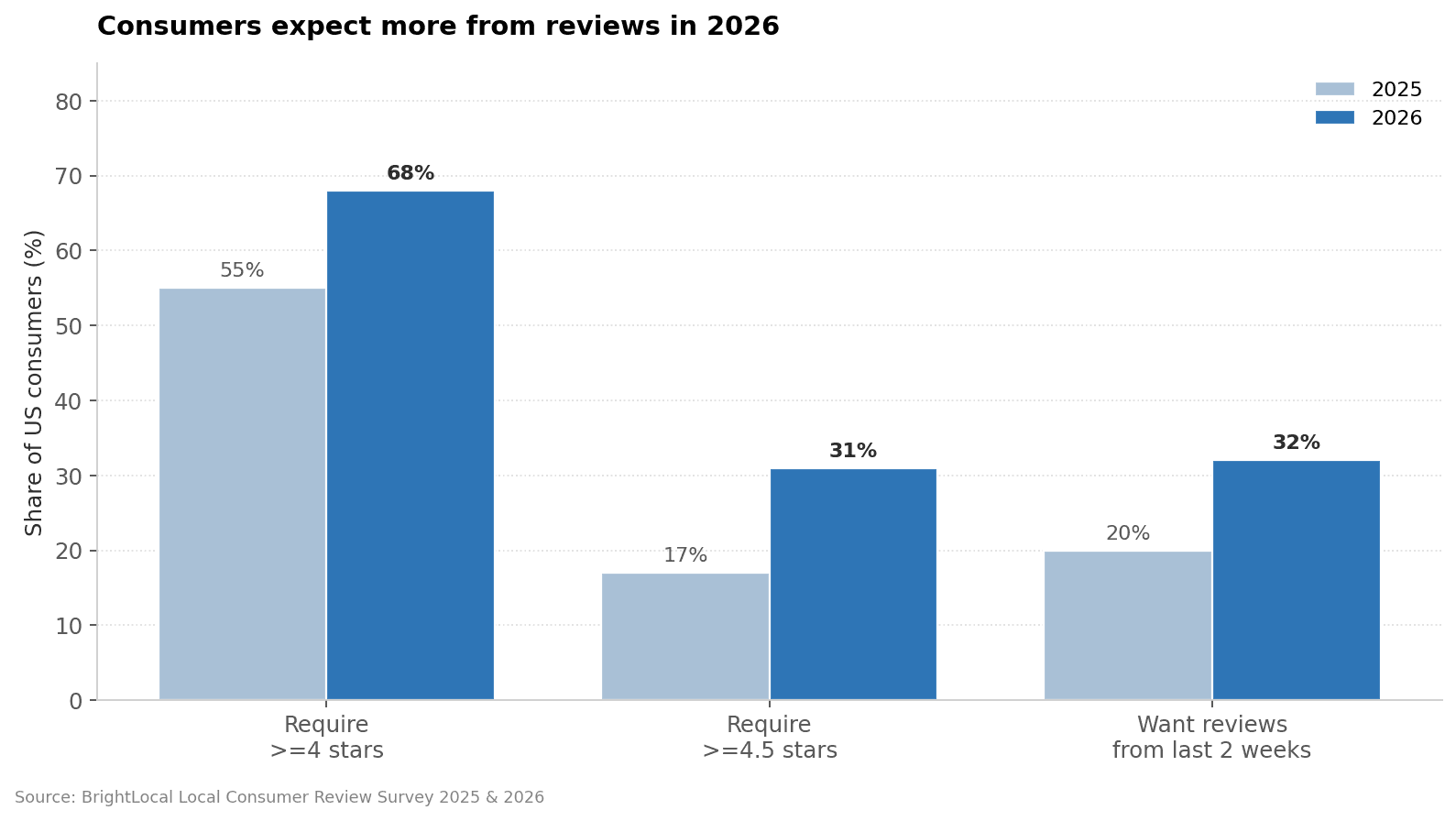
BrightLocal’s February 2026 Local Consumer Review Survey is the cleanest refresh of the canonical review stats (BrightLocal — Local Consumer Review Survey 2026). The headlines:
97% of consumers read reviews for local businesses (the famous “99%” claim from 2019/2020 has come down — and only 41% “always” read them, up from 29% in 2025).
68% require a minimum 4-star rating to consider a business — up from 55% in 2025. The older “78% won’t consider under 4 stars” claim that floats around marketing decks isn’t in the current data.
31% will only use businesses with 4.5+ stars — nearly doubled from 17% in 2025.
47% won’t use a business with fewer than 20 reviews; only 9% will use a business with 5 or fewer.
32% of consumers now want reviews from the last 2 weeks (up from 20% in 2025). Recency expectations are tightening fast.
49% trust online reviews as much as personal recommendations — not the “88%” that older roundups quote. That older figure traces back to 2014–2018 BrightLocal data.
80% are more likely to use a business that responds to all reviews; 19% expect a same-day response (tripled from 6% in 2025); 50% are turned off by templated responses.
On the conversion side, the canonical study is still Uberall’s 2019 analysis of 64,000 Google Business Profiles: a 0.1-star rating bump lifts conversion ~25% (calls + driving directions + website clicks). The biggest jump is 3.5→3.7 stars, where conversion grew 120% (Uberall — Reputation Management Revolution). Uberall hasn’t re-run the study, so caveat with the year.
Reviews also remain 16–20% of local pack ranking weight in Whitespark’s 2026 Local Search Ranking Factors survey (Whitespark — Local Search Ranking Factors 2026), with recency and velocity now weighted higher than raw volume. Behind the scenes, Google’s spam machine is working overtime: the company reported 240M+ policy-violating reviews removed in 2024 (+40% YoY), and Sterling Sky’s tracking showed review-deletion rates rose 600%+ between January and July 2025 (Sterling Sky — review posting blocks surging). Roughly 38% of deleted reviews were 5-star — Google is targeting fake positives, not just 1-star attacks.
Google Business Profile in 2026
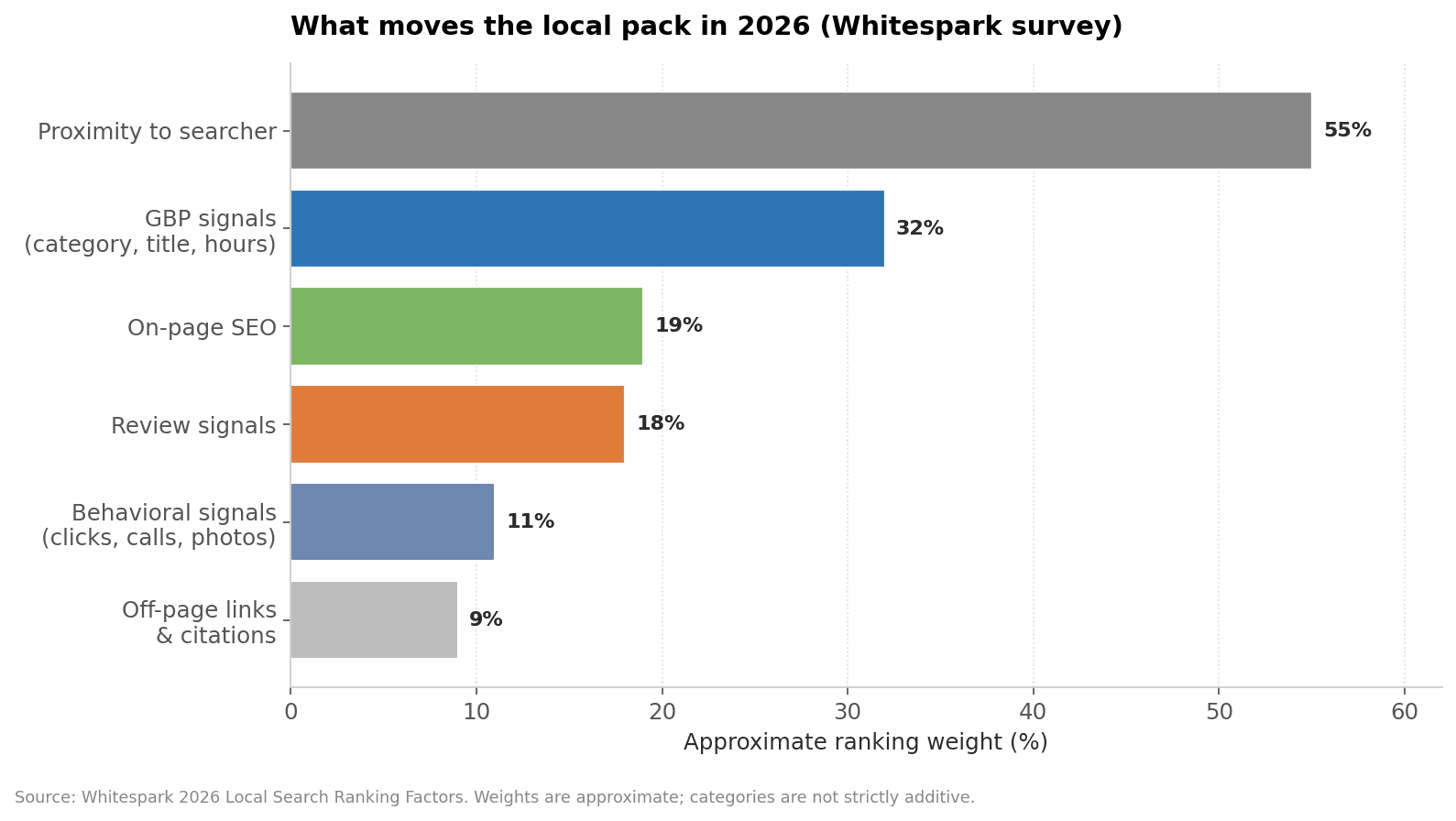
Whitespark’s 2026 survey of 47 top local SEOs (Whitespark — 2026 Local Search Ranking Factors) puts the controllable signal weights at roughly:
Proximity to the searcher — ~55% of ranking decisions, and largely uncontrollable.
GBP signals — ~32% of weight: primary category, keywords in the business title, hours / open-status, expert-curated list presence.
On-page SEO — ~19%.
Review signals — 16–20%.
Behavioral signals (clicks, calls, direction requests, photo views) — first time confirmed as a measurable factor in the 2026 survey.
BrightLocal’s GMB Insights Study (2019, 45,264 listings — flag the year) is still the most-cited per-profile benchmark: the average GBP gets 1,260 views, 33 website clicks, 12 calls, 14 direction requests, and 59 total actions per month, with 84% of traffic from discovery searches and 16% from direct (BrightLocal — GMB Insights Study).
Birdeye’s April 2026 State of Google Business Profile refreshes the engagement mix on top of that baseline: website 47%, directions 38%, calls 15% — directions share rose from 34% in 2025 (Birdeye — State of Google Business Profile 2026). Two more numbers worth memorising: 76% of GBP profiles are verified in 2026 (up from 71% in 2024), and 86% of GBP impressions come from category-based (non-branded) searches — which is exactly why Whitespark’s top GBP signal is your primary category.
Photos are still the most under-invested lever in local. Birdeye’s 2026 data shows the average verified profile has fewer than one photo, even though Google’s own data says listings with photos get 42% more direction requests and 35% more website clicks, and WebFX’s 2026 benchmarks show profiles with 10+ photos earn 2× more engagement (WebFX — Google Business Profile benchmarks). Verified profiles also generate up to 4× more website visits than unverified ones (Birdeye).
Reach context: Google Maps surpassed 2 billion monthly active users in Q3 2024, Sundar Pichai confirmed on Alphabet’s earnings call. Google Maps holds roughly 70% of global navigation-app share; Apple Maps ~11%; Waze ~8%; Bing Maps <2%. Apple Business Connect quietly opened to all businesses — including service-area and online-only — in October 2024, putting profile-claim reach across 1B+ Apple users (Apple — Business Connect expansion).
The local pack just changed shape
Sterling Sky’s February 2026 “State of Local SEO” report is the cleanest measurement of what’s actually showing up on local SERPs. Across roughly 1,200 mobile reports tracked through Places Scout:
Local pack ads on mobile grew from ~1% to ~22% of tracked reports in 12 months — 6.5% in Nov 2025, 14% in Dec 2025, 22% in Jan 2026.
Local Services Ads (LSAs) coverage grew from ~11% of tracked queries in early 2025 to 31% by November 2025.
The new AI local pack — Google’s LLM-powered 1–2 result version — currently appears on ~7% of tracked searches and shows ~68% fewer unique businesses than the traditional 3-pack.
On the AI Overview side, Whitespark’s May 2025 case study (540 queries across Houston, Phoenix, Denver in six sectors) found AI Overviews appear on ~68% of local business queries on average but the rate swings wildly by query intent (Whitespark — prevalence of AI Overviews in local search).
Query type | Example query | AI Overview | Local Pack |
|---|---|---|---|
Simple local | “tacos San Francisco” | 15% | >90% |
Informational local | “how long does an eye exam take near me” | 92% | 6% |
Hybrid local | “average cost of dental implants in Phoenix” | 97% | 17% |
Across the wider web — not just local — AI Overview prevalence has whipsawed: ~25% of queries in July 2025, down to 15.69% in November 2025, then up to ~48% by February 2026 (+58% YoY) (Search Engine Land — Google AI Overviews surge and pullback).
Clicks are getting squeezed. First Page Sage’s updated December 2025 dataset puts Local Pack CTRs at 17.6% / 15.4% / 15.1% for positions 1, 2, 3 — and shows organic position 1 CTR dropping from 39.8% to 23.7% when a local pack is present (First Page Sage — Google CTRs by position). 58.5% of US Google searches end without a click overall (SparkToro 2024), and roughly 80% of AI Overview queries are zero-click. BrightLocal’s 2025 survey shows 42% of consumers still click a local pack result on local queries — that hasn’t collapsed yet.
Quieter but important: Google’s “Diversity Update,” rolling out since August 2024, limits how often the same domain shows up in both the local pack and organic results for the same query. If your GBP links to your top organic page, that page may be demoted in organic — Sterling Sky has documented it; Google has not officially confirmed (Sterling Sky — Diversity Update).
AI search has entered the local pack
SOCi’s January 2026 Local Visibility Index ran 350,000 locations across 2,751 multi-location brands through ChatGPT, Perplexity, Gemini, and Google’s 3-pack (Search Engine Land — AI Local Visibility Report 2026). The recommendation rate gap is the headline of the year:
ChatGPT recommended just 1.2% of locations. Perplexity 7.4%. Gemini 11%. Google’s local 3-pack: 35.9%. SOCi calls AI visibility “3 to 30 times harder” than traditional local search.
Business-profile data accuracy is bimodal — Gemini is 100% accurate (it’s grounded in Google Maps), while ChatGPT and Perplexity sit at 68%. About a third of what those two say about your business is wrong.
AI recommendations also raise the rating bar. AI-recommended locations average 4.3 stars on ChatGPT vs 3.9 stars in Google’s local pack.
Strong Google local rankings don’t transfer. Only 45% of brands ranking in the top 20 of traditional retail local search also appeared in the top AI recommendations.
Even small businesses are now using AI to decide where to shop and which contractor to call, and the picks aren’t lining up with Google’s 3-pack. Where AI engines actually find local businesses matters more than ever — and the three big chatbots have meaningfully different mixes.
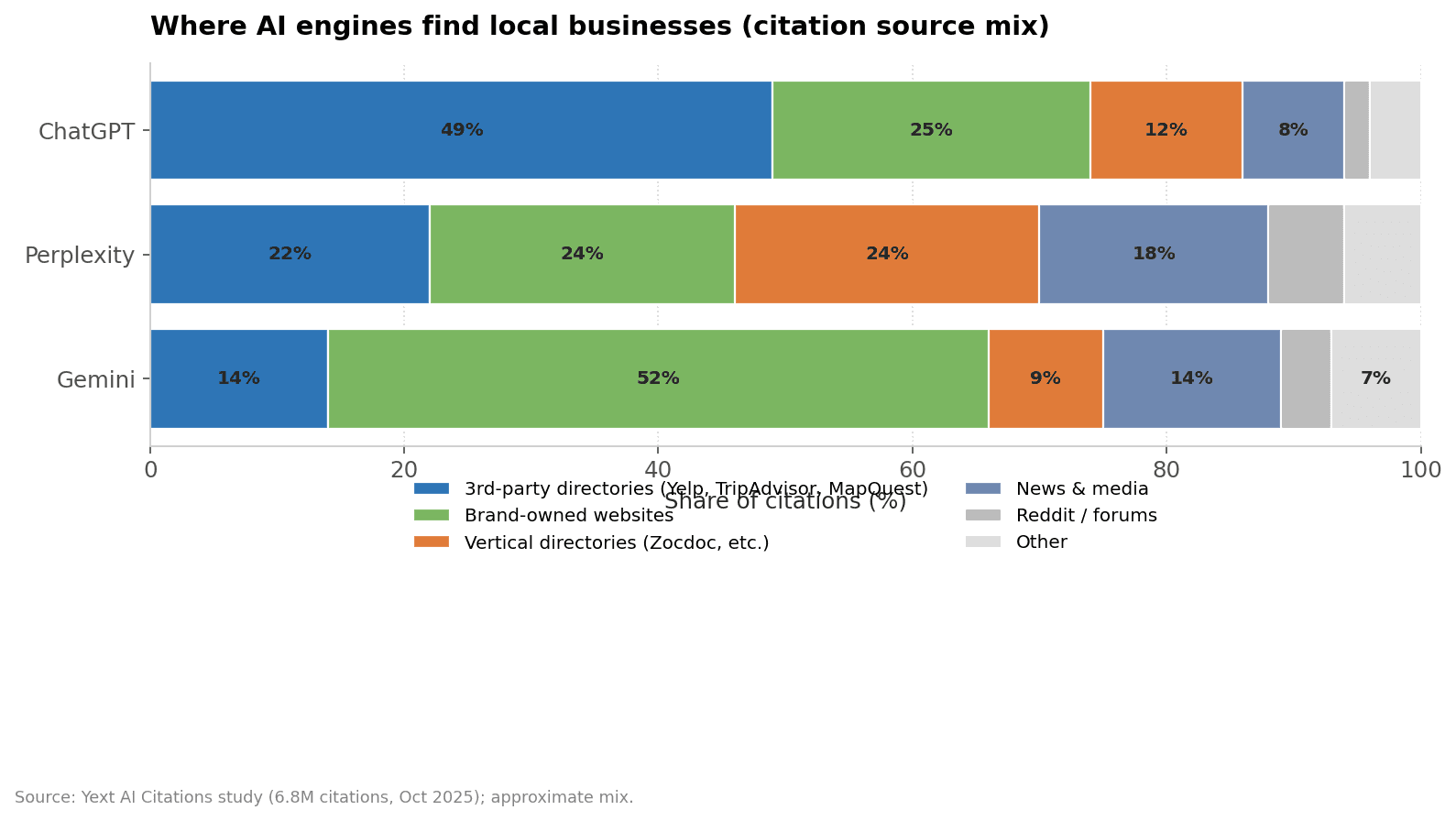
Yext’s October 2025 study of 6.8M citations across 1.6M responses found ChatGPT pulls 48.73% of its citations from third-party directories — Yelp, TripAdvisor, MapQuest — climbing to 46.3% on subjective “best X” queries (Yext — how Gemini, ChatGPT, Perplexity cite brands). Gemini is the opposite — 52.15% of its citations come from brand-owned websites. Perplexity leans on vertical directories (Zocdoc in healthcare, TripAdvisor in hospitality) for 24% of citations on subjective local queries.
On the Google side, AI Overviews on local “near me” healthcare queries went from 100% in December 2023, to 14% in December 2024, to 0% in December 2025 — a complete reversal in two years (BrightEdge — healthcare AI evolution 2023–2025). Google is deferring local intent to the Maps stack rather than the AI layer. And ChatGPT only got opt-in location sharing in March 2026 — before that, it inferred location from IP or whatever the user typed.
What this means for your local SEO strategy in 2026
Run the stats above through the “what should I do on Monday morning” filter and seven moves stand out:
Pick your primary GBP category carefully. It’s Whitespark’s #1 controllable factor, and 86% of impressions come from non-branded searches that hinge on category match.
Tighten review recency. 32% of consumers now expect reviews from the last 2 weeks. Set up a steady request cadence — not a one-time push.
Hit a 30%+ review response rate. Uberall showed 80% higher conversion vs competitors at 10%. Skip templates — 50% of consumers are turned off by generic replies.
Photograph everything. Average verified profile has under one photo; profiles with 10+ photos get 2× engagement and ~40% more direction requests.
Diversify review platforms. Whitespark’s September 2025 study found Facebook, Yelp, and TripAdvisor dominate review sources for ChatGPT-visible businesses; SE Ranking found multi-platform review presence on G2, Capterra, Trustpilot, and Yelp multiplies AI citations 3–6×.
Track AI visibility separately from local rank. Only 45% of brands ranking top-20 in traditional local search also appear in top AI recommendations. If you’re only watching the 3-pack, you’re missing the channel.
Don’t bet the farm on local 3-pack clicks alone. 58.5% of all US searches are zero-click; ~80% of AI Overview queries are zero-click; ads are now in 22% of mobile local packs. Volume of impressions matters as much as click position.
If GBP is the table-stakes layer, the next layer is making sure you show up in AI answers — citations from ChatGPT, Perplexity, and Gemini won’t show up in your GBP Insights, but they’re shaping where customers walk in.
Track the clicks Google still sends you
QuickSEO is a free Google Search Console dashboard for all your websites. Connect Search Console, pick the properties you want, and see clicks, impressions, CTR and average position for every site on one screen, each compared with the previous period, with the keywords and pages behind the numbers. Connect Search Console for free →
The bottom line
Local SEO in 2026 still rewards the same fundamentals — proximity, category, reviews, photos, completeness — but the surface they ride on has changed. Ads now take a fifth of the mobile local pack. AI Overviews appear on two-thirds of local business queries, even as Google quietly pulls them back from “near me” intent. And the AI engines customers are increasingly asking — ChatGPT, Perplexity, Gemini — recommend a tiny fraction of locations from a citation mix you don’t fully control. The SMBs and agencies winning next year are the ones treating GBP, local rank, and AI mentions as one channel, measured together.
QuickSEO shows clicks, impressions, keywords and pages for every website you manage, compared with the period before.
- Unlimited websites on the free plan
- No credit card needed
Keep reading
Related posts
More articles on the same topics, prioritized by shared tags and keyword overlap.