Small Business AI Adoption in 2026: 68% Use AI Regularly + 50 More Stats

 Summarize in ChatGPT
In July 2024, Intuit QuickBooks measured 48% of US small businesses regularly using AI. By April 2025 that figure had hit 68%. By January 2026 it was 77%. This is one of the fastest technology adoption curves ever recorded among small and midsize businesses — faster than smartphones, broadband, or e-commerce.
But the interesting story isn't that adoption happened. It's where SMBs are spending those AI hours: 77% put marketing and customer engagement at the top of the use-case list, and 89% of B2B marketers now write copy with AI. Meanwhile, almost half of brands have no plan for the surface their customers are increasingly starting on — AI chatbots like ChatGPT, Claude, Gemini, and Perplexity. This post unpacks 50+ data points across both sides of that gap.
1. The headline numbers: how fast SMB adoption moved
Survey after survey published over the past 18 months converges on the same shape: rapid, broad-based SMB AI adoption, with the question only of where on the curve a given subgroup sits. The cleanest longitudinal read is the QuickBooks Small Business Insights series, which surveys roughly 2,000-5,000 SMBs each quarter:
July 2024: 48% of SMBs regularly use AI
April 2025: 68% — a 20-point jump in nine months; 28% report daily AI use; 13% call AI a “core component” of their business
January 2026: 77% across the US, Canada, UK, and Australia
The Goldman Sachs 10,000 Small Businesses Voices survey (n=1,256, all 50 US states + DC + PR, fielded January-February 2026) puts the number at 76% — within the noise. The US Chamber of Commerce Empowering Small Business 4th edition tracks the generative-AI cut specifically: 23% in 2023, 40% in 2024, 58% in 2025.
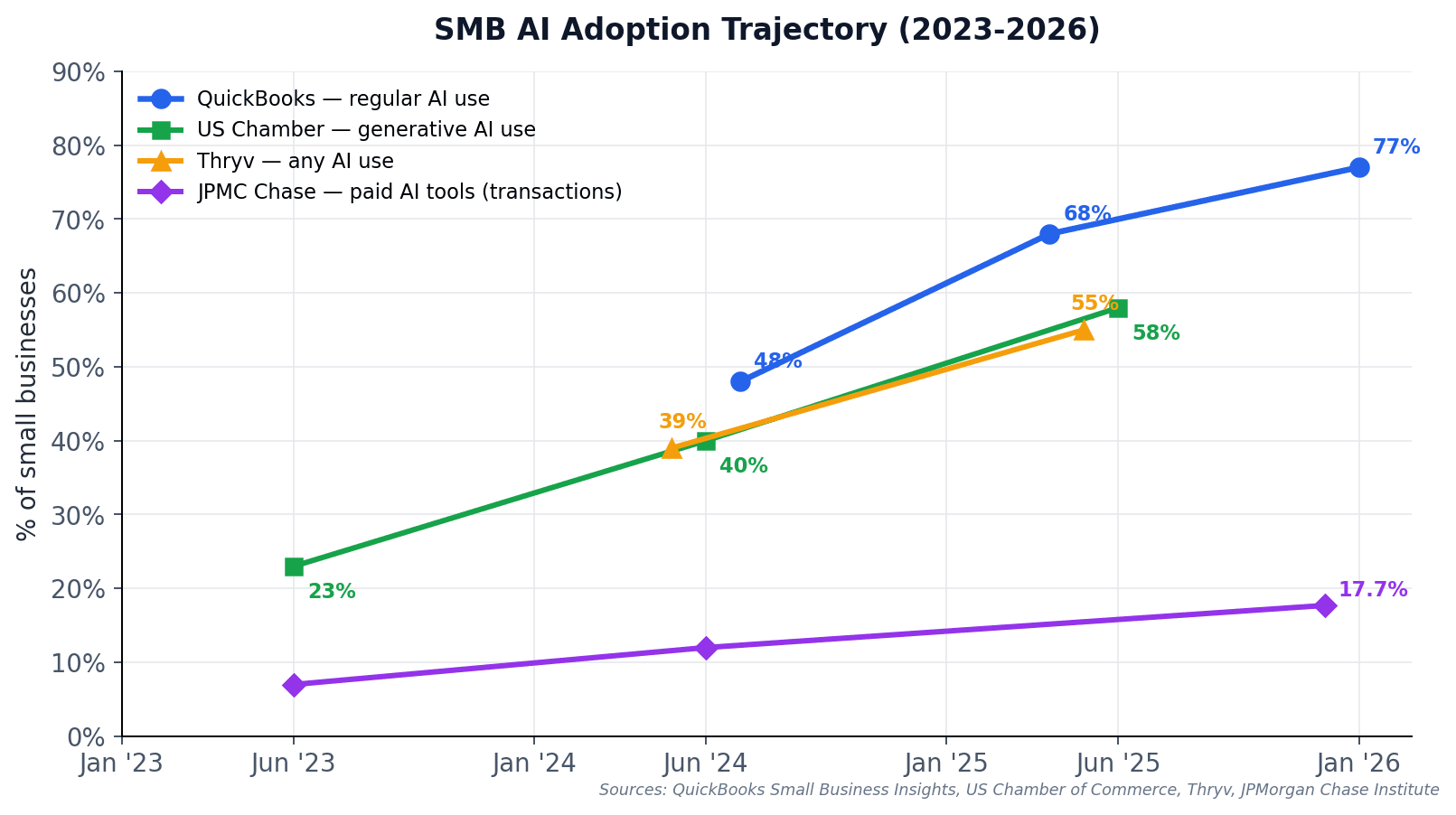
Chart 1 — SMB AI adoption trajectory (2023-2026), across four primary sources.
The wide spread in headline numbers is real and reflects definitional differences. The JPMorgan Chase Institute analyzes actual paid transactions across 4.6 million Chase Business Banking accounts and reports 17.7% — much lower because it requires writing a check to an AI vendor. The US Census Bureau BTOS reports just 8.8% under a strict “production AI use” definition for firms under 250 employees. Self-reported regular use sits in the 55-77% band.
Why surveys disagree — 8.8% (production AI use) → 17.7% (paid AI tools) → 55% (any AI use) → 68-77% (regular use) → 88% (any use, generously defined). Always anchor on the definition before quoting a single headline number.
Headline SMB AI adoption stats 2025-2026
Source | Sample | Period | Rate | Definition |
|---|---|---|---|---|
QuickBooks Small Business Insights | ~2,200 US SMBs ≤100 emp. | Apr 2025 | 68% | Regularly use AI |
QuickBooks Small Business Insights | ~5,000 SMBs (US/CA/UK/AU) | Jan 2026 | 77% | Regularly use AI |
Goldman Sachs 10,000 SB Voices | n=1,256 across 50 states | Jan-Feb 2026 | 76% | Currently use AI |
US Chamber of Commerce | Empowering Small Business 4th ed. | 2025 | 58% | Use generative AI |
Salesforce SMB Trends 6th Ed. | n=3,350 ≤200 emp., 26 countries | 2025 | 75% | At least experimenting |
Thryv 2025 SMB AI Survey | n=540, 1-100 emp., US | May 2025 | 55% | Any AI use |
JPMorgan Chase Institute | 4.6M small businesses (transactions) | 2025 | 17.7% | Paid AI tools |
US Census Bureau BTOS | Biweekly survey, ~200k firms | Sep 2025 | 8.8% | Production AI use |
Table 1 — Major SMB AI adoption studies, harmonized side-by-side. Definitions are doing most of the work.
2. The revenue and productivity case
The most consistent finding across SMB AI surveys: among adopters, the impact reported is overwhelmingly positive. The Salesforce SMB Trends 6th Edition (n=3,350 across 26 countries) reports the headline outcome stack:
91% of SMBs using AI say it boosts revenue
87% say AI helps them scale operations
86% report improved margins
85% see measurable ROI
78% call AI a “game-changer”
Goldman Sachs' January-February 2026 reading aligns: 93% of SMB AI users say AI has had a positive impact on their business, 84% cite efficiency/productivity gains, and 67% expect AI to grow revenue. QuickBooks' April 2025 cut shows 41% of users reporting revenue increases vs. just 2% reporting decreases.
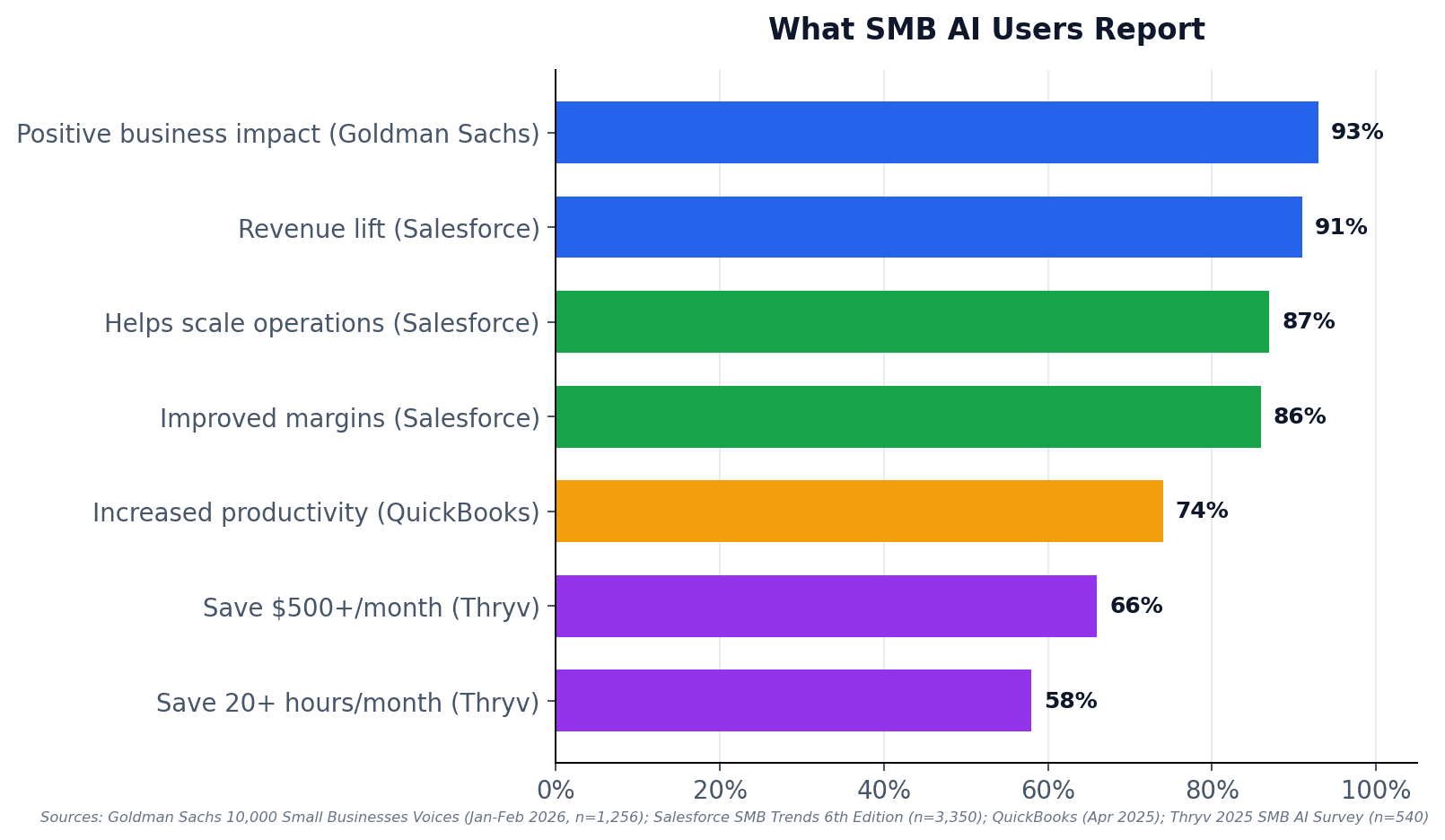
Chart 2 — Self-reported outcomes among SMB AI users, harmonized across four 2025-2026 surveys.
The hours and dollars-saved data is sharper. Thryv's 2025 SMB AI Survey (n=540) reports that 58% of SMB AI users save 20+ hours per month, and 66% save between $500 and $2,000 per month. Business.com's 2026 SMB AI Outlook finds an average of 5.6 hours saved per employee per week — 7.2 hours for managers, 3.4 for individual contributors.
One honest caveat: Goldman Sachs' own analysis notes that despite a median ~30% productivity gain on specific localized AI tasks, there is no meaningful relationship yet between AI adoption and economy-wide productivity. The gain is real, but it's task-specific. The framing for an SMB owner: AI is currently a tool that buys back hours, not a force multiplier on the whole business.
3. Where SMBs actually deploy AI: content and SEO lead
Across surveys, the runaway #1 SMB AI use case is marketing and customer engagement. The Reimagine Main Street / PayPal survey (n=947 SMBs, $25k-$5M revenue) reports that 77% of SMBs see marketing and customer engagement as the highest-impact AI use case — well above operations, finance, or HR.
The CMI/MarketingProfs B2B Content Marketing 2026 report (n=1,015 B2B marketers, fielded June-August 2025) gives the cleanest task-level breakdown:
95% of B2B marketers use AI-powered applications
89% use AI specifically for content creation (written copy)
53% use AI for creative assets (image/video generation)
41% use AI for SEO analysis and optimization
87% of those B2B AI users say productivity improved; 80% say operational efficiency improved
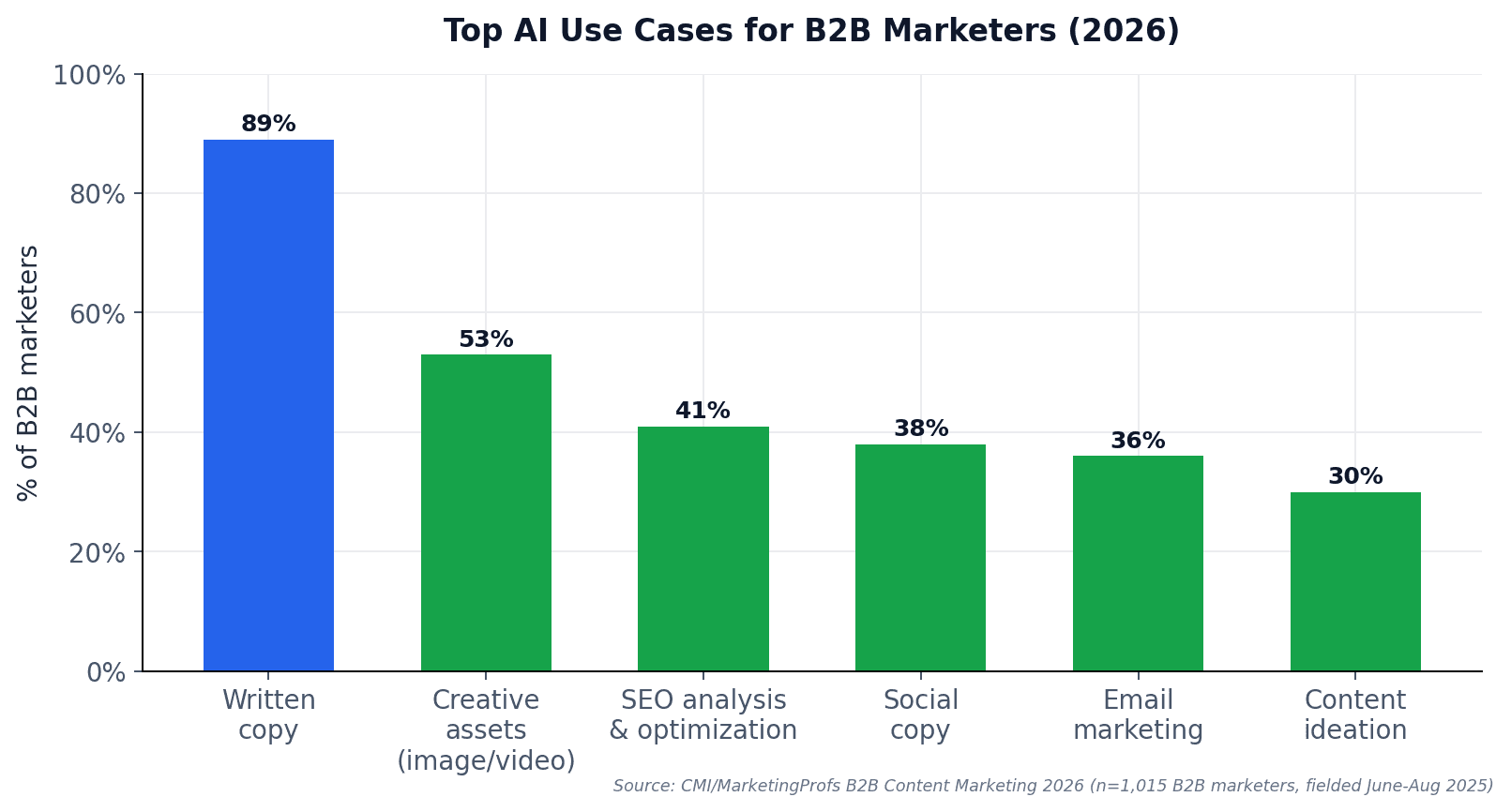
Chart 3 — Where B2B marketers actually use AI. Written copy is in a class of its own.
HubSpot's 2026 State of Marketing Report projects 94% of marketers will use AI in content creation in 2026 (up from ~80% in 2024). 80% are already using AI for content, 75% for media production. QuickBooks' own data shows marketing as the runaway top use case among SMBs, which lines up with broader content marketing ROI benchmarks for 2026 — small teams are simply producing far more content per headcount than they were a year ago.
On the SEO side specifically: Salesforce State of Marketing 2026 (n=4,450 marketing decision-makers) reports that 85% of marketers say AI is reshaping their SEO strategy, and 88% have begun optimizing for AI-generated responses — what the industry now calls Answer Engine Optimization (AEO) or Generative Engine Optimization (GEO). 61% of marketers are increasing SEO budgets in 2026, up from 44% in 2025.
The quality-vs-perception gap
Adoption is one thing; results are another. A Semrush study published April 2026 (~42,000 blog pages across 200,000 URLs and 20,000 keywords, classified via GPTZero) found that human-written content occupies the #1 Google position 80% of the time, while AI-only content holds #1 just 9% of the time. Yet 72% of SEOs surveyed in the same study “believe” AI content performs as well as or better than human content. That perception gap is what costs SMBs traffic when they over-trust pure AI output.
A complementary DigitalApplied 6-month SERP study (200 articles tracked from October 2025 through April 2026) reports the operational version of the same finding: sites publishing 50-100 quality human-edited AI articles saw traffic gains of 30-80%; sites publishing 1,000+ unedited AI articles saw drops of 40-90%. Editorial layer matters more than volume.
4. Investment trajectory: this is not a 2025 phase
Whatever doubts there were about generative AI being a hype cycle, the investment signal among SMBs is uniformly forward-leaning:
71% of SMBs plan to increase AI investment in the next 12 months; only 4% plan to scale back (Salesforce)
78% of “growing” SMBs plan to increase AI investment, vs 55% of “declining” peers (Salesforce)
88% of small businesses plan to maintain or increase AI investments in the coming year (SBE Council/TechnoMetrica)
96% of small business owners plan to adopt emerging technologies including AI (US Chamber)
45% of B2B marketers picked AI-powered marketing tools as their #1 spending priority for 2026 (CMI/MarketingProfs)
There's also a striking JPMorgan Chase Institute cohort effect: SMBs that started paying for AI tools in 2019 now spend an average of ~$90/month on AI (+80% over six years). SMBs that started in 2024 average $29/month with a flat trajectory. Early adopters compound; late adopters dabble. AI line items are now sitting next to traditional marketing budgets — see SMB SEO spending and the budgets propping it up for the full picture on where SEO dollars go and how AI fits in.
5. Who's adopting fastest: industry, size, geography
Headline adoption rates hide enormous variation. The most consistent finding across primary sources is sector skew. The US Census BTOS production-AI use rates show the Information sector at 21.9% adoption versus Construction at 1.4% — roughly a 15× gap inside the same economy. Professional services, finance, and educational services cluster at the top; hospitality, agriculture, and construction at the bottom.
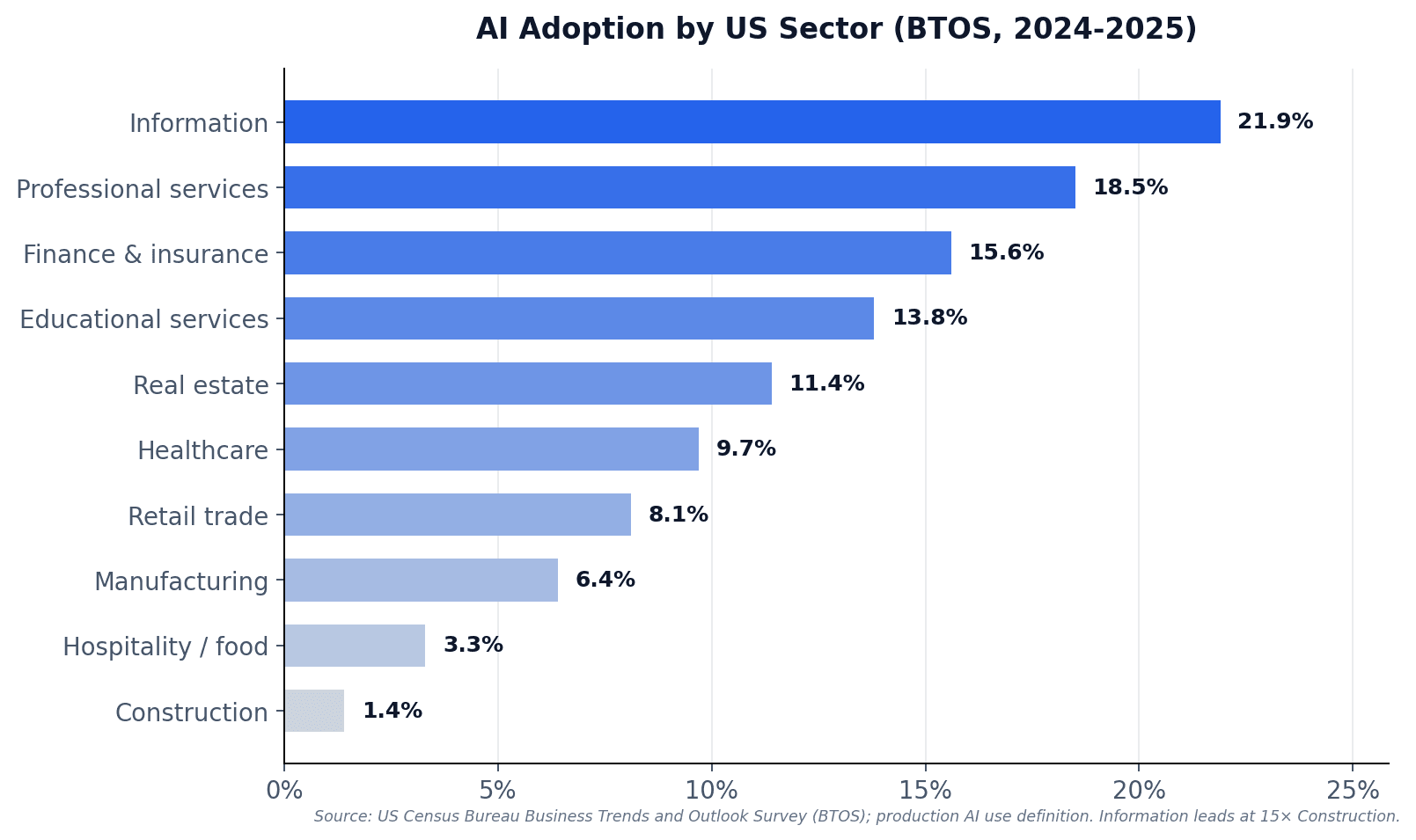
Chart 4 — AI adoption by US sector, BTOS production-use definition.
McKinsey's enterprise-tilted State of AI data tells the same story at a higher absolute level: professional services 80%, advanced industries 79%, media/telecom 79% versus consumer goods/retail 68%, financial services 65%, healthcare 63%, energy/materials 59%.
The size-and-shape effect
OECD's AI Adoption by Small and Medium-Sized Enterprises (December 2025, 5,000 SMEs across 7 OECD countries) finds 40% of firms with 250+ employees use AI, vs 20.4% of 50-249 and just 11.9% of firms with 10-49. Eurostat's 2025 ICT survey shows 55% of large EU companies vs 19% of SMEs.
Business size | AI adoption | Why | Profile |
|---|---|---|---|
≤9 employees | 11.9% (OECD) | Solopreneurs use ChatGPT free | Solo |
10-49 employees | 11.9% (OECD) | Mid-low — resource-constrained | Lagging |
50-249 employees | 20.4% (OECD) | Operations scale unlocks AI ROI | Sweet spot |
250+ employees | 40.0% (OECD) | Dedicated teams, training budgets | Leaders |
Table 2 — Adoption gap by business size (OECD 2025, cross-country SME data).
Two counterintuitive findings stand out. First, the SBA Office of Advocacy reports that the US small-versus-large adoption gap has shrunk from 1.8× to roughly 1.2× in 18 months. Small firms (<250 employees) went from 6.3% to 8.8% production AI use while large firms went from 11.1% to 10.5%. Small firms are catching up faster than large ones are scaling. Second, Thryv's data shows the 10-100 employee band as the sweet spot at 68% adoption — outpacing both solopreneurs and the 250+ enterprise tier. Mid-size SMBs have enough scale to justify AI ROI but not enough bureaucracy to slow adoption.
Geography mostly proxies for sector mix
Eurostat 2025 puts Denmark at 42.0% enterprise AI use, Finland at 37.8%, Sweden at 35.0%; Romania at 5.2% and Poland at 8.4% trail. Visual Capitalist's US state breakdown of BTOS data has Colorado leading at 23.2%, Arizona at 22.9%, DC at 22.5%; West Virginia at 10.8% lowest. The driver is industry composition, not technological backwardness — states and countries with more knowledge-intensive small businesses lead because their underlying mix of firms is suited to AI.
6. Workforce: AI is hiring, not firing — at SMBs
Whatever the enterprise narrative on AI replacing labor, the SMB data points firmly in the opposite direction. The US Chamber's 2025 report finds 82% of small businesses using AI increased their workforce over the past year. Goldman Sachs' January 2026 survey: 87% of SMB AI users say AI augments rather than replaces employees. The SBA / BTOS supplement concludes that small employers using AI are the most likely group to expect AI to increase rather than decrease their employment needs.
The most plausible mechanism: at SMB scale, AI removes the constraint on what one person can produce, which makes the marginal next hire more attractive — not less. A two-person agency can now serve three or four clients per principal, which means hiring a junior to handle the inbound.
7. The training and trust gap
The single most concerning finding in the SMB AI literature is the implementation gap. The SBA Office of Advocacy reports that roughly 50% of US small firms using AI report no investment in implementation (training, change management, dedicated time). Goldman Sachs' January 2026 reading: 73% of SMB AI users say more training and resources would help them implement AI successfully.
OECD's cross-country D4SME 2025 survey identifies the skills gap as the #1 cited barrier for SMB AI adoption, amplified for the smallest firms with no in-house tech function. Among non-adopters specifically, SBE Council finds 77% “see no reason” to use AI yet, 16% cite knowledge barriers, and 15% cite limited resources. Reimagine Main Street / PayPal reports the AI “Explorer” segment's top worries as data privacy/security (38%), time/resource constraints (37%), and unclear ROI (34%).
Practical implication: the SMBs reporting the biggest revenue and productivity lifts are not the ones with the fanciest AI stack — they're the ones who invested any time at all in training, prompt libraries, and workflows. Buying a tool isn't a strategy.
8. The AI search visibility gap: where SMBs are still losing
Adoption on the production side has caught up. Adoption on the discovery side has not. Consumer and B2B buyer behavior has shifted faster than most SMBs realize:
45% of consumers now use AI to find local businesses, up from just 6% in 2025 (BrightLocal Local Consumer Review Survey 2026). AI is the third most-used local discovery tool, ahead of Yelp and TripAdvisor.
51% of B2B software buyers now start their research in an AI chatbot; 71% use chatbots somewhere in research (G2 Answer Economy 2026, n=1,076).
69% of B2B buyers chose a different vendor than originally planned based on AI chatbot guidance. One-third bought from a vendor they had never heard of before.
85% of B2B buyers think more highly of a vendor when an AI chatbot mentions them. 4 in 5 say chatbots accelerated their purchase decision.
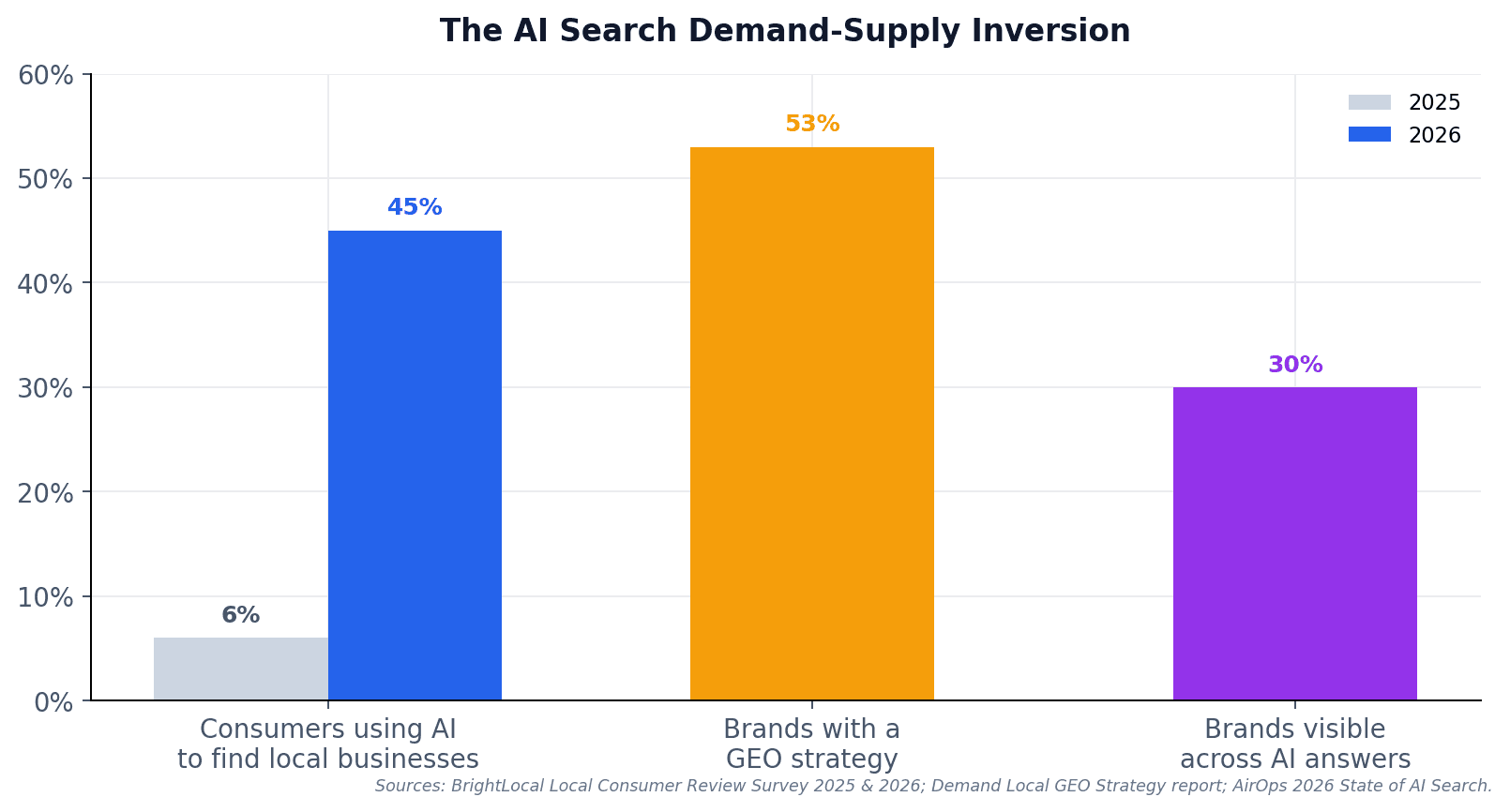
Chart 5 — The AI search demand-supply inversion: consumer/buyer behavior has flipped; SMB supply has not caught up.
On the supply side, the gap is stark. PolyGrowth's 10,000-local-business study finds that ChatGPT recommends only 1.2% of local business locations when users ask for a service in their area, and 83% of restaurants don't appear in any AI local recommendation. Businesses found by both ChatGPT and Perplexity averaged 133 Google reviews; invisible businesses averaged 11. The discovery layer has moved on; most SMBs haven't.
Metric | Value | Source |
|---|---|---|
Local businesses recommended by ChatGPT | 1.2% | PolyGrowth 10,000-business study |
Restaurants invisible in AI local recommendations | 83% | PolyGrowth |
Brands without a GEO strategy | ~47% | Demand Local 2026 |
Brands visible across 5 consecutive AI runs | 20% | AirOps 2026 State of AI Search |
Citation overlap across ChatGPT, Perplexity, Claude, Gemini | 11% | 5W Research (118k AI responses) |
AI bot share of HTML requests, in 8 months | 2.6% → 10.1% | Thunderbit 2026 |
Organic CTR collapse when AI Overviews trigger | −61% | Seer Interactive Sept 2025 |
Zero-click rate when AI Overviews appear | 83% | Seer Interactive |
Table 3 — The AI chatbot citation reality SMBs are walking into.
Why the gap exists: structural problems, not just laziness
Four structural shifts are squeezing SMB visibility:
Zero-click amplification. Seer Interactive's September 2025 study shows organic CTR on queries with AI Overviews dropped 61% (1.76% → 0.61%); when AIO triggers, the zero-click rate hits 83%.
AI Overviews aimed at SMB queries. Semrush + Datos found nearly 60% of AIO-triggering keywords have ≤100 monthly searches — the long-tail queries SMBs depend on.
Platform fragmentation. 5W Research analyzed 118,000 AI responses and found only 11% of cited domains overlap across ChatGPT, Perplexity, Claude, and Google AI Mode. A brand visible in one chatbot is usually invisible in the others.
Volatility. AirOps' 2026 State of AI Search reports that 92% of brands are failing at AI search visibility; only 30% remain visible from one answer to the next, and just 20% across 5 consecutive runs.
The flip side: AI traffic, when SMBs do get it, is unusually high quality. The Visibility Labs / ALM Corp 12-month study (94 ecommerce brands, January-December 2025) found ChatGPT referral traffic converts 31% higher than non-branded organic search (1.81% vs 1.39%). Similarweb reports AI referral users spend 15 minutes on site vs 8 minutes for Google referrals, generate 12 pageviews vs 9, and convert on transactional sites at 7% vs 5%.
Knowing whether ChatGPT, Claude, Gemini, and Perplexity mention you at all is the first step of getting your brand seen in the age of AI search. That's also why the GEO services market is projected to grow from $1.01B in 2025 to $17.02B by 2034 — a 45.5% CAGR. CMOs noticed before the SMB middle did; 94% of CMOs plan to increase AEO/GEO investment in 2026.
9. What this means for an SMB owner in 2026
Pulling everything together, three moves separate the SMBs getting compounding AI returns from the ones still calling it a productivity hack:
1. Don't be in the 50% with no training plan
Goldman Sachs and SBA Advocacy both find that outcomes correlate with implementation, not adoption. Buying ChatGPT Team and walking away is what most SMBs do. The 73% who say they need more training are telling you what the ROI gap looks like inside their own walls.
2. Treat AI search as a channel, not an experiment
Half your buyers are starting in chatbots. Only 1.2% of local businesses get recommended. Whatever your current SEO posture is, you need a separate read on whether ChatGPT, Claude, Gemini, and Perplexity mention you — and which competitors they mention instead.
3. Track outputs, not just inputs
It's easy to measure how much AI content you've published. It's harder, and more valuable, to measure whether that content is moving brand mentions in the AI surfaces where your customers now look first. Adoption is the easy half. Visibility is the half that compounds.
Track your AI visibility before your competitors do
QuickSEO tracks your brand's presence across ChatGPT, Gemini, Claude, and Perplexity alongside Google Search. Pick the prompts your buyers actually ask, watch which competitors get cited instead of you, and see which content is moving the needle on AI visibility — daily, on one dashboard.
Start with a free AI visibility audit at quickseo.ai — paste your URL, get cited prompts and competitor citations in under a minute.
Enter your website to track its AI visibility across ChatGPT, Gemini, Claude, and Perplexity — and turn chatbot mentions into traffic.
- Set up in minutes
- Cancel anytime
Keep reading
Related posts
More articles on the same topics, prioritized by shared tags and keyword overlap.