Summarize in ChatGPT
If your business isn't showing up when nearby customers search for what you offer, you're not losing to luck — you're losing to a competitor who has done their homework. A local SEO audit is a systematic evaluation of your business's online presence that identifies technical errors, content gaps, and opportunities to improve your visibility in local search results.
The urgency has never been greater. 46% of all Google searches have local intent, and 98% of consumers search online for local businesses before making a decision. Yet the playing field is shifting — fast. Local SEO now includes tasks geared to establishing relevance and authority within a targeted geographic area, and search engines alongside large language models (LLMs) like Google Gemini and ChatGPT reference many different data points to determine who will be surfaced.
This guide gives you a complete, actionable local SEO audit framework for 2026 — covering everything from Google Business Profile fundamentals to the AI visibility layer that most businesses are completely ignoring.
Why a Local SEO Audit Matters More Than Ever in 2026
A local SEO audit in 2026 is not a surface-level scan of title tags and meta descriptions. It is a full business visibility assessment across search, maps, AI platforms, citations, brand demand, and behavioral trust signals.
In 2026, local search is more competitive than ever, and relying on basic tactics is no longer sufficient. The stakes are concrete: businesses in the Google 3-pack receive 126% more traffic and 93% more actions — calls, clicks, and direction requests — than those ranked below it.
But ranking in the traditional local pack is only half the battle now. AI platforms are far more selective than Google's local results: only 1.2% of locations were recommended by ChatGPT, 11% by Gemini, and 7.4% by Perplexity — compared to brands appearing in Google's local 3-pack 35.9% of the time. AI visibility is three to 30 times harder to achieve than ranking well in traditional local search.
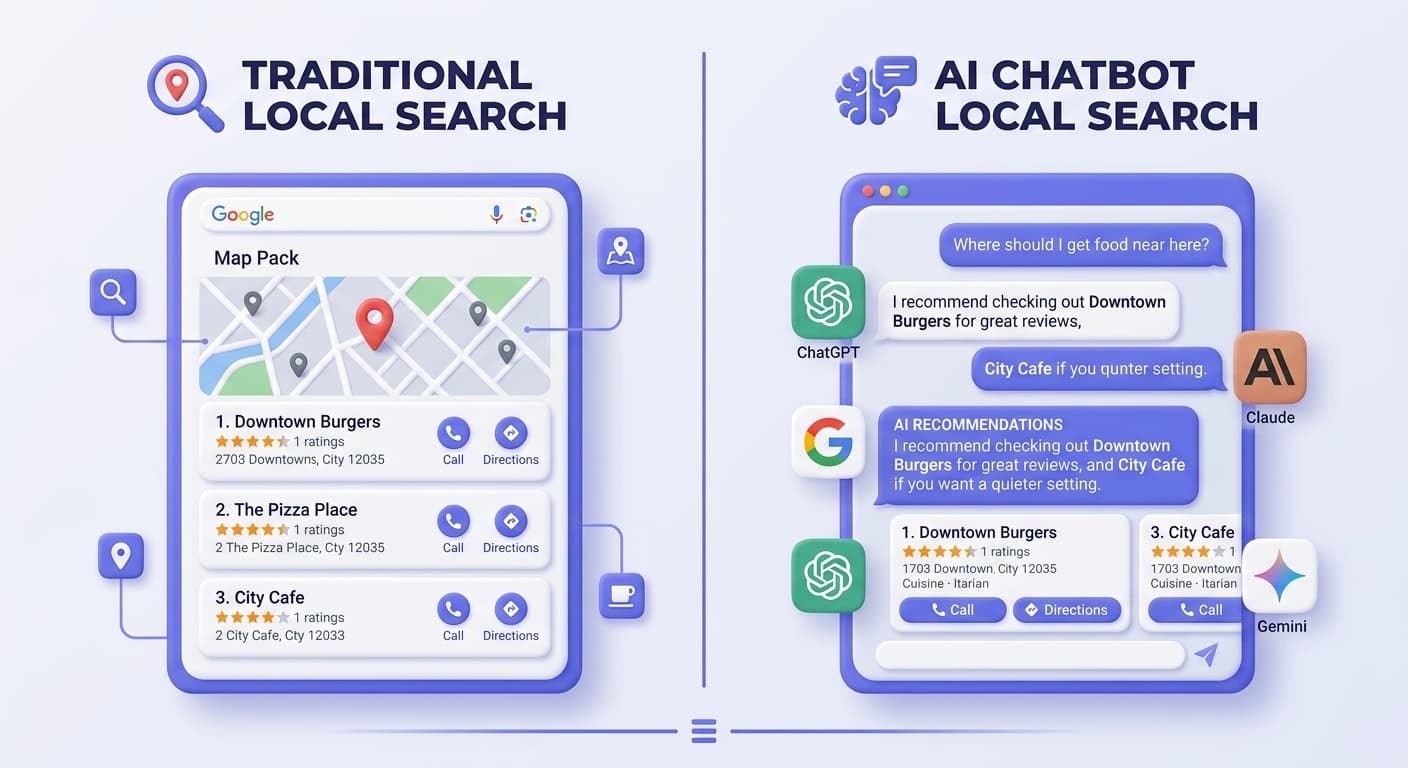
This dual reality — traditional local SEO plus AI visibility — is exactly why a thorough, up-to-date local SEO audit has become non-negotiable for any business that competes on geography.
Step 1: Audit Your Google Business Profile (GBP)
Your Google Business Profile is the cornerstone of local SEO. It's often the first thing a potential customer sees when searching for your services, making auditing this profile the highest priority for any local business.
Your primary business category is the most important factor in Google's local results, and getting this wrong can completely derail your rankings. The consequences can be dramatic: one HVAC contractor saw his rankings plummet overnight when his primary category changed from "air conditioning repair service" to "air conditioning contractor" — going from ranking #1 to #31 for his key term.
GBP audit checklist:
✅ Verify the profile is claimed and access is confirmed by the correct owner/manager
✅ Confirm the business name exactly matches your legal name
✅ Check that primary and secondary categories are accurate and exhaustive
✅ Ensure business hours are correct — Google actually ranks a business higher when it's open, so accuracy matters
✅ Populate all service fields with detailed descriptions and keywords used naturally
✅ Verify the website URL links to the correct landing page
✅ Add or refresh photos — businesses with 100+ photos get 520% more calls than the average listing
✅ Review GBP Insights for the past 90 days (calls, direction requests, profile views) to establish a baseline
Step 2: Audit NAP Consistency Across All Directories
NAP — Name, Address, Phone number — is the backbone of local citation authority. Even minor discrepancies — like "St." vs. "Street" or different phone number formats — can create conflicting signals for search engines, diluting your local authority and confusing potential customers.
Citations featuring your business name, address, and phone number help search engines cross-reference the accuracy of your NAP, while also increasing your digital footprint and getting your brand in front of customers through various channels.
NAP audit checklist:
✅ Search your business name in Google and compare all listed NAP data against your canonical NAP on your contact page
✅ Pay particular attention to top-tier directories: Yelp, Bing Places, Apple Maps, Facebook Business, Yellow Pages, Foursquare, and any industry-specific directories
✅ Flag any listing where the address format differs, the phone number is an old or tracking number, or the business name has been modified
✅ Look for and eliminate duplicate listings on the same platform — duplicates can dilute your ranking power and confuse users
✅ Check vertical-specific directories relevant to your category (e.g., Healthgrades for medical, Angi for home services, OpenTable for hospitality)
In practice, the most common finding across local SEO audits is a combination of an incomplete Google Business Profile and NAP inconsistency across citations — two issues that individually suppress rankings and compound each other when present simultaneously.
Step 3: Assess Your Review Profile
Reviews are not just a trust signal for customers — they're a core ranking factor. If you're not getting new reviews regularly, it's going to be very hard to maintain high rankings, as Google sees a steady flow of new reviews as a sign that your business is active and trustworthy.
Review audit checklist:
✅ Look at the volume, frequency, and quality of your reviews. Check if you've responded to all recent reviews — both positive and negative feedback require a professional response.
✅ Check review velocity: how many new reviews are you earning per month?
✅ Compare your review count, velocity, and average rating to your top 3 competitors
✅ Identify patterns in negative reviews that may point to operational issues
✅ Set up a system to proactively request reviews from satisfied customers
Step 4: Audit On-Page Local SEO Signals
Your website is the foundation that amplifies — or undermines — everything your Google Business Profile communicates. Your website must provide clear signals to search engines about your location and services, as technical errors can prevent your pages from being indexed properly, leading to a loss in rankings.
On-page local SEO checklist:
✅ Review your main service pages to ensure they're optimized for local keywords — each page should target a specific service and location combination
✅ Ensure your NAP is in the footer of every page on your website and verify that your contact page has an embedded Google Map
✅ Evaluate your header structure (H1, H2, H3) for logical organization — use QuickSEO's free Heading Structure Analyzer to catch issues quickly
✅ Ensure unique content per city page, with local references, map embed, NAP consistency, and no duplicate content
✅ Check title tags and meta descriptions include primary keyword + city name
✅ Verify that internal links connect service pages to location pages cohesively
Step 5: Perform a Technical SEO Audit
Technical SEO does not create growth, but it prevents suppression. For local businesses, technical issues are often invisible killers. Technical issues are silent killers of local ranking. A slow-loading site on a mobile device is a major turn-off for a user in a "near me" moment, leading to high bounce rates that signal poor user experience to Google.
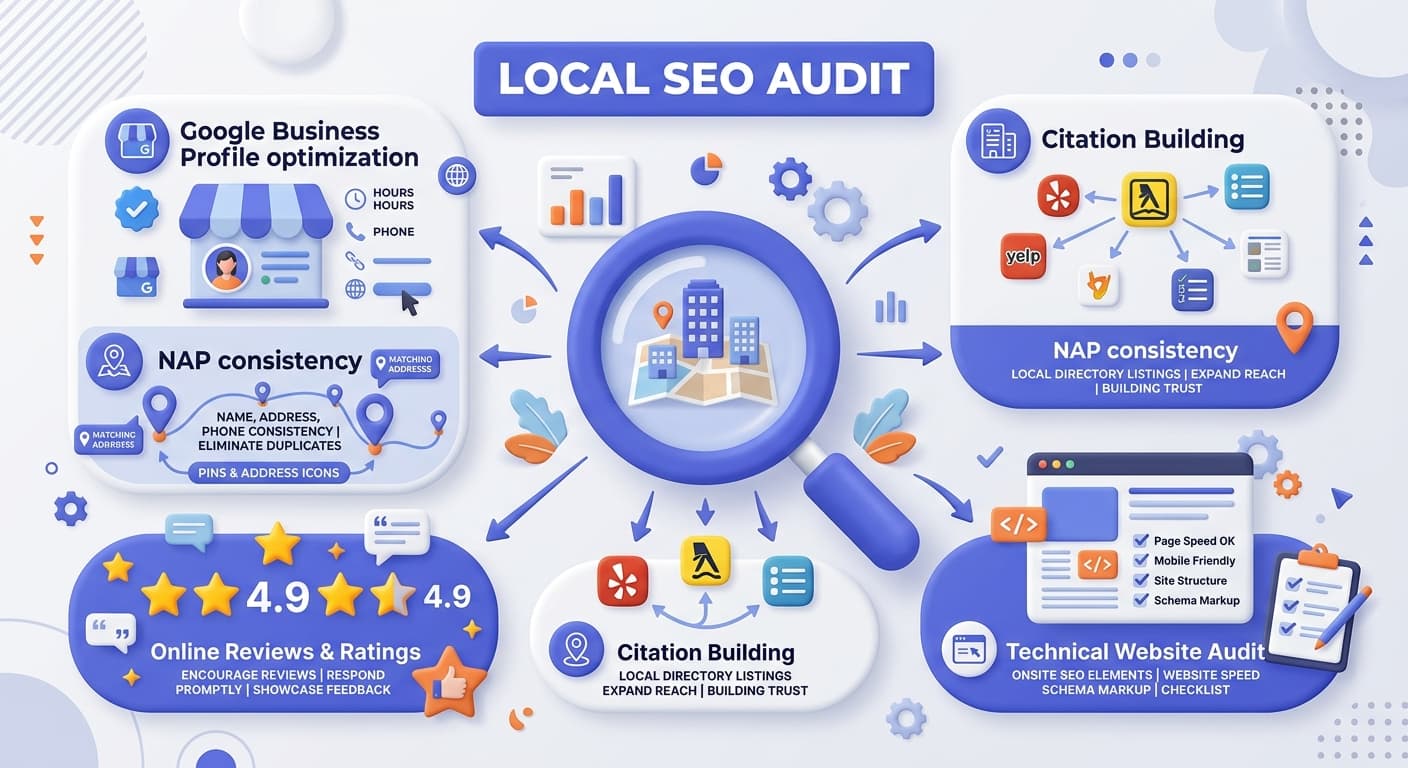
Technical audit checklist:
✅ Verify HTTPS is active, the site is mobile-friendly, PageSpeed scores are acceptable, Core Web Vitals are passing, broken links are absent, crawl errors are resolved, XML sitemap is present, robots.txt is configured, and canonical tags are implemented
✅ Validate your XML sitemap — use QuickSEO's Sitemap Validator to flag any errors
✅ Check that your robots.txt isn't accidentally blocking important pages with the Robots.txt Validator
✅ Audit your structured data — LocalBusiness schema, Organization schema, FAQ schema, Review schema, and Product or Service schema are all critical, as no structured data weakens AI extraction
✅ Test page speed on mobile — one medical practice that cut its mobile load time from 4 seconds to 1.2 seconds saw a 28% increase in appointment bookings from mobile searches
Step 6: Audit Your Local Keyword Strategy
A deep dive into your local keywords and the intent behind them is essential. This isn't about chasing broad, generic terms — it's about uncovering the exact phrases people in your specific service area type into Google when they need what you offer right now.
This means shifting focus from something general like 'plumbing services' to a high-intent, geo-modified term like 'emergency plumber near me' — identifying opportunities that drive immediate action, whether that's a phone call, a form submission, or a visit to your store.
Keyword audit checklist:
✅ Identify your top 10–20 target local keywords (service + location combinations)
✅ Check current rankings in both Map Pack and organic results using Google Search Console
✅ Use Google's "People Also Ask" to discover content gaps around questions your local customers are already asking
✅ Audit for keyword cannibalization — multiple pages competing for the same local terms — using QuickSEO's Keyword Cannibalization Checker
✅ Map each keyword to a specific page and identify any orphaned content
Step 7: Evaluate Your Local Backlink Profile
Backlinks are votes of confidence from other websites, and a local business should focus on earning links from other local organizations, news sites, and industry blogs.
Backlink audit checklist:
✅ Audit your backlink profile for quality vs. toxic links
✅ Ensure a natural link profile with variety of anchor texts and source types. Compare your profile to your top three local competitors and identify where they're getting their links to look for opportunities.
✅ Look for opportunities to create local citations in general and industry-specific directories. Add your business to general directories and reach out to organizations that promote local businesses, including chambers of commerce, small business associations, and tourism websites.
✅ Look for unlinked brand mentions and reach out to convert them into links
Step 8: Competitive Benchmarking
You cannot improve what you don't measure — and you cannot dominate what you don't understand. Your customers are seeing your competitors' listings, reading their reviews, and visiting their websites every single day. Analyzing their efforts tells you what Google currently rewards in your specific market and for your specific services.
Competitor audit checklist:
✅ Identify the top 3 businesses currently ranking in the local pack for your primary keywords
✅ Review what they may be doing to gain ranking advantage — follow the same checklist to identify how they may be optimizing their keywords, content, Google Business Profile, reviews, local business listings, or backlinks
✅ Compare review counts, photo quantity, GBP completeness, and posting frequency
✅ Benchmark your citation coverage against theirs
✅ Identify content topics they're ranking for that you haven't addressed yet
Step 9: Audit Your AI Visibility — The 2026 Priority
This is the layer most businesses are completely missing in their local SEO audits. While 94% of brands surveyed invest heavily in traditional SEO, 62% are "technically invisible" to generative AI models. When asked direct, unbranded questions about their core services, AI models failed to cite them in 81% of test cases.
Of 8,500+ analyzed ChatGPT prompts, 31% trigger a web search — but for local intent queries, this rises to 59%. This means local businesses have a significant opportunity to be cited by AI chatbots, but only if they're optimized for it.
AI visibility audit checklist:
✅ Manually test your brand in ChatGPT, Claude, Gemini, and Perplexity with your core local service queries
✅ Check whether business profile information is accurate in AI responses — business profile information was only about 68% accurate on ChatGPT and Perplexity
✅ Prioritize content depth (sentence and word counts) and readability, which matter most for securing AI mentions and citations
✅ Ensure your structured data (LocalBusiness, FAQ, Review schemas) is complete to improve AI extraction
✅ Structure content strategically — comparison pages with tables earn 25.7% more citations, and validation pages with list sections earn up to 26.9% more citations
✅ Track your AI visibility scores over time across all major chatbots to measure improvement
Step 10: Set Up Ongoing Monitoring and a Reporting Cadence
One of the biggest mistakes in local SEO audits is treating it as a one-time project rather than an ongoing process.
Local SEO is an ongoing system. Performing this audit quarterly ensures that you stay ahead of competitors and continue to grow your organic visibility. However, some signals need more frequent attention: running a full local SEO audit review quarterly catches most meaningful changes before they compound into sustained ranking drops, but NAP consistency and review velocity warrant monthly monitoring or continuous automated tracking.
Monitoring checklist:
✅ Set quarterly full audit cycles using a consistent framework (spreadsheet or template)
✅ Monitor NAP consistency and review velocity monthly
✅ Track keyword rankings in both Map Pack and organic results weekly
✅ Review GBP Insights data monthly (calls, direction requests, website clicks)
✅ Track AI visibility scores across ChatGPT, Claude, Gemini, and Perplexity monthly
✅ Create a priority list of issues found and set a timeline for fixing them — start with high-impact items like GBP corrections and technical errors before moving to long-term tasks like link building
For building out your reporting infrastructure, QuickSEO's local SEO audit template is a great starting point for keeping your findings organized and actionable.
The New Layer: Why AI Visibility Is Now Part of Every Local SEO Audit
Traditional local SEO and AI visibility are no longer separate disciplines — they're two sides of the same coin. 76% of practitioners describe the future of SEO in 2026 as one where visibility depends less on ranking position and more on presence across AI search, SERP features, and intent-driven surfaces.
US businesses need a tighter local search system in 2026 because customers now compare maps, reviews, websites, directories, and AI summaries before they call or visit. Every single signal you clean up in your local SEO audit — from accurate NAP data to complete structured data to a strong review profile — simultaneously improves both your Google local pack visibility and your likelihood of being cited by AI chatbots.
Local SEO works best when every signal tells the same story: who you are, what you do, where you serve, and why customers trust you. That principle applies whether the answer is delivered by Google Maps, Google AI Overview, ChatGPT, Gemini, or Claude.
🚀 Track Your Local SEO & AI Visibility in One Dashboard
Tired of juggling Google Search Console, rank trackers, and AI chatbot spot checks in separate tools? QuickSEO gives you Google Search analytics — clicks, impressions, rankings — alongside AI visibility tracking across ChatGPT, Claude, Gemini, and Perplexity, all in one dashboard. Monitor your AI Score, track which prompts your brand appears in, and see exactly where competitors are beating you in AI-generated answers — without the guesswork. Get started for free at quickseo.ai →
Final Thoughts: Build Your Local SEO Audit Into a System
Running a local SEO audit isn't a one-time fix. A strong local audit provides businesses with a clear growth roadmap and helps improve overall local search visibility across maps, organic search results, and AI-powered discovery platforms. It shows what to fix first, what to build next, and what to monitor every month. When teams align profile data, website architecture, citations, reviews, links, and reporting, they create stronger search engine trust signals and better customer journeys.
The businesses winning in local search in 2026 are not the ones doing the most — they're the ones doing the right things consistently. Use this checklist as your repeatable playbook, run it quarterly, and adapt it as the landscape evolves. The gap between businesses that audit systematically and those that don't has never been wider — or more costly.
Enter your website to track its AI visibility across ChatGPT, Gemini, Claude, and Perplexity — and turn chatbot mentions into traffic.
- Set up in minutes
- Cancel anytime
Keep reading
Related posts
More articles on the same topics, prioritized by shared tags and keyword overlap.