Summarize in ChatGPT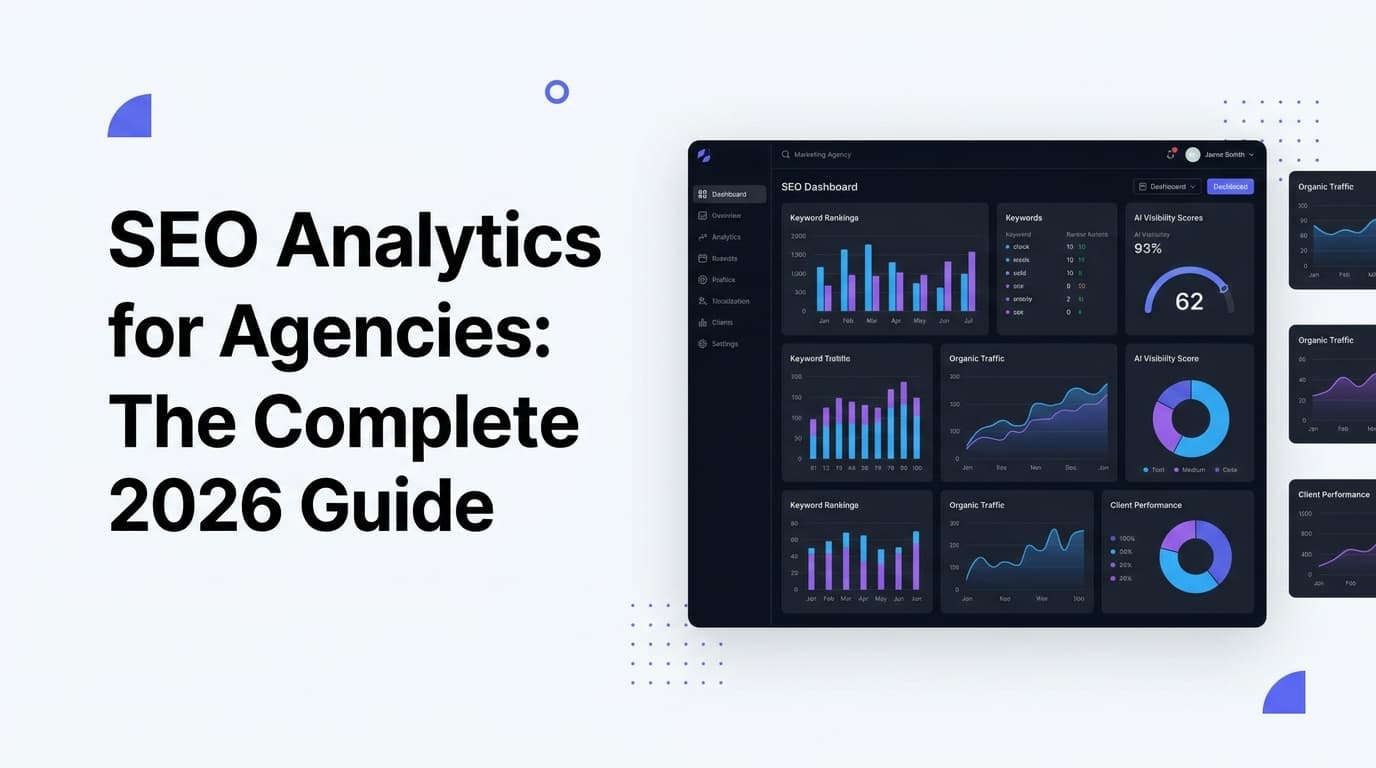
Running a successful SEO agency in 2026 is no longer just about getting clients to page one. The search landscape has fundamentally shifted — and so have the analytics frameworks agencies need to keep up. SEO analytics transforms raw search engine data into clear, actionable insights. It's how agencies track organic traffic, monitor keyword rankings, and measure what's really moving the needle for client campaigns.
But here's the challenge: it's not just about traffic anymore; the way users interact with search engines has fundamentally changed. As we look toward 2026, the nature of agency reports is undergoing a radical shift. Standard dashboards tracking keyword rankings are no longer sufficient. With the rise of AI search, including Google's AI Overviews and engines like Perplexity, clients have new, urgent questions: Are we being cited by generative AI? What is our "answer share" in this new landscape?
This guide breaks down everything SEO agencies need to know about analytics in 2026 — from the foundational metrics that never go out of style, to the cutting-edge AI visibility tracking that's becoming the new competitive differentiator.
Why SEO Analytics Still Matters (More Than Ever)
Despite all the disruption from AI search, the fundamentals of SEO analytics remain critically important. SEO analytics and reporting help your agency go beyond top-level numbers. It turns complex search engine optimization efforts into understandable stories — highlighting what's working, what needs adjusting, and where new opportunities are hiding.
Manual reporting wastes 45% of analyst time on data preparation tasks. An automated dashboard eliminates this overhead by connecting GA4, GSC, rank tracking, and backlink data into a single refreshed view.
And the stakes for getting it right are high. Measuring your clients' marketing metrics is a vital aspect of any marketing agency's job, and SEO is no exception. However, due to its long-term nature and slow ROI, tracking SEO performance can be a challenge.
The agencies that master analytics will outperform those relying on gut instinct — and they'll retain clients far longer by consistently proving measurable value.
The Core SEO Metrics Every Agency Must Track
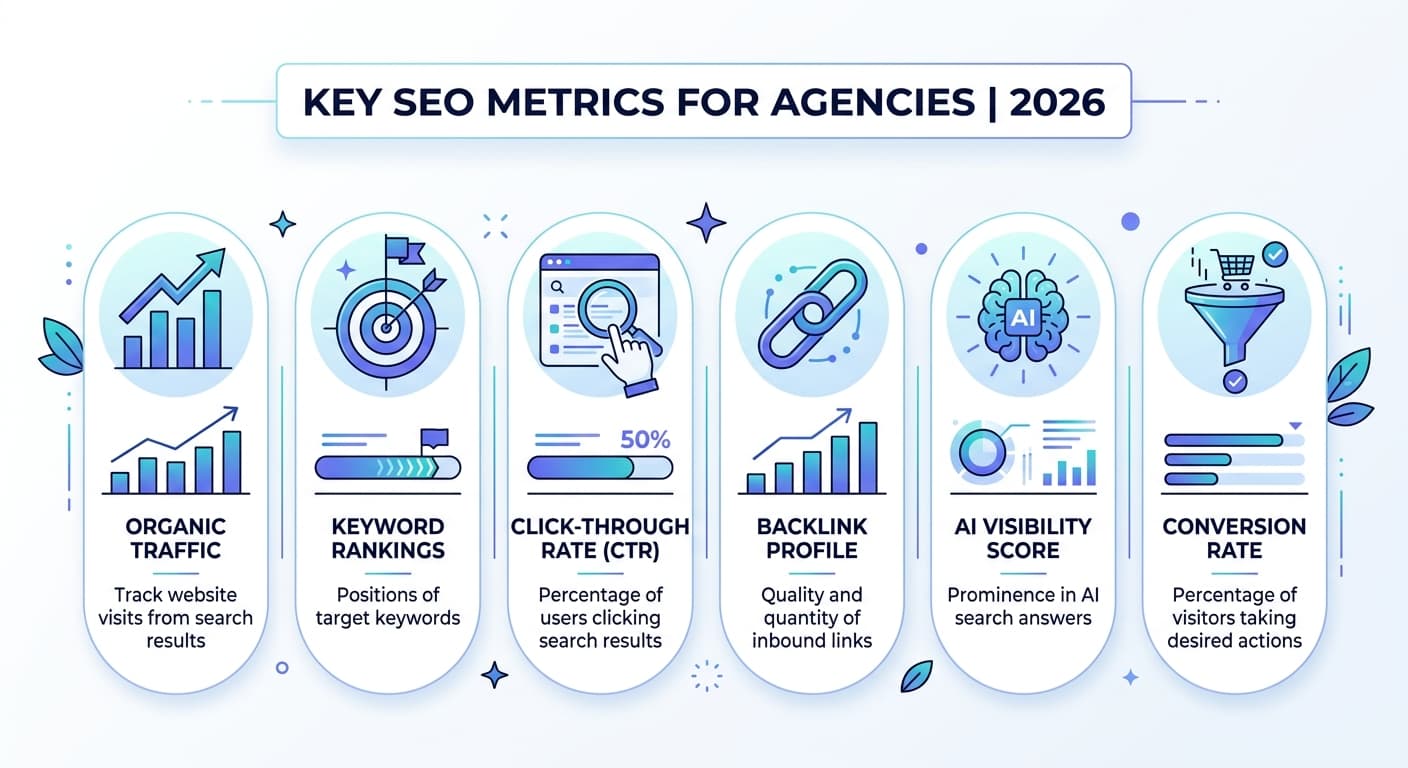
SEO analytics is the process of gathering and examining data about how a website performs in search engine results. This includes tracking things like keyword rankings, organic traffic, click-through rates, and backlink profiles. The goal is to use this information to create and improve strategies for boosting a website's visibility and authority in Search Engine Results Pages (SERPs).
Here are the essential metrics that belong in every agency client dashboard:
1. Organic Traffic
The most fundamental metric. While other SEO metrics might show trends, this metric gives quantifiable proof that your agency's marketing efforts are bringing in more visitors, which should, all else being equal, convert to leads and customers. It's even better if your clients' organic traffic and conversion rates are growing at a faster rate than other channels! The quality of the search traffic will depend on which keywords you're ranking for, the content that they are landing on, and how you define conversions.
2. Keyword Rankings & Rank Tracking
Group keywords, track daily positions across search engines, and spot ranking shifts before your clients do. Don't just track positions in isolation — connect ranking data to page-level actions to show clients how your SEO work drives actual results.
3. Click-Through Rate (CTR)
CTR bridges the gap between visibility and traffic. Use our SERP preview tool to ensure your clients' titles and meta descriptions are compelling enough to drive clicks from their current positions.
4. Backlink Profile
Monitor domain strength and link changes at a glance. Backlink quality — not just quantity — is what moves the needle in 2026.
5. Technical SEO Health
Catch crawl errors, duplicate content, site speed issues, and mobile usability problems before they impact visibility. Load time, interactivity, and layout shifts all influence SEO outcomes. Tracking these valuable SEO metrics with a Core Web Vitals report helps ensure that the site experience isn't holding back rankings.
6. Conversion Rate & Revenue Attribution
Keyword rankings and organic traffic growth are critical KPIs, but what we're really measured on is our ability to create bottom-line dollars for the business. Always tie SEO performance to revenue outcomes the client already cares about.
Building Your Agency's Analytics Tech Stack
SEO analytics in 2026 requires integration across Google Search Console, GA4, rank tracking tools, backlink databases, and your CRM. The tool stack you choose depends on team size, technical resources, and data volume.
Here's how to think about building a scalable agency stack:
Foundation Tools (Non-Negotiable):
Google Search Console — provides valuable insights into search visibility, keyword performance, and technical health.
Google Analytics 4 — where agencies connect organic search traffic to real behavior like page views, drop-offs, and conversions.
Research & Audit Tools:
A crawl tool for technical audits (e.g., Screaming Frog, Sitebulb)
A backlink and keyword research platform (e.g., Ahrefs, Semrush)
Reporting & Client Dashboards: Combine rankings, traffic, conversions, site audits, and backlink data in one dashboard to get a full picture of each campaign's performance.
AI Visibility Tracking (The New Frontier): Most agencies rely on a hybrid stack: traditional SEO platforms for baseline performance, combined with AI visibility tools and controlled manual sampling to track citations, mentions, and inclusion across AI platforms.
The Rise of AI Visibility: The New Metric Agencies Can't Ignore
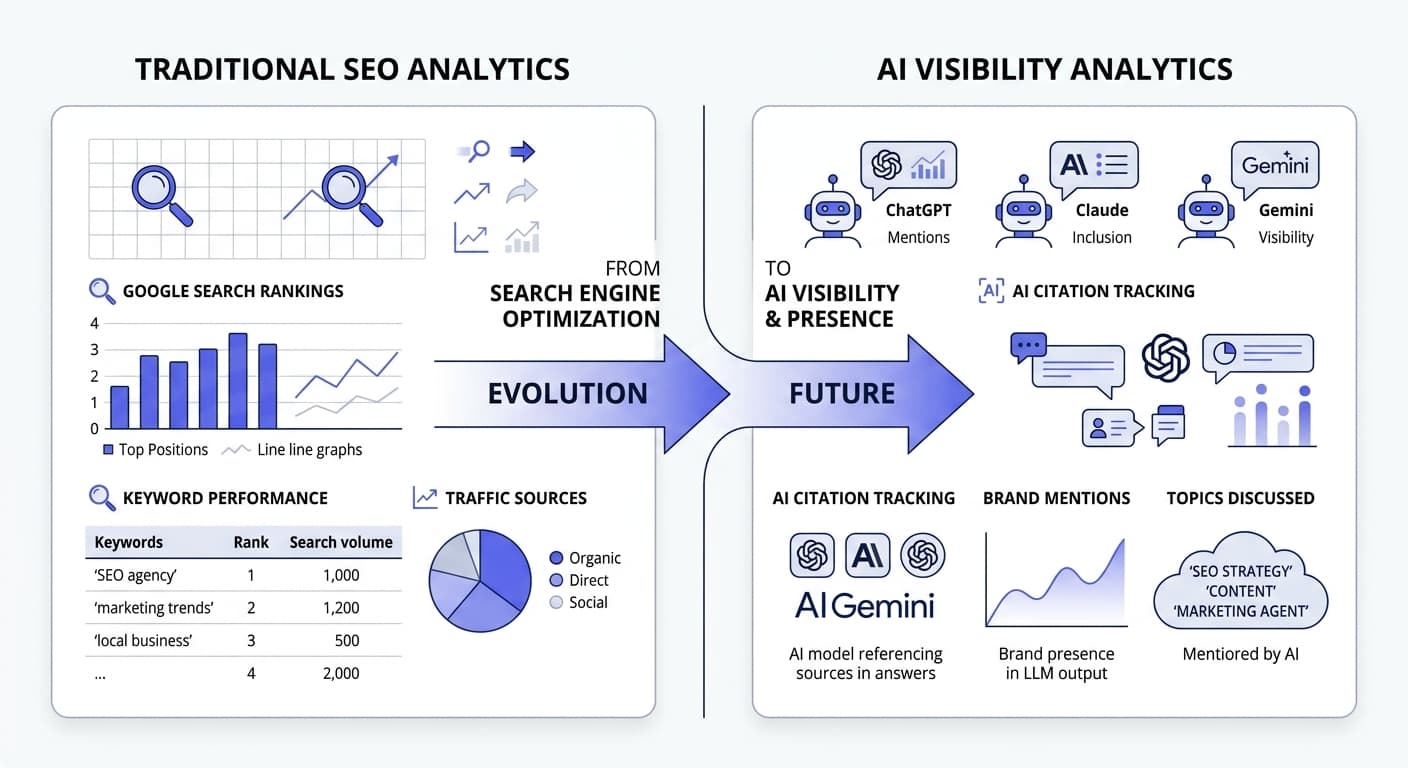
This is the biggest shift in SEO analytics in 2026. AI search adoption is surging: with AI search nearing 1 billion users and tools like ChatGPT becoming mainstream, tracking brand visibility in AI-generated answers is now essential for SEO success.
The data tells a stark story:
Only 14% of marketers currently use AI citation tracking, despite 43% naming AI search optimization as a core 2026 strategy.
Over 58.5% of Google searches now end without a click, up to 83% of AI-generated answer queries are resolved on the results page.
According to AirOps's 2026 State of AI Search research, only 30% of brands stay visible from one AI answer to the next, and only 20% remain visible across five consecutive runs.
Gartner predicted traditional search engine volume would drop 25% by 2026 due to AI chatbots and virtual agents, and industry data confirms AI-driven search has surged from under 10% of interactions in 2023 to roughly 30% by early 2026.
Agencies managing search and AI visibility are facing a separate set of pressures. Clients now ask whether they're showing up in ChatGPT or Gemini, and how this affects their overall visibility.
What AI Visibility Tracking Actually Measures
AI search has shifted visibility from clicks and rankings to inclusion, citations, and influence inside generated answers. AI visibility tracking focuses on:
Citation frequency — How often is your client's brand mentioned in AI-generated responses?
Mention sentiment — Is the brand being portrayed positively, neutrally, or negatively?
Competitive share of voice — monitoring AI visibility shows where competitors are being mentioned or cited, so agencies can win more presence in the same query spaces.
Source/citation domain tracking — This metric is critical because approximately 85% of brand mentions in AI search originate from third-party pages, not the brand's own domain. If the dominant cited source is a review site the client has not earned coverage on, the digital PR roadmap writes itself.
Why AI Visibility Is So Hard to Achieve
The latest 2026 data reveals a stark reality: appearing in AI recommendations is significantly more difficult than ranking on traditional search engines. The Difficulty Spike: Achieving AI visibility is 3–30x harder than traditional SEO.
It takes approximately 250 unique mentions or publications for an LLM to form a definitive "understanding" of your brand. This is exactly why agencies that start tracking — and optimizing for — AI visibility now have a significant first-mover advantage.
How to Set Up an AI Visibility Reporting Framework for Clients
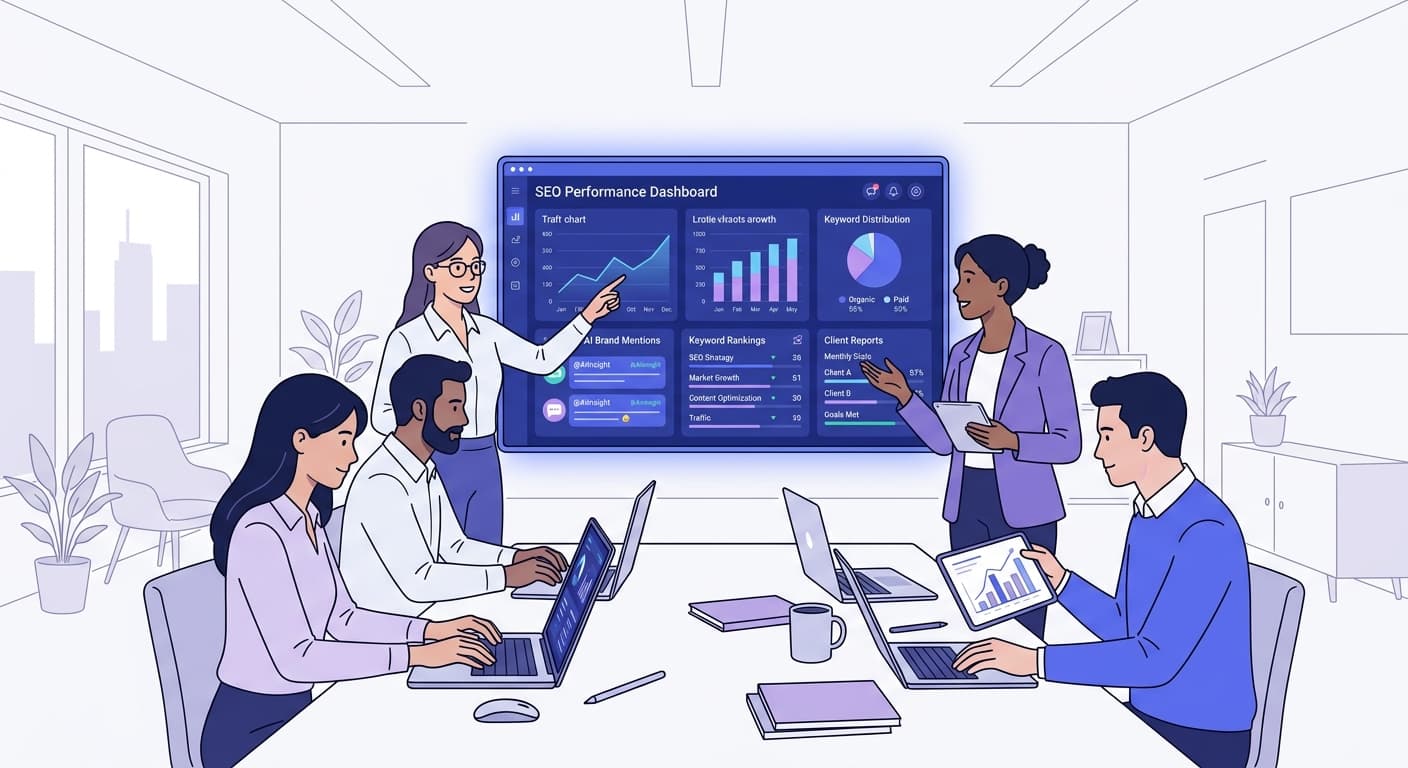
Volatility is exactly why agencies need structured AI search visibility tracking instead of one-off screenshots. Here's a practical framework to get started:
Step 1: Establish a Baseline
Establish a baseline of where the brand appears in AI answers, which competitors are cited, and which prompts/pages are missing. Run this baseline audit during client onboarding so you have something concrete to discuss immediately.
Step 2: Define the Right Prompt Set
Design tracked prompts that reflect real user buying intent. Think: "What is the best [category] for [use case]?" not just brand-name searches. Focus on repeatable patterns such as prompt categories, query clusters, and entity inclusion. Avoid forcing AI visibility into traditional ranking charts, and instead track how often and where brands are selected within AI-generated responses.
Step 3: Set a Reporting Cadence
A four-tier reporting cadence — daily anomaly alerts, weekly digest, monthly white-label PDF, quarterly QBR — lets agencies serve analysts, account leads, and CMOs from one tracking stack.
Track daily or weekly internally so you catch real shifts early, but report monthly trends to the client unless something urgent happens. Frequent internal checks plus a calmer external cadence keeps everyone informed without causing alarm over normal noise.
Step 4: Tie AI Visibility to Business Outcomes
Tie citation frequency to a downstream number the CFO already tracks, like branded search volume, demo requests, or self-reported "how did you hear about us" data. A rising citation rate that lines up with a rising lead number is far more convincing than the citation rate alone.
As AI visibility increases, branded query volume in Google and Bing tends to follow. Agencies that pull branded search data alongside AI visibility tracking can show clients how generative discovery feeds traditional search demand and tightens cross-channel attribution reporting.
Key SEO Analytics Best Practices for Agencies in 2026
Automate Everything You Can
Businesses that automate SEO workflows can respond more quickly to algorithm changes, reduce repetitive manual tasks, and free up teams to focus on higher-value strategic initiatives. Use our AI meta description generator and AI title tag generator to accelerate on-page optimization at scale.
Review Cadence Matters
Reviewing your SEO analytics should be a regular practice — not a one-off. For high-priority campaigns or new projects, a weekly review is recommended; for most ongoing engagements, a monthly cadence is sufficient if you're using automation, anomaly detection, and metric alerts to spot issues before they become problems.
Track Leading and Lagging Indicators
Track leading indicators (content production, technical improvements, link acquisition, review growth) monthly while monitoring lagging indicators (rankings, traffic, conversions) quarterly. This gives clients realistic expectations and keeps your agency accountable to meaningful milestones.
Prioritize E-E-A-T Signals
Experience, Expertise, Authoritativeness, and Trust (E-E-A-T) remain vital for content to rank. Include E-E-A-T signals like author profiles, citations, case studies, and original data in your content to increase credibility and influence rankings.
Don't Ignore Zero-Click Impact
SERP features drive two types of value: trackable direct traffic from Local Pack listings and rich snippets, and unmeasured brand influence from AI Overviews and Featured Snippets. Most analytics platforms only capture the first type, making the second invisible in reporting. Agencies that account for both types of value tell a far more complete story to clients.
Build for Scalability
SEO analytics in 2026 is not about collecting more data — it's about diagnostic confidence. The frameworks that turn fragmented signals into defensible insights are what separate great agencies from average ones.
How to Prove SEO ROI to Clients
One of the perennial challenges for SEO agencies is demonstrating clear ROI — especially since due to its long-term nature and slow ROI, tracking SEO performance can be a challenge.
Here's how leading agencies prove value in 2026:
Connect SEO to pipeline data — Integrate your SEO platform with the client's CRM to show how organic traffic flows into leads and deals.
Use multi-channel attribution — Attribution insights that tie SEO traffic to actual outcomes like form fills, sales, or booked calls are essential for demonstrating business impact.
Track branded search lift — Rising branded search volume is a proxy for growing brand authority, partly driven by AI visibility.
Report on content ROI — Show which pieces of content are driving the most traffic, leads, and revenue over time.
Package AI visibility as a differentiator — Packaging AI visibility tracking as a recurring service line, with a clear deliverable, prompt-set governance, and an attribution story tied to verified sales, turns a measurement task into retainer revenue.
For agencies looking to build out their reporting infrastructure, our SEO report templates provide a ready-made foundation for consistent, professional client deliverables.
The Agency Analytics Mindset Shift: From Rankings to Presence
AEO (Answer Engine Optimization) represents an evolution of SEO that specifically focuses on optimizing for AI systems that directly answer questions rather than just ranking web pages. Traditional SEO aimed to get your page listed in the top 10 results; AEO aims to get your content cited in the answer that AI systems provide.
This doesn't mean abandoning traditional SEO. It means expanding the definition of "visibility." The rise of optimizing for AI search engines (also called GEO, AEO, AIO or LLMO) doesn't mean SEO is dead. It means SEO alone is no longer enough.
Agencies that help clients optimize for AI visibility — through structured data, authoritative content, and brand building — position them for success regardless of how other trends evolve.
The agencies winning in 2026 are treating AI visibility not as a separate project, but as an integrated layer of their existing SEO analytics reporting — one dashboard, one client conversation, one unified story about where the brand shows up and where it needs to grow.
🚀 Track Google Search AND AI Chatbots — In One Dashboard
Stop guessing where your clients rank. QuickSEO combines traditional Google Search analytics with AI visibility tracking across ChatGPT, Claude, Gemini, and Perplexity — all in one clean dashboard. Monitor clicks, impressions, keyword rankings, and AI citation scores. Run AI visibility audits. Track exactly which prompts surface your clients' brands in AI-generated answers. Join thousands of marketers already tracking their AI & SEO performance with QuickSEO. 👉 Get started for free at quickseo.ai
Conclusion
SEO analytics for agencies has never been more complex — or more valuable. By analyzing data regularly, you'll identify under-performing pages, discover opportunities to improve SEO, and make data-driven decisions that drive results.
The agencies that will thrive through 2026 and beyond are those that build a complete analytics picture: technical health, keyword performance, backlink authority, content impact, conversion attribution, and AI visibility. Each layer tells a different part of the story.
The agencies that thrive in this environment will be those that embrace complexity, communicate clearly, adapt continuously, and maintain unwavering focus on delivering real business results for clients. The tools and tactics will keep changing, but the mission remains constant: help clients connect with audiences who need what they offer.
Start by auditing your current reporting stack. Are you tracking AI visibility alongside traditional metrics? If not, that's your biggest opportunity right now — and it's one your competitors are likely still sleeping on.
Enter your website to track its AI visibility across ChatGPT, Gemini, Claude, and Perplexity — and turn chatbot mentions into traffic.
- Set up in minutes
- Cancel anytime
Keep reading
Related posts
More articles on the same topics, prioritized by shared tags and keyword overlap.