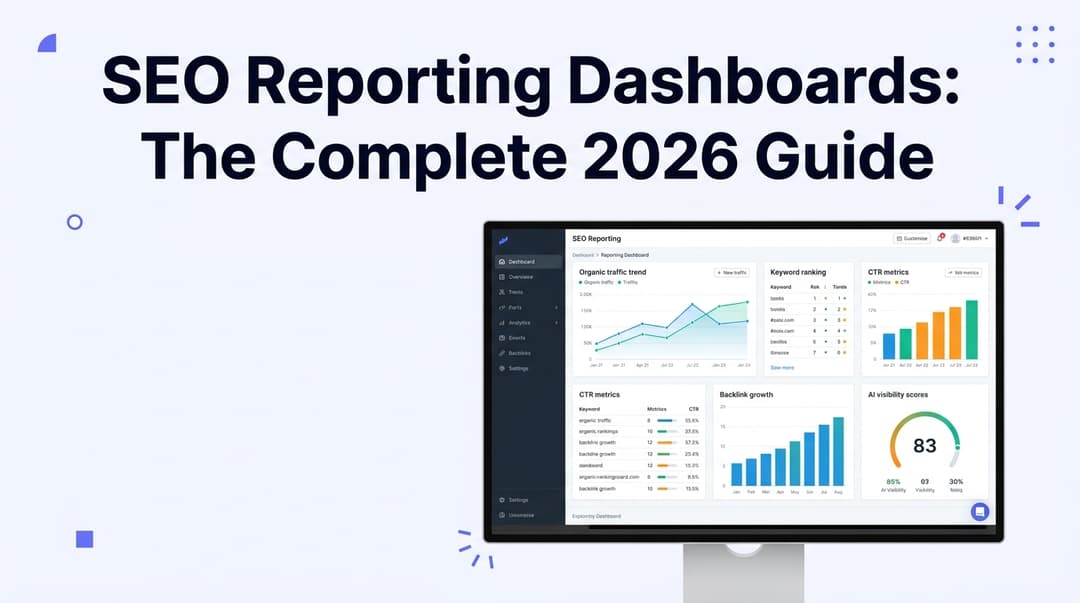
Multi-Site SEO Reporting: The Complete 2026 Guide for Agencies & Enterprises

 Summarize in ChatGPT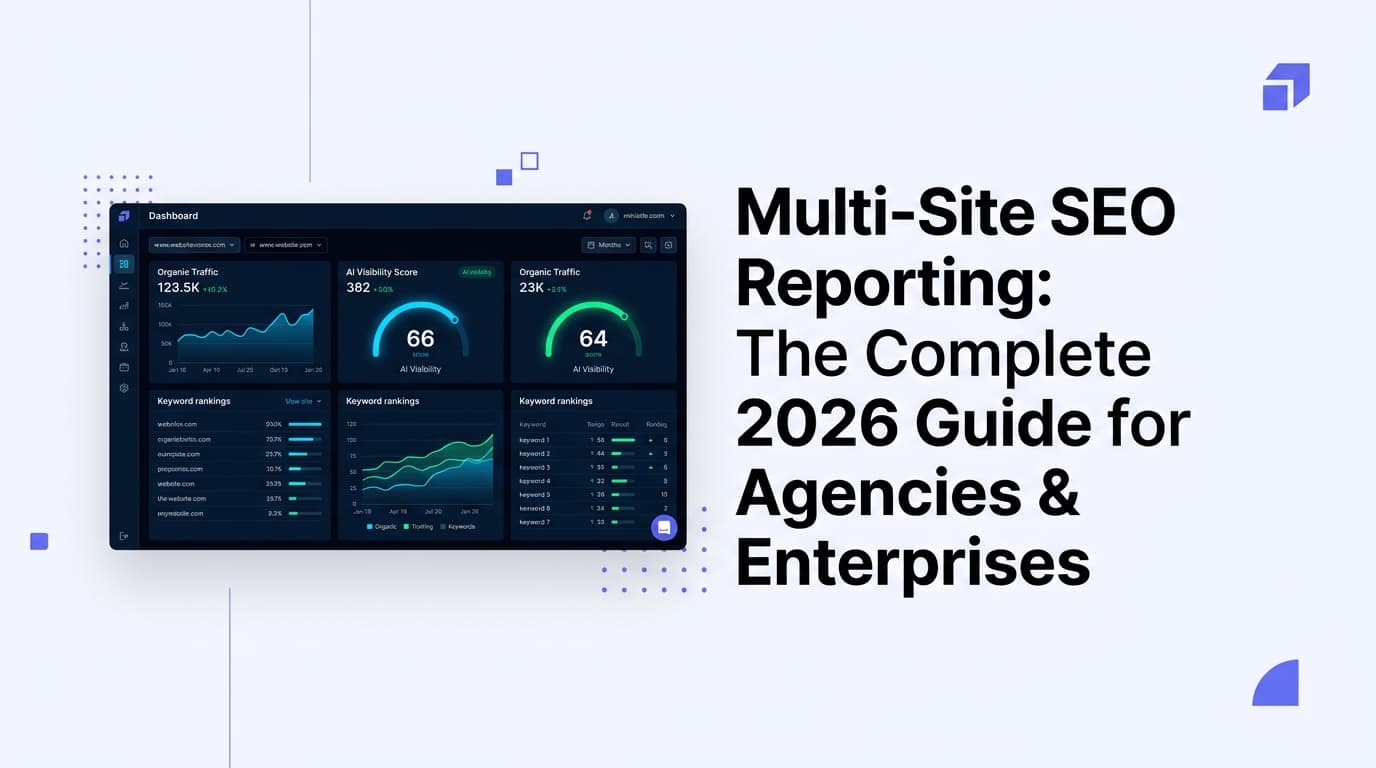
If you manage more than one website, you already know the pain: separate logins, conflicting data, siloed reports, and an ever-growing stack of browser tabs that never seems to shrink. Whether you're running a digital agency with 30+ client domains, a franchise brand with 150 location pages, or an enterprise portfolio spanning multiple markets, multi-site SEO reporting is one of the most operationally draining challenges in modern search marketing.
And in 2026, it got harder.
Your clients no longer just ask "Where do we rank on Google?" Now they ask two questions. The second one — "Are we showing up when someone asks ChatGPT or Perplexity about our category?" — is the one most agencies can't answer yet. Traditional rank trackers measure position on a results page. They say nothing about whether ChatGPT recommends you, or whether Perplexity cites your guide. AI visibility tools close that gap.
This guide breaks down everything you need to build a scalable, centralized multi-site reporting operation — one that covers both Google Search and the AI search layer — without burning out your team.
Why Multi-Site SEO Reporting Is So Challenging
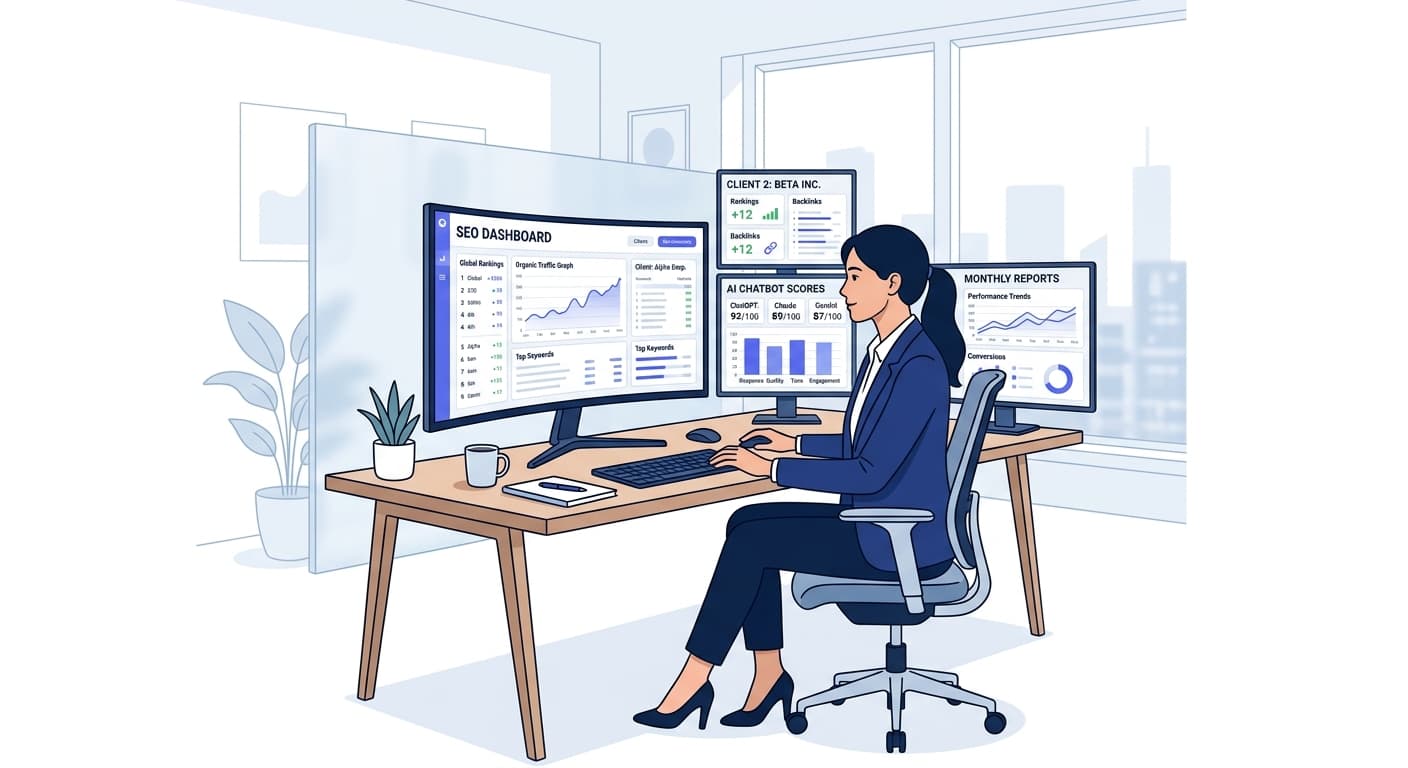
Managing SEO across multiple websites is complex, requiring a tailored SEO strategy to drive traffic, improve rankings, and increase visibility, all without competing with each other. There is a lot more to consider than just optimizing keywords; it can take a significant amount of time and resources if there is no strategy in place.
The problems compound as you add more properties:
The Fragmentation Problem
Without a centralized SEO tool, each new website adds a new layer of complexity: separate logins, separate reports, separate keyword lists, and no way to benchmark one site against another.
Every site has its own keyword targets, its own technical debt, its own content calendar, and its own competitive landscape. Without centralized multi-site SEO management, teams default to a rotation model: audit Site A this week, Site B next week, and hope nothing breaks on the 48 sites you are not looking at.
Reporting becomes a patchwork of dashboards that don't reconcile. Content overlaps and competes across domains. In enterprise and multi-brand organizations, this creates a hidden tax: you spend more time coordinating SEO than doing SEO.
The Scale Problem
The average digital agency manages between 10 and 50 client websites at any given time. Without a centralized SEO tool, each new website adds a new layer of complexity: separate logins, separate reports, and no way to benchmark one site against another.
Agencies managing client portfolios face a unique scaling problem: every new client adds operational overhead but margins stay flat. Logging into 40 different WordPress dashboards, pulling 40 separate reports, and context-switching between 40 different keyword strategies burns hours that should go toward acquiring new clients.
The AI Visibility Blind Spot
Even if you have a solid Google Search Console setup for each property, traditional tools track Google rankings. They can't tell you whether Perplexity recommends your client's product, whether Gemini cites their pricing page, or whether ChatGPT knows they exist at all.
AI Overviews reduce clicks on the #1 organic result by 58% (Ahrefs, December 2025). Meanwhile, 73% of SEO professionals agree AI tools are becoming an important part of their SEO strategy (HubSpot 2026 State of Marketing Report). Reporting on Google alone is no longer enough.
The Core Components of a Strong Multi-Site Reporting Stack
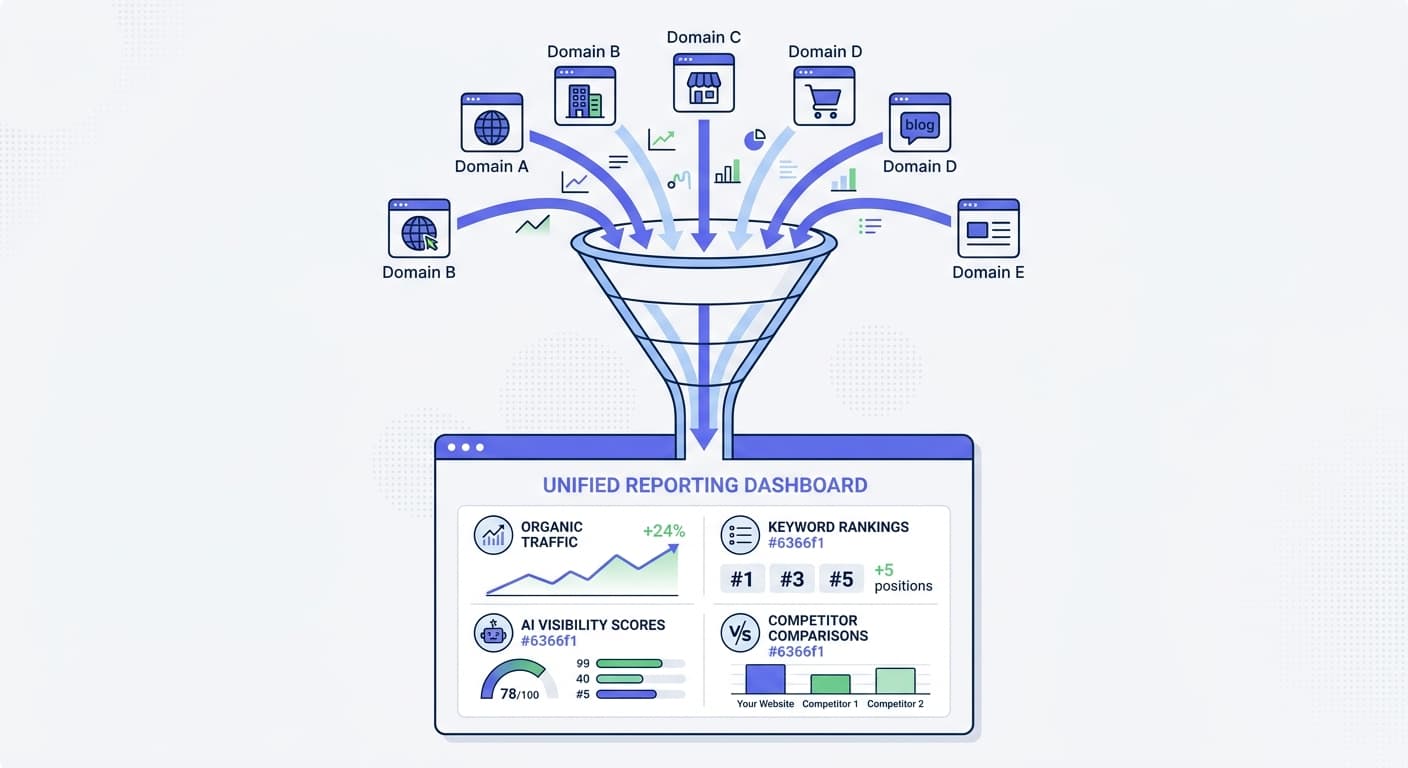
The winning approach combines: portfolio-level governance (templates, technical standards, and brand rules), centralized measurement and reporting, coordinated content and internal linking strategies to avoid duplication and cannibalization, and scalable workflows for audits, fixes, and publishing.
Here's what each layer looks like in practice:
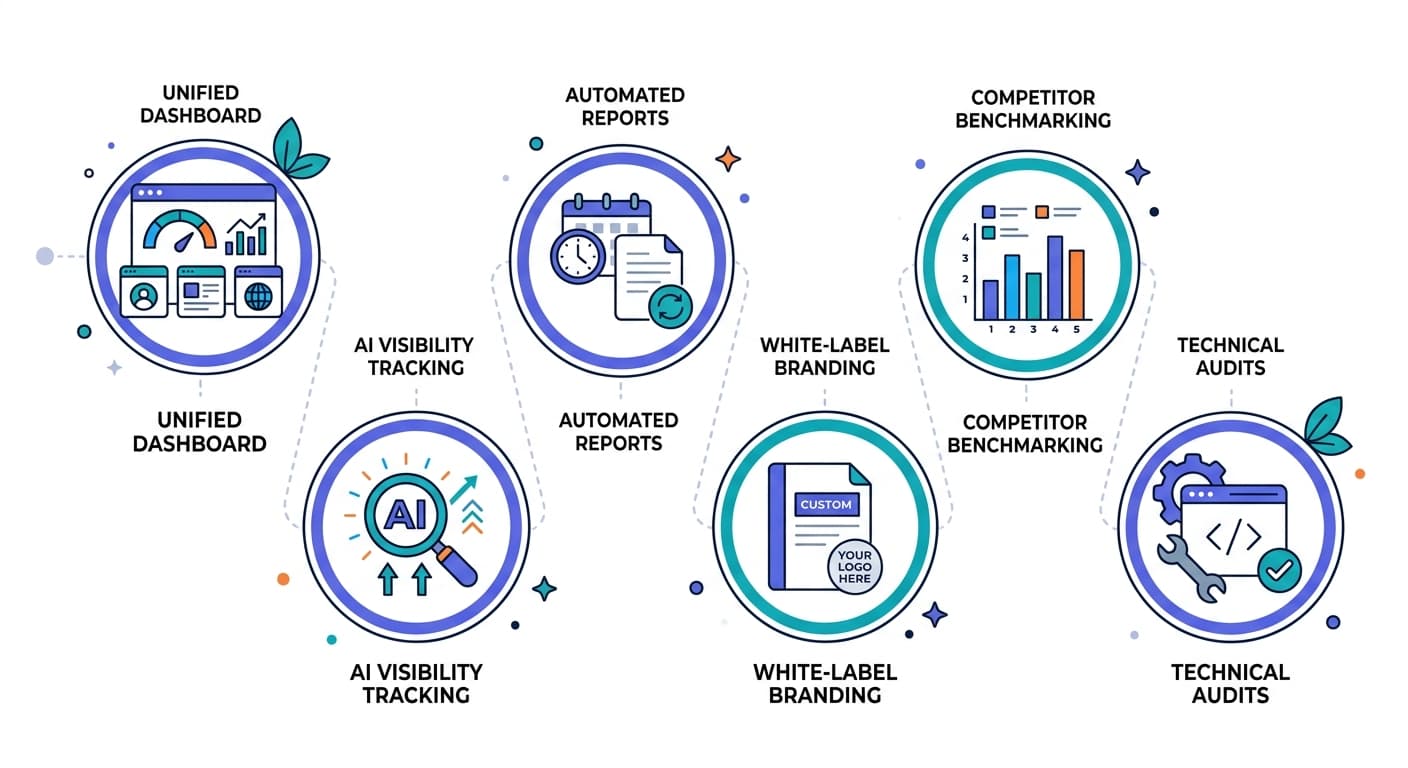
1. A Unified Dashboard (Not Multiple Tabs)
Managing SEO for multiple websites with one tool is not only possible — it's the most efficient way to scale your search strategy without drowning in browser tabs, disconnected reports, and siloed data. Whether you run a digital agency, a portfolio of niche sites, or a multi-brand enterprise, a unified multi-site SEO platform can consolidate keyword tracking, audits, backlink analysis, and reporting under a single dashboard.
A true multi-project dashboard should give you:
Bird's-eye portfolio health: A true multi-project dashboard shows you the health, ranking trajectory, and traffic trends for every website at a glance — without clicking into individual projects. This bird's-eye view is essential for prioritizing which site needs attention first.
Centralized alerts: Centralized alerts catch technical issues like broken links, crawl errors, or sudden ranking drops across all sites instantly.
Competitive benchmarking: You can compare keyword gaps and backlink profiles between your own sites or against competitors.
2. Automated Reporting
Manual SEO reporting requires repeated work. You pull marketing data from multiple sources, update spreadsheets, and rebuild the same reports each cycle. All that time cuts into analysis. Automated SEO reporting removes those steps. Automated reporting tools pull data on a fixed schedule and refresh reports without manual updates.
This matters even more if you manage multiple clients or locations. SEO reporting tools for agencies let you create reports once and reuse the same structure across accounts. That leaves more time to review SEO performance, spot technical issues, and produce actionable insights tied to SEO success.
According to Semrush data cited by Rank Authority, agencies managing 10+ client sites save an average of 6–8 hours per week by centralizing their SEO stack.
3. AI Visibility Tracking
This is the reporting dimension that most legacy tools completely miss. In 2026, your multi-site reporting stack needs to cover not just Google SERPs but also how each of your properties appears inside AI chatbots.
GEO monitoring tracks how and where a brand appears inside AI-generated responses across platforms like ChatGPT, Perplexity, and Google AI Overviews, where there are no ranked positions and visibility depends on citations and source authority.
Coverage of at least five to six major platforms is a practical baseline for agency use in 2026, as clients will ask about performance across ChatGPT, Google AI Overviews, Perplexity, and Gemini at minimum.
4. Technical SEO Audits at Scale
Maintaining technical health across a portfolio of sites is one of the biggest operational bottlenecks. Different sites run different CMS platforms — WordPress here, Shopify there, a custom React app somewhere else. Each platform has its own SEO plugin, its own metadata format, and its own quirks. SEO standards drift across the portfolio because there is no single source of truth.
Running regular audits using tools like QuickSEO's technical SEO audit helps you catch issues like broken links, crawl errors, and indexation problems before they compound across your portfolio. Tools like the robots.txt validator and sitemap validator are practical starting points for keeping each domain audit-ready.
5. White-Label Client Reporting
White-label dashboards let agencies send branded, professional reports to every client from one place. For agencies, this isn't a "nice-to-have" — it's the difference between looking like a professional operation and sending clients raw spreadsheet exports every month.
Reporting needs proof. You need white-label data that shows clients where they stand across AI engines, not just Google.
Who Needs Multi-Site SEO Reporting?
Any organization that operates more than a handful of websites faces the same portfolio management challenge. Here are the most common use cases. Franchise operations with 50 to 200+ locations need local SEO at scale.
The most common scenarios:
SEO agencies managing 10–100+ client domains, each with unique keyword targets and reporting cadences
Enterprise brands with regional microsites, product sub-brands, or international domains
Franchise networks that need consistent local SEO performance across every location
Media companies running multiple editorial properties targeting different audiences
E-commerce brands with separate Shopify stores for different product lines or markets
Media companies with multiple properties — news sites, niche blogs, vertical publications — depend on organic traffic for ad revenue. Each property targets different audiences and keywords, but they share a need for technical excellence: fast load times, clean schema markup, optimized metadata, and strong internal linking. Centralized multi-site SEO management ensures every property meets the same technical standards while maintaining editorial independence. Cross-property linking strategies and shared topical authority compound organic growth across the entire network.
Multi-Site Reporting Best Practices for 2026
Set Portfolio-Level SEO Governance
Multi-site SEO governance isn't bureaucracy — it's how you move faster. Google's systems reward helpful, reliable content and strong technical foundations; you can't rely on ad-hoc processes across multiple teams.
Establish shared standards across all your properties for:
Title tag and meta description templates
Schema markup types and required properties
Internal linking structures
Canonicalization rules
Sitemap update frequency
Use tools like the AI schema markup generator and canonical tag generator to build consistent patterns you can roll out across every domain.
Tailor Reports to Different Audiences
Executives care about business outcomes. Show how organic search traffic connects to leads, sales, or revenue. Focus on SEO metrics such as organic traffic trends, conversion data, and search engine visibility for priority target keywords. Skip technical details that don't tie back to financial impact.
Meanwhile, SEO specialists need data they can act on. Include keyword rankings, position tracking, keyword performance over time, and technical SEO issues like site speed or indexing problems. Add backlink gap analysis and search rankings across search engines.
Build a Consistent Reporting Cadence
SEO is a continuous task that requires an adaptive approach. With trends and customer behaviors constantly changing, it is vital to regularly review data to identify underperforming content and shifting user intent. This will ensure that you are proactively optimizing pages and campaigns while staying reactive to any sudden changes. Regular reports will provide consistent data to support tactical decision-making and also provide visibility for key stakeholders.
Set up automated weekly or monthly report delivery per client. Consistent reporting reveals trends that one-off checks miss.
Avoid Keyword Cannibalization Across Sites
One of the most common pitfalls in multi-site portfolios is having two properties compete for the same keyword, effectively splitting authority and suppressing both. Use a keyword cannibalization checker to audit overlap across your portfolio and assign clear topical ownership to each domain.
Include AI Visibility Metrics in Every Client Report
AI visibility is the differentiator agencies are using to win new business in 2026. If you're still delivering reports that only show impressions and clicks, you're leaving an opening for a competitor to offer something more compelling.
Standard AI visibility metrics to include per property:
AI Score: How prominently is the brand cited across ChatGPT, Claude, and Gemini?
Tracked Prompt rankings: Which queries trigger brand mentions — and at what position?
Share of voice: How does the brand compare to competitors in AI-generated answers?
Citation trend: Is AI visibility improving or declining week-over-week?
What to Look for in a Multi-Site Reporting Platform
Key features to look for: multi-project dashboards, white-label reporting, bulk keyword tracking, and site audit scheduling.
Here's a fuller feature checklist to evaluate any platform:
Feature | Why It Matters |
|---|---|
Portfolio/Overview Dashboard | See all sites' health and rankings at a glance |
White-Label Reporting | Branded reports for every client from one place |
Bulk Rank Tracking | Efficiently manage 50+ keywords × 20+ sites |
AI Visibility Coverage | Track ChatGPT, Gemini, Claude, Perplexity per site |
Automated Report Scheduling | Consistent cadence without manual intervention |
Competitor Tracking | Benchmark each site against its own rivals |
Technical Audit Scheduling | Catch issues before they erode rankings |
Role-Based Access | Clients and team members see only what they need |
Role-based access for account managers, strategists, and clients is non-negotiable at agency scale. You don't want a client accidentally editing another client's prompt library.
For agencies specifically, answering AI visibility questions across a portfolio of 10, 30, or 100 client sites is a fundamentally different job than tracking a single brand. You need bulk runs, per-client dashboards, white-label reports, and pricing that doesn't punish you for adding an analyst or a client.
How QuickSEO Supports Multi-Site Reporting
QuickSEO was purpose-built around the challenge that agencies describe most: needing a single dashboard that puts Google Search Console data and AI visibility side by side. QuickSEO's AI visibility tracking lets you monitor how each of your properties — and your clients' properties — appear across ChatGPT, Claude, and Gemini, alongside traditional search analytics.
Key capabilities for multi-site reporting include:
Tracked Prompts: Set up industry-relevant queries per client and monitor which properties appear, and at what position, across AI chatbots
Share of Voice: See how each domain competes against rivals for both Google and AI search real estate
Competitor Tracking: Benchmark each client against their specific competitors, not a generic pool
AI Score + Search Analytics in one view: No switching between platforms to piece together a full performance picture
Search analytics integration: Pull in clicks, impressions, and GSC data alongside AI visibility metrics for a genuinely unified report
🚀 Ready to Unify Your Multi-Site Reporting?
Stop juggling separate dashboards, disconnected spreadsheets, and one-dimensional Google-only reports. QuickSEO gives you one place to track and improve your presence across Google Search AND AI chatbots like ChatGPT, Claude, and Gemini — for every site in your portfolio. Join thousands of marketers already tracking their AI & SEO performance with QuickSEO. 👉 Get started for free at quickseo.ai
Common Multi-Site Reporting Mistakes to Avoid
Even seasoned SEO teams fall into these traps when managing portfolios at scale:
1. Treating every site identically Each domain has its own competitive landscape, audience intent, and content maturity. A single reporting template is fine for structure, but the insights and priorities should be site-specific.
2. Reporting only on what's easy to pull Teams still report on impressions and keyword counts without tying performance to outcomes. In 2026, SEO must align with business objectives. Push past vanity metrics.
3. Ignoring AI search entirely AI search adoption is surging: with AI search nearing 1 billion users and tools like ChatGPT becoming mainstream, tracking brand visibility in AI-generated answers is now essential for SEO success. Leaving this out of your reports means leaving your clients exposed to a competitor who does track it.
4. Manual report building every cycle If your enterprise has more than one domain, you may find yourself wasting a lot of time with individual reporting. The ability to view and analyze different domains in one snapshot will save you valuable time and will allow you to scale your SEO and digital marketing strategy.
5. No cross-site governance SEO governance is one of the most underinvested areas in modern search programs. Without governance, SEO breaks at scale. If each property is operating on its own playbook with no shared standards, you'll spend more time fixing drift than building growth.
Conclusion
Multi-site SEO reporting in 2026 is no longer just about pulling keyword rankings from a few different Search Console properties. It's about building a unified, scalable system that gives every stakeholder — from the CMO to the technical SEO specialist to the individual client — a clear, accurate picture of performance across both traditional search and the fast-growing AI search layer.
The agencies and enterprises that win in this environment are the ones that invest in centralization early: one dashboard, consistent governance, automated delivery, and reporting that covers Google and ChatGPT, Claude, Gemini, and Perplexity.
If you're still managing multi-site reporting through a patchwork of tools and manual exports, now is the time to upgrade. The data is available. The tools exist. The only question is whether your reporting stack is keeping up.
For a deeper look at how AI search is reshaping the metrics that matter, see our guide to AI search vs. Google search in 2026 — and why your brand needs to be tracking both.
Enter your website to track its AI visibility across ChatGPT, Gemini, Claude, and Perplexity — and turn chatbot mentions into traffic.
- Set up in minutes
- Cancel anytime
Keep reading
Related posts
More articles on the same topics, prioritized by shared tags and keyword overlap.