Summarize in ChatGPT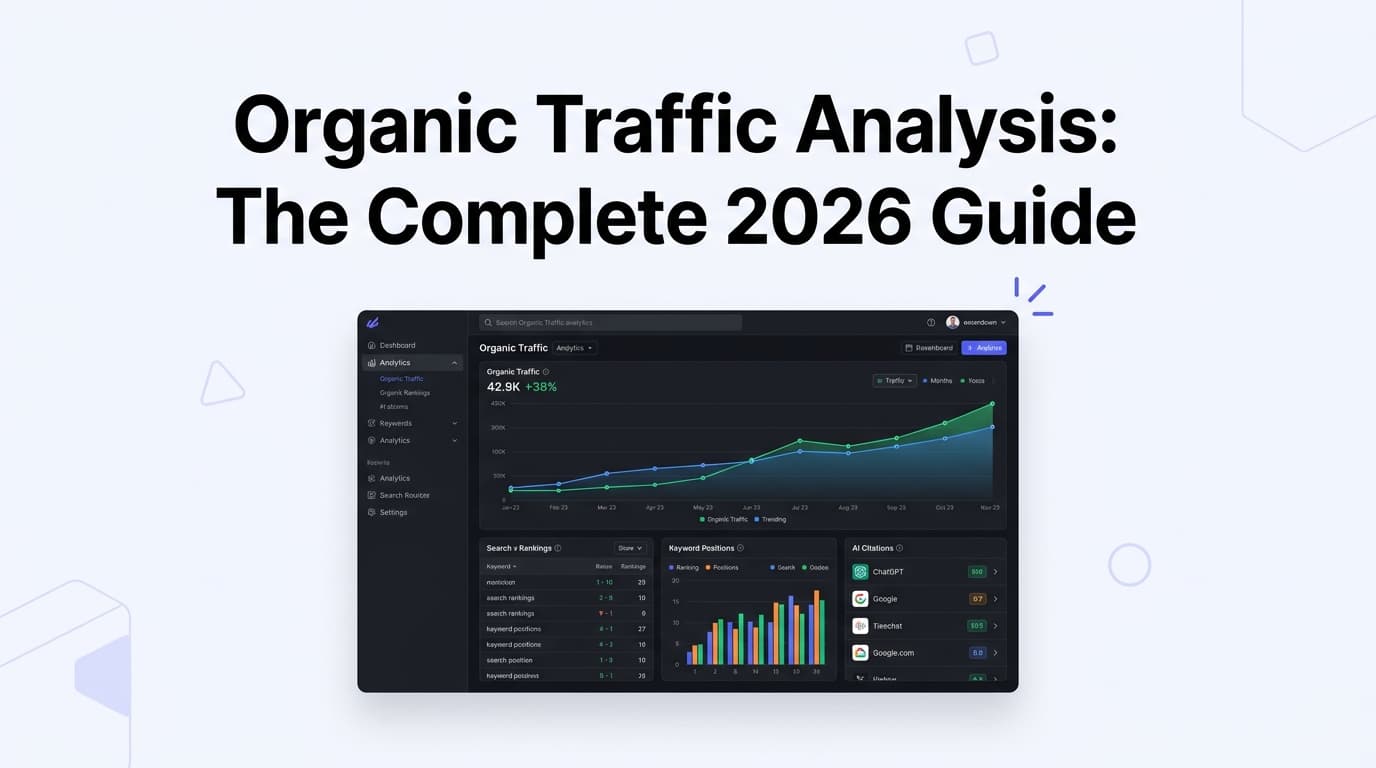

Organic traffic has always been the gold standard of digital marketing — but in 2026, the rules have fundamentally changed. AI Overviews, zero-click searches, and the rise of answer engines like ChatGPT and Perplexity mean that simply counting sessions in Google Analytics no longer tells the full story.
If you want to grow and protect your organic visibility, you need a deeper, more sophisticated approach to analysis — one that accounts for both traditional search and the new AI-powered discovery layer. This guide walks you through everything you need to know: what organic traffic analysis is, which metrics matter, which tools to use, and how to build a strategy that compounds over time.
What Is Organic Traffic Analysis?
Organic traffic analysis is the process of measuring, interpreting, and acting on the data generated by visitors who arrive at your website through unpaid search results. This includes clicks from Google, Bing, and increasingly, AI-powered platforms that link out to sources when answering user queries.
A complete traffic analysis answers five key questions:
Where is the traffic coming from? (Google organic, AI referrals, direct, social, email, referral)
What are visitors doing on the site? (pages viewed, engagement depth, scroll behavior)
Who is converting? (segmented by source, device, and behavior)
Why is performance changing? (period-over-period comparisons, algorithmic shifts)
What should you do about it? (prioritized action items)
Anything less than this is just data review — not true analysis.
Why Organic Traffic Analysis Is More Complex in 2026
The organic search landscape has undergone seismic shifts. Nearly 50% of consumers now use AI-powered search, which means traditional organic strategies must evolve to capture both human attention and machine understanding.
The headline stats are stark:
Zero-click searches now comprise 60% of Google queries overall and 77% on mobile devices, meaning users often find answers directly on search results pages without visiting websites.
Google's AI Overviews now appear for roughly 13% of queries and reduce CTR by up to 47–58% when present.
Organic CTR was just 0.61% with AI Overviews present versus 1.62% without them.
At the same time, organic search still drives 53% of all website traffic and delivers a 700% ROI as a long-term channel. The opportunity is very real — but your analysis framework needs to evolve with it.
This shift means growth can no longer be measured solely by visitor volume; engagement metrics like average session duration (54 seconds), bounce rates (46.9% for organic search), and conversion rates now define success more accurately than raw traffic numbers.
The Core Metrics of Organic Traffic Analysis
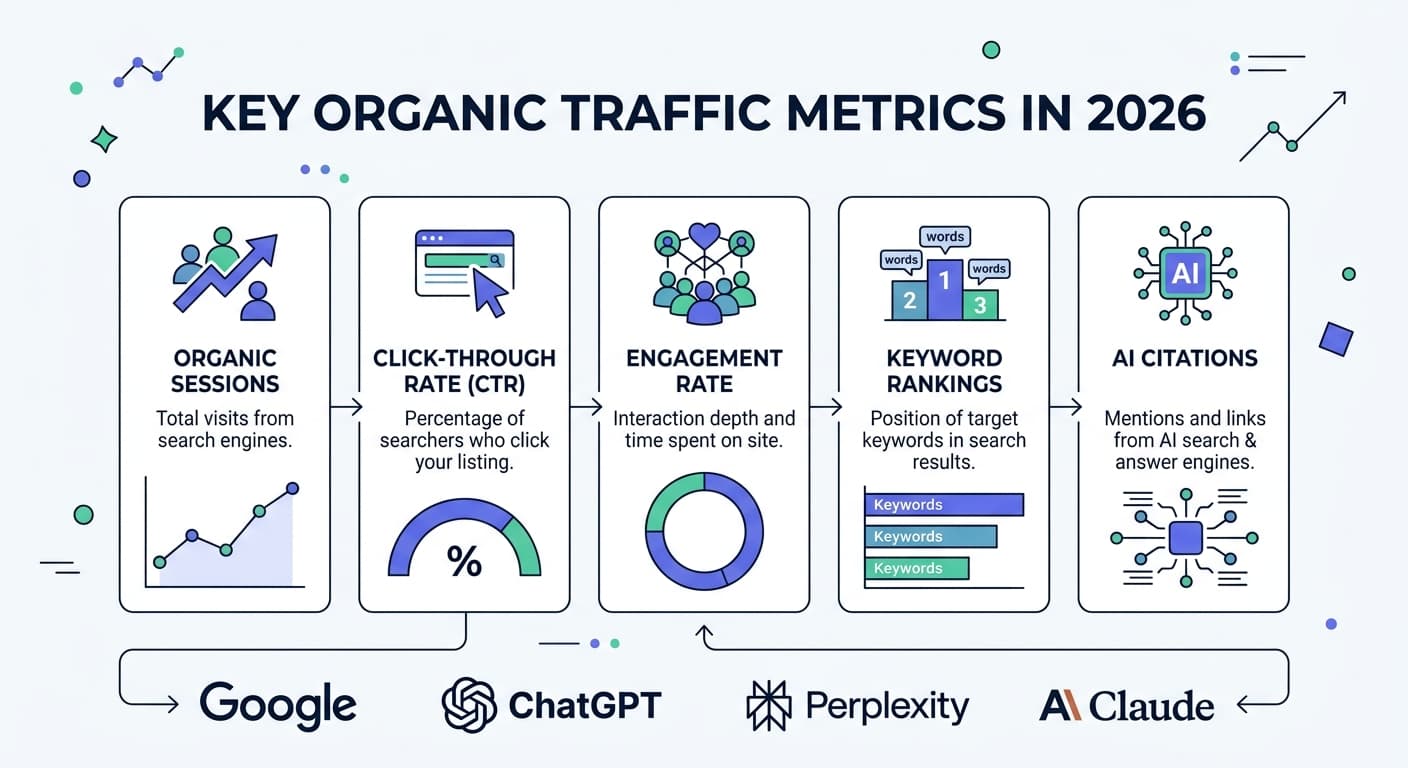
1. Organic Sessions & Users
This is the baseline: how many people are arriving from unpaid search results? In GA4, organic search traffic is considered one of the key performance indicators for SEO because it measures the volume of unpaid clicks your site receives from search engine result pages (SERPs).
Track both total organic users and new vs. returning users from organic. New users signal your SEO is reaching fresh audiences; returning users indicate your content builds loyalty.
2. Engagement Rate (Not Bounce Rate)
GA4 replaced the old bounce rate metric with a more nuanced one. GA4 provides post-click metrics designed to qualify engagement, including engaged sessions, defined as sessions lasting at least 10 seconds, containing a conversion event, or at least 2 pageviews or screenviews.
Engagement rate (engaged sessions divided by total sessions) complements volume-based readings and gives you a far more honest picture of whether your organic visitors are finding value in your content.
3. Click-Through Rate (CTR) from Search Console
The Google organic search traffic report is a pre-made detail report in GA4 that displays landing pages with associated Search Console and Analytics metrics for your linked Search Console property.
By linking GA4 with Google Search Console, you can identify pages with high impressions but low CTR — a prime signal that your title tags or meta descriptions need work. Use QuickSEO's free AI Title Tag Generator and AI Meta Description Generator to quickly optimize these elements.
The fastest results in organic traffic come from optimizing title tags and meta descriptions on pages that already have high impressions but low CTR in Google Search Console — this can show results within 2–4 weeks.
4. Keyword Rankings & Positions
Rank tracking tells you which keywords are driving impressions and clicks, and whether your positions are trending up or down. Tools like Ahrefs' Keywords Explorer stand out for their click metrics: the Keywords Explorer provides click metrics and traffic potential estimates, giving you a more realistic picture of what ranking for a keyword is actually worth.
5. Landing Page Performance
The Landing Page report helps you identify which pages attract and retain the most organic traffic, with GA4 automatically tracking critical metrics for each landing page. Sort by organic sessions and cross-reference with engagement rate and conversions to find your highest-value pages.
6. AI Citations & Visibility (The New Frontier)
This is the metric most SEO teams are still missing. AI search should be treated as its own acquisition channel rather than a noise variable in direct traffic — unexplained direct traffic in 2026 is often AI traffic.
When ChatGPT, Perplexity, Claude, or Gemini cite your content, users land on your site tagged as "direct" traffic in GA4. To properly understand your full organic footprint, you need to track AI citations separately.
Setting Up Your Organic Traffic Analysis Stack
No single tool covers everything, and the teams performing best in 2026 are building deliberate stacks rather than relying on one platform to do it all. Here's what a robust 2026 analysis stack looks like:
Google Analytics 4 (GA4)
Your post-click analytics foundation. Use it to measure engagement, conversions, landing page performance, and user journeys from organic search. GA4 stores data for up to 16 months, making it easier to spot long-term trends.
Google Search Console (GSC)
Your pre-click data layer. GSC shows impressions, clicks, average position, and CTR for every query your site ranks for. Search Console keeps data for the last 16 months, giving you a robust historical baseline for trend analysis.
Third-Party SEO Tools (Ahrefs, Semrush)
For competitive analysis and keyword research. Content gap analysis at both the domain and page level makes it easy to find keyword opportunities your competitors are capturing that you're missing.
AI Visibility Tracking
Traditional tools don't show you whether your brand is being cited in AI chatbots. This is where platforms like QuickSEO fill a critical gap — tracking your brand's presence across ChatGPT, Claude, Gemini, and Perplexity alongside your traditional Google rankings in a single dashboard.
How to Conduct a Step-by-Step Organic Traffic Analysis
Step 1: Benchmark Your Current State
Before analyzing trends, establish a clear baseline:
Total organic sessions (last 90 days vs. prior 90 days)
Top 10 organic landing pages by sessions and engagement rate
Average keyword position from Google Search Console
Overall CTR across all queries
Use QuickSEO's Website Grader to get an instant snapshot of your site's overall SEO health as part of this initial audit.
Step 2: Segment Your Traffic
Don't analyze organic traffic as a single blob. Segment it by:
Branded vs. non-branded keywords — branded traffic measures brand awareness; non-branded measures SEO reach
Device type — mobile vs. desktop behavior differs significantly
Landing page category — blog posts vs. product pages vs. service pages
Geographic region — especially important for local businesses
Step 3: Identify Your Content Gaps
The useful question is: where are the clicks going, who is losing them first, which content still earns a visit? The short answer is that search demand still exists, but a larger share of value now gets absorbed by AI summaries, zero-click behavior, and paid surfaces before the user ever reaches your site.
Use a Keyword Gap Analyzer to find the queries your competitors rank for that you're missing entirely. These represent your highest-priority content opportunities.
Step 4: Diagnose Traffic Drops
When organic traffic drops, work through this diagnostic checklist:
✅ Check GSC for manual actions or security issues
✅ Cross-reference drop timing with known Google algorithm updates
✅ Review your Internal Linking Audit for newly broken links or orphaned pages
✅ Look for cannibalization issues with the Keyword Cannibalization Checker
✅ Audit your Robots.txt and XML Sitemap for crawl issues
Step 5: Prioritize Content Updates
Go through your top-performing articles and update any statistics, examples, or references to reflect current data. Replace outdated screenshots, refresh product comparisons, and remove references to deprecated tools or strategies.
Updating and republishing existing content that's slipped in rankings, alongside targeting low-competition long-tail keywords, can reach page one within 60–90 days.
Step 6: Track AI Visibility Alongside Google Rankings
76.1% of URLs cited in AI Overviews already rank in the traditional organic top 10 — meaning strong traditional SEO is your best path to AI visibility too. But you need to measure both separately.
When someone asks ChatGPT for software recommendations or Perplexity for industry best practices, AI models decide which brands to mention based on relevance, authority, and how well your content answers common questions. Structure your content to answer questions AI models commonly receive.
Key Signals Your Organic Analysis Should Flag
When reviewing your organic traffic data, watch for these patterns:
Signal | What It Means | Action |
|---|---|---|
📈 High impressions, low CTR | Title/meta not compelling | Rewrite title tags and meta descriptions |
📉 Rankings stable but traffic dropping | SERP features absorbing clicks | Optimize for featured snippets and AI Overviews |
🔄 Sudden traffic spike to "direct" | Likely AI citation traffic | Track AI citations systematically |
⬇️ Engaged sessions declining | Content quality or relevance issue | Update and deepen existing content |
🚫 Page dropping from position 3 to 15 | Possible cannibalization | Consolidate competing pages |
The 2026 Organic Analysis Mindset: Beyond Sessions
The best strategies in 2026 require a data-driven approach that connects every content asset, technical optimization, and user experience improvement directly to business outcomes. This means focusing on qualified traffic that reduces dependency on paid channels while accelerating pipeline velocity and customer lifetime value.
This means measuring organic traffic success not just by session volume, but by:
Revenue attributed to organic — connect GA4 to your CRM
Lead quality from organic — organic leads tend to have higher intent
Share of voice in AI answers — are you being cited when it matters?
Content ROI — which articles are driving the most pipeline?
The most robust view connects: organic entry page → key events → conversion. From there, you can estimate business contribution using your own conventions (value, qualified lead, CRM stage) and prioritise improvements accordingly.
Common Organic Traffic Analysis Mistakes to Avoid
1. Treating all organic traffic equally Not all organic sessions are created equal. A visitor from a high-intent "buy now" query is worth far more than a curious click on an informational article. Always segment by intent.
2. Ignoring AI traffic hidden in "direct" As noted above, AI-referred traffic often appears as direct in GA4. If your direct traffic is growing unexplainably, investigate your AI citation footprint.
3. Optimizing for rankings alone You may see Search Console impressions increasing while GA4 organic sessions are flat or declining. This pattern — high impressions, low clicks — is increasingly associated with zero-click search behavior, where Google answers the query directly in the SERP. Rankings without clicks don't grow your business.
4. Neglecting content freshness Allocate a portion of your content calendar specifically to link-earning content — pieces that contain something genuinely citable that does not exist elsewhere. One original research piece per quarter that produces genuine editorial links is worth more than many additional keyword-optimised articles.
5. Analyzing in isolation Comparing organic with other channels helps avoid misleading conclusions — for example, SEO statistics often highlight how SEO and paid search share traffic and conversions, which reinforces the value of channel-level analysis rather than relying on site-wide averages.
Building an Automated Organic Traffic Growth Engine
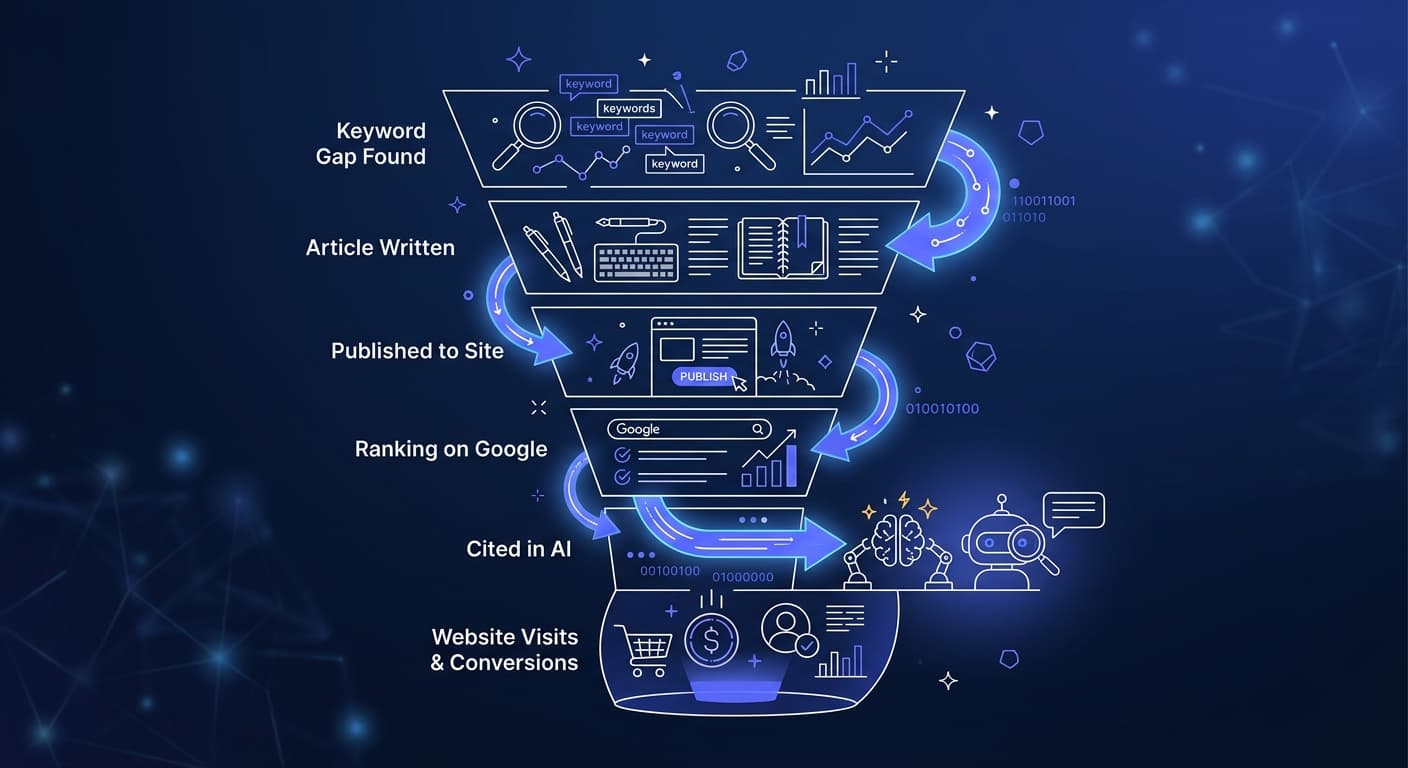
Manual analysis is valuable, but the brands winning in 2026 are those that have automated the cycle of finding gaps → creating content → publishing → tracking results.
The brands seeing the strongest organic growth in 2026 are those treating AI search visibility as seriously as traditional SEO.
The ideal workflow looks like this:
Discover keyword and content gaps automatically
Generate on-brand, research-backed articles targeting those gaps
Publish directly to your CMS without manual copy-pasting
Track performance in both Google and AI chatbots
This is exactly what QuickSEO does on autopilot — finding where you're invisible in Google and AI search, writing articles built to rank, and publishing them to your site every day.
🚀 Stop Guessing. Start Growing.
QuickSEO finds where you're invisible in Google and AI chatbots, writes on-brand articles built to rank and get cited, and publishes them to your site — every day. Sites running QuickSEO are already climbing the rankings, getting cited in ChatGPT, Claude, Gemini, and Perplexity, and turning organic traffic analysis insights into automated growth. Try QuickSEO free — no payment required →
Conclusion
Organic traffic analysis in 2026 is no longer a simple exercise of checking your session count in Google Analytics. It requires a layered approach that covers traditional search performance, engagement quality, content gap identification, and — critically — your visibility in AI-powered answer engines.
The brands that master this holistic view will build compounding, sustainable organic growth that reduces dependence on paid advertising and creates durable competitive advantages. Start by benchmarking where you are today, identify your biggest content gaps, and build a system that continuously turns analysis into action.
Whether you're using QuickSEO's suite of free SEO tools for quick audits or leveraging the full autopilot platform to automate content creation and publishing, the path forward is clear: treat your organic traffic data not as a report card, but as a roadmap.
Enter your website to track its AI visibility across ChatGPT, Gemini, Claude, and Perplexity — and turn chatbot mentions into traffic.
- Set up in minutes
- Cancel anytime
Keep reading
Related posts
More articles on the same topics, prioritized by shared tags and keyword overlap.