Prompt Performance Analysis: The Complete 2026 Guide to Tracking AI Visibility

 Summarize in ChatGPT
If your SEO strategy still revolves purely around Google rankings, you're already playing catch-up. In 2026, the question isn't just "where do I rank?" — it's "does my brand appear when someone asks an AI chatbot?" That shift has given rise to a critical new discipline: prompt performance analysis.
Prompt performance analysis is the process of systematically testing the queries your customers ask AI tools like ChatGPT, Perplexity, Gemini, and Claude — then measuring how often, how prominently, and how positively your brand shows up in the answers. Think of it as keyword tracking for the AI era: instead of monitoring a position on a search results page, you're monitoring your brand's presence inside synthesized, conversational responses.
This guide covers everything you need to know — why prompt performance matters, how to build a prompt testing framework, what metrics to track, and how to act on the data.
Why Prompt Performance Analysis Matters in 2026
In 2026, the search bar is no longer limited to simply retrieving links — it's synthesizing answers, evaluating competing claims, and increasingly influencing purchasing decisions. The implications for marketers are profound.
37% of product discovery queries now start in AI interfaces like ChatGPT and Perplexity. If your brand isn't appearing in those conversations, you're missing a massive and growing share of buyer intent — before a single click is ever made.
Traditional SEO metrics, including rankings and clicks, are insufficient in a synthesis-first environment. New performance indicators such as citation frequency, share of model, and AI-generated referral traffic are essential to measure ROI and justify digital investment.
The stakes are also highly competitive. Research from 5W's 2026 Airlines & Hotels AI Visibility Index found that the top three brands captured over 70% of citation share in most subcategories — winner-takes-most dynamics identical to Google's early days. Getting into the AI answer early is a strategic advantage that compounds over time.
The hard truth? An analysis of 177 brands across healthcare, SaaS, and financial services found that 90% of brands have zero AI search mentions. That's an enormous gap — and an enormous opportunity for brands that move first.
What Is a "Prompt" in AI SEO Context?
Before diving into analysis, it's important to define what we mean by a prompt in this context. Prompt analysis is the process of understanding what people ask AI tools, how AI interprets those questions, and which brands it chooses to reference in the answers. It's the discipline that bridges the gap between what your customers are asking ChatGPT and whether your brand shows up when they do.
This is fundamentally different from keyword research. Keyword research tells you what people type into a search bar. Prompt analysis tells you what people ask an AI — and critically, which brands the AI decides to reference in response. One discipline optimizes for a ranked list. The other optimizes for the synthesized answer.
The 5 Core Prompt Types to Track
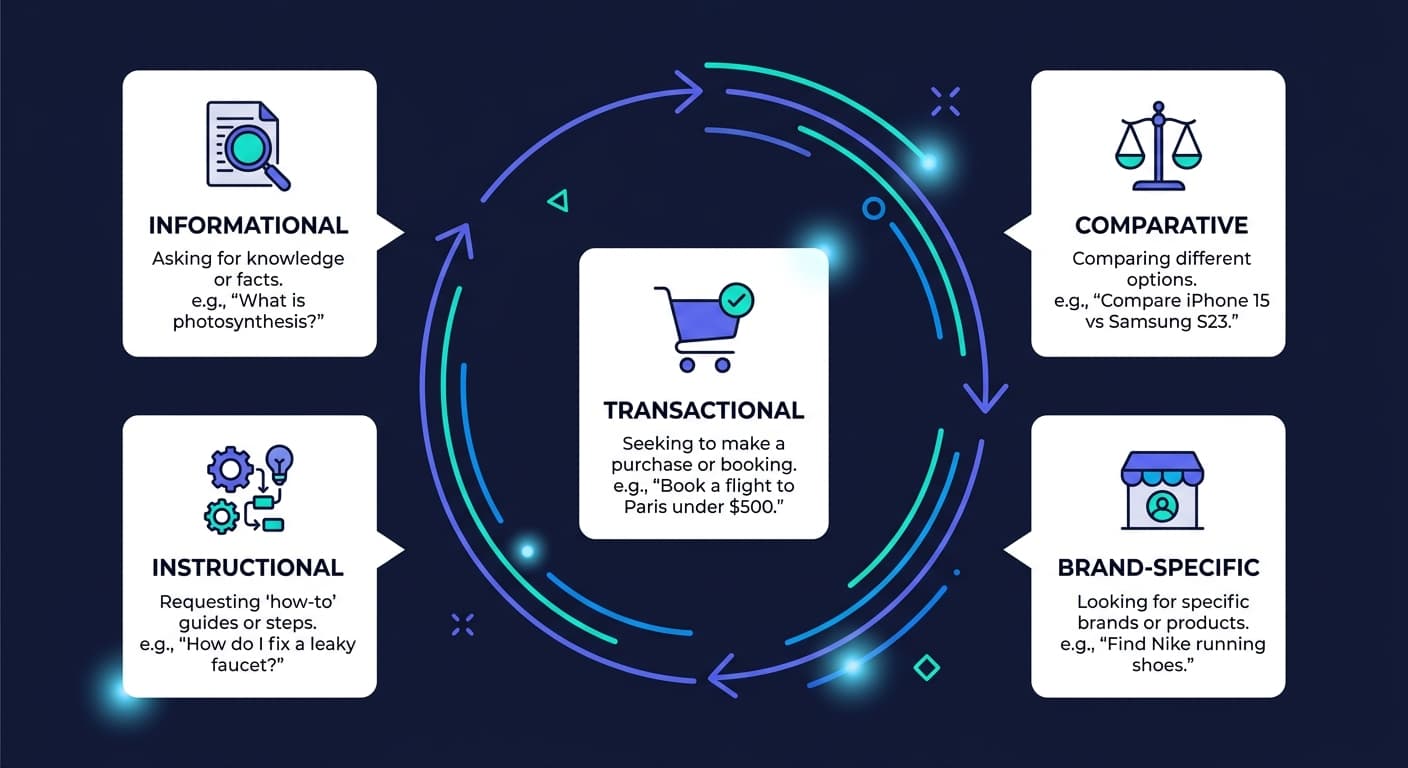
According to research from AI visibility specialists, there are five primary prompt types that every brand should track:
Informational prompts — "What is [your product category]?" or "How does [your service] work?" These are top-of-funnel queries where AI builds initial brand awareness.
Comparative prompts — "What's the best [product] for [use case]?" or "[Brand A] vs [Brand B]?" These are high-intent queries where AI creates shortlists.
Transactional prompts — "Where can I buy [product]?" or "Which [service] should I use?" These are decision-stage queries with direct revenue impact.
Brand-specific prompts — Questions that directly name your brand, testing how AI describes and positions you.
Instructional prompts — Step-by-step "how to" queries. These prompts often have the highest dwell time in AI interfaces — users follow along with instructions while the AI answer stays open. Being cited in an instructional prompt means sustained brand exposure during an active task.
Tag each prompt by type (informational, comparative, transactional, brand-specific, instructional) and by funnel stage (awareness, consideration, decision). This taxonomy makes your analysis actionable and helps you pinpoint exactly where visibility gaps are hurting your business.
Building Your Prompt Testing Framework
Step 1: Define Your Prompt Set
Before you get down to the level of selecting prompts, you need to establish the topics and sub-topics you want to track. Topics ensure you cover all the important areas that lead potential customers to you and also serve as convenient buckets for high-level analysis of your performance. Sub-topics get you to the useful questions to track. Once you've identified topics, it's easy to break them down into the kinds of prompts you want to track.
A strong starting set includes 20–40 prompts covering all five types above. Research by Citation Labs analyzing prompt portfolio performance across 40 clients found that concentrated efforts on 15–20 high-value prompts outperformed broader tracking sets of 100+ lower-quality prompts by 73% in terms of conversion-driven traffic generation. Quality beats quantity here.
Critically, use the language your customers actually use. Analysis comparing prompt performance across 500 tracked queries found that prompts constructed using validated audience language patterns generated relevant AI recommendations 64% more frequently than prompts using internal company terminology or generic phrasing.
Step 2: Run Prompts Across All Major AI Engines
Run each prompt across ChatGPT, Perplexity, and Gemini, and add Claude if your buyers use it. Run every prompt at least twice per engine, because AI answers are non-deterministic and a single run is closer to a coin flip than a measurement.
Why does multi-engine tracking matter so much? Because each platform behaves very differently:
Perplexity leans heavily on live, search-backed results and cites them openly, so it rewards content that is well-structured, recently updated, and already ranking — and its visible source links make it the easiest engine to learn from.
ChatGPT draws on a mix of training data and web browsing and is less consistent about linking, so it tends to favor brands with a strong, established presence across the web rather than a single fresh page.
Gemini is wired into Google's ecosystem, so traditional search strength and structured data carry weight there.
Independent audits in 2026 have found the overlap between the sources different AI engines cite can be strikingly low — in some cases only around a tenth of cited domains shared between ChatGPT and Perplexity. This is exactly why tracking a single engine produces false confidence, and why any real monitoring spans the set.
Step 3: Record Structured Data Per Prompt
For each prompt run, log the following data points:
Brand mentioned: Yes or No
Position: First, second, third recommendation, or absent
Sentiment: Positive, neutral, or negative framing
Competitors named: Which rivals appear alongside (or instead of) you
Sources cited: Which URLs, domains, or content types the AI referenced
Log the answers in a simple sheet: appeared yes/no, position, competitors named, sources cited. Within an hour you have a baseline that tells you where you are invisible, where you are buried, and which competitors own the answers you want.
Key Metrics for Prompt Performance Analysis
1. Visibility Rate (The Core Metric)
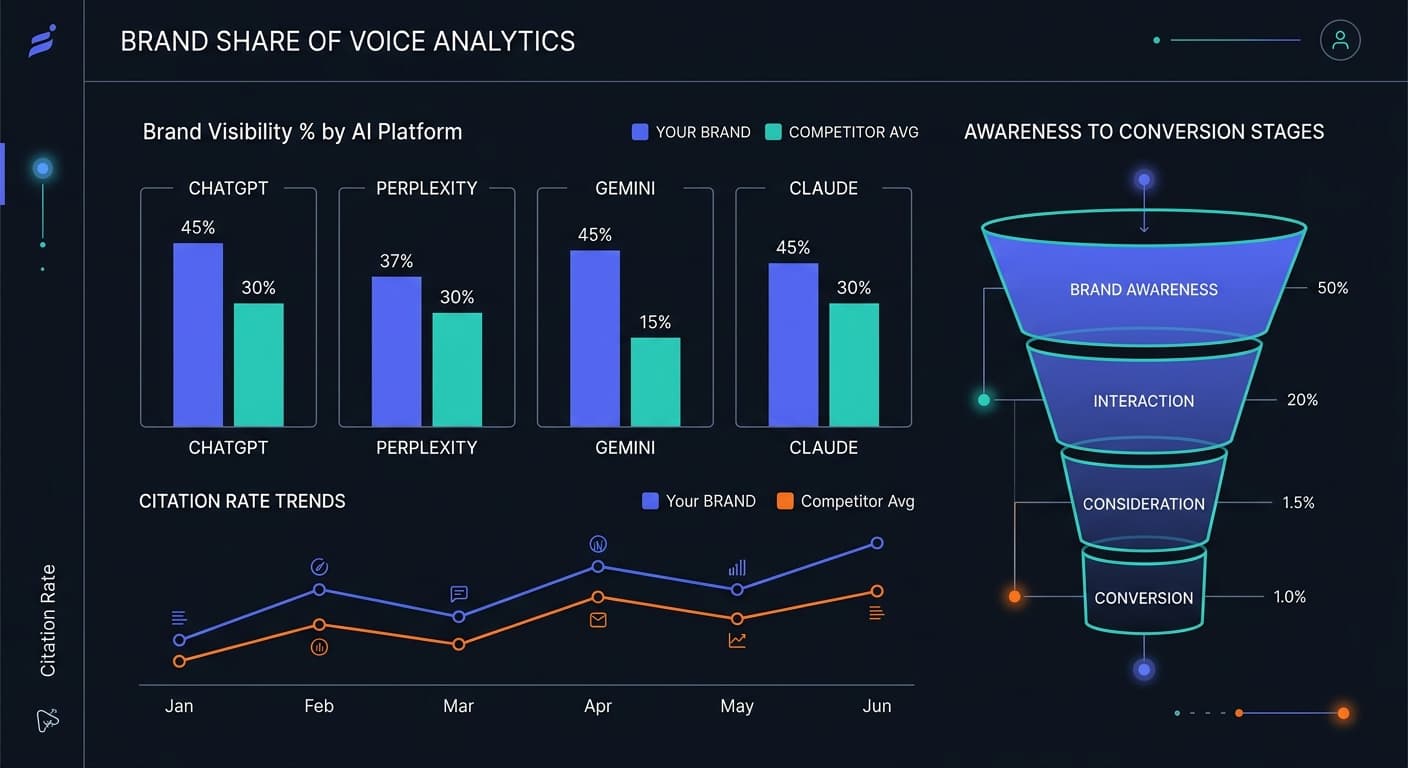
Track visibility rate, not rank. The useful metric is: what percentage of relevant prompts mention your brand? A 40% visibility rate across 200 prompt runs is meaningful data. Being "ranked #2" in a single ChatGPT response means nothing.
This is perhaps the most important conceptual shift in prompt performance analysis. Position within a single AI response is random noise. But your frequency of appearance across many prompt runs is a stable, trackable, and improvable signal.
2. Share of Voice (AI SOV)
Share of voice — sometimes called share of prompt — is the anchor metric: the percentage of AI responses that name your brand for a category query, measured against competitors.
Benchmark against 3–5 direct competitors. Your absolute visibility rate matters less than your relative position. If you appear in 30% of responses and your top competitor appears in 65%, the gap tells you more than your number alone.
3. Citation Rate vs. Mention Rate
Mentions build awareness. Citations drive traffic. Some platforms (like Perplexity) always cite sources with links. Others (like ChatGPT) mention brands without linking most of the time. Tracking both separately gives you a clearer picture of your AI visibility.
4. Sentiment Score
Beyond whether your brand appears, how AI describes you matters enormously. Track whether AI engines frame your brand positively, neutrally, or negatively. A brand that appears in 50% of responses but is described with reservations may fare worse in conversion than one appearing in 30% with glowing sentiment.
5. Citation Source Profile
A Profound analysis of 6.8 million citations across 1.6 million AI responses found that ChatGPT and Perplexity source content very differently: ChatGPT leans on third-party directories (48.7% of its citations), while Perplexity emphasises industry expertise and customer reviews. Knowing which content types get cited tells you where to invest your content efforts.
Understanding Prompt Volatility
One of the trickiest aspects of prompt performance analysis is dealing with answer variability. AI-generated responses exhibit significantly higher volatility than search rankings. The same prompt entered on different days — or even hours apart — can produce materially different recommendations based on model updates, training data refresh cycles, and user context variables.
Research conducted by seoClarity comparing AI Mode responses across multiple queries found variation rates exceeding 40% week-over-week for identical prompts. This is why a single manual test is misleading — it may reflect a momentary state rather than your true visibility baseline.
The solution is volume and consistency. SparkToro research shows you need volume (60–100 runs per prompt) to produce statistically meaningful visibility data, so daily automated tracking that accumulates over time gives you the most reliable picture.
Only 30% of brands stay visible from one AI answer to the next — AI citation patterns are volatile, not stable. Pages not updated quarterly are 3x more likely to lose AI citations. Brands with both mentions and citations in AI answers are 40% more likely to resurface in subsequent prompts — consistency compounds.
How to Improve Your Prompt Performance
Once your tracking baseline is established, the real work begins: optimizing your content and presence to improve performance across your tracked prompt set. Here are the highest-leverage actions:
Content Optimization for AI Extraction
AI search optimization focuses on engineering content for extractability, verifiability, and contextual clarity so that AI systems can accurately interpret and represent a brand.
Practically, this means:
Place direct answers immediately after question-format headings (H2/H3). Implement direct, concise answers (40–60 words) immediately following your question-based H2 or H3 headers.
Use clear formatting — bulleted lists for options, numbered steps for sequences, and tables for comparisons.
Keep content fresh. Updating key content every 30 days produces a 3.2x citation rate increase.
Build Presence on Third-Party Sources
Reddit is the single most-cited source across every major AI engine at roughly 40% frequency. If your brand has thin or negative Reddit presence, your ChatGPT share of voice will suffer regardless of how good your website content is.
Beyond Reddit, review profiles matter significantly. Review profiles correlate with significantly higher AI citation rates across all platforms, verticals, and brand sizes. Brands with no Trustpilot profile have a median AI citation rate of 1%. Brands with even a minimal profile — as few as 1–13 reviews — jump to 53.5%. That's a 52 percentage point swing.
Build Content Clusters, Not Isolated Pages
Build content clusters so you appear across multiple related queries via Reciprocal Rank Fusion — the process by which AI engines like ChatGPT weight content that surfaces consistently across multiple sub-queries. A single authoritative page is far less powerful than a network of interlinked content covering a topic comprehensively.
Our topical map generator can help you plan a cluster strategy that maximizes your AI citation potential across a full topic space.
Implement Structured Data
Schema markup helps AI engines verify entity facts and understand your brand's context. You can use our AI Schema Markup Generator to produce accurate structured data without writing a single line of JSON-LD manually.
From Manual Testing to Automated Prompt Performance Tracking
Manual tracking works for initial assessment but fails at scale and consistency. Running 15–20 prompts yourself across ChatGPT and Perplexity, then documenting results in a spreadsheet, provides a useful baseline snapshot. However, AI responses vary by session, time, and model version, making single-point manual tests unreliable for trend measurement.
Automated tracking solves three critical problems: Consistency — same prompts tested at regular intervals produce comparable data points; Scale — hundreds of prompts across multiple engines run simultaneously; Historical context — month-over-month and week-over-week trends reveal whether optimization efforts are working.
This is where tools purpose-built for prompt performance analysis become essential. According to Taylor Scher SEO's 2026 data, only 16% of brands have any systematic way to track AI search performance, making crawler-level analytics a significant competitive advantage for early adopters.
Connecting Prompt Performance to Business Outcomes
The ultimate goal of prompt performance analysis isn't data for its own sake — it's business growth. Connect AI visibility metrics, such as citation presence and AI-sourced referral traffic, to assisted conversions, engagement depth, and sales cycle velocity. Attribution modeling should incorporate AI-generated touchpoints as early-stage influencers to quantify their contribution to revenue outcomes.
For traffic attribution specifically, note that platforms differ significantly:
GA4 can track referral traffic from ChatGPT when users click citation links, but only about 20% of ChatGPT mentions include clickable links. The other 80% of brand recommendations, descriptions, and comparisons are invisible to GA4.
Perplexity is fundamentally different from every other platform because it crawls the web in real time and always includes clickable inline citations. Every response references 4–8 sources, and each one links back to the original page.
This means your true prompt performance impact is larger than what any analytics tool can directly measure. Brands appearing consistently in AI answers are building awareness and trust at every stage of the buyer journey — even when no click is logged.
Use our SEO ROI Calculator to model the estimated value of AI visibility improvements alongside your traditional SEO investments.
Prompt Performance Analysis: A 2026 Action Plan
Here's a condensed roadmap to get started:
Audit your current AI visibility — Run 15–20 prompts manually across ChatGPT, Perplexity, Gemini, and Claude. Record your baseline.
Build your prompt taxonomy — Categorize prompts by type (informational, comparative, transactional, brand-specific, instructional) and funnel stage.
Focus on high-value prompts — Prioritize the 15–20 prompts most closely tied to buyer decision-making in your category.
Optimize content for AI extraction — Add direct answers under question headings, update content quarterly, implement structured data.
Expand third-party presence — Build review profiles, pursue editorial coverage on high-authority domains, cultivate Reddit and community presence.
Automate tracking — Move from manual spreadsheets to continuous automated monitoring so you can detect changes, spot competitor moves, and measure the impact of your optimizations.
Connect to revenue — Track AI referral traffic in GA4, model assisted conversions, and report AI SOV alongside traditional SEO metrics.
Conclusion
Prompt performance analysis is no longer an experimental discipline — it's the measurement framework that determines whether your brand wins or loses in AI-driven discovery. Ranking is gone. There is only visibility. What matters now is if your brand is mentioned or cited by AI search engines when people search for things related to you.
The brands that will dominate AI search in 2026 and beyond aren't the ones with the biggest budgets — they're the ones that build systematic prompt testing programs, act on the data, and consistently show up where their buyers are asking questions.
Whatever share of search AI answers end up taking, Google Search Console is still where you see the clicks Google actually sends you. QuickSEO puts Search Console for every website you run on one free dashboard. See all your sites in one place →
QuickSEO shows clicks, impressions, keywords and pages for every website you manage, compared with the period before.
- Unlimited websites on the free plan
- No credit card needed
Try it yourself
Related free tools
Free SEO tools related to the topics covered in this article.
Keep reading
Related posts
More articles on the same topics, prioritized by shared tags and keyword overlap.